- What happened on the LBJ Express Lane
- Facts known so far and what remains under investigation
- Understanding multi-vehicle collisions and post-crash fires on urban interstates
- How Texas agencies investigate fatal crashes on managed toll lanes
- Where to obtain official records in Dallas County
- Rights of grieving families in a Texas wrongful death and survival claim
- Insurance considerations after a Dallas motorcycle crash
- Preserving evidence and why quick action matters
- Community context and roadway safety on I-635 in North Dallas
- Practical steps community members can take after a serious crash
- Call-to-Action: Why timely steps matter after a fatal interstate crash
- Commentary from Gosuits Dallas, Texas Personal Injury Attorney
What happened on the LBJ Express Lane
Local reports indicate a motorcyclist was killed in a fiery multi-vehicle crash on the LBJ Express Lane along I-635 in the Dallas area. The LBJ, known to many of us for its managed tolled lanes that weave between Central Expressway and I-35E, is one of the busiest east-west corridors in North Dallas. In incidents like this, lanes are commonly closed for hours as investigators document the scene, firefighters address any vehicle fires, and crash reconstructionists analyze vehicle positions and debris patterns.
Details provided publicly so far are limited. The report notes a multi-vehicle collision followed by fire, and that a motorcyclist died at the scene. Authorities typically determine the exact time, the number and type of vehicles involved, and the sequence of impacts during the on-scene investigation and subsequent review. If additional official information is released, it will likely come from local law enforcement or the appropriate county or state agency.
Facts known so far and what remains under investigation
What is known: there was a collision involving multiple vehicles on the LBJ Express Lane that resulted in a fire, and a motorcyclist lost their life. The LBJ Express Lane system is part of I-635, serving neighborhoods around Lake Highlands, Preston Hollow, the Galleria Dallas area, and the High Five interchange at US 75. Multi-vehicle pileups on this corridor often cause significant secondary congestion onto frontage roads and adjacent general-purpose lanes.
What remains under investigation: the initiating cause, whether a chain reaction occurred, which vehicles first collided, whether any hazardous materials were present, the role of speed, lane changes, or distracted driving, and whether the fire came from fuel system damage or electrical components. Formal findings generally require physical evidence analysis and witness statements.
Understanding multi-vehicle collisions and post-crash fires on urban interstates
Multi-vehicle collisions on high-speed roadways are dynamic events. A small misjudgment, tight following distance, or sudden braking can cascade quickly when traffic is dense. When a motorcycle is involved, vulnerability increases because there is no protective frame around the rider. According to federal data, motorcyclists face significantly greater risk per mile traveled than occupants of passenger vehicles. NHTSA reports that motorcyclists are overrepresented in traffic fatalities nationwide, and 2022 marked a modern-era high for rider deaths. See NHTSA’s motorcycle safety resources for current context and data at NHTSA Motorcycles.
Vehicle fires can follow collisions when fuel systems, batteries, or other combustible materials are compromised. The U.S. Fire Administration has documented the characteristics of highway vehicle fires, including the roles of mechanical failures and crash damage. You can review national findings at the U.S. Fire Administration’s page on vehicle fires at USFA Vehicle Fires.
In a busy corridor like the LBJ, a post-crash fire adds complexity for first responders. Dallas Fire-Rescue typically works alongside law enforcement to suppress flames, prevent secondary incidents, and protect motorists who may be stopped in live lanes.
How Texas agencies investigate fatal crashes on managed toll lanes
Fatal crashes on managed toll lanes are investigated much like any serious crash on a state roadway. Depending on the precise location, Dallas Police Department traffic officers or another agency with jurisdiction may lead the scene investigation. TxDOT maintains and regulates much of the state highway system and sets standards for crash reporting, but local police investigate the incident and generate the formal crash report.
Key steps law enforcement and investigators typically take include:
- Securing the scene to prevent additional collisions, especially where sightlines are limited by barriers or curves in the managed lanes.
- Documenting physical evidence such as skid and yaw marks, vehicle rest positions, crush patterns, and debris fields.
- Interviewing witnesses and involved drivers to understand traffic conditions, speeds, and lane changes immediately before impact.
- Reviewing any available video, including in-vehicle dash cameras from motorists or law enforcement, and potentially traffic management cameras where accessible under applicable policies.
- Analyzing vehicle data from event data recorders in some vehicles where available, and reviewing motorcycle condition and equipment factors.
- Coordinating with the medical examiner for cause and manner of death determination and any toxicology that may inform the timeline and reconstruction.
Under Texas law, crash reports are created by the investigating agency and released to eligible requestors under Transportation Code section 550.065. The statute explaining who may obtain a crash report and how is available here: Texas Transp. Code 550.065.
Where to obtain official records in Dallas County
Several official records can help families and insurers understand a crash like this. The agencies below are the typical sources in Dallas. When requesting, be ready with the crash date, approximate location on I-635, and, if known, the report number and investigating officer’s name.
- Texas crash report. Crash reports are governed by Texas Transportation Code 550.065. Eligible requestors, including certain family members, insurers, and involved parties, may request the report after the investigating agency submits it to the state system. See the statute here: Texas Transp. Code 550.065.
- Dallas County medical examiner records. The Dallas County Institute of Forensic Sciences is the medical examiner’s office. Families may request information about the status of an examination, and later may request non-confidential portions of a report as permitted by law. While the office’s website is not on a .gov domain, it is the official county ME. If unsure where to start, a family doctor or funeral home can often explain typical next steps with the county ME.
- Death certificate. In Texas, death certificates are issued through county or state vital records. The Texas Department of State Health Services provides vital records statewide at Texas DSHS Vital Records.
- Fire incident report. Dallas Fire-Rescue generates incident reports when a fire response occurs. These can document fire origin observations and suppression details. Contact the city’s public records office for guidance.
- Toll road or managed lane operator documentation. Managed lanes may maintain operational logs or incident notifications. These records are not always public, but counsel can advise on how to request or preserve them when relevant.
If you are unsure which law enforcement agency handled the scene, the location description on the LBJ usually helps. For example, a crash near the High Five could involve Dallas Police, while farther west or east sometimes brings in nearby municipalities. If you cannot identify the agency, a request under Transportation Code 550.065 using names and date can still locate the report once filed.
Rights of grieving families in a Texas wrongful death and survival claim
Texas law allows certain family members to bring claims when a death is caused by the negligence or wrongful act of another. Two types of civil claims are commonly discussed: a wrongful death claim on behalf of statutory beneficiaries, and a survival claim brought by the decedent’s estate.
- Wrongful death. The Texas Civil Practice and Remedies Code sets out who may bring a wrongful death action and for what harms. See Texas CPRC Chapter 71 for the framework.
- Survival claim. This preserves claims the person could have brought had they lived, now prosecuted by the estate representative.
- Comparative fault. Texas uses a proportionate responsibility system. A claimant barred from recovery if found more than 50 percent responsible, and any recovery is reduced in proportion to responsibility. The statutory framework is outlined in Texas CPRC Chapter 33.
Deadlines matter. In most cases, the limitation period for wrongful death and personal injury in Texas is two years from the date of the incident. See Texas CPRC 16.003. Separate notice rules may apply when a governmental unit is a defendant, often requiring notice within six months. See Texas CPRC 101.101. The specific facts determine which deadlines apply.
Because this crash occurred on I-635 in Dallas, potential defendants in a civil claim might include individual motorists and their insurers. If a commercial vehicle was involved, additional rules and carrier records may become important. In multi-vehicle situations, responsibility can be shared among drivers depending on the circumstances, which is why prompt, methodical evidence preservation is critical.
Insurance considerations after a Dallas motorcycle crash
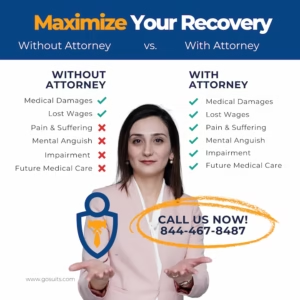
Insurance issues tend to be complicated after a Dallas car accident that involves a motorcycle, especially when a fire destroys vehicles and on-scene evidence. Policies commonly in play include the at-fault driver’s liability coverage, the motorcyclist’s uninsured or underinsured motorist coverage, and medical payments or personal injury protection coverage if elected.
- Liability coverage. Texas requires motorists to carry minimum liability insurance. Claims can be made for harms caused by negligent driving.
- UM UIM. Uninsured and underinsured motorist coverage can apply when the responsible driver lacks adequate coverage. Texas Department of Insurance provides consumer guidance on auto policies and coverages at TDI Auto Insurance Guide.
- PIP or MedPay. Personal injury protection and medical payments coverage can assist with certain medical costs and, in the case of PIP, can cover limited non-medical losses, depending on the policy.
- Coordination with health insurance. Health plans might have subrogation interests, which can affect settlement allocation later.
Statements to insurers carry risk. What someone says to an adjuster can be used against them later, even in a multi-vehicle setting where fault is disputed. It is prudent to speak with a seasoned attorney before giving recorded statements, signing medical authorizations, or accepting early settlement offers. Many motorcycle accident lawyers and wrongful death lawyers offer no-cost initial consultations to help families understand their options.
Preserving evidence and why quick action matters
A fiery crash on the LBJ Express Lane can erase or degrade critical evidence fast. Vehicles may be towed and sold for salvage, electronic control module data can be overwritten, and surveillance footage from nearby businesses or traffic systems may be overwritten on short cycles.
- Vehicle inspections. Prompt inspection and documentation of all involved vehicles can capture crush profiles, transfer marks, and component failures possibly linked to ignition sources.
- ECM and telematics. Passenger vehicles and some motorcycles store data that might reflect speed and braking inputs. Preservation letters help ensure data is not lost.
- Witness interviews. Rapid outreach preserves memory while details are still fresh, especially in complex interchanges near the High Five or the Galleria where traffic patterns change quickly.
- Managed lane data. Time-stamped toll entries, if obtainable, can corroborate vehicle presence and timing. Access typically requires cooperation or legal process.
In multi-vehicle cases, legal teams often work with reconstructionists and, in fire cases, with origin and cause specialists. For families, engaging qualified help early can prevent the unintentional loss of time-sensitive information.
Community context and roadway safety on I-635 in North Dallas
Neighbors in Lake Highlands, Far North Dallas, and the stretch around the Galleria know the LBJ can be unforgiving at rush hour and late at night. Short weaving sections, tight barrier walls in managed lanes, and frequent merges near the High Five can magnify mistakes. Motorcyclists often choose managed lanes for steadier speeds, yet collisions still happen when traffic suddenly compresses.
Helmet use is a familiar conversation in our community. Texas law requires helmets for riders under 21, and riders 21 and older may ride without a helmet if they meet training and insurance criteria. The statute is here: Texas Transp. Code 661. In civil cases, defense insurers sometimes argue comparative fault based on protective gear decisions. Each case is fact specific, and the law focuses on whether someone’s negligence caused the crash.
NHTSA’s national overview for motorcycles underscores the stakes for riders and drivers alike. You can find educational materials on sharing the road safely and the human factors that drive serious crashes at NHTSA Motorcycles.
Practical steps community members can take after a serious crash
In the aftermath of a violent collision, it can be hard to know where to begin. The steps below are general information to help orient those navigating official processes in Dallas County.
- Identify the investigating agency. Note the exact location within the LBJ Express corridor and any officer names provided at the scene. This helps locate the formal crash report later.
- Request the crash report. Use the authority in Texas Transp. Code 550.065 as guidance for eligibility and process. Some reports take several days or longer to become available.
- Coordinate with the medical examiner. The Dallas County Institute of Forensic Sciences will guide families on identification, autopsy status, and release. Funeral homes often assist with communication and logistics.
- Secure insurance information. Gather policy numbers for all vehicles and notify carriers that an incident occurred. Before providing any recorded statement or signing authorizations, consider speaking with a seasoned attorney, since statements can affect liability and coverage.
- Preserve personal devices and accounts. Save photos, dashcam files, and cellphone data that captured the moments before or after the crash.
- Document expenses and impacts. Keep receipts, work records, and a simple journal of impacts. This becomes important in claims handling and future documentation.
When a commercial vehicle is involved, additional records like driver logs, dispatch notes, and maintenance files can become critical. Families often benefit from help by commercial vehicle accident lawyers or interstate truck accident lawyers who understand how to preserve those records early, even if it is not yet clear that a truck caused the chain reaction.
Call-to-Action: Why timely steps matter after a fatal interstate crash
Time matters in roadway fatality cases for three practical reasons. First, evidence disappears. Vehicles are moved, eyewitness recollections fade, and digital footage can be overwritten in days. Second, insurance companies begin evaluating liability right away, sometimes before the crash report is finalized. Third, Texas law sets strict deadlines for notice and for filing claims, including shorter windows when any governmental entity might be implicated in roadway operations.
- Pin down the who and where quickly. Identify which agency wrote the report and the precise LBJ Express Lane segment. This streamlines the report request and any follow-up with investigators.
- Preserve vehicles and data before salvage. Ask tow lots not to dispose of vehicles without notice, and consider formal preservation requests for any involved vehicles, including those not owned by the family.
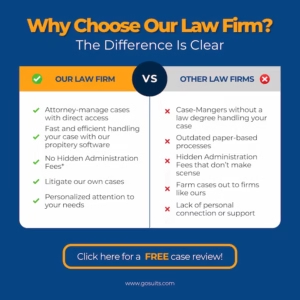
- Consult a qualified attorney before insurer interviews. Understanding rights and the rules around proportionate responsibility can prevent lasting harm to a claim. Early legal input also helps with targeted evidence gathering and avoiding missteps with adjusters.
- Calendar deadlines. Note the two-year limitation period under CPRC 16.003 and consider the six-month notice requirement for claims involving governmental units under CPRC 101.101. The specific facts determine applicability.
Taking these steps early improves the accuracy of any future findings and promotes fair handling by insurers. It also respects the memory of the person lost by ensuring the truth of what happened on our community’s roadway is not obscured by the passage of time.
Commentary from Gosuits Dallas, Texas Personal Injury Attorney
Our hearts are with everyone affected by the fatal crash on the LBJ Express Lane. A sudden loss on a familiar roadway shakes a community, and it is felt from Lake Highlands to the neighborhoods around the Galleria and beyond. The thoughts shared here are for general information and education. Every situation is different, and families deserve personal attention to their facts.
Based on what is publicly known, this was a multi-vehicle collision followed by a fire in a constrained managed lane environment. Those settings leave little room for error. In our view, the critical questions will include how the chain of impacts began, whether unsafe lane changes, speed differentials, or following distances contributed, and whether the post-impact fire was a result of predictable damage that could have been mitigated by earlier actions from others. When motorcycles are involved, it is especially important that investigators capture vehicle data and witness accounts before they are lost, since even small details can clarify how responsibility should be allocated under Texas proportionate responsibility rules.
Insurance companies and, at times, large corporations leverage early control of information. Adjusters call quickly, frame the narrative, and sometimes seek recorded statements that seem routine but later get used to minimize responsibility. In multi-vehicle collisions, it is common to see an attempt to spread fault broadly, including onto an injured motorcyclist who cannot respond for themselves. Without guidance, people unknowingly sign medical authorizations or accept partial payments that complicate future claims. Consulting with seasoned personal injury lawyers or motorcycle accident lawyers at the outset helps level the playing field and ensures that vital evidence is preserved before it disappears.
A free consultation is valuable because it gives families a safe space to ask questions, understand potential timelines under CPRC 16.003, and hear how insurance coverages, including UM UIM and PIP described in the Texas Department of Insurance guide, may apply. It also allows discussion of practical steps, like preservation letters for vehicles and requests for official records under Transportation Code 550.065. No one should have to navigate those processes alone or on a timetable set by an insurer.
To everyone sharing the LBJ each day, please take care, allow room for riders, and watch your mirrors before every lane change. Small decisions in our managed lanes carry big consequences. For those processing this loss, our community stands with you.