- What happened in western Escondido
- Location context: Meyers Avenue and Barham Drive near SR 78
- How investigators reconstruct crashes with big rigs and motorcycles
- Potential civil liability and insurance layers
- How to obtain official records and updates
- Preserving evidence early in truck collision cases
- California wrongful death and survival laws
- Community concerns and safety considerations
- How insurance companies approach these claims
- Time-sensitive steps that often protect a potential claim
- Commentary from Gosuits Escondido, California Personal Injury Attorney
- References
What happened in western Escondido
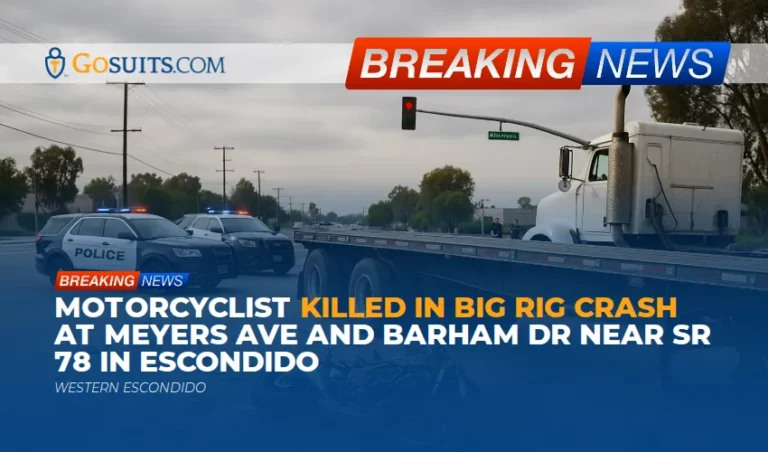
A deadly collision between a motorcyclist and a flatbed big rig occurred late Thursday morning at the intersection of Meyers Avenue and Barham Drive on the west side of Escondido. According to police, the crash happened around 10:40 a.m. and the rider died at the scene. The intersection was closed for several hours while Escondido police investigated, and the San Diego County Medical Examiner’s Office worked to identify the rider and notify next of kin. As of now, investigators have not released a cause and are still gathering evidence and witness statements.
When a fatal crash involves a commercial vehicle, the fact-finding phase can take longer than a typical roadway collision. That is not unusual. Investigators often need to analyze vehicle damage, roadway markings, available camera footage, and data from the truck’s required records to build a complete picture of what happened.
Location context: Meyers Avenue and Barham Drive near SR 78
Neighbors who drive this corridor know how quickly traffic can stack up near the Nordahl Road and West Mission Road junction and the State Route 78 on- and off-ramps. Barham Drive connects the industrial and business parks along the San Marcos and Escondido line and funnels mid-morning traffic to SR 78. Nearby landmarks include the Nordahl Marketplace area and the hospitals and medical offices farther north and east. At 10:40 a.m., visibility is generally good, but traffic patterns can shift with deliveries, campus schedules, and construction around the 78.
Even when signals operate normally, intersections that mix local traffic with regional freight routes present real hazards. A flatbed tractor-trailer has longer stopping distances and wider turn radii than passenger vehicles, and lane positioning at intersections can become critical, particularly for riders whose profile is smaller and less visible to heavy vehicle drivers [3].
How investigators reconstruct crashes with big rigs and motorcycles
Escondido police will typically combine scene work with data collection to determine the cause. That can include:
- Scene documentation Skid or scuff marks, gouges, debris fields, vehicle final rest positions, and signal timing data.
- Vehicle inspections Brake components, lighting, tire condition, mechanical issues, and load securement for the flatbed trailer.
- Statements and video Witness interviews, nearby business or traffic cameras, and any body-worn or in-car camera footage retained by responding agencies.
- Commercial records For trucks, federal regulations require hours-of-service compliance and the use of electronic logging devices that record a driver’s duty status and can help confirm timelines [2] [12]. Supporting documents and driver logs are subject to specific retention rules under federal law [13].
Motorcyclists face unique vulnerability because they have less physical protection and can be harder to detect in traffic. National Highway Traffic Safety Administration resources frequently emphasize conspicuity, speed management, and the importance of drivers scanning for riders, especially at intersections [1].
If lane sharing was occurring at any point before impact, it is worth noting that California permits lane splitting if done safely, and the California Highway Patrol provides guidance to encourage safer behavior by both riders and drivers around this practice [4]. Whether lane splitting occurred is unknown at this time, and investigators’ findings will control.

Potential civil liability and insurance layers
Without speculating about fault in this specific crash, serious collisions between a motorcycle and a commercial flatbed can involve multiple potential at-fault parties and insurance layers:
- Truck driver Possible liability can arise from unsafe turns, signal violations, failure to yield, speed too fast for conditions, or distracted driving. Duty hours, fatigue, and route planning are often reviewed against federal limits and company policies [2].
- Motor carrier or trucking company Employers may be responsible under respondeat superior for their driver’s negligence and, in certain circumstances, for negligent hiring, training, supervision, or maintenance practices.
- Vehicle maintenance providers Improper brakes or lighting can create third-party liability if maintenance was outsourced.
- Cargo loaders or shippers On a flatbed, improperly secured or oversized loads can affect maneuverability and stopping distances.
- Public entities In rare cases, dangerous road conditions, signal timing defects, or signage issues may be implicated. Claims against government entities must follow strict notice and timing requirements under the Government Claims Act [8].
Commercial carriers typically maintain higher liability limits than private motorists, and there may be multiple applicable policies including primary motor carrier liability, excess or umbrella coverage, and, depending on facts, shipper or broker coverage. Sorting out who pays and in what order often requires detailed policy analysis and, sometimes, inter-insurer disputes.
For a broader primer on how these cases proceed in our state, see legal overview for truck accident victims in california.
How to obtain official records and updates
Families and involved parties often look for reliable ways to get official information. Here are common sources and what to expect under California law.
Escondido Police collision report
California Vehicle Code section 20012 governs who can obtain a traffic collision report. These reports are confidential but must be made available to parties in interest, which generally includes those involved in the crash, their legal representatives, and their insurers [9]. Escondido Police reports are requested through the department’s records process; the agency may require proof of involvement or authorization. Processing times can vary when a report is part of an active investigation, especially in fatality cases.
If a report is not yet ready, a records unit may provide a tracking or incident number. When making a request, having the date, approximate time, exact intersection, and responding agency name helps staff locate the file efficiently.
San Diego County Medical Examiner’s Office
The Medical Examiner investigates sudden, unexpected, or violent deaths in the county. After identification and next-of-kin notification, the office prepares reports that may include a cause and manner of death when available. Family members can find instructions for requesting records and understanding the process on the county’s official site [10].
Medical Examiner reports can take time, particularly if toxicology or specialized testing is needed. Patience is understandable during a painful wait, but checking the county’s guidance will clarify what’s available and when.

Public records requests in California
Beyond the collision report, some supporting materials might be reachable through a California Public Records Act request. The PRA provides access to non-exempt public records, though certain investigative materials may be withheld while an investigation is ongoing. The California Attorney General provides a public overview of PRA rights and limits [11].
If a public entity’s actions are at issue, the PRA can be a tool for requesting signal timing logs, traffic counts, or maintenance records. That said, many items are retained for limited periods, and commercial carriers are private parties not subject to the PRA, so requesting directly through counsel is often necessary.
Preserving evidence early in truck collision cases
Time matters. Commercial motor carriers have data and records that can shed light on what happened, but federal retention rules do not require permanent storage of all items. For example, federal regulations require motor carriers to retain records supporting a driver’s hours of service for at least six months [13]. Electronic logging devices, bills of lading, fuel receipts, and GPS breadcrumbs can all be highly informative when preserved promptly [12].
Other materials can include dash camera footage on the truck, forklift or yard camera video showing load securement, driver qualification files, maintenance and repair records, and dispatch communications. A well-timed preservation letter can help ensure key evidence is not overwritten in the ordinary course of business. The stopping-distance characteristics of heavy vehicles, particularly when carrying loads, are a recurring focus of expert analysis in these cases [3].
California wrongful death and survival laws
When a collision causes a death, two types of civil claims may be available under California law, depending on the facts and the family structure.
- Wrongful death This claim compensates eligible heirs for their own losses, such as loss of financial support, companionship, and household services. It is brought by the decedent’s heirs under Code of Civil Procedure section 377.60 [6].
- Survival action This claim belongs to the decedent’s estate and seeks damages the decedent could have pursued had they lived, such as medical bills or property damage incurred before death, under section 377.30 [7].
Most wrongful death claims must be filed within two years of the date of death under Code of Civil Procedure section 335.1, though there are exceptions that can shorten the timeline, such as claims involving public entities that trigger a six-month administrative claim deadline under Government Code section 911.2 [5] [8]. Because these rules are unforgiving, documenting key dates early is important.
Before any insurance claim is opened, it is generally prudent to consult a qualified attorney to understand rights and options. Speaking directly with an insurer too soon can lead to recorded statements that may be used to limit or contest claims later. A quick legal consult helps set boundaries, plan a safe communications strategy, and account for the specific deadlines that apply.
Community concerns and safety considerations
Residents around the Barham corridor know that freight traffic, construction projects, and midday shopping runs combine to create complex traffic at places like Nordahl and West Mission. It is reasonable for the community to ask: what helps prevent a tragedy like this?
- Visibility and scanning NHTSA highlights that riders are less visible than cars. Drivers turning across oncoming paths should look twice for motorcycles, especially at intersections and when a large vehicle could block the view [1].
- Heavy-vehicle limits Big rigs have longer stopping distances and wider turning needs. Planning maneuvers early and avoiding last-moment turns reduces risk around smaller road users [3].
- Lane sharing awareness California permits lane splitting if done safely. CHP guidance asks riders to consider speed differentials and traffic conditions, and asks drivers not to impede or block riders lawfully sharing a lane [4].
- Protective gear While we do not know the rider’s gear in this crash, California requires compliant helmets for riders and passengers. Proper gear does not prevent every tragedy, but it remains a core safety layer.
North County road users share these intersections every day. A few seconds of extra scanning and patience, especially around heavy trucks and motorcycles, can make all the difference.
How insurance companies approach these claims
In fatal collisions involving commercial trucks, insurers quickly deploy adjusters and sometimes on-call crash teams. Their goal is to gather information and, when possible, shape the narrative early. It is routine for commercial insurers to request recorded statements, medical histories, and authorizations. Those requests can feel urgent, but they are also strategic.
Families exploring their options may benefit from learning how truck accident lawyers structure the early evidence phase, including preservation letters, safe communications protocols, and a timetable for obtaining essential records. Aligning communications before opening a claim helps reduce the risk of inadvertent statements that can later be characterized as admissions.
When cases are local to North County, some prefer working with Escondido truck accident lawyers who understand the traffic patterns near SR 78 and the specific agencies likely to hold records, from local police to regional transportation offices. Local familiarity can streamline the practical steps that follow.
Time-sensitive steps that often protect a potential claim
Here are prudent tasks that frequently help preserve rights and strengthen clarity for everyone involved. These are general observations, not case-specific directives.
- Prioritize a legal consult before speaking to insurers Insurance adjusters may sound supportive, but recorded statements are designed to lock in facts that can limit future claims. A brief consultation helps set a plan for safe communications and documentation.
- Request the collision report as soon as it is available Under California law, parties in interest can obtain the report through the investigating agency’s records process [9]. Expect a delay in fatal cases while the investigation is active.
- Preservation letters to the trucking company Ask that relevant ELD data, dashcam video, maintenance files, driver qualification records, dispatch logs, and load documents be preserved. Federal record-keeping rules allow some materials to be overwritten after limited periods [13].
- Identify potential public records For intersection signal timing, maintenance logs, or traffic count studies, consider tailored requests under the Public Records Act. Some items may be exempt during an active investigation, but many operational records are not [11].
- Document losses methodically Keep copies of funeral and memorial expenses, travel costs, time away from work, and other out-of-pocket losses. These records support both wrongful death and survival claims.
- Calendar the most conservative deadlines For most wrongful death claims, the two-year statute applies [5]. If a public entity could be implicated, the six-month government claim deadline may apply [8].
- Coordinate with the Medical Examiner’s Office Follow county guidance on when and how autopsy and investigative reports become available, and who can request them [10].
What is the exact thing people should do now? Confirm the investigating agency and incident number, plan an evidence preservation request to the carrier through counsel, and begin gathering documentation of losses. Why now? Because trucking records and camera footage are not kept forever, and early decisions about what to say to insurers can affect outcomes months later.

Commentary from Gosuits Escondido, California Personal Injury Attorney
Our hearts are with those directly affected by this crash near Barham Drive and Meyers Avenue. Losing a neighbor on our roads is devastating. This commentary is shared for educational and general informational purposes only, grounded in what is publicly reported and in the broader rules that govern commercial trucking and motorcycle safety in California.
Based on what is known, investigators have significant work ahead to determine the cause. In a collision that involves a flatbed big rig, it is appropriate to examine heavy vehicle maneuvering, load securement, visibility at the intersection, signal timing, and the truck’s regulatory compliance during the hours leading up to the crash. For the rider’s family, clarity about the sequence of events will matter deeply, and objective evidence like scene data, camera footage, and required carrier records can provide that clarity.
Insurance companies and large corporations often move quickly after a serious crash. Adjusters can be courteous, but they are trained to minimize exposure. They may solicit recorded statements before all facts are known, seek broad medical authorizations, or push for early resolutions that do not reflect the full extent of losses. Commercial carriers also control much of the key evidence, so delays in preservation requests can lead to critical data being overwritten under standard retention schedules.
That is why a free consultation can be so important at the outset. It gives people a chance to ask questions, understand timelines like the two-year statute or the six-month government claim rule where applicable, and set a plan to preserve essential records from the carrier and the investigating agencies. It is one step that can reduce uncertainty during an already difficult time.
References
- Motorcycles Road Safety – NHTSA
- Summary of Hours of Service Regulations – FMCSA
- CMV Driving Tips: Stopping Distances – FMCSA
- Lane Splitting is Legal in California – CHP
- California Code of Civil Procedure § 335.1 – leginfo.ca.gov
- California Code of Civil Procedure § 377.60 – leginfo.ca.gov
- California Code of Civil Procedure § 377.30 – leginfo.ca.gov
- California Government Code § 911.2 – leginfo.ca.gov
- California Vehicle Code § 20012 – leginfo.ca.gov
- San Diego County Medical Examiner – sandiegocounty.gov
- California Public Records Act Overview – oag.ca.gov
- Electronic Logging Devices Rule – FMCSA
- 49 CFR § 395.8 Driver’s record of duty status – eCFR