- What we know about the 405 Freeway motorcycle fatality in Long Beach
- Why this stretch of the 405 backs up so fast
- Where to get official information and records
- Safety and legal context for motorcycle collisions on Southern California freeways
- Possible civil liability issues investigators may review
- Evidence that can matter in a freeway motorcycle crash
- Insurance issues after a fatal motorcycle collision
- Local notes for Long Beach area families and commuters
- Why timely action matters now
- Commentary from Gosuits Long Beach, California Personal Injury Attorney
- References
What we know about the 405 Freeway motorcycle fatality in Long Beach
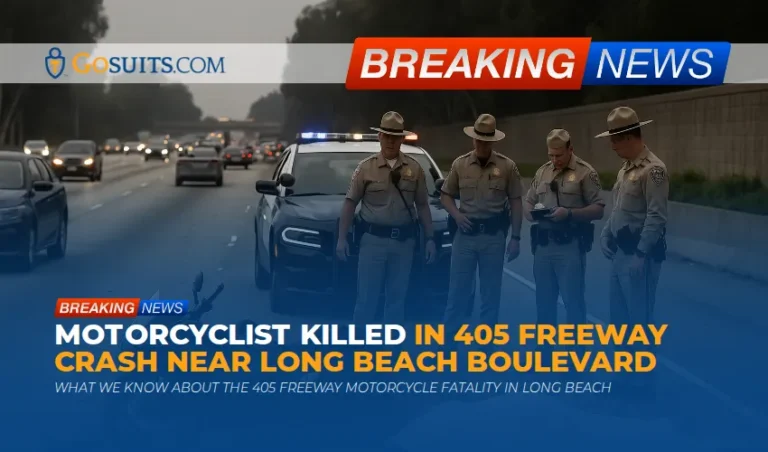
Early this morning, a motorcyclist was tragically killed in a crash on the southbound 405 Freeway just north of Long Beach Boulevard. According to the California Highway Patrol, dispatchers received multiple 911 calls reporting a collision involving a motorcycle and a blue Honda shortly before 6:55 a.m. CHP Officer Bobby Eurin confirmed the rider died at the scene. No details about the rider’s identity were immediately available. Officers began a comprehensive scene investigation to determine what led to the crash.
To manage the scene safely and allow investigators room to work, authorities closed the three left lanes of the southbound freeway until at least 9:30 a.m. By 8:30 a.m., traffic congestion stretched back to just short of the 110 Freeway, and the northbound 405 also saw heavy delays east of Studebaker Road. If you were commuting through the Bixby Knolls and Wrigley areas, the backups were felt not only on the mainline but also on feeder roads like Long Beach Boulevard and Atlantic Avenue.
CHP is the lead investigating agency on this segment of the 405. In California, fatal freeway collisions trigger a multi-step process that can include collision mapping, physical evidence documentation, witness interviews, and later, the release of official records to eligible requestors. That process can take days or weeks, depending on the evidence available.
Why this stretch of the 405 backs up so fast
Locals know that the 405 near Long Beach Boulevard is sensitive to even minor slowdowns. Proximity to key interchanges and choke points, including the 110 connector to the northwest and the 605/Long Beach exchange to the southeast, means an incident spikes delay across both directions. Morning commuters from Carson, Signal Hill, and Lakewood feed into this corridor, amplifying the ripple effects.
On mornings like this, Caltrans QuickMap is the best live source for closures and lane-by-lane updates. It also displays CHP incident markers, camera snapshots, and estimated travel times for the 405, 710, and 110 corridors [5]. If your route regularly runs past Long Beach Boulevard, consider surface-street alternates for major incidents, but be mindful that Long Beach PD and traffic operations often adjust signals to accommodate detours during freeway closures.
Where to get official information and records
CHP collision report and how to request it
For freeway incidents in this area, CHP prepares the official collision report. Eligible parties, including involved drivers, registered owners, and legal next of kin in fatal cases, can request a copy. The process uses the CHP 190 form, “Application for Release of Information,” which can be submitted by mail or in person to the appropriate CHP Area office. Instructions and the form are available from CHP’s records portal and forms page [1] [2].
You will typically need the date, approximate time, freeway and nearest cross street, and the investigating officer’s Area office if known. If you do not know which CHP Area is handling the report, CHP staff can help route the request based on the time and location of the crash.
Autopsy and coroner’s records
In Los Angeles County, the Department of Medical Examiner manages investigations into sudden and traumatic deaths. Families can check case status and request records, including autopsy and examination reports, directly through the Department’s website. The Medical Examiner also explains timelines, release procedures, and what documentation is needed from next of kin [3].
It is normal for a coroner’s investigation to take several weeks before final cause-of-death findings are certified, particularly if laboratory analyses are required. Provisional information may be available sooner, and the office can advise on how to coordinate with funeral homes for timely release.
Death certificates for official matters
Death certificates in Los Angeles County are issued by the Registrar-Recorder/County Clerk. Families commonly need certified copies to handle insurance, banking, and other estate matters. Ordering options, eligibility, and fees are provided by the County Clerk’s records portal [4].
Traffic closures and traveler information
Caltrans QuickMap provides real-time lane closure details, traffic speeds, and major incident flags across the 405, including camera images where available. It is frequently used by commuters and logistics companies to adjust routes during closures or prolonged investigations [5].
911 audio, CAD logs, and public records
Families and involved parties sometimes request 911 audio or computer-aided dispatch logs for timeline clarity. These requests are typically handled under the California Public Records Act. Agencies provide guidance on how to submit requests and what exemptions may apply. The California Attorney General’s Office maintains a general overview of open government and records rights that can help you get started [15]. Keep in mind that some materials may be redacted or temporarily withheld during an active investigation.
Safety and legal context for motorcycle collisions on Southern California freeways
Investigations involving motorcycles on high-speed corridors like the 405 consider many factors: lane position, surrounding vehicle movements, visual obstructions, and traffic density. In California, lane splitting is permitted under the Vehicle Code, and CHP publishes safety guidance to help riders and drivers coexist more predictably in dense traffic. The legal definition of lane splitting appears in California Vehicle Code section 21658.1 [7], and CHP’s motorcycle safety page offers practical tips for riders and drivers who share congested freeways where lane sharing is common [8].
Nationally, motorcycles remain overrepresented in fatal crash statistics relative to their share of traffic. NHTSA maintains current data and discusses the role of speed, visibility, impairment, and protective gear in crash outcomes [9]. For state-level context, California’s Office of Traffic Safety regularly publishes crash rankings and survey data that show regional patterns by roadway type and time of day [10]. Morning peak periods, like the timeframe of today’s crash, often feature stop-and-go waves, sudden lane changes, and short decision windows that can complicate safe passing and merging.
From a civil perspective, California applies comparative fault to traffic collisions. That means an injured party’s recovery can be reduced by any percentage of fault assigned to them, and multiple parties can share responsibility. California’s jury instructions describe how jurors allocate comparative responsibility when evidence supports it [11].
Possible civil liability issues investigators may review
It is too early to determine precisely what caused this crash, and official findings will come from CHP and, if relevant, the Medical Examiner. Generally, though, freeway motorcycle investigations may touch on the following civil liability themes:
- Unsafe lane changes or merges including failures to check mirrors and blind spots before moving into a lane that may be occupied by a motorcycle. California Vehicle Code duties apply to all drivers when changing lanes and turning.
- Following too closely or abrupt braking in dense traffic conditions, where short headways can turn minor decelerations into severe impacts for a rider.
- Speed relative to conditions where traffic flow varies rapidly between 15 and 55 mph, and both riders and drivers must adjust to prevent conflicts.
- Driver distraction including in-vehicle systems, phone usage, or other attention-diverting behavior that interferes with scanning for smaller road users.
- Lane splitting dynamics with a focus on traffic speed differential, rider positioning, and the predictability of vehicle movements in adjacent lanes.
- Mechanical condition and lighting such as brake lamps, turn signals, reflective gear, or motorcycle lighting that affects conspicuity in pre-dawn or overcast light.
If a third-party driver’s negligence contributed to the crash, civil claims may include wrongful death by eligible survivors under California Code of Civil Procedure section 377.60 [13]. If roadway conditions maintained by a public entity are alleged to have played a role, separate claim procedures and strict timelines under the Government Claims Act may apply [14]. Because these cases can involve multiple insurance carriers and complex fault allocations, many families seek guidance from Los Angeles motorcycle accident lawyers who are familiar with freeway dynamics and Los Angeles County procedures.
Evidence that can matter in a freeway motorcycle crash
While CHP and other responders document the scene, additional evidence from the public can be important. If you witnessed the event or captured relevant video, note the time, your vantage point, and any details about traffic speed or lane changes. For families and involved parties, consider the following evidence types:
- Dashcam and helmet camera video from surrounding vehicles or the rider, showing lane positions, signals, and movements in the seconds before impact.
- Third-party vehicle data such as OEM telematics or ADAS event logs that sometimes record speed, braking, or steering inputs during crashes.
- 911 audio and CAD logs to help clarify timelines, caller observations, and the initial characterization of the crash.
- Photographs of the scene including lane markings, debris fields, scrape marks, and vehicle rest positions before tow-away.
- Damage profiles to both the motorcycle and the other involved vehicle, which can inform reconstruction of the angle and severity of contact.
- Eyewitness contact information especially commuters who saw erratic driving or abrupt merges near Long Beach Boulevard.
- Medical records and, in fatal cases, coroner findings that connect trauma patterns to crash mechanics.
In the first week after a fatal crash, families often juggle paperwork while processing sudden loss. A practical, step-by-step overview can help keep documents organized for insurance and potential claims. This resource may help: los angeles wrongful death checklist.
Insurance issues after a fatal motorcycle collision
In the aftermath of a fatal collision, several insurance layers may come into play: the other driver’s liability policy, the rider’s own policies, and any umbrella or uninsured/underinsured motorist coverages that might apply. Before speaking with an adjuster or providing a recorded statement, it is wise to consult with an attorney. Insurers are trained to ask questions that may affect apportionment of fault and coverage. Early statements can be used later in ways that families do not anticipate. This is one of the moments when people consider consulting motorcycle accident lawyers to understand rights, time limits, and how insurance carriers evaluate these claims.
California generally provides a two-year time limit for wrongful death actions arising from negligence [12]. If a public entity may be implicated, administrative claim deadlines can be as short as six months [14]. Eligibility to bring a wrongful death claim is defined by statute, with spouses, children, and certain dependents among those commonly authorized [13]. Because freeway collisions often hinge on details like relative speed, whether signals were used, and how traffic was flowing at that moment, many families in the region choose to speak with Los Angeles motorcycle accident lawyers who regularly analyze complex multi-vehicle interactions and comparative fault arguments.
California law also requires drivers to report crashes to the DMV in specific circumstances, including those involving injury or death, within 10 days using the SR 1 form. This reporting duty is separate from insurance notifications and police reports, and it applies regardless of fault determinations [6].
Local notes for Long Beach area families and commuters
When a fatal crash happens on the 405 through Long Beach, multiple local systems activate at once: CHP manages the freeway scene, Caltrans handles traffic controls and closures, and the Los Angeles County Department of Medical Examiner oversees decedent care and next-of-kin communication. Here are practical local notes people in our community often ask about:
- Which agency handled the scene: On the 405 through Long Beach, CHP is typically the primary collision investigator. Their Area office handling this stretch can advise you on the correct place to submit the CHP 190 request [1] [2].
- How to check coroner status: The Department of Medical Examiner’s website offers case status tools and contact paths for families [3].
- Death certificates for official tasks: The LA County Registrar-Recorder/County Clerk handles certified copies that banks, insurers, and employers often require [4].
- Navigating traffic the day of the crash: QuickMap is the go-to for closures and live camera views; keep an eye on the 110 and 710 as alternates, and expect spillover onto Long Beach Boulevard and Atlantic Avenue when multiple lanes are closed [5].
Community-wise, residents in Bixby Knolls and California Heights feel the impact most acutely when freeway incidents spill traffic onto surface streets around Long Beach Boulevard, Wardlow Road, and San Antonio Drive. During protracted closures, signal timing often changes to clear queues, so give yourself extra time and be mindful of pedestrians and school zones near Wardlow Park and Hughes Middle School during the morning rush.
Why timely action matters now
Here’s what typically needs attention after a serious or fatal freeway collision, and why it is time-sensitive:
- Secure critical evidence early. Video and scene data degrade fast. Dashcam footage may auto-delete in days, and businesses overwrite parking-lot video quickly. Preserving this material while memories are fresh helps clarify how traffic was moving near Long Beach Boulevard at the moment of impact.
- Identify and contact witnesses. Commuters who saw an abrupt lane change or near-miss may be traveling the same route tomorrow but harder to reach next week. Names and short statements captured early can reduce disputes later.
- Obtain official records. CHP collision reports, 911 audio, and coroner records each follow their own timelines and eligibility rules. Getting requests in promptly can prevent downstream delays with insurance claims or estate matters [1] [2] [3].
- Understand reporting requirements. State rules may require an SR 1 filing with the DMV after a crash involving injury or death, even if fault is disputed or still under investigation [6].
- Be cautious with insurance communications. Statements made early can shape the evaluation of liability and coverage. Before calling an insurer, many people choose to consult counsel to understand how adjusters frame questions and how comparative fault could be argued [11].
- Calendar legal deadlines. California’s two-year limit for wrongful death can be shorter in claims against public entities, where a six-month administrative claim may apply [12] [14]. Acting within those windows preserves options for civil recovery.
Timely action helps ensure that critical information is preserved and that statutory timelines do not close off options before facts are fully understood.
Commentary from Gosuits Long Beach, California Personal Injury Attorney
Our hearts are with the rider’s loved ones and everyone caught in the morning gridlock who witnessed a tragic scene. We offer this article for educational purposes and general information during a very difficult time.
On corridors like the 405 near Long Beach Boulevard, conditions change quickly. A single abrupt lane movement can intersect with a rider’s lawful travel path in an instant. In cases like this, the core questions usually revolve around visibility, signaling, and whether surrounding drivers acted reasonably for the traffic conditions at that moment. CHP’s measurements, vehicle damage patterns, and any available video will be central to understanding what happened.
Insurance carriers and large corporations often move fast to shape the narrative. They understand how to use early statements, partial records, and gaps in evidence to argue comparative fault or minimize payouts. People dealing with sudden loss are at an information disadvantage, and that is where a seasoned and skilled perspective on liability, policy limits, and timelines can help level the field.
Obtaining a free consultation before speaking with any insurer can help people understand their rights, the role of comparative fault in California, and the key evidence to preserve. Even if no claim is ultimately filed, that early guidance can prevent avoidable missteps and ensure decisions are grounded in a clear understanding of the process.
References
- Collision Report Request – California Highway Patrol
- CHP 190 Application for Release of Information – California Highway Patrol
- Department of Medical Examiner – County of Los Angeles
- Death Records – LA County Registrar-Recorder/County Clerk
- QuickMap – California Department of Transportation
- Accident Reporting Requirements – California DMV
- Vehicle Code § 21658.1 Lane Splitting – California Legislature
- California Motorcyclist Safety Program – California Highway Patrol
- Motorcycles Road Safety – NHTSA
- Traffic Safety Surveys and Rankings – California OTS
- Judicial Council of California Civil Jury Instructions (CACI) – California Courts
- CCP § 335.1 Two-Year Statute for Injury/Death – California Legislature
- CCP § 377.60 Wrongful Death – California Legislature
- Gov. Code § 911.2 Claims Presentation Deadline – California Legislature
- Open Government and Public Records – California Attorney General