- What we know about the Abelia Road motorcycle collision
- Where and when it happened, and who responded
- Injuries and hospital transport
- Why early morning motorcycle crashes are so dangerous
- What investigators will likely examine
- How liability is typically determined in motorcycle versus car crashes in California
- Practical steps for riders and families in Santa Clarita after a serious crash
- How to get official records and reports
- Santa Clarita Valley Sheriff’s Station collision report
- California DMV SR-1 accident report requirement
- Los Angeles County Medical Examiner-Coroner records
- 911 audio, CAD logs, and traffic video
- Insurance considerations riders should know
- Community safety notes for Santa Clarita riders and drivers
- What to do before speaking with insurance
- Time-sensitive actions that protect health and rights
- Commentary from Gosuits Santa Clarita, California Personal Injury Attorney
- References
What we know about the Abelia Road motorcycle collision
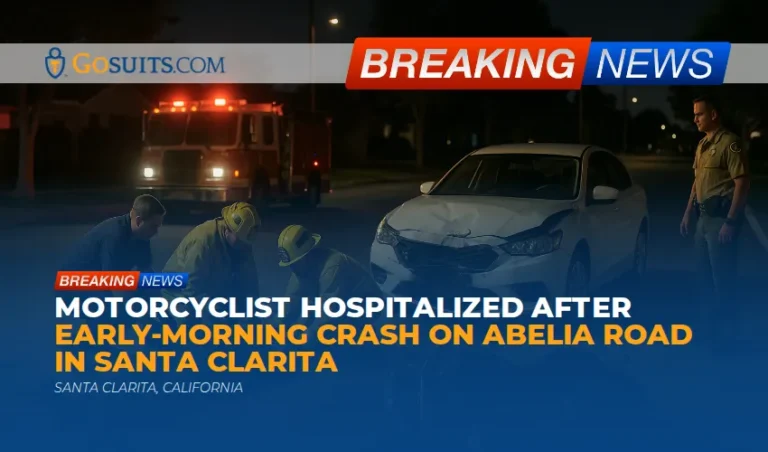
Early Saturday morning, a motorcycle and a car collided in the 30000 block of Abelia Road in Santa Clarita. The call to first responders came in at 3:39 a.m., according to a Los Angeles County Fire Department spokesperson quoted in local reporting. Firefighters reached the scene at 3:52 a.m., and by 4:04 a.m., an adult male motorcyclist was being transported to Henry Mayo Newhall Hospital in Valencia for treatment. Reports from the scene indicate the motorcycle impacted the front of a white sedan. As of publication in the local story, Santa Clarita Valley Sheriff’s Station deputies had not released additional details on cause or fault.
Abelia Road is a residential corridor where quiet predawn hours can still see cut-through traffic, service vehicles, and occasional late-night returns from the I-5, the 14, or McBean Parkway. Even in calm conditions, the combination of darkness, potential glare from oncoming headlights, and reduced reaction time for all road users can raise crash risk. We are keeping the motorcyclist and everyone impacted in our thoughts.
Where and when it happened, and who responded
The collision occurred in the 30000 block of Abelia Road in Santa Clarita around 3:39 a.m. Fire crews and Santa Clarita Valley Sheriff’s Station deputies responded. In Santa Clarita, serious injury collisions like this typically fall under the Santa Clarita Valley Sheriff’s Station for primary investigation unless the California Highway Patrol handled the scene, which sometimes happens on freeways and state routes. The early morning timing matters. At that hour, visibility is low, drivers may be fatigued, and lighting transitions can affect depth perception and hazard detection. These are well-known risk factors for all road users, including motorcyclists [5].
Injuries and hospital transport
The motorcyclist was transported to Henry Mayo Newhall Hospital, which routinely treats emergency and trauma patients from incidents throughout the Santa Clarita Valley. The nature and extent of the rider’s injuries were not publicly released at the time of the initial report. In serious motorcycle collisions, first responders prioritize stabilization, airway and breathing support, spine precautions, and rapid transport to definitive care. The national data on motorcycle crashes reinforce why speed to care matters. Motorcyclists face higher rates of serious injury per vehicle mile traveled than occupants of passenger cars, and proper helmets significantly reduce the risk of fatal head injury [4].
Why early morning motorcycle crashes are so dangerous
Throughout Southern California, the risk profile for riders shifts at night and in the early morning. Darkness reduces contrast and makes it harder for drivers to judge a rider’s distance and speed. Even on familiar streets, streetlight coverage can be inconsistent. Headlight glare can further sap a driver’s ability to perceive a slim motorcycle silhouette, especially if the rider is approaching on a slight curve or elevation change. State safety agencies consistently urge riders and drivers to increase following distance and use extra caution in low light. California’s Office of Traffic Safety and NHTSA have long highlighted impaired driving, speed, and visibility as key crash contributors for motorcyclists [4][5].
What investigators will likely examine
While deputies had not yet released findings, traffic investigators typically look at a consistent set of factors after a motorcycle versus car crash:
- Impact configuration and resting positions of the motorcycle and sedan, which help reconstruct speed, direction, and point of impact.
- Lighting, sightlines, and roadway layout at the 30000 block, including any parked vehicles, curves, or vegetation that might limit visibility.
- Skid marks, debris fields, and scrape patterns that indicate braking, evasive action, and exact collision angle.
- Damage profiles on each vehicle, including crush zones on the sedan’s front end and contact points on the motorcycle.
- Driver and rider statements, witness observations, and any available dash or doorbell camera footage from nearby homes.
- Lighting and reflective gear used by the rider, and whether the motorcycle’s headlamp, brake lamp, and turn signals were functioning.
- Potential impairment or distraction for any involved party, as well as phone records where appropriate and permitted by law.
For riders and families wanting to understand what to preserve in the days after a crash, a practical resource is the Los Angeles motorcycle crash checklist, which outlines photos, notes, and documents that often matter later.
How liability is typically determined in motorcycle versus car crashes in California
California uses comparative negligence, which means more than one party can share fault in a collision. Liability often turns on roadway rules, right of way, and the reasonableness of each person’s actions in the moments before impact. Common fault patterns in motorcycle versus car crashes include left turns across a rider’s path, unsafe lane changes into a rider’s lane, failure to yield from a driveway or side street, and speed or following distance issues.
Because this crash occurred on a residential street, a few scenarios may be assessed by investigators, without assuming anything specific about this event:
- Left turn or pull-out conflicts where a driver turns or pulls from curbside parking into a rider’s path.
- Overtaking or approach visibility where headlight glare or limited light reduces a driver’s ability to judge an oncoming motorcycle’s speed.
- Lane positioning choices by the rider that may affect how visible the motorcycle looked from the driver’s perspective.
If a public entity’s roadway design or maintenance contributed to visibility problems or hazards, time limits apply to potential claims under the California Government Claims Act [8]. That is a narrow scenario, and any such assessment depends on the facts, but it is one reason people often seek a detailed case review early.
Practical steps for riders and families in Santa Clarita after a serious crash
In the first days after a serious collision, information tends to scatter across multiple agencies and sources. It helps to keep things organized with a simple plan:
- Prioritize medical care. Follow hospital instructions, attend follow-up appointments, and save every discharge summary, prescription, and referral. Keep a simple pain and limitations journal so changes are tracked day by day.
- Secure the motorcycle and gear. Ask the tow yard not to destroy or release the motorcycle for salvage until you can document it. Photograph the helmet, jacket, gloves, and boots before they are cleaned or discarded. Damage to gear often helps show impact forces and mechanism of injury.
- Collect scene details while fresh. Photos, short videos, and a simple map sketch of the 30000 block area, including streetlights and parked vehicles, can preserve critical context.
- Identify potential cameras. Ring or Nest doorbells, home security cameras, and vehicle dash cams on Abelia Road or nearby cross streets sometimes overwrite in a matter of days. A polite, timely request can make a real difference.
- Note any symptoms that emerge later. Headaches, dizziness, sleep difficulties, neck stiffness, and numbness can appear or worsen over 24 to 72 hours. Seek care promptly if anything changes.
When legal questions come up, motorcycle accident lawyers can help assess fault, preserve evidence, and explain how insurance coverages may apply without committing anyone to a decision on the spot.
How to get official records and reports
Multiple agencies may have documents tied to a single Santa Clarita crash. Gathering the right records early can clarify what happened and support insurance claims. Here is where to look and what to expect.
Santa Clarita Valley Sheriff’s Station collision report
If the Santa Clarita Valley Sheriff’s Station was the primary agency, you can request the traffic collision report through the Los Angeles County Sheriff’s Department records process. The station webpage provides local contact information, while LASD’s Records and Identification handles report requests and eligibility details [1][2]. Be prepared to provide the report number if available, date and time of the collision, location, and names of involved parties. Some reports are limited or redacted by law.

California DMV SR-1 accident report requirement
Separately from the police report, California requires a DMV SR-1 to be filed within 10 days if there is injury, death, or property damage over a threshold amount. The SR-1 is mandatory even if law enforcement took a report and even if the other party was at fault. The DMV provides the SR-1 form and instructions online [3]. Failing to file the SR-1 when required can lead to license consequences, so this task should not be overlooked.
Los Angeles County Medical Examiner-Coroner records
In cases involving a fatality, the Los Angeles County Department of Medical Examiner handles examinations and releases reports to eligible next of kin. Families can contact the department for information on the process, timelines, and how to request documents through their official website [6]. In non-fatal injury cases, hospital records and EMS run sheets are more typical sources of medical documentation.
911 audio, CAD logs, and traffic video
Depending on the agency that handled the scene, you may be able to request 911 audio, computer aided dispatch logs, or traffic collision photographs. If CHP handled the incident, their collision report request page explains what records may be available and the forms required [7]. If LASD responded, similar requests usually go through their records unit [2]. Traffic camera footage on residential streets is rare, so private cameras on homes, rideshares, and parked vehicles often matter most.
Insurance considerations riders should know
Insurance coverage in a motorcycle versus car crash can involve several layers:
- At-fault driver’s liability coverage for bodily injury and property damage.
- Your own collision and MedPay, if purchased.
- Uninsured and underinsured motorist coverage on the rider’s policy, which may be crucial if the at-fault driver has low limits.
Statements to insurance carriers are recorded, and what is said early can influence how a claim is evaluated later. If a public entity might be involved due to roadway conditions, the California Government Claims Act usually requires a written claim to the entity within six months of the incident for personal injury matters [8]. Because deadlines are strict, people often want a prompt, fact-specific review of available evidence before opening recorded discussions with insurers.
Community safety notes for Santa Clarita riders and drivers
Santa Clarita drivers and riders share a mix of residential streets and larger arterials that connect to McBean Parkway, Newhall Ranch Road, and the freeway network. A few practical reminders supported by California agencies:
- Lane positioning and conspicuity help. Reflective elements, bright helmets, and high-beam use during the day can increase detectability. CHP’s lane splitting safety page also offers guidance on safe speeds and spacing when lane splitting on permitted corridors, which is a legal maneuver in California within CHP guidelines [9].
- Left turns are a classic conflict. Drivers should look for the smaller visual profile of motorcycles, especially in low light. Riders can use lateral lane position and speed selection to enhance visibility while approaching intersections.
- Speed and following distance. Extra space gives everyone time to react on neighborhood streets where parked cars and driveways obscure sightlines. OTS emphasizes speed management and sober driving as pillars of motorcycle safety in California [5].
What to do before speaking with insurance
It is common for adjusters to make quick contact. Before giving any recorded statement, consider taking these steps:
- Gather all photos and notes from the scene, the tow yard, and the motorcycle and gear. Organize them by date.
- Collect medical documentation, including emergency department summaries, imaging orders, and follow-up referrals.
- List potential witnesses and cameras on the block. Reach out early if you plan to ask neighbors for footage.
- Confirm which law enforcement agency took the lead, and note the incident or report number if available.
Before contacting any insurance company, many people first consult with a qualified attorney for a free case review to understand their rights, coverage options, and how to avoid statements that can be taken out of context later. In particular, motorcycle accident lawyers can help identify critical evidence windows, advise on the DMV SR-1, and coordinate preservation of the motorcycle and apparel for inspection. What someone says to an insurer can be used to challenge fault, causation, or the necessity of medical care, so planning ahead matters.
Time-sensitive actions that protect health and rights
Here is a plain-language, time-based roadmap that helps explain the urgency of certain tasks. This section is educational and meant to guide anyone who wants to stay on top of deadlines and preserve key evidence.
- First 24 to 72 hours
- Get medical evaluation, follow discharge instructions, and monitor for delayed symptoms like headaches or neck stiffness.
- Photograph the motorcycle, helmet, jacket, gloves, and boots. Do not authorize salvage or repairs until documentation is complete.
- List witnesses and camera sources on the block and politely request copies before footage is overwritten.
- First 7 to 10 days
- Confirm which agency holds the collision report and note the incident number.
- Complete and submit the DMV SR-1 if injury or qualifying property damage occurred [3].
- Start a simple daily pain and limitations journal to track how injuries affect work, school, and family routines.
- First 2 to 4 weeks
- Request the collision report when available, and review for accuracy.
- Collect medical records, bills, and out-of-pocket receipts. Keep ride-share, parking, and pharmacy receipts together.
- If roadway conditions may be a factor, learn about public entity claim deadlines that can be as short as six months for personal injury claims in California [8].
The benefit of acting now is twofold. First, health outcomes often improve with timely, consistent care. Second, evidence that is strongest in the first days, like private camera footage and detailed photos of the motorcycle and gear, can make the difference in proving what happened. For a local perspective, consulting with motorcycle accident lawyers in Los Angeles can bring clarity about coverage, fault, and the best order of next steps.

Commentary from Gosuits Santa Clarita, California Personal Injury Attorney
We are thinking about the rider, the family, and everyone affected by this early morning crash on Abelia Road. Collisions like this shake a neighborhood. Please treat this write-up as general information intended to help the community understand what typically happens after a serious motorcycle collision in our area.
From a civil injury perspective, several factors often come into play in a motorcycle versus sedan crash on a residential street. Investigators will look closely at visibility, approach speed, headlamp use, and any left turn or pull-out movements. The reported front-end damage to the sedan is consistent with a crossing or approach conflict, but only a full scene analysis, witness statements, and vehicle inspections can answer the why with confidence.
In our experience, insurance companies and corporate claim units frequently move fast to shape the narrative. They may suggest a rider could have done more to avoid the impact or try to minimize injuries by pointing to gaps in care. Sometimes they request broad medical authorizations or push recorded statements before all the facts are gathered. These tactics work best when people do not know their rights or the deadlines that apply. Being proactive with records, photos, and a careful plan for communications helps level the field.
A free consultation can be valuable in this setting. It gives people a chance to understand coverage, comparative fault rules, and the evidence that tends to matter most, without making commitments. The goal is not to rush a decision, but to make sure time sensitive steps are handled correctly and no one is boxed in by early statements or missed deadlines.
References
- Santa Clarita Valley Sheriff’s Station – Los Angeles County Sheriff’s Department
- Records and Identification – Los Angeles County Sheriff’s Department
- SR-1 Report of Traffic Accident Occurring in California – California DMV
- Motorcycles Traffic Safety – NHTSA
- Motorcycle Safety Program – California Office of Traffic Safety
- Los Angeles County Department of Medical Examiner-Coroner
- Requests for Collision Reports – California Highway Patrol
- California Government Code section 911.2 – Government Claims Act Deadline
- Lane Splitting Safety – California Highway Patrol