- What we know about the San Marcos SR 78 motorcycle crash
- Why late-night construction zones on SR 78 can be high risk for riders
- Immediate steps families can take after a fatal highway crash in North County
- How to obtain official records and reports
- Possible civil liability paths after a work zone crash
- Work zone standards that may matter in the investigation
- Evidence to preserve and who may have it
- Insurance considerations after a fatal motorcycle crash
- Local safety context for San Marcos, SR 78, and North County
- Key California timelines and notice requirements
- Why taking action promptly matters and what to do
- References
- Commentary from Gosuits San Marcos, California Personal Injury Attorney
What we know about the San Marcos SR 78 motorcycle crash
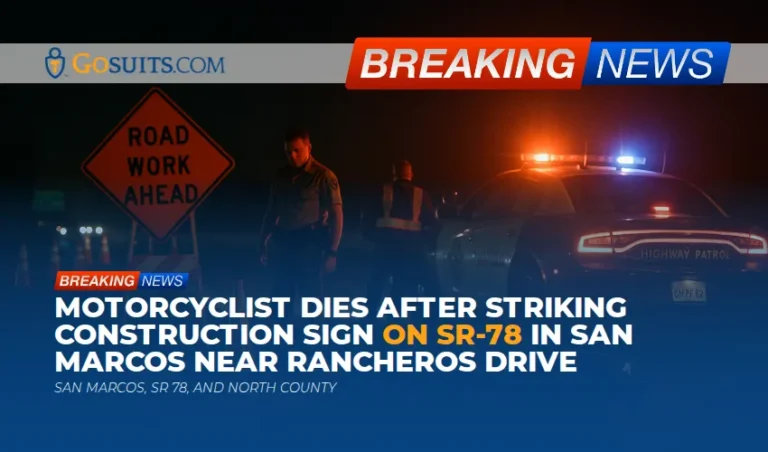
In the early morning hours of Saturday, a motorcyclist riding a Kawasaki was killed after striking a construction sign on State Route 78, the Ronald Packard Parkway, in San Marcos. California Highway Patrol reported the crash at 2:39 a.m. on the westbound side near the Rancheros Drive onramp. At the time of reporting, the rider’s name, gender, city of residence, and additional crash details had not yet been released. The location sits in the corridor that links Oceanside and Escondido, cutting through San Marcos just south of Cal State San Marcos and not far from the hubs along San Marcos Boulevard and Rancho Santa Fe Road.
Construction activity on SR 78 has been familiar to North County commuters, especially near onramps where signage, cones, and temporary tapers can change quickly. When a fatal crash happens in a work zone during low-visibility hours, families naturally have questions about what traffic control was in place, who set it up, and whether it complied with California’s required standards. Those questions are appropriate and often guide the next steps in an investigation.
Why late-night construction zones on SR 78 can be high risk for riders
Motorcyclists face greater exposure in any crash, and night work zones add layers of complexity. Nationally, motorcycle riders continue to be overrepresented in fatal traffic crashes according to federal safety data, and visibility is a persistent factor after dark. Federal highway safety officials also track work zone safety concerns, noting how lane shifts, narrowed shoulders, and temporary signage can contribute to elevated crash risk if traffic control is not planned and maintained correctly [1] [2].
California requires work zones to follow the California Manual on Uniform Traffic Control Devices, commonly called the CA MUTCD. Among other things, the CA MUTCD sets out expectations for where and how advance warning signs are placed, the size and reflectivity of those signs, taper lengths for lane closures, and nighttime visibility requirements. These rules are designed so a driver or rider has adequate time to perceive, process, and respond to the changed road environment [3].
Even in a simple setup, a poorly placed or non-reflective sign can turn into a fixed-object hazard. Riders on the westbound Ronald Packard Parkway at 2:39 a.m. would have been relying on headlight illumination and whatever reflectivity or lighting the work zone provided. That is precisely why the physical layout and any recent changes to the construction staging are important details for investigators to lock down as soon as possible.
Immediate steps families can take after a fatal highway crash in North County
Families do not have to wait for weeks to start organizing information. Taking a few practical steps early can help protect answers later.
- Identify the investigating agency and request the collision report. Fatal crashes on state highways in San Diego County are typically investigated by the California Highway Patrol. The official CHP collision report will include a diagram, measurements, involved parties, and any initial observations. CHP provides a process to request a copy of the report once it is available [4].
- Contact the San Diego County Medical Examiner’s Office. The Medical Examiner oversees the death investigation, identification, and autopsy records for fatalities in the county. Families can request information about next steps, including how to obtain reports when released [5].
- Secure any personal evidence immediately. Preserve the rider’s helmet, clothing, phone, and any onboard camera or GPS device. Do not attempt to clean or repair items. Store everything in a safe, dry place.
- Document what you know about the roadway conditions. Write down what relatives, witnesses, or first responders shared about construction activity, lighting, sign placement, and any lane closures. Memory fades quickly, and small details can matter.
- Be cautious with insurance communications. Before giving recorded statements or signing anything, speak with a qualified attorney. What is said to insurers early on can be used against the claim later. It is prudent to understand your rights through a free consultation first.
How to obtain official records and reports
Multiple public agencies may hold pieces of the full picture. Here is where to start, and what to ask for.

CHP collision report and supplemental materials
CHP maintains the primary collision report for crashes on SR 78. You can request the report directly from CHP after it is approved for release. Ask for any available supplemental reports, including scene photographs and measurements, if those are releasable under CHP policy [4].
San Diego County Medical Examiner records
The Medical Examiner’s Office can advise families on availability of autopsy and investigative reports once the case is complete. These documents can confirm cause of death and may include observations relevant to helmet damage, impact forces, or other forensic details [5].
Caltrans and contractor work zone records
Caltrans owns and maintains SR 78. For active projects, Caltrans typically requires contractors to follow approved traffic control plans that dictate where and how construction signs and devices are placed. Request the traffic control plan sheets for the date and time of the crash, any field change orders, nightly lane closure logs, and inspection reports verifying setup compliance. The CA MUTCD and Caltrans standard plans form the baseline that contractors must follow [3] [6].
911 audio, dispatch logs, and scene communications
Dispatch and CAD logs can help establish the first time-stamped calls, unit arrival times, and any notes about hazards or obstructions. In San Diego County, 911 calls are routed through regional public safety dispatch. Families can consult with counsel about making tailored public records requests that accurately identify the date, time, and location parameters for the materials requested under California’s public records laws.
Traffic operations and crash data
California’s statewide crash database, SWITRS, is maintained in part by CHP and can be queried for historical crash patterns at or near the Rancheros Drive onramp area. Historical patterns sometimes reveal recurring problems at a specific location, which may be relevant in a work zone analysis [7].

Possible civil liability paths after a work zone crash
Every case turns on its facts, but a work zone fatality on a state highway commonly raises several areas of potential civil liability. None of the below implies fault in this crash; they are simply issues that often warrant a closer look.
- Contractor and subcontractor traffic control duties. If a private contractor set up the construction sign and related devices, that contractor is typically responsible for compliance with the approved plan and the CA MUTCD. Failures in placement, nighttime retroreflectivity, or maintenance of signs and cones can support negligence theories when proved.
- Caltrans design, maintenance, or oversight questions. Where a claim implicates the public owner’s design approvals, inspection protocols, or maintenance responsibilities, specialized rules and defenses apply. Families considering a claim against a public entity must comply with the California Government Claims Act before any civil lawsuit can be filed in court [8]. For a broader primer on claims that involve California’s state transportation agency, see Can You Sue Caltrans for Damage Incurred on the Road?.
- Comparative negligence and visibility. In California, fault can be shared among multiple actors. Visibility conditions, speed, impairment evidence, and conspicuity of the work zone all factor into how liability is ultimately assigned. A thorough reconstruction can clarify the sequence of events.
- Product or equipment defects. In some crashes, defective or substandard traffic control devices or sign supports may contribute to injury severity. If equipment used in the work zone deviated from required standards, separate product liability theories may be considered.
Investigating these paths often requires prompt collection of field evidence, calibration of sight distances, and verification that temporary traffic control was implemented as drawn. If there are questions about sign placement at the Rancheros Drive onramp, precise measurements of distances and heights become critical.
Work zone standards that may matter in the investigation
The CA MUTCD is the governing standard for traffic control devices in California work zones. A few provisions and concepts often arise in litigation following work zone crashes:
- Advance warning sign spacing. The distance between “Road Work Ahead” and subsequent sequence signs should provide adequate perception-reaction time based on speed. Insufficient spacing can be hazardous, especially at night.
- Retroreflectivity and sign condition. Work zone signs must be retroreflective and maintained so they are effective during nighttime operations. Damaged, dirty, or non-reflective devices can violate the standard of care [3].
- Taper lengths and buffer spaces. Tapers that shift traffic laterally and buffer zones that provide recovery space are specified by speed. Truncated or improvised tapers can increase crash risk.
- Device selection and placement height. Sign size, mounting height, and lateral offset from the traveled way are all defined. Improper placement can bring a device too close to the path of travel.
- Inspection and documentation. Caltrans standard plans and specifications require nightly setups to match plan sheets or approved alternatives, with inspection documentation. Deviations often leave a paper trail in lane closure logs and inspector notes [6].
Evidence to preserve and who may have it
Work zone fatality cases can turn on small details that are easy to lose if not preserved quickly. A focused preservation effort usually targets:
- Temporary traffic control plan sheets. Held by Caltrans and the prime contractor. These show intended device layout.
- Nightly lane closure and inspection logs. Document when and how the zone was set. These can confirm whether the construction sign struck by the motorcycle was placed per plan.
- Scene photographs and measurements. CHP photos, contractor site photos, and any third-party images. Measurements of sign heights, offsets, and distances from reference points are crucial.
- Vehicle and helmet inspections. The Kawasaki, helmet, and rider gear should be preserved in as-is condition for a qualified biomechanical or reconstruction expert to review.
- Public and private video. Caltrans traffic cameras, nearby business CCTV, and vehicle dashcams. Caltrans and CHP may have time-limited retention. It is best to send preservation requests as soon as possible.
- Witness statements. Especially from workers who set the traffic control, first responders, and motorists who passed through the area around 2:39 a.m.
Families often ask who should send preservation letters. In practice, counsel will typically notify Caltrans, the general contractor, known subcontractors, the CHP Area Office, and potentially nearby property owners with relevant cameras. Doing this early helps reduce disputes later about spoliation or missing records.
Insurance considerations after a fatal motorcycle crash
Insurance coverage can involve several policies. Many households do not realize that a private auto policy’s uninsured or underinsured motorist coverage may apply in more scenarios than head-on collisions, including some no-contact incidents depending on the language of the policy and the facts. There may also be MedPay or death benefits on certain policies.
Before notifying any insurer or giving a recorded statement, it is generally wise to speak with motorcycle accident lawyers who handle wrongful death claims. Policies have exclusions and conditions that can become traps in the first 72 hours. An early strategy discussion can help align notifications with evidence preservation needs, avoid admissions, and map coverage sources that might not be obvious.
When public entities or contractors may be involved, there are added wrinkles. Some insurers will immediately tender a low initial offer or seek broad releases, particularly if there is uncertainty about fault. This is another moment when advice from motorcycle accident lawyers in Irvine who regularly confront complex roadway or construction cases can level the playing field, especially given the short deadlines described below.
Local safety context for San Marcos, SR 78, and North County
Anyone who drives SR 78 knows it is a critical East-West artery for North County. Traffic patterns change quickly between the I-5 and I-15 junctions, and the corridor sees daytime congestion along with periodic nighttime work. Federal highway authorities highlight that work zones require enhanced attention to nighttime visibility and proper device placement, because driver expectancy is altered by unfamiliar tapers, narrowed lanes, and construction vehicles entering or exiting the roadway [1].
At the same time, national motorcycle safety research continues to underscore the vulnerability of riders. NHTSA’s traffic safety analyses have documented that riders face a significantly higher fatality rate per vehicle mile traveled than occupants of passenger cars, with nighttime conditions and fixed-object collisions featuring among recurrent risk patterns [2]. California’s Office of Traffic Safety also maintains statewide and county-level snapshots that help the public understand trends affecting riders and other road users from year to year [9].
For San Marcos families, these data points do not answer what happened at one specific work zone near Rancheros Drive. But they do help frame the right questions: Was the work zone set and maintained per plan, with the right spacing and retroreflectivity to give a rider reasonable time to react? Did the sign that was struck sit where the plan located it, at the proper lateral offset? Was the onramp area configured differently than the plan sheets? Answers to those questions tend to come from the paper and photo trail discussed above.
Key California timelines and notice requirements
California has strict rules when a potential claim involves a government entity like Caltrans. Before filing a lawsuit in court, a written administrative claim must be presented to the public entity, generally within six months of the incident for claims involving death or injury. Missing this step can bar a later civil case, with limited exceptions. This requirement is set out in the California Government Claims Act [8].
There are also practical, shorter timelines driven by evidence preservation. For example, some traffic camera systems and dispatch audio may be overwritten within days or weeks. Contractor lane closure logs and daily diaries should be requested promptly so they can be retained. When counsel is engaged early, preservation letters and California Public Records Act requests can be coordinated quickly and precisely to reduce the risk of lost evidence.
Why taking action promptly matters and what to do
Here is what action looks like in the first stretch after a work zone fatality on SR 78, and why timing matters.
- Pin down the official record quickly. Obtaining the CHP report number, identifying the Medical Examiner case number, and noting the Caltrans project identification begin the paper trail that investigators and courts rely on. This reduces ambiguity later and makes it easier to request precise records.
- Preserve field conditions before they change. Work zones are temporary by nature. A sign that was in one spot Saturday may be gone or moved Sunday. Acting now supports accurate reconstructions and reduces disputes about where devices sat when the crash occurred.
- Protect rights under short government claim deadlines. If a public entity may be implicated, the six-month Government Claims Act clock is already running. Early action ensures notices are filed correctly and completely.
- Anticipate insurer tactics and avoid early missteps. By taking time to understand policy language and claim sequencing before speaking with adjusters, families can avoid common pitfalls that reduce the value and clarity of the claim later on.
- Coordinate with community resources thoughtfully. In North County, families often lean on local networks, from faith communities in San Marcos and Escondido to campus supports at Cal State San Marcos. Channeling those efforts into practical help, like transportation to appointments and help organizing records, eases the administrative burden.

References
- Work Zone Safety Facts and Statistics – Federal Highway Administration
- Motorcycle Safety – National Highway Traffic Safety Administration
- California Manual on Uniform Traffic Control Devices – Caltrans
- Request a Collision Report – California Highway Patrol
- Medical Examiner – County of San Diego
- Standard Plans and Specifications – Caltrans
- Statewide Integrated Traffic Records System (SWITRS) – California Highway Patrol
- California Government Code Section 911.2 – Legislative Information
- Collision Ranking Results – California Office of Traffic Safety
Commentary from Gosuits San Marcos, California Personal Injury Attorney
Our hearts are with the family, friends, and neighbors affected by this tragedy on the Ronald Packard Parkway. Losing a loved one on a familiar stretch of SR 78 is devastating, and we recognize that in moments like this, people want clarity and compassion more than anything else. This commentary is offered for general information and education, not as legal advice.
From a personal injury perspective, a fatal collision with a construction sign at 2:39 a.m. immediately raises work zone safety questions. It is appropriate to look closely at what devices were in place, whether they were set per plan, and if nighttime visibility met the CA MUTCD’s requirements. The onramp area near Rancheros Drive can be visually demanding for riders in the dark, so device spacing, mounting heights, and retroreflectivity take on even more importance. At the same time, the factual record must be developed carefully and respectfully. The CHP report, Medical Examiner findings, Caltrans traffic control plans, and contractor logs will anchor any fair assessment of what happened and why.
Insurance carriers and large entities know the early hours shape a claim. Adjusters sometimes move fast to secure blanket authorizations or recorded statements, or to suggest narrow interpretations of coverage. Construction contractors and public agencies may move equally fast to control records before anyone asks the right questions. That speed can leave families feeling outmaneuvered. Taking time to understand rights and obligations first can prevent avoidable missteps, especially where government claim procedures and complex traffic control standards intersect.
There is real value in a free consultation before engaging with insurers or sending informal requests. A brief, no-cost conversation helps people understand the timeline, identify the specific records that matter, and avoid saying something that could be misunderstood later. It also opens the door to coordinated preservation letters and properly framed requests for public records so critical evidence does not slip away. In a work zone case on a state highway, that early organization can make all the difference in getting to the truth.