- What We Know About the Moreno Valley Crash
- Where It Happened and Local Context
- Status of the Investigation and Evidence That Matters
- Practical Steps Families Can Take in the First Days
- Civil Legal Context After a Fatal Motorcycle Crash in California
- Insurance Issues That Often Arise After Crashes Like This
- How Fault Is Analyzed in Car vs. Motorcycle Collisions
- Community Safety Notes Near Moreno Beach and Auto Mall
- How to Preserve Evidence Now
- Action Steps and Why Timing Matters
- References
- Commentary from Gosuits Moreno Valley, California Personal Injury Attorney
What We Know About the Moreno Valley Crash
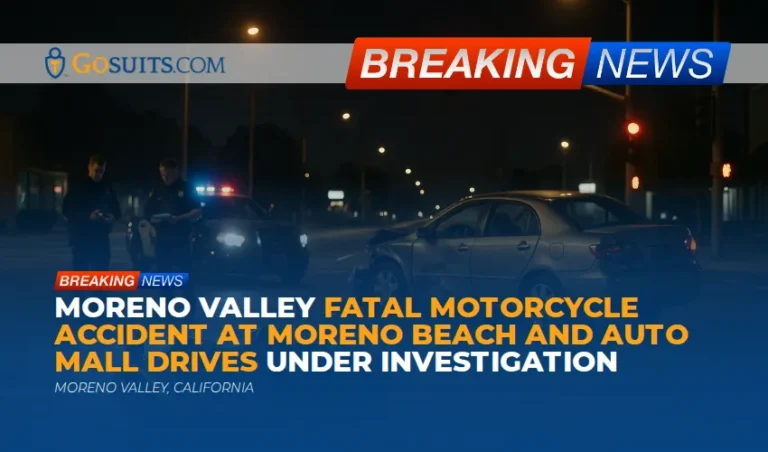
According to information released by the Riverside County Sheriff’s Department, a two-vehicle collision at Moreno Beach Drive and Auto Mall Drive in Moreno Valley occurred at approximately 9:10 p.m. on Monday, January 12. The crash involved a motorcycle and a passenger vehicle, and both vehicles sustained significant damage. The motorcyclist, a 25-year-old woman from Moreno Valley, was transported to a local hospital where she was pronounced deceased. Authorities reported that one individual was seen running from the involved car and was later arrested on suspicion of controlled substance for sale and a probation violation. Investigators are continuing their work to determine who was driving the car at the time of the crash and the sequence of events that led to the collision.
Officials asked that anyone with information contact investigators at 951-486-6700 or 951-776-1099. Those numbers can be helpful for witnesses who saw the crash or drivers with dashcam footage from the area around 9 p.m.
Where It Happened and Local Context
The intersection of Moreno Beach Drive and Auto Mall Drive serves residents and workers in east-central Moreno Valley, including the nearby auto dealerships, restaurants, and late-night service businesses clustered around the Moreno Valley Auto Mall. Evening traffic along Moreno Beach Drive is a mix of local patrons and drivers connecting to and from State Route 60 using the Moreno Beach offramp. After 9 p.m., lighting conditions and sight lines at commercial driveways can affect how quickly drivers detect motorcycles, especially if other vehicles are turning in and out of parking lots.
Locals know this part of town stays active even as stores wind down for the night. That means a steady flow of cars, service trucks, and sometimes drivers unfamiliar with the area. In winter months, darkness sets in early, which can reduce contrast and make it harder to judge distance and speed. Visibility and driver attention on multi-lane corridors like Moreno Beach are recurring safety concerns for riders and pedestrians alike.
Status of the Investigation and Evidence That Matters
Deputies stated the investigation is ongoing and that they are working to identify the driver of the car at the time of the crash. In serious and fatal collisions, investigators typically review:
- Physical evidence at the scene such as skid marks, gouge marks, final rest positions, and debris fields to reconstruct speeds, angles, and impact points.
- Vehicle damage patterns that can show pre-impact braking, point of impact, and whether lights or indicators were likely on or off.
- Witness statements and surveillance video including nearby store cameras, dealership security systems, and any available traffic cameras to capture approach paths and signals.
- Electronic data from onboard systems or event data recorders on the car, if present, and any motorcycle-mounted camera or rider device data.
- Toxicology screening and sobriety indicators consistent with state protocols for serious-injury or fatal traffic investigations [3].
Families and witnesses can help by sharing any camera footage, photographs, or observations from the crash or the moments before it. Even a brief clip from a dashcam leaving the Auto Mall or a timestamped smartphone photo may materially assist the timeline.
Practical Steps Families Can Take in the First Days
When a collision results in a loss of life, several agencies and record systems may be involved. Here is a clear, step-by-step framework that respects the investigative process and helps ensure important documents are obtained for insurance and potential civil claims.
Requesting the Traffic Collision Report
Because deputies responded and are investigating, the collision report should be requested from the investigating agency. In California, agencies commonly process collision reports in accordance with statewide procedures. If the California Highway Patrol is the investigating agency, collision reports are requested under CHP protocols and often use the CHP 190 application form [3]. Some sheriff’s departments use similar workflows and require proof of involvement or a showing of legal interest to release a report. It is normal for fatal reports to take longer due to reconstruction and supplemental findings.
Tip: Ask the records unit for the report number, estimated completion date, and whether there will be supplemental reports. Also ask how certified copies will be provided. If you intend to pursue a civil claim, request that the agency retain and preserve all associated video evidence and photographs pending your formal request.
Autopsy and Coroner Records
In Riverside County, coroner services are administered by the Sheriff-Coroner. Coroner records can include an autopsy report, coroner investigator narrative, toxicology, and identifying documents. Under California law, specific next-of-kin ordinarily have access to coroner records, while public records access to certain materials may be limited by statute for privacy and investigative reasons. California Government Code provisions govern coroner investigations and disclosure, and families often receive guidance directly from the Coroner’s Office on how and when reports will be available. If unsure, call the Sheriff-Coroner main line and request instructions for obtaining the autopsy report and related records. Expect toxicology to take several weeks.
Death Certificate and Vital Records
For insurance and estate matters, a certified death certificate is typically necessary. In California, certified copies are obtained from the county recorder or through the California Department of Public Health Vital Records, following identity verification rules [4]. Funeral homes often assist families with ordering the first certified copies.
Insurance Notifications and the DMV SR-1
California requires an SR-1 Report of Traffic Accident to be filed with the DMV within 10 days if there was an injury, a fatality, or more than $1,000 in property damage, regardless of fault [4]. Insurance carriers often assist with SR-1 filings, but families should confirm the form is submitted. Be cautious with any adjuster communications. Before giving a recorded statement or signing releases, it is prudent to consult with a qualified attorney. What is said to an insurer can be used to interpret liability and damages later in the process.
Civil Legal Context After a Fatal Motorcycle Crash in California
California law recognizes two distinct but related civil claims when a person dies from injuries caused by another’s wrongful act: a wrongful death claim and a survival action.
Wrongful Death Claim
A wrongful death claim compensates certain surviving family members for losses they sustain due to their loved one’s death, such as the loss of financial support, love, companionship, and guidance. Eligible claimants and the scope of recoverable harms are defined in California Code of Civil Procedure section 377.60 [5]. A wrongful death claim often addresses the long-term economic and human impact on the family unit.
Survival Action
A survival action, authorized by California Code of Civil Procedure section 377.30 [6], allows the decedent’s estate to recover damages the decedent would have been entitled to had they survived, such as medical expenses incurred between injury and death and, in limited circumstances, punitive damages. The survival action is brought by the personal representative of the estate or by the successor in interest if no personal representative has been appointed.
Statute of Limitations
In most California cases involving wrongful death, a two-year statute of limitations from the date of death applies under California Code of Civil Procedure section 335.1 [7]. There are exceptions that can shorten or occasionally lengthen deadlines, particularly if a government entity is involved, which may require a claim within six months. Families should calendar the two-year period immediately and confirm whether any government claim deadlines apply.
Liability and Evidence
Fault in a motorcycle crash can hinge on relatively small time-distance judgments at intersections or driveways. Left-turn yields, right-of-way assessments, headlight conspicuity, and whether a turning driver properly scanned for an oncoming rider are all common issues. Investigators will look for evidence of speed, lighting, visibility, and whether either party was impaired or distracted. If the driver fled or is unidentified, that can affect avenues of recovery and can make uninsured motorist coverage particularly important.
Insurance Issues That Often Arise After Crashes Like This
Insurance coverage becomes the practical engine of compensation in most roadway fatality cases. In a car vs. motorcycle collision, the following are commonly relevant:
- Liability coverage of the at-fault driver or vehicle owner for wrongful death damages as permitted by law.
- Uninsured or underinsured motorist coverage on the rider’s own policy, which can apply if the at-fault driver is unidentified or inadequately insured, subject to policy terms and California regulations [8].
- Med Pay and Funeral Benefits if included on the motorcycle policy, which may provide limited, no-fault benefits to help with immediate costs.
- Stacking and offsets depend on California law and the exact policy language. Families should obtain certified policy declarations and endorsements early.
Insurance companies evaluate liability using police reports, recorded statements, medical causation, and expert reconstruction. However, early statements can be incomplete and unintentionally framed against the family’s interests. For that reason, many families consult motorcycle accident lawyers before providing recorded statements or signing medical authorizations. Adjusters may press for immediate details while facts are still developing; it is reasonable to pause, gather records, and speak to counsel first.
In many Southern California cases, families benefit from experienced legal teams familiar with roadway design, local traffic volumes, and area-specific crash patterns. If a claim must proceed, negotiations typically involve structured evidence packages, reconstruction analysis, and careful valuation of both economic and non-economic harms.
Families in the Inland Empire often seek guidance from Moreno Valley motorcycle accident lawyers who can protect their rights, explain insurance interplay, and help ensure insurers comply with California consumer protection standards.
How Fault Is Analyzed in Car vs. Motorcycle Collisions
National data show that motorcyclists remain disproportionately at risk in multi-vehicle crashes. NHTSA’s motorcycle safety analyses consistently identify turning and crossing-path collisions as high-risk environments for riders, particularly when another vehicle turns left across a rider’s path or violates right of way in an intersection or driveway context [1]. California’s Office of Traffic Safety tracks motorcycle-involved injury and fatal crashes at the city and county level, and California agencies continue to emphasize visibility, scanning, and speed management for both drivers and riders [2].
California permits lane splitting when done safely, and state guidance emphasizes that other drivers must be alert to motorcycles filtering through traffic. The California Highway Patrol provides safety information on lane splitting and rider visibility that applies year-round, but especially at night when contrast is lower and drivers may misjudge distances [9]. While lane splitting may not be at play in a specific crash, education on scanning for motorcycles when changing lanes or turning into commercial driveways is critical in busy corridors like those around the Moreno Valley Auto Mall.
Legal analysis in these cases often weighs driver behavior, traffic control at the intersection, line-of-sight obstructions, roadway lighting, and conspicuity. Even small differences in time-speed-distance can change fault apportionment. These technical questions underscore why independent evidence preservation is vital.
For those trying to understand how legal help fits into these cases, see the role of a personal injury lawyer in motorcycle accident cases in california for a deeper overview of investigations, evidence, and claim strategy.
Community Safety Notes Near Moreno Beach and Auto Mall
Residents and workers in this part of Moreno Valley are familiar with after-hours traffic that continues as dealerships close and restaurants serve late diners. Lighting, glare from storefronts, and frequent turning movements in and out of the Auto Mall and neighboring centers can lead to complex sight lines. Riders traveling along Moreno Beach Drive at night benefit from high-visibility gear and reflective accents, while drivers can do their part by slowing for turns, signaling early, and scanning twice for two-wheel traffic.
Crashes here resonate with the community. Many of us have shopped for cars in that district or met friends for a bite after work nearby. When something this serious happens, it reminds everyone to take an extra beat at the stop line, check mirrors a second time, and yield when in doubt.
How to Preserve Evidence Now
Accurate fact finding supports both public safety and any potential civil claim. Consider these steps to protect key evidence related to the crash:
- Save all photos and videos from the scene, even if they seem minor. Device metadata can help establish timelines.
- Identify potential cameras within sight of the intersection, including dealership lots, gas stations, restaurants, and retail stores. Politely request that managers retain footage for the relevant time window. A formal preservation letter can follow.
- Note witnesses and collect names, phone numbers, and brief descriptions of what they observed. Even a partial license plate for a witness vehicle can lead to a helpful statement later.
- Preserve the motorcycle and gear in their post-crash condition. Do not repair or discard parts, helmet, apparel, or accessories. They may be critical to reconstruction and injury causation analysis.
- Keep medical and funeral documentation including transport records, medical bills, and invoices. These items support both survival action damages and wrongful death claim elements.
- Request the collision report promptly and calendar follow-ups with the records unit. Ask for any supplemental reports that may be issued.
Action Steps and Why Timing Matters
Here is a grounded, practical framework that respects the difficult circumstances:
- Confirm the investigating agency and report number so you can track the collision report and any supplements.
- Coordinate with the Coroner’s Office to understand timelines for autopsy and toxicology, and how certified records will be released to next-of-kin.
- Order certified death certificates through county vital records or the state, since most insurers and financial institutions will require them [4].
- Secure insurance policy documents including declarations pages for all potentially applicable policies, such as the rider’s policy and any household policies with uninsured or underinsured motorist coverage.
- Preserve video evidence by sending written preservation requests to nearby businesses as soon as possible. Many systems overwrite footage in days.
- Avoid recorded statements to insurers before consulting counsel. Early statements can be taken out of context.
- Calendar legal deadlines including the DMV SR-1 window and the two-year wrongful death statute, and verify whether any government claim deadlines apply [4] [7].
Why act now? Surveillance footage cycles quickly, vehicles risk being altered, and written statements are more reliable while memories are fresh. Timely action also helps ensure that insurers do not control the narrative before essential facts are documented.
References
- Motorcycles Road Safety Overview – NHTSA
- Motorcycle Safety – California Office of Traffic Safety
- Collision Reporting Procedures – California Highway Patrol
- Accident Reporting SR-1 – California DMV
- CCP § 377.60 Wrongful Death – California Legislature
- CCP § 377.30 Survival Action – California Legislature
- CCP § 335.1 Statute of Limitations for Injury/Wrongful Death – California Legislature
- Auto Insurance Guides – California Department of Insurance
- Lane Splitting Safety – California Highway Patrol
- Motorcycle Safety – CDC
Commentary from Gosuits Moreno Valley, California Personal Injury Attorney
Our hearts are with the family and friends of the young rider who lost her life. Writing about a loss like this is difficult, and the goal here is to share clear, practical information rather than to speculate or assign blame. Every collision story is unique, and nothing in this article should be taken as a directive for anyone’s particular case.
From a civil-injury perspective, several facts stand out. This occurred at night at a busy commercial intersection, which often presents complex turn movements and visibility challenges. Investigators reported significant vehicle damage and are working to identify who was driving the car. That determination is important for civil liability and for understanding which insurance policies apply. In many motorcycle cases of this type, video from nearby businesses and cars passing through the intersection becomes the most valuable evidence for reconstructing approach speeds, turn timing, and right-of-way decisions.
Insurance companies and corporate defendants move quickly to shape the narrative. Adjusters may call early asking for recorded statements before families have seen the collision report or coroner records. Those statements can be used to dispute fault or to argue that a rider’s speed or visibility was the real problem. It is not uncommon for low early offers to be made before key evidence is gathered or analyzed. Insurers understand the pressure families face, and they sometimes use that to their advantage by pushing for broad medical authorizations, releases, or quick settlements without complete information.
A free consultation serves an important purpose in this setting. It allows families to understand the difference between wrongful death and survival claims, to identify all available insurance, and to send timely evidence preservation requests. It also helps ensure that no one gives a recorded statement or signs a release that could limit options later on. Counsel can coordinate with investigators, gather video before it is overwritten, and help the family plan next steps around autopsy timing, DMV filings, and claim deadlines while keeping the focus on healing and remembrance. Families deserve room to grieve and the assurance that their rights are protected while the facts are still being collected.