- What safety officials are warning about at Hollywood Burbank Airport
- Why the collision risk feels higher around Burbank and Van Nuys
- What federal agencies have said and done so far
- How near midair collisions are analyzed and prevented
- The local picture: routes, neighborhoods under flight paths, and peak times
- If an incident happens: immediate steps for passengers and witnesses
- Where to get official records and reports in Los Angeles County
- Potential civil liability after a midair or near-midair injury event
- Insurance issues after an aviation incident
- Timelines and deadlines that matter in Southern California
- Community safety actions and advocacy in and around Burbank
- Why taking organized action early matters
- References
- Commentary from Gosuits Burbank, California Personal Injury Attorney
What safety officials are warning about at Hollywood Burbank Airport
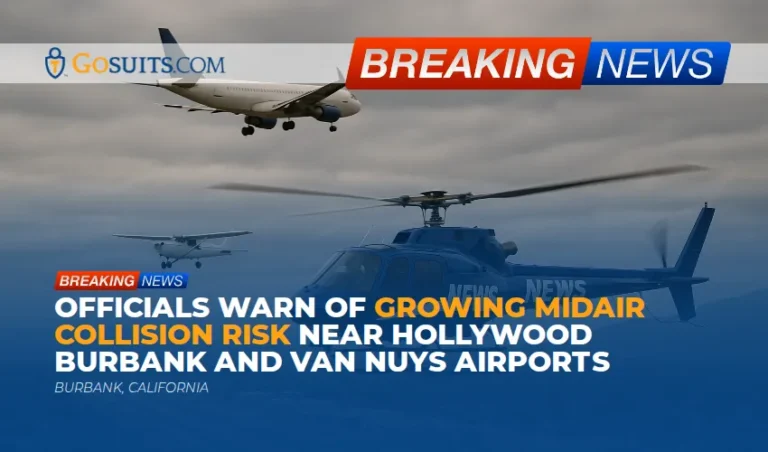
Federal transportation safety officials are sounding the alarm about a growing risk of a midair collision in the skies around Hollywood Burbank Airport. In recent testimony, the National Transportation Safety Board leadership highlighted repeated close calls and a complex, crowded Southern California airspace that funnels many different types of aircraft into a relatively tight area. Nearby Van Nuys Airport, one of the busiest general-aviation hubs in the country, adds to the mix as commercial jets, private fixed-wing aircraft, news and tour helicopters, and law enforcement aircraft frequently share similar altitudes during climbs, descents, and transitions. Safety voices say these warning signs should be treated with urgency before a near miss turns into something worse.
For Burbank travelers who appreciate the airport’s convenience compared with LAX, the headlines are unsettling. The concern, though, isn’t about panic. It’s about making sure known risks are managed using proven measures rather than relying on luck or last-second “see and avoid” maneuvers in crowded skies [1][2].
Why the collision risk feels higher around Burbank and Van Nuys
Anyone who lives along the Chandler Bikeway, near Magnolia Park, or in Sun Valley knows the Burbank sky is busy. The airspace is layered with controlled segments, including Class C around Hollywood Burbank Airport and nearby air traffic corridors serving Van Nuys and the wider Los Angeles basin. Burbank has intersecting runways, and traffic often arrives over the San Fernando Valley and departs toward the Verdugo Mountains or the I-5 corridor. Add in helicopter operations that hop between the foothills, studios in Toluca Lake, and downtown Los Angeles, and you get a web of trajectories that can converge on busy days [7].
Safety agencies have long cautioned that the traditional “see and avoid” principle is limited, especially with high closure speeds, sun angles, blind spots around cockpit structure, and the human eye’s difficulty detecting converging objects without relative motion cues. In dense airspace, those limitations are magnified [1][2]. The result is a higher chance of last-moment evasive action or too-late detection.
What federal agencies have said and done so far
The Federal Aviation Administration has acknowledged the complexity of the Los Angeles basin’s airspace. Recent efforts emphasize data-driven safety work, including better charting of helicopter routes, enhanced traffic awareness tools, and continual refinement of procedures. The FAA also stresses technology adoption, such as the widespread requirement for ADS-B Out equipment in most controlled airspace, which broadcasts an aircraft’s position to improve tracking and deconfliction [4][5][6]. The NTSB, for its part, continues to push for measures that reduce the necessity of last-ditch visual avoidance, urging layered defenses that reduce the chance of conflict in the first place [1].
Even with these initiatives, safety officials argue that more tailored steps may be warranted for specific hot spots. In places like Burbank and Van Nuys, where operations are consistently robust according to FAA traffic databases, the focus typically turns to route design, altitude stratification, controller workload, and pilot awareness programs [10][11].
How near midair collisions are analyzed and prevented

Layered defenses
Midair collision prevention relies on multiple layers that work together, not a single silver bullet:
- Airspace design and procedures: Controllers and procedure designers build altitude and route separations so flows intersect less often and with more predictable timing [7].
- Pilot education and preflight planning: Knowing local routes and hot spots reduces surprises. In the LA basin, that includes studying helicopter routes and special VFR corridors where applicable [6][7].
- Technology aids: ADS-B and traffic displays help pilots detect threats earlier. On airliners and many business aircraft, TCAS provides alerting and resolution advisories to avoid conflicts [5].
- Reporting and data analysis: Voluntary, non-punitive reporting through NASA’s ASRS helps identify trends and precursors so mitigations can be put in place proactively [3].
- Visual scanning techniques: Even with tech, trained scanning remains essential, guided by FAA collision avoidance guidance and safety alerts [1][2].
Why “see and avoid” is not enough in crowded skies
In simple conditions and low-traffic environments, pilots can often detect and avoid other aircraft visually. But research and safety bulletins have documented common failure modes: small angular size of distant aircraft, cockpit blind spots, workload during takeoff and approach, and glare. The NTSB’s message is direct: do not depend on vision alone in complex airspace; use equipment, charts, procedures, and ATC services as part of a comprehensive strategy [1][2].
The local picture: routes, neighborhoods under flight paths, and peak times
On any given weekday morning, you can watch departures arc over the Empire Center, then climb toward the San Gabriels, while arrivals descend over North Hollywood toward Runway 8. Van Nuys funnels business jets and training traffic just a few miles to the west, with helicopters weaving to and from studio lots and police missions. During peak times, controllers at Burbank and Van Nuys manage tight spacing, rapid handoffs, and frequent pilot requests. Sunny afternoons can be especially busy when sightseeing and training intensify.
For residents, the sound of a twin-engine turboprop or a rotorcraft cutting across the Valley is familiar. For pilots, this environment demands careful adherence to assigned altitudes, routes, and readbacks. For passengers, it means trusting a system that depends on both human skill and modern equipment.
If an incident happens: immediate steps for passengers and witnesses
Most flights are uneventful. But if a serious incident occurs in the Burbank area, a few early actions can preserve safety and important information.
- First, check safety and health: Follow crew instructions. If you are on the ground and witness an event, keep a safe distance, call 911, and provide clear location information such as cross streets near the airport perimeter.
- Document what you can: If safe, note the time, aircraft description or tail number, direction of travel, and any sounds or maneuvers that stood out. Save photos or videos you took. Do not trespass on secured airport property.
- Identify other witnesses: Names and contact information can help investigators and families later.
- Preserve travel records: Save boarding passes, itineraries, seat assignments, and any post-incident communications from the airline.
Before speaking with any insurance company, it is wise to consult with an attorney to understand your rights, what must be disclosed, and what can wait. What you say early can be used to question or limit a future claim.
Where to get official records and reports in Los Angeles County
Families and injured passengers often need official documents to understand what happened. In the Burbank area, here is where key records typically originate. Many agencies have public records portals, and most will explain what is publicly releasable and when.

Law enforcement and emergency response
- City of Burbank Police Department: For police incident numbers, 911 logs, and certain reports generated within city jurisdiction. The City maintains a Records Unit and public records request process under the California Public Records Act. Start with the City of Burbank’s official website or call the Records Unit for instructions [11].
- Burbank Fire Department and Airport ARFF: Incident logs, response times, and patient transport records may be available through the fire department’s records process. Coordination with airport emergency services can affect where records are kept.
Medical examiner and autopsy documents
- Los Angeles County Department of Medical Examiner: For decedent identification, coroner’s case status, and autopsy reports when applicable. The Department offers guidance on who can request records, fees, and expected timelines [8].
Aviation-specific reports
- NTSB Aviation Accident Database and Dockets: If an accident meets reporting thresholds, the NTSB will open an investigation. Dockets can include factual reports, witness statements, radar data, and photos. Final reports explain probable cause and contributing factors when the investigation is complete [9].
- FAA records via FOIA: Radar data, air traffic control audio, facility logs, and certain correspondence may be available through the FAA’s FOIA Service Center. Requests should identify the date, time window, aircraft, and the nature of the records sought [8].
- NASA ASRS: While ASRS reports are de-identified and non-punitive, patterns from these voluntary submissions can help illustrate local hot spots or recurring operational challenges [3].
For all of these, expect that some records are held back during active investigations or are redacted to protect sensitive information. Staying patient and organized helps.
Potential civil liability after a midair or near-midair injury event
Every case is unique, and the facts drive who may be responsible in whole or in part. Common civil liability pathways in aviation events include:
- Operator negligence: A commercial carrier or private operator whose pilot deviated from procedures or acted unreasonably under the circumstances.
- Maintenance and inspection errors: If an equipment failure contributed, the maintenance provider or repair station might face scrutiny.
- Air traffic services: In rare situations, claims may be asserted against the United States under the Federal Tort Claims Act for alleged negligence by federal employees. FTCA claims have specific notice and timing requirements and are different from ordinary state claims [12].
- Airport or local public entities: Claims alleging dangerous conditions of public property or operational decisions may require strict compliance with California’s Government Claims requirements before any lawsuit can be filed against a public entity [13].
Aviation cases are complex. The identities of all potentially responsible parties, their insurers, and any government immunities or pre-suit claim requirements should be evaluated early. Many people choose to speak with accident lawyers to understand how responsibility might be allocated among private parties, public entities, and federal agencies.
Insurance issues after an aviation incident
Aviation-related injuries engage a patchwork of insurance policies. Commercial carriers have layered liability coverage and strict internal reporting protocols. Charter operators and private owners carry various liability limits that may differ widely. If a helicopter is involved, the policy terms can differ from fixed-wing policies. For passengers, travel insurance, health insurance, and occasionally uninsured or underinsured motorist coverages may become relevant depending on the facts.
Here is the key: speak with an attorney first before making any recorded statements or signing medical authorizations for an insurance company. Initial statements can be used later to argue that injuries were minor or unrelated. Early medical authorizations can open the door to fishing expeditions into unrelated health history. A brief consultation can help structure communications so necessary information is provided without waiving important protections.
Timelines and deadlines that matter in Southern California
Deadlines in aviation cases are strict and can differ by defendant. Two that matter locally:
- California public entity claims: In many cases against local or regional public entities, a written claim must be filed within a short window before any lawsuit is permitted. Missing this step can bar the claim entirely [13].
- Federal Tort Claims Act: Claims against the United States require formal notice using federal procedures and have their own timelines separate from state court deadlines [12].
If a potential claim involves a local or regional public agency, the timing can be especially unforgiving. For an overview tailored to Los Angeles-area public entity claim timing, see Claims Act Deadline in Los Angeles.
Because timing affects evidence preservation too, this is another reason some families in Burbank talk with counsel early. In busy airspace, ATC tapes, radar data, and surveillance footage can be subject to routine retention policies unless a prompt legal hold or request is made.
Community safety actions and advocacy in and around Burbank
The Valley’s residents care deeply about safety and quality of life. From Magnolia Park to Toluca Lake and along the I-5, people live, work, and play under flight paths. Community-focused steps can help:
- Stay informed about published routes: Pilots and aviators can brief the FAA’s Los Angeles helicopter route charts and VFR procedures to reduce surprises and align expectations [6][7].
- Report near misses responsibly: Pilots can use NASA ASRS for de-identified safety reporting that helps everyone learn and improve [3].
- Support layered safety tech: Adoption and proper use of ADS-B and cockpit traffic displays help shrink the detection gap in crowded skies [5].
- Engage in public meetings: When route changes or procedure updates are proposed, residents and local aviators can give practical feedback based on lived experience in Burbank, North Hollywood, Glendale, and the surrounding neighborhoods.
Why taking organized action early matters
What exactly should be done after an aviation incident? Collect and preserve records, identify responsible agencies, and note deadlines that might impact any civil claim process. Acting early helps in three concrete ways.
- Preserve time-sensitive evidence: ATC audio, radar data, surveillance video, and onboard digital logs can be overwritten or purged under routine retention schedules. Early preservation requests reduce the risk of loss.
- Avoid avoidable missteps: Uncoordinated statements to insurers or investigators can complicate future claims. Sequencing communications with a clear record-keeping plan prevents confusion.
- Protect short deadlines: Government-related claims and certain notice requirements start fast. Understanding which entities are public, private, or federal helps map out the correct process while the window is still open.
When the news cycle moves on, the practical work for affected families is just beginning. Clarity and organization in the first days and weeks can make a long-term difference.

References
- Prevent Midair Collisions: Don’t Depend on Vision Alone – NTSB
- AC 90-48D: Pilots’ Role in Collision Avoidance – FAA
- Aviation Safety Reporting System Overview – NASA
- 14 CFR 91.225 ADS-B Out Equipment and Use – eCFR
- ADS-B: Automatic Dependent Surveillance–Broadcast – FAA NextGen
- Helicopter Route Charts, Los Angeles – FAA
- Aeronautical Information Manual: Airspace and ATC Procedures – FAA
- Los Angeles County Department of Medical Examiner – Los Angeles County
- Aviation Accident Database and Docket Management System – NTSB
- Air Traffic Activity Data System – FAA
- Burbank Police Department, Records and Services – City of Burbank
- Understanding the Federal Tort Claims Act – U.S. DOJ
- California Government Claims Program – CA Department of General Services
Commentary from Gosuits Burbank, California Personal Injury Attorney
Our hearts go out to everyone who feels unsettled reading about the collision concerns over Hollywood Burbank Airport. This article is meant for general information and community awareness. From what is publicly known, the combination of high traffic volumes, mixed aircraft types, and tightly layered airspace near Burbank and Van Nuys can create conditions where one small deviation or delay has outsized consequences. Safety leaders are right to emphasize layered defenses rather than relying solely on pilots seeing one another at the last moment.
In the aftermath of any aviation incident, people often face a confusing web of agencies and insurers. Large companies and insurers know that the first hours and days shape the record. They frequently move fast, and they understand exactly which details help them reduce exposure. Many people do not. That information imbalance can affect evidence preservation, the framing of injuries, and the characterization of what happened.
Speaking with a seasoned advocate early can help level that playing field. It is common for people in this situation to consult accident lawyers before they engage with adjusters. Conversations with insurers should be thoughtful and accurate, and they should not get ahead of medical care or evidence collection. For those who prefer to work with Los Angeles accident lawyers familiar with Southern California airspace, local procedures, and public entity claim rules, that local context can be valuable.
If an incident touches a public agency or the federal government, timelines begin quickly and require specific notices. Even in non-fatal events, injuries can take days to fully declare themselves, and the paper trail around ATC audio, radar data, or airport surveillance may be short-lived without prompt requests. A free consultation is often an efficient way to understand options, organize next steps, and avoid missteps while the facts are still developing.