- What we know about the Melrose Park semi and bicyclist collision
- Where and when it happened and the investigation status
- Why left turns by semis are so dangerous for people on bikes
- Illinois rules that apply to bicyclists and turning drivers
- Commercial trucking and potential civil liability considerations
- Evidence families and witnesses should preserve now
- How to obtain key records in Cook County and Illinois
- Insurance and claims after a fatal truck and bicycle crash
- Local safety context in Melrose Park’s industrial corridors
- Wrongful death basics in Illinois
- Timelines to expect for reports and toxicology
- Why acting now matters
- Commentary from Gosuits Melrose Park, Illinois Personal Injury Attorney
What we know about the Melrose Park semi and bicyclist collision
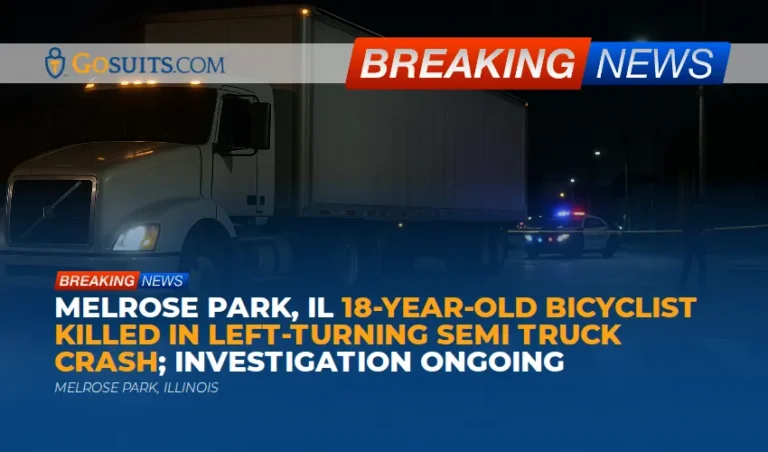
In Melrose Park, a west suburban community just outside Chicago, an 18-year-old bicyclist was fatally struck by a semi truck. Officials and family members stated he had just finished an evening shift and was riding home in the bike lane when an 18 wheeler turning left collided with him. Video from a nearby business captured the moment a tractor trailer turned and hit the bicyclist as he traveled a short distance from his workplace. Police indicated the truck driver reportedly did not see the rider, and attorneys representing the family have filed a wrongful death lawsuit naming the driver, the trucking company, and the company operating the distribution warehouse the driver was entering. Melrose Park police have said the investigation is ongoing and toxicology testing is being conducted. No charges have been announced at this time.
Where and when it happened and the investigation status
The collision occurred last week in Melrose Park, Illinois, as the teen left work near a distribution facility. It was close to 11 p.m., a time when lighting and visibility can add to risk around large commercial vehicles turning into warehouse driveways and loading zones. Police noted they are still investigating and awaiting toxicology results. In fatal crashes, it is common for multiple agencies to be involved in documentation and for various sources of evidence to be gathered, including surveillance video, vehicle data, and witness statements.
Why left turns by semis are so dangerous for people on bikes
Large trucks have extensive blind spots, especially on the left front quarter during turning and near the long trailer sides. The Federal Motor Carrier Safety Administration (FMCSA) stresses that people driving near semis should not assume the truck driver can see them, because of the sizable No Zone areas on all sides of a tractor trailer [1]. When a driver commits to a left turn across a bike lane or across the path of through traffic, several risk factors converge.
Key risk factors at left turns
- Extended blind spots Large cabs and trailers significantly reduce a driver’s ability to see bicyclists riding alongside or approaching from the rear in a bike lane [1].
- Trailer off-tracking A trailer’s rear wheels follow a tighter path than the cab, meaning a bicyclist riding straight in a bike lane can be encroached upon if the cab turns left.
- Nighttime visibility In low light, contrast and sight lines are reduced. Even with reflective gear or lights, a turning truck can mask a rider from view at the critical moment.
- Complex driveways Warehouse entrances often require wide turns and may have signage or landscaping that partially blocks views for both drivers and riders.
These physical and environmental factors, combined with the duty to yield before turning left, are why safety plans in urban industrial areas often emphasize turn restrictions or protective timing for vulnerable road users. Chicago’s own safety initiatives point to the need for engineering and operational strategies to prevent turning conflicts that involve people walking or biking [2].
Illinois rules that apply to bicyclists and turning drivers
Illinois law gives bicyclists the same rights and duties as drivers of vehicles on the roadway, which includes the right to be seen and to proceed straight through in a bike lane unless otherwise directed [3]. Under Illinois traffic law, a driver intending to turn left must yield the right of way to any vehicle approaching from the opposite direction that is so close as to constitute an immediate hazard [4]. Because bicyclists are granted the rights and duties of vehicle operators, a bicyclist proceeding straight in the bike lane can be within the class of traffic to whom a left-turning driver must yield.
Separate from right-of-way rules, commercial drivers have professional obligations to maintain a proper lookout and operate safely in line with federal safety standards. FMCSA educational materials highlight the unique blind spots and wide turns that require extra caution around people walking or biking [1].
Commercial trucking and potential civil liability considerations
Attorneys for the family have filed a civil wrongful death lawsuit naming the truck driver, the owner of the trucking company, and the company operating the distribution warehouse that the driver was entering, according to publicly reported information. We will not speculate about specific liability in this case, but in general, civil claims after a fatal crash can involve several theories depending on the facts and evidence:

Typical civil liability pathways that may be evaluated
- Driver negligence Allegations can include failing to keep a proper lookout, failing to yield during a left turn, or unsafe turning maneuvers when bicyclists are present. Relevant statutory duties often include the general duty to exercise due care and specific duties like yielding before a left turn [4].
- Vicarious liability of the motor carrier If a driver is an employee acting within the scope of employment, the carrier can typically be held responsible for the driver’s negligence under respondeat superior.
- Negligent entrustment or supervision In some cases, claims arise based on hiring, training, or supervision decisions if evidence supports that theory.
- Site operations or traffic control When a crash occurs at or near a business entrance, attorneys sometimes examine driveway design, signage, traffic management, and whether on-site protocols addressed known turning risks for large trucks and vulnerable road users.
Investigation is crucial in any commercial vehicle fatality. That can include identifying and preserving surveillance video, telematics or black box data from the truck, training and dispatch logs, driver hours-of-service records, and site plans. The FMCSA summarizes hours-of-service rules designed to reduce fatigue among commercial drivers, which can become relevant depending on timing and work hours in a particular case [5].
When loved ones and communities are looking for answers, Chicago truck accident lawyers may help families understand how these legal theories apply based on the evidence.
Evidence families and witnesses should preserve now
Preserving evidence early makes a meaningful difference in cases involving large trucks and vulnerable road users. Several items can change or disappear within days. If a family chooses to seek legal guidance, attorneys can send preservation notices and begin gathering materials systematically.
High priority evidence after a fatal truck and bicycle crash
- Nearby surveillance video Car washes, restaurants, gas stations, and warehouse cameras often overwrite footage within days. Document business names and addresses, and request that footage be preserved.
- Dashcams If the truck or nearby vehicles had dashcams, that footage can be critical to turn-path analysis and line-of-sight questions.
- Telematics and EDR Commercial trucks may have electronic data recorders, telematics, and GPS that can show speed, braking, and path. Preserve those sources promptly.
- Scene documentation Photographs of the bike lane, lighting, driveway geometry, skid marks, debris fields, and any temporary signage. Measurements can later support expert reconstructions.
- Witness identities Gather names, phone numbers, and short descriptions of what each person saw or heard.
- Work and schedule records For both the decedent and the truck driver, schedules may be relevant to timing, route, and hours-of-service context [5].
For a structured walk-through of what to collect locally, see our Chicago truck crash evidence checklist.
How to obtain key records in Cook County and Illinois
Several official records become available in the weeks and months after a fatal crash. Exact processes vary by agency, so it helps to track request dates and confirmation numbers.
Police traffic crash report
- Local police report When a municipal department like Melrose Park Police investigates, their Records Division can provide the crash report after it is approved. Policies vary by department, and some require in-person or written requests.
- Illinois State Police reports If the Illinois State Police handled or assisted with the investigation, reports can be requested through the ISP Crash Reports portal [6].
- Content to expect Reports typically include a narrative, diagram, involved parties, citations if any, and listed witnesses. Supplemental reports may follow as evidence is developed.
Medical examiner findings in Cook County
- Cook County Medical Examiner For deaths in Cook County, the Medical Examiner’s Office maintains case records, including autopsy and toxicology when performed. Their Records Unit provides guidance on who may request which documents and expected timelines [7].
- Timelines Toxicology can take several weeks or longer depending on caseload and testing requirements. Families and counsel can check status with the Medical Examiner to understand expected release dates [7].
IDOT crash data and roadway context
- Illinois Crash Facts and Statistics The Illinois Department of Transportation publishes annual crash data that can inform discussions about statewide trends for crashes involving large trucks and bicyclists [8].
When making any records request in Illinois, the state’s public records laws may apply to certain materials. Response times and eligibility can vary, and some records are restricted to next of kin.
Insurance and claims after a fatal truck and bicycle crash
Commercial vehicle cases often involve multiple policies. There may be the truck driver’s liability coverage, the motor carrier’s policy, and potentially policies related to a contracting shipper or a premises owner, depending on the relationships involved. Each policy can contain different reporting requirements and exclusions.
Important early steps
- Consult an attorney before speaking with insurers Any statement to a trucking company or insurer can be recorded and may be used to limit or dispute a claim later. It is generally best to consult an attorney first for a free consultation to understand rights and obligations.
- Preservation and notice Timely preservation letters to the motor carrier and any third parties are critical to protect evidence such as dashcam, EDR, and dispatch records.
- Avoid quick recordings or releases Early offers to resolve claims can come before key evidence or official findings are available. Rushing can affect the ability to fully present liability and damages later.
- Understand the layers of coverage Motor carriers can have primary and excess policies. There may also be cargo or general liability coverages that intersect with roadway claims in limited scenarios.
Families often have questions about who is responsible for funeral costs, wage loss, or support for dependents. Those questions are addressed through the civil claims process using Illinois wrongful death and survival statutes, described below. Before engaging with an opposing insurance carrier, truck accident lawyers can help evaluate the landscape and protect the record.
In serious crashes in the Chicago suburbs, many families also look to Chicago truck accident lawyers who understand how local police agencies, Cook County offices, and regional warehouse operators handle investigations and records.
Local safety context in Melrose Park’s industrial corridors
Melrose Park is a hardworking community with arterial roads and warehouse districts that see heavy truck activity, particularly around corridors feeding into distribution facilities. Evening shift changes and late-night deliveries can produce clusters of left turns into driveways and cross-traffic near bike lanes. Residents know the mix of semi traffic near North Avenue and other industrial routes that connect to rail and interstate corridors.
Chicago’s broader Vision Zero effort emphasizes reducing fatal and serious injuries by focusing on known danger points, including intersections and turning movements near places where people walk or bike [2]. In practice, that can mean protected intersections, improved lighting, better driveway sight lines, and clearer separation of truck entrance paths from bike lanes. While agencies continue building safer infrastructure, professional drivers remain obligated to maintain a proper lookout and yield appropriately.
Wrongful death basics in Illinois
When a life is tragically lost due to another’s alleged negligence, Illinois provides two separate civil frameworks that often work together.
Two complementary civil claims
- Wrongful Death Act Brought for the exclusive benefit of surviving next of kin, addressing losses to the family unit such as loss of support and society, consistent with Illinois law [9].
- Survival Act Allows the decedent’s estate to pursue claims the person could have brought had they lived, including certain damages up to the time of death [10].
Which damages may be recoverable depends on the facts and the evidence, and no two cases are the same. Attorneys typically evaluate economic and noneconomic components, along with any aggravating factors relevant to liability. Families sometimes ask about how long such cases take. Timeframes vary based on the investigation, evidence disputes, and whether litigation is required to obtain necessary records and testimony.
Timelines to expect for reports and toxicology
It is normal for official information to roll out over weeks or months after a fatal crash.
Common timing benchmarks
- Initial police crash report Often available within days to a few weeks, with supplements later as new information arrives.
- Cook County Medical Examiner findings Autopsy and toxicology timelines vary. Toxicology results routinely take several weeks or more depending on testing and volume [7].
- Commercial carrier records Telematics and EDR data exist immediately but may require prompt preservation notices to prevent deletion or overwriting.
- Statewide crash statistics IDOT publishes annual reports that can take many months to compile and release, but are helpful for understanding broader trends [8].
Nationally, NHTSA reports that bicyclist fatalities remain a serious safety issue, with many crashes involving turning conflicts at intersections and driveways. Keeping context in mind helps communities advocate for safe design and operations around busy warehouse districts [6], [11].
Why acting now matters
What to do next
- Organize and preserve Save photos, videos, and any documents that relate to the event or the location. Note the date and time you requested footage from nearby businesses.
- Request records promptly Contact the local police Records Division about the crash report, and the Cook County Medical Examiner about case status. Track dates and request numbers.
- Seek legal guidance before insurer contact Get a free consultation with a seasoned attorney before giving any recorded statement to a trucking company or insurer. Statements can be used to limit claims later.
- Document impacts Keep a log of memorial expenses, travel, time away from work, and family impacts, which can help later in claim evaluation.
Why timing is urgent
- Video overwrites quickly Many security systems overwrite within days. A simple preservation call today can keep crucial evidence available.
- Data can be lost Truck telematics and dispatch data may not be stored indefinitely, especially absent a preservation notice.
- Witness memories fade Early outreach helps ensure accurate recollections of traffic flow, lighting, and turn paths.
- Insurance strategies start early Opposing insurers begin building their files right away. Understanding rights at the outset can avoid missteps that are hard to undo.
Commentary from Gosuits Melrose Park, Illinois Personal Injury Attorney
We are heartbroken for the family, friends, and coworkers mourning this young man. No words can ease the pain of losing someone so full of promise. This article is intended to share general information and education about how investigations and civil claims typically proceed after a fatal truck and bicycle collision.
From what has been publicly reported, this appears to be a classic turning conflict involving a semi and a bicyclist traveling in a bike lane. Professional drivers have to take extra care at left turns near bike facilities and driveways, especially at night. The question in the civil realm is often whether the driver and company met their duties to keep a proper lookout, yield when turning, and operate safely given known blind spots and site conditions. Video and physical evidence around the driveway and lane can be pivotal.
Insurance companies and large corporations are sophisticated. They move quickly to minimize exposure, sometimes taking recorded statements before families understand the process, or presenting early offers while key evidence is still developing. They know what to ask and what to avoid, and they may rely on the lack of public access to commercial records like telematics or internal protocols.
That is why it is so important to speak with a skilled attorney for a free consultation before dealing with insurers. A consultation can help explain rights, outline what evidence to preserve, and discuss how wrongful death and survival laws apply. Even a short conversation early on can prevent missteps that are difficult to undo later.
Resources
- Tips for Driving Safely Near Large Trucks and Buses – FMCSA
- Vision Zero Chicago – City of Chicago
- 625 ILCS 5/11-1502 Bicycles – Illinois General Assembly
- 625 ILCS 5/11-902 Left turns – Illinois General Assembly
- Summary of Hours of Service Regulations – FMCSA
- Crash Reports – Illinois State Police
- Medical Examiner – Cook County Government
- Illinois Crash Facts and Statistics – IDOT
- Illinois Wrongful Death Act 740 ILCS 180 – Illinois General Assembly
- Illinois Survival Act 755 ILCS 5/27-6 – Illinois General Assembly
- Bicyclist Safety – NHTSA