- Why this guide matters right now in California communities
- Immediate steps to take after a bicycle car crash
- Calling 911, police reports, and California reporting rules
- Exchanging information and protecting your words
- Documenting the scene and your bicycle
- Medical care, follow ups, and why timelines matter
- Who to contact for official records in California
- Your rights as a cyclist under California law
- Common causes and potential civil liability
- Insurance claims, recorded statements, and coverage layers
- Preserving evidence that proves what happened
- Local context for Los Angeles riders
- If a loved one was killed: key steps for families
- Deadlines that can affect California claims
- Call to action: practical next steps to take today
- Commentary from Gosuits California Personal Injury Attorney
Why this guide matters right now in California communities
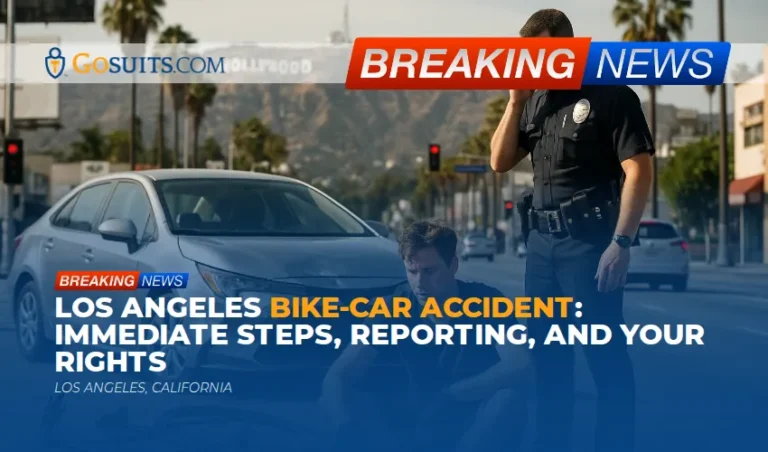
California’s streets and coastal paths are part of our everyday lives, whether you are cutting across the UCLA campus, commuting down Venice Boulevard, or riding the LA River Path on a quiet Saturday morning. When a bicycle and a car collide, the cyclist is exposed to a much higher risk of serious injury. The California Office of Traffic Safety has repeatedly flagged bicyclist safety as a priority, as riders face life changing harm in collisions that drivers walk away from [1]. Nationally, cyclist fatalities have risen in recent years, a trend federal safety data tracks closely [2].
If a bicycle car crash just happened, you may feel overwhelmed. What needs to be reported, and to whom? How do you get the police report, your medical records, or even traffic camera footage? How should you handle insurance calls without being taken advantage of? The sections below offer a step by step roadmap grounded in California law and practical experience.
Immediate steps to take after a bicycle car crash
There is a lot happening in the minutes after a collision. Safety and health come first, and small choices can protect both your wellbeing and your future claim.
- Get to a safer location if you can. If you are in traffic, move to the curb or a median. Ask bystanders for help stopping traffic if you cannot move.
- Call 911 or ask someone nearby to call. Report any injury, even if you think it is minor. Adrenaline can mask pain.
- Do not leave the scene. Wait for law enforcement and medical evaluation unless you must leave for emergency care.
- Limit conversation about fault. You can be polite and exchange information later. Avoid apologizing or guessing what happened.
Calling 911, police reports, and California reporting rules
A documented response matters. In California, accurate reporting supports both public safety and any claim you may pursue later.
- Ask for officers to respond and prepare a traffic collision report. In cities like Los Angeles, that may be LAPD’s Central Traffic Division for downtown or the appropriate regional division where the crash occurred. On highways or in unincorporated areas, CHP will typically respond.
- Know the driver’s legal reporting duties. California Vehicle Code section 20008 requires the driver of a vehicle to report a collision involving injury or death to the CHP or local police within 24 hours [3].
- File the California DMV SR 1 if required. Any party to a collision must file an SR 1 with the DMV within 10 days if anyone was injured or property damage exceeded the statutory threshold. The DMV hosts the SR 1 form and instructions online [4].
If your crash happened along corridors like Sunset Boulevard, Figueroa, or Sepulveda, you might see LAPD or CHP at the scene. If it occurred near the 10 or 405 interchanges, CHP likely handles the report. Either way, make sure the officer notes every visible injury, damage to your bike and gear, and the exact point of impact on the roadway.
Exchanging information and protecting your words
While you wait for law enforcement, exchange information without arguing or speculating.
- Exchange driver and vehicle information. Ask to see the driver’s license, registration, and insurance card. Take photos of each.
- Get contact details for all witnesses. Names, phone numbers, and a brief voice memo of what they saw can be incredibly helpful later.
- Keep your statements factual and brief. Do not discuss fault. Anything you say could appear later in reports or insurance notes.
- Decline any on scene recorded statements. You are not required to give a recorded statement to any insurer at the scene.

Documenting the scene and your bicycle
Your phone is your best tool. Take many photos and short videos from different angles. If you cannot, ask someone to help.
- Photograph the road and surroundings. Include skid marks, debris, lane markings, parked cars, and any construction or obstructions. Document lighting at night and wet pavement after rain.
- Capture the vehicles and your bike. Get close ups of damage, the point of impact, and the final resting positions. Photograph the driver’s car including license plate, bumper, headlights, and mirrors.
- Record traffic controls and visibility. Photograph stop signs, signals, crosswalks, bike lane symbols, curb paint, parked vehicles, and any blocked sightlines.
- Preserve gear and clothing. Do not clean or repair your helmet, gloves, lights, reflectors, or torn clothing. These items are physical evidence of force and direction of impact.
Medical care, follow ups, and why timelines matter
Cyclists often suffer head, neck, shoulder, and lower extremity injuries. Pain can surge hours later. When in doubt, get checked.
- Accept medical evaluation on scene. If paramedics recommend transport, go. If you choose to leave, visit urgent care or your primary care provider as soon as possible.
- Tell providers this was a traffic collision. This ties your diagnosis and treatment to the crash in your medical records.
- Follow up even if you feel “okay.” Concussions, internal injuries, and ligament damage are often delayed in onset.
- Keep a symptom journal. Note headaches, dizziness, sleep disruption, anxiety in traffic, and activity limitations. These details can matter later.
Who to contact for official records in California
Getting the right records early helps you understand what happened and supports your potential claim. Here is where to start in California.
- Police or CHP collision report. Request it from the investigating agency. CHP provides a statewide collision report request process and form CHP 190 [5]. LAPD maintains instructions for requesting traffic collision reports online [6].
- DMV SR 1 confirmation. Keep a copy of your submitted SR 1. If you filed online or by mail, note the date and any confirmation number from the DMV [4].
- Medical records. You have a right to your medical records under federal law, including ER records, imaging, and bills [7].
- Traffic camera or public records. If a city or county agency owns cameras or case notes, you can request records under the California Public Records Act [8].
- Autopsy and coroner records in fatal cases. In Los Angeles County, the Medical Examiner Coroner manages autopsy and investigative records [9]. In San Francisco, records are handled by the Office of the Chief Medical Examiner [10].
Your rights as a cyclist under California law
California law recognizes that people on bikes are roadway users with rights and duties. Understanding a few key rules helps you make sense of how liability is evaluated.
- Same rights and duties as drivers. Bicyclists generally have the same rights and responsibilities as vehicle drivers when riding on the roadway [11].
- Bike lane use and exceptions. When a bike lane is present, cyclists typically should use it, with important exceptions for passing, turning left, avoiding hazards, and when the lane is too narrow to share safely with a vehicle [12].
- Three foot passing requirement. California requires drivers to provide at least three feet when passing a bicyclist under most conditions [13]. For a plain language explainer, see our guide on the California three foot law for cyclists.
- Helmet law for minors. Riders and passengers under 18 must wear a properly fitted and fastened bicycle helmet under state law.
These rules do not exhaust the Vehicle Code, but they are the provisions most commonly discussed in bicycle car collisions. When an insurance adjuster tries to argue you should have hugged the curb or rode in the gutter, remember that California law centers on reasonable and safe roadway use, not arbitrary second guessing of riders.
Common causes and potential civil liability
How do these crashes typically happen in places like Silver Lake, Koreatown, or near the Expo Line? The patterns are familiar, and they guide liability analysis.
- Unsafe passing. A driver crowding a cyclist within three feet, sideswiping or forcing them into a curb or parked cars, conflicts with California’s passing rule [13].
- Left or right hook turns. A driver turning left across a cyclist’s path or making a sudden right turn without yielding to a cyclist proceeding straight in a bike lane.
- Dooring. A car occupant opens a door into a cyclist’s path on streets lined with curbside parking like Melrose Avenue or Abbot Kinney.
- Failure to yield at driveways and alleys. Drivers pulling out from garages or parking lots onto arterial streets like Lincoln Boulevard often focus on vehicle traffic and miss cyclists.
- Speed, distraction, or impairment. These factors magnify risk in every scenario and can support claims of negligence.
- Roadway defects or obscured signage. Potholes, debris, or faded bike lane markings can contribute to a crash. Claims against public entities follow special rules and deadlines [14].
California uses comparative fault. Even if a cyclist is found partially responsible, recovery is typically reduced by that percentage rather than barred outright. Adjusters sometimes overreach on this point, which is one reason careful documentation matters.
Insurance claims, recorded statements, and coverage layers
After a bicycle car accident, insurance carriers mobilize quickly. Know the coverage types that may apply and protect yourself from common pitfalls.
- Liability coverage of the at fault driver. This is the primary source for injury and property damage claims.
- Uninsured and underinsured motorist coverage. Your own auto policy’s UM or UIM coverage can apply even if you were on a bicycle, depending on the policy.
- Medical payments coverage. Med Pay on your auto policy, if available, may pay medical bills regardless of fault.
- Health insurance. Your health plan can help you access treatment while liability is determined. Subrogation may apply later.
If an insurer calls, be respectful and gather their contact details, claim number, and mailing address. Before any recorded statement, contact an attorney first. What you say to an insurance company can be used against you later, and early statements often occur before you know the full medical picture. The California Department of Insurance provides consumer resources and accepts complaints if claims handling seems unfair [15].
Preserving evidence that proves what happened
Evidence fades quickly on Los Angeles streets. Here is how to strengthen your case.
- Secure video promptly. Ask nearby businesses for exterior video. Make a CPRA request to the city or county if a public camera may have captured the crash [8].
- Save your gear. Keep your cracked helmet, bent wheel, broken light mount, and torn clothing in a safe place. Photograph serial numbers and damage.
- Record the healing process. Photograph bruising, stitches, swelling, road rash, and assistive devices like slings or crutches.
- Track expenses and lost time. Keep receipts for repairs, rideshares to appointments, and out of pocket costs. Note missed shifts or gigs.
Local context for Los Angeles riders
Neighborhood context matters in Los Angeles. Crashes spike where bike lanes disappear near freeway ramps, around schools at pickup times, and on popular weekend corridors to Griffith Park and the beach. Expect investigators to consider sightlines at cresting hills on Glendale Boulevard, the timing of protected lefts along Santa Monica Boulevard, and whether bike lane markings were visible along Figueroa after a recent repaving.
If the collision occurred near USC, LAC USC Medical Center is a Level I trauma center, and records from that facility carry considerable clinical detail. On the Westside, care may begin at Ronald Reagan UCLA Medical Center or Santa Monica UCLA. Whether you were commuting through the Arts District, rolling through Echo Park, or crossing near Fairfax High, use the same steps above. Facts, photos, and prompt care look the same across the County of Los Angeles.
If a loved one was killed: key steps for families
When a family member is lost in a bicycle collision, the first priorities are dignity, clarity, and support. This is a hard road, and there is no single right way to walk it.
- Obtain the collision report. Request from LAPD or CHP depending on jurisdiction [5] [6].
- Request coroner records. In Los Angeles County, the Medical Examiner Coroner manages autopsy and investigative records that may answer difficult questions [9].
- Preserve personal effects. Helmets, clothing, and the bicycle can help forensic experts analyze crash forces and directions.
- Consider public records requests. CPRA requests can secure 911 audio, dispatch logs, and traffic camera footage in a timely manner [8].
- Mind deadlines for claims involving public entities. If road design or maintenance played a role, you may need to deliver a government claim within six months [14].
Deadlines that can affect California claims
Deadlines are not suggestions. A missed date can reduce your options or end a claim entirely.
- Personal injury statute of limitations. In California, you generally have two years from the date of injury to file a lawsuit [16].
- Wrongful death statute of limitations. The same two year period typically applies, measured from the date of death [16].
- Government claims. Claims against public entities often require a written claim within six months of the incident [14].
- DMV SR 1. File within 10 days when required by California law [4].
Call to action: practical next steps to take today
– Gather and organize: Put all photos, videos, witness contacts, and receipts in one folder. Keep your helmet, clothing, and damaged bike components untouched.
– Secure official records: Request the police or CHP collision report, obtain your medical records, and submit the DMV SR 1 if required. Early, accurate records reduce disputes later.
– Protect the claim: Decline recorded statements to insurance until you fully understand your injuries and your rights. A careful, informed approach often prevents avoidable mistakes.
– Act within timelines: Mark your calendar for the two year statute of limitations and the six month government claim deadline if a public entity is involved. Early action keeps every option on the table.
– Prioritize care: Continue medical treatment and follow clinician advice. Document progress and setbacks. A consistent medical record reflects the true impact of the crash.
Commentary from Gosuits California Personal Injury Attorney
Our hearts are with riders and families navigating the aftermath of a bicycle car collision. This article is for general information and education, meant to help people in our California communities take steady, confident steps after a crash.
From what we see across Los Angeles County, many cases come down to a driver’s attention, space, and speed. The three foot passing rule is not just a technicality. It recognizes that a moment of crowding can cause a lifetime of harm. When police reports, medical records, and photos line up, accountability follows.
Insurance companies and large corporate defendants understand how to control the flow of information. They may ask for a recorded statement right away, imply that you do not need certain care, or suggest partial fault without seeing all the evidence. These tactics often rely on people not knowing the rules of the road, the reporting requirements, or the timelines.
A free consultation with a seasoned attorney provides clarity. It helps you avoid statements that can be taken out of context and surfaces coverage you might not realize applies, such as UM or Med Pay. Most importantly, it gives you a clear plan so you can focus on healing while the evidence is preserved and the process moves forward.
References
- Bicyclist Safety – California Office of Traffic Safety
- Traffic Safety Facts: Bicyclists and Other Cyclists – NHTSA
- California Vehicle Code § 20008 – Report of Accident to Police or CHP
- Traffic Accident Report SR 1 – California DMV
- Collision Report Request – California Highway Patrol
- Traffic Collision Reports – Los Angeles Police Department
- Your Rights to Access Medical Records – U.S. HHS
- California Public Records Act Overview – California DOJ
- Records and Requests – Los Angeles County Medical Examiner Coroner
- Records Requests – San Francisco Office of the Chief Medical Examiner
- California Vehicle Code § 21200 – Rights and Duties of Bicyclists
- California Vehicle Code § 21208 – Bike Lanes
- California Vehicle Code § 21760 – Three Feet for Safety Act
- California Government Code § 911.2 – Government Claims Presentation Deadline
- Consumer Complaints – California Department of Insurance
- California Code of Civil Procedure § 335.1 – Two Year Statute of Limitations