- What we know about the Long Beach Airport tunnel crash
- Roadway and tunnel context near Lakewood Boulevard and Spring Street
- Early investigative details and what they may mean for civil claims
- Who investigates and why the NTSB may be involved
- What families can do in the first 72 hours
- How to obtain official records in Long Beach and Los Angeles County
- Preserving evidence from vehicles, roadway, and nearby cameras
- Insurance and wrongful death basics in California
- Local contacts and community resources
- Community safety reflections for Long Beach
- Why acting promptly matters after a fatal collision
- Commentary from Gosuits Long Beach, California Personal Injury Attorney
- References
What we know about the Long Beach Airport tunnel crash
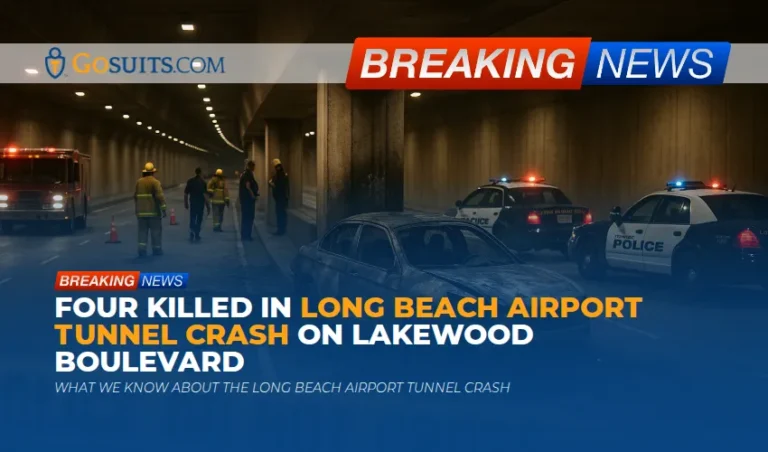
Just after 1 a.m. on Saturday, February 21, 2026, a 2008 Honda Accord traveling south on Lakewood Boulevard from Spring Street struck the center median curb, lost control, hit the underpass center support wall beneath Long Beach Airport, and caught fire. Long Beach Fire Department crews extinguished the flames and rendered aid. One woman was located outside the vehicle but tragically succumbed to her injuries. Three additional occupants were found deceased inside the car. Police have stated that speed and impairment are being investigated as possible factors. Identities are being withheld pending official identification and family notification. The National Transportation Safety Board (NTSB) has publicly noted it is looking into the collision, which is consistent with its role in select major roadway and tunnel events.
This incident took place in the tunnel section of Lakewood Boulevard that passes under Long Beach Airport. Drivers in the area know that stretch well for its quick transition from surface streets to a confined underpass environment. Anyone who witnessed the crash or has information about who was driving has been asked by the Long Beach Police Department to contact the Collision Investigation Detail at 562-570-7355. Anonymous tips may be provided via L.A. Crime Stoppers.
Roadway and tunnel context near Lakewood Boulevard and Spring Street
Local residents in Long Beach’s Lakewood Village and East Long Beach neighborhoods are familiar with the Lakewood Boulevard corridor, particularly around Spring Street and the approach to the airport tunnel. Heading southbound from Spring, there is a median and then a slight descent into the underpass. Visibility in a tunnel changes quickly, and the lane curvature combined with posted speeds can demand extra attention at night when lighting and contrast differ from daytime driving. The roadway configuration also includes center supports that divide the underpass structure. Striking any fixed object at speed can lead to catastrophic energy transfer and, as seen here, the possibility of a post-impact fire.
While the exact causes remain under investigation, it is helpful for the community to understand that even small roadway inputs at higher speeds can produce dramatic yaw or loss of control, especially if a vehicle encounters a curb, uneven surface, or sudden steering correction. NHTSA data consistently show that speeding and impaired driving dramatically increase crash severity and the likelihood of fatalities. See the references for national data overviews on these risk factors [1] [2].
Early investigative details and what they may mean for civil claims
LBPD has stated that speed and impairment are possible factors. For families, that language signals two things. First, police are likely collecting and analyzing physical evidence such as tire marks, vehicle crush profiles, debris fields, and event data recorder information if available. Second, toxicology testing and a timeline of the occupants’ movements before the crash may be part of the inquiry.
In a civil wrongful death or injury claim, findings related to speed or impairment can affect determinations of negligence. California’s “basic speed law” requires drivers to travel at a safe speed for conditions, not just the posted limit, and violating a safety statute may be evidence of negligence in a civil case [3]. If impairment is corroborated by evidence, that can weigh heavily in liability analyses as well. That said, investigations are methodical and can take weeks or months. It is normal for families to have limited information initially, followed by incremental updates from law enforcement or the medical examiner’s office.
One notable detail is that investigators are seeking help to identify the driver. When multiple occupants are in a vehicle and injuries are severe, driver identity is not always immediately clear. This question can be crucial for several reasons, including which auto insurance policy applies, whether permissive use coverage is triggered, and whether other legal theories might be implicated.
Who investigates and why the NTSB may be involved
Local law enforcement typically leads crash reconstruction on city roadways. In Long Beach, the Police Department’s Collision Investigation Detail handles serious and fatal traffic collisions. The NTSB may open an investigation when a crash in a tunnel or other unique context raises broader transportation-safety issues that could inform recommendations nationwide. While the NTSB does not assign civil or criminal liability, its reports often focus on systemic safety improvements, vehicle systems, roadway design, and emergency response factors. The agency’s published process and product types include factual reports, safety recommendations, and, in some cases, public dockets with photographs and technical data [4].
What families can do in the first 72 hours
When a loved one is lost suddenly, the first days are overwhelming. It helps to break the process into manageable steps.
- Confirm official points of contact. Expect outreach from the Los Angeles County Department of Medical Examiner regarding identification and next-of-kin notifications, and from LBPD regarding witness statements or evidence. Write down names, titles, and phone numbers for future reference.
- Start a simple information log. Keep a dated notebook or digital file noting every call, message, or document received. This record is invaluable later when insurance adjusters or agencies ask for timelines.
- Preserve personal devices and accounts. If your loved one used a smartphone, email, or rideshare apps shortly before the incident, that data may help establish timelines. Do not delete messages or reset accounts.
- Hold off on insurance statements until you have guidance. Before providing any recorded statement to an insurance company, consult a seasoned attorney to understand rights and potential pitfalls. What is said early on can be used against claimants later, even if said in grief or confusion.
- Identify potential beneficiaries and heirs. California’s wrongful death and survival statutes govern who can bring claims and what damages may be pursued. A focused conversation with counsel can clarify who should be the point person for communications and forms [5].
How to obtain official records in Long Beach and Los Angeles County
Accurate documentation is the backbone of any civil claim or administrative process after a fatal collision. Here are the core records and how to request them.
Police collision report
LBPD prepares a traffic collision report for fatal crashes. This report may include diagrams, narratives, measurements, and preliminary assessments. Parties of interest, such as next of kin or their legal representatives, can typically request a copy once the report is approved. The Long Beach Police Department provides records request procedures and contact information through its official website and Records Division. Check the Police Department’s public information and records pages for the most current request process and any fees. The department’s main public portal is operated by the City of Long Beach [6].
Medical Examiner records
In Los Angeles County, the Department of Medical Examiner handles decedent identification, examinations, and certification of cause and manner of death. Families can request copies of autopsy reports and related documents directly from the department. Processing times vary based on investigative needs and case volume. Detailed instructions, eligibility, and fee information are available from the department’s official site [7].
Death certificates
Certified copies of death certificates are issued by the Los Angeles County Registrar-Recorder/County Clerk. These documents are often needed for insurance claims, estate matters, and certain benefits. The Registrar-Recorder provides in-person, mail, and online order options, along with identity verification requirements and fee schedules [8].
DMV accident reporting and forms
California requires an SR-1 to be filed with the DMV in collisions that meet certain thresholds. While law enforcement typically handles state-level fatal crash reporting, some related forms or declarations may still be necessary for insurance or vehicle title purposes. The DMV maintains current instructions and forms online [9].
Event Data Recorder and vehicle evidence
Many vehicles contain an Event Data Recorder, which can store crash-related data such as speed, braking, and seatbelt status for a short window around the impact. NHTSA provides technical resources describing EDR functions. Because EDR data can be overwritten or lost, preservation must be requested early and handled by professionals [10].
Preserving evidence from vehicles, roadway, and nearby cameras
Evidence can disappear quickly after a collision, particularly when a vehicle is declared a total loss and moved to storage. Here are practical steps to protect critical information.
- Secure the vehicle immediately. Locate the vehicle’s current storage facility and request that it be placed on a “hold” to prevent disposal or destructive teardown. Written notice is best.
- Request preservation of EDR and airbag control module data. A written preservation letter can help ensure no one powers the vehicle or performs actions that could overwrite data before a proper download.
- Identify nearby cameras and data sources. The Lakewood Boulevard underpass and approaches may be covered by city traffic cameras, nearby business security systems, or airport perimeter cameras. A prompt, targeted request to preserve footage, combined with a public records request where appropriate, can make the difference. California agencies have specific retention schedules, so time is of the essence.
- Document the scene and roadway features. Photograph the median curb, support walls, lighting, signage, and any skid marks or gouge marks as soon as conditions are safe. If official investigators have already documented the scene, supplemental photos can still help illustrate conditions for insurers and, if necessary, a jury.
To organize these steps, consider using a concise checklist approach. Our resource on the Los Angeles wrongful death checklist covers documents and timelines families often face after a loss.
Insurance and wrongful death basics in California
Multiple insurance layers may be involved in a fatal single-vehicle crash. Which policies apply can hinge on who was driving, whether the vehicle was owned or borrowed, and whether any commercial or rideshare context is present. Because LBPD has asked the public for help identifying the driver, coverage analysis may be complex and dependent on permissive use rules under California law.
- Bodily injury liability coverage. This is the policy of the at-fault driver and often the starting point for wrongful death claims. Identifying the correct driver and policy is essential.
- Owner liability and permissive use. California law can hold a vehicle’s owner vicariously responsible for a permissive user’s negligent operation. The specifics and limits are statutory and fact-dependent, and separate negligence theories like negligent entrustment may be considered in some cases.
- Uninsured and underinsured motorist coverage. If coverage is limited or disputed, UM/UIM on a decedent’s or household policy may be relevant. Policy language governs, so request certified policy copies early.
- Wrongful death and survival claims. Wrongful death claims seek losses the family suffers. Survival actions address certain claims the decedent would have had if they had lived, continuing through the estate. California’s statute of limitations for wrongful death is generally two years from the date of death, but specialized claims and exceptions exist [5]. If a dangerous public property condition is alleged, a separate government claim deadline as short as six months may apply [11].
Insurance companies often move quickly to gather statements. Before anyone gives a recorded statement, it is wise to speak with an attorney. Insurance adjusters are trained to ask questions in ways that minimize their exposure. Families should know their rights and the implications of anything placed on the record. Skilled car accident lawyers can help manage communications, identify all available coverage, and protect against premature settlements. In our experience, Los Angeles car accident lawyers are familiar with local roadway conditions, tunnel lighting transitions near LGB, and area traffic patterns overnight, which can be relevant to case framing.
Local contacts and community resources
Here are local points of contact and what they generally provide. Verify hours and procedures before visiting, as policies can change.
- Long Beach Police Department, Collision Investigation Detail. Witness information, collision investigation updates, and traffic collision report availability timelines. Main line for this unit per the public notice: 562-570-7355. General LBPD public information and records policies are maintained on the City of Long Beach website [6].
- Los Angeles County Department of Medical Examiner. Decedent identification, examination, cause and manner of death, and access to official reports for authorized requesters [7].
- Registrar-Recorder/County Clerk, Los Angeles County. Certified copies of death certificates for eligible requesters, with instructions for mail, in-person, or online orders [8].
- California DMV. Collision-related administrative forms and guidance, including the SR-1 report process and insurance verification requirements [9].
Community safety reflections for Long Beach
Long Beach residents drive this corridor daily, from pre-dawn commutes past the Long Beach Exchange shopping district to late returns from flights into LGB. At night, the southbound approach from Spring Street into the underpass requires a quick visual adjustment, and posted speeds can feel deceptively manageable in light traffic. The margin for error shrinks in a tunnel. Striking a median curb at speed can redirect a vehicle into fixed objects within a split second.
City planners and transportation agencies periodically review severe crashes for potential engineering countermeasures. While this investigation is ongoing, communities often discuss measures like improved lighting contrast at tunnel entrances, additional reflective channelizers near medians, or high-friction surface treatments to reduce loss of control. The NTSB’s participation indicates a broader safety lens may be applied here, potentially informing recommendations that extend beyond one city’s boundaries [4].
Residents can also contribute to safety by driving at or below safe speeds for conditions, avoiding impairment of any kind, and staying attentive to lane curvature and sightlines in confined roadway environments. National data repeatedly emphasize how speed and impairment amplify the violence of a crash, turning survivable impacts into tragedies [1] [2].
Why acting promptly matters after a fatal collision
Several timelines begin immediately after a fatal crash. Acting promptly preserves rights and evidence. Here is what should be done and why timing is critical.
- Secure records and evidence now. Police reports, Medical Examiner documents, and vehicle EDR data form the factual backbone of any claim. Early requests reduce the risk of lost data or long backlogs delaying answers.
- Channel communications through informed counsel before speaking to insurers. Insurance adjusters often contact families within days. A free consultation with a lawyer before giving any recorded statement helps ensure nothing is said that could be misconstrued. Statements can be used later, even if made in shock or grief.
- Identify all insurance layers early. Quickly confirming who was driving and which policy or policies apply can determine the path forward. Policy limits, exclusions, and permissive use terms vary and can shape strategy from day one.
- Calendar legal deadlines immediately. California’s wrongful death statute generally allows two years to file a lawsuit, but certain government-related claims can require a formal claim within six months. Missing a deadline can close doors that cannot be reopened [5] [11].
- Document economic and non-economic losses as they unfold. Funeral expenses, lost financial contributions, and the human impact on a family are all part of a potential claim. Keeping organized records right away avoids reconstruction struggles later.
These steps are not about rushing while grieving. They are about protecting options so decisions can be made thoughtfully when the time is right. Speaking with a lawyer early is not a commitment to any course of action. It is an information-gathering step to understand rights and obligations. Families deserve clarity before fielding calls from insurance carriers whose financial incentives may not align with the needs of those left behind. Experienced car accident lawyers can help map out a plan and keep critical timelines on track.
Commentary from Gosuits Long Beach, California Personal Injury Attorney
Our hearts are with the families and friends grieving this devastating loss under the Long Beach Airport tunnel. This overview is intended for education and general information, not as a directive for any specific case. When a crash is this severe and questions remain about speed, impairment, and even who was behind the wheel, it creates deep uncertainty alongside grief.
From a civil-injury perspective, investigators will piece together what happened second by second. The geometry of that underpass, median contact, and fixed-object impact point are all reconstructable. The open question about the driver matters, because insurance coverage and liability assessments turn on who was operating the vehicle and whether they had permission. Families should not be surprised if multiple insurers seek recorded statements quickly.
In our view, insurance companies and large institutions often take advantage of how little most people know about these processes. They ask questions in ways that can minimize payouts, they push for early statements, and sometimes they hint at quick settlements before full facts are known. It is not personal. It is how their systems are designed. That is precisely why learning about rights and options early is so important. What seems like a simple answer in week one can undercut a claim in month six when full reports and data arrive.
A free consultation with a seasoned attorney helps people understand timelines, coverage layers, and how to safely interact with insurers and agencies. It does not obligate anyone to file a claim or lawsuit. It provides a needed map at a time when the road ahead feels uncertain.
References
- Speeding – National Highway Traffic Safety Administration
- Drunk Driving – National Highway Traffic Safety Administration
- California Vehicle Code § 22350 Basic Speed Law – California Legislative Information
- Investigation Process – National Transportation Safety Board
- California Code of Civil Procedure § 335.1 Wrongful Death Limitations Period – California Legislative Information
- Long Beach Police Department – City of Long Beach
- Los Angeles County Department of Medical Examiner
- Death Records – Los Angeles County Registrar-Recorder/County Clerk
- Report of Traffic Accident Occurring in California (SR-1) – California DMV
- Event Data Recorder (EDR) – National Highway Traffic Safety Administration
- California Government Code § 911.2 Claims Presentation Deadline – California Legislative Information