- What we know about the La Jolla multi-vehicle crash
- Where and when it happened
- Community impact, closures, and detours
- Evidence and ongoing investigation
- What families can do now for records and support
- How California law may apply in a multi-vehicle crash
- Rights of injured passengers and families after a fatal crash
- Insurance layers in a six-vehicle collision
- Preserving evidence the right way
- Getting official records in San Diego: police, autopsy, and vital records
- Medical care, trauma care, and community resources
- Safety context for La Jolla corridors and crash data
- What to expect from claims and important timelines
- If an insurer calls: how to protect yourself
- Why acting promptly matters
- Commentary from Gosuits La Jolla, California Personal Injury Attorney
- References
What we know about the La Jolla multi-vehicle crash
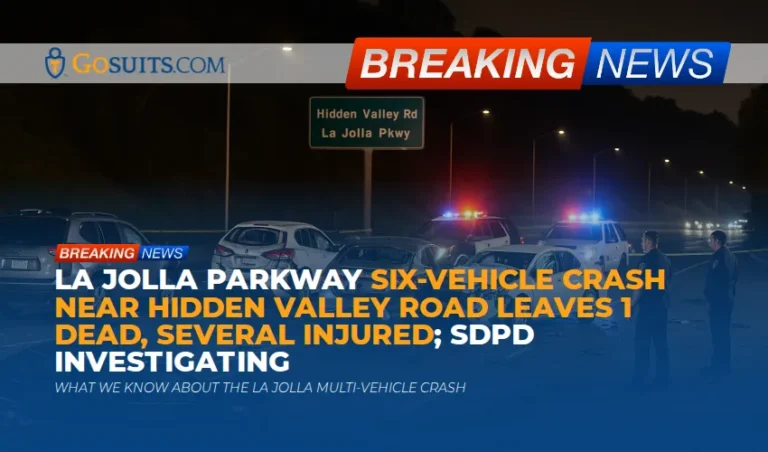
On Thursday night, a six-vehicle collision near La Jolla Parkway and Hidden Valley Road left one man dead and multiple people injured, according to San Diego Police Department statements shared with local media. At the time police briefed the press, investigators had not confirmed the total number of people hurt. SDPD traffic detectives remained on scene into the night to collect physical evidence and speak with witnesses. A Tesla equipped with a video camera was among the vehicles involved, and investigators indicated the footage may assist them in understanding what happened.
This corridor is familiar to local drivers. La Jolla Parkway funnels traffic between Interstate 5 and the village, with Torrey Pines Road carrying a steady flow toward La Jolla Shores, the Cove, and UC San Diego. Crashes in this area can quickly gridlock both commuters and residents running everyday errands or heading to evening events.
Where and when it happened
Police reported the crash occurred around 8:30 p.m. near the intersection of La Jolla Parkway and Hidden Valley Road. That timing lines up with heavier evening movements from I-5 into La Jolla and back toward neighborhoods like Bird Rock, the Muirlands, and La Jolla Shores. Even at night, the Parkway’s downhill grade and merges can demand quick decisions, especially when traffic is fluctuating. The investigation will seek to determine how vehicles interacted in the moments before impact and whether any one driver’s actions triggered a chain reaction.
Community impact, closures, and detours
SDPD announced road closures around Torrey Pines Road and La Jolla Parkway, and urged drivers to avoid the area and use alternate routes. When this corridor is closed, typical detours include:
- I-5 to Gilman Drive to reach UC San Diego, La Jolla Village, and Torrey Pines via North Torrey Pines Road.
- Soledad Mountain Road for access to parts of La Jolla and Pacific Beach, depending on closure points.
- Mission Bay Drive and Grand Avenue if approaching from the south and diverting toward PB before cutting north.
Residents reported delays and reroutes lasting for an extended period while detectives surveyed the scene. If you witnessed the crash or have dashcam footage, SDPD typically asks witnesses to contact the department through its non-emergency channels so detectives can follow up.
Evidence and ongoing investigation
It usually takes time to reconstruct a multi-vehicle collision. Detectives will look at vehicle resting positions, debris fields, tire marks, vehicle damage profiles, and any onboard or third-party video. The presence of a Tesla with a video camera may help, since many models capture data through dashcam or Sentry features. Investigators may also examine electronic data recorders to learn about speed, braking, and steering inputs shortly before impact. Federal regulators have long described how event data recorders function and how they can be used to analyze a collision sequence [8]. California also has rules on who can access a vehicle’s data and the conditions for disclosure [9].
Detectives will cross-check vehicle damage and occupant statements against physical evidence. They may also seek nearby business or traffic cameras. Even small details such as light timing and lane changes can matter in a chain reaction event. While the investigation proceeds, officials often withhold certain facts until they can confirm them.
What families can do now for records and support
When a crash results in serious injury or death, families often need timely records to understand what happened and to manage next steps. Early actions often include:
- Requesting the police traffic collision report, once it is available. The San Diego Police Department provides information on obtaining reports through its records services [1].
- Contacting the San Diego County Medical Examiner for confirmation of identity, cause and manner of death, and to learn about the process for autopsy and final reports [2].
- Obtaining certified death certificates through the County Assessor/Recorder/County Clerk once available [3].
- Understanding state reporting requirements, such as the DMV’s SR-1 accident report requirement and driver reporting obligations under the Vehicle Code [4] [5].
- Exploring victim support resources, including California’s Victim Compensation program, which can assist eligible families with certain crime-related losses, including funeral expenses when applicable to the case type [15].
If you plan to make any insurance claim, it is wise to speak with a qualified attorney first. What you say to an insurer early on can be recorded and used to question or minimize a claim later.

How California law may apply in a multi-vehicle crash
In a six-vehicle crash, fault can be straightforward or highly complex. California uses comparative fault principles. That means each driver’s share of responsibility can be evaluated and assigned percentages. The Judicial Council’s civil jury instructions address how juries consider comparative negligence in determining damages [6]. In practice, investigators and, later, insurers and litigants may assess a range of factors, including whether one driver set off a chain reaction by following too closely, speeding, or making a sudden unsafe maneuver.
Public entities can sometimes be implicated in traffic collisions, for example when a claim argues that signals, signage, or roadway design contributed to the danger. Those cases are exceptionally fact specific. California’s Government Claims Act requires a written claim to be filed within a short window, typically six months, before a lawsuit can move forward against a public entity [7]. Families considering anything involving a government entity should consult counsel promptly to avoid missing deadlines. There are also defenses and immunities that may apply to public entities, which further underscores the need for timely legal guidance.
Rights of injured passengers and families after a fatal crash
Passengers are rarely at fault for a crash, and they usually have the right to bring claims against the drivers or entities whose negligence contributed to their injuries. This can include the driver of the vehicle they were riding in and drivers of other vehicles whose actions helped cause the crash. In a multi-vehicle event, that often means multiple liability insurance policies may be in play. Coordination is important so claims do not conflict and to ensure all potential sources of recovery are identified.
When a crash results in a fatality, certain family members may have the right to bring a wrongful death claim, and the decedent’s estate may have a survival action for claims the decedent could have pursued had they survived. The timeline for filing is limited by statute, so it is important to understand deadlines early. California’s general statute of limitations for wrongful death is found in the Code of Civil Procedure [13], subject to exceptions and special rules. Guidance from seasoned counsel can help families navigate eligibility, damages categories, and timing considerations without guesswork.
Insurance layers in a six-vehicle collision
Multi-vehicle crashes often involve overlapping coverages, including each driver’s bodily injury liability, uninsured or underinsured motorist coverage, and potentially umbrella policies. If a rideshare or commercial vehicle is involved, different policy limits and carrier rules may apply. Claims can also raise issues about sequence of payouts and how multiple policies coordinate. This is one reason people often seek out car accident lawyers to help map out coverage and avoid missteps that delay or reduce recovery.
Because six vehicles were involved here, it is common to see multiple insurers contact witnesses and injured people quickly. Before speaking with any carrier, consider consulting an attorney. Insurers may request recorded statements. Those statements can be used to challenge your account if minor details shift later. For a practical overview of how policy layers can line up in multi-car crashes, see Which Insurance Pays First After a Multi Car Crash.
Preserving evidence the right way
Physical and digital evidence can fade fast. Steps that often help include:
- Photographs and video of vehicle damage, interior damage, roadway markings, fluid spills, and the surrounding scene taken as soon as safely possible.
- Witness information, including names and contact details for anyone who saw the crash or the moments leading up to it.
- Vehicle data and dashcams, especially if any vehicle had operating dashcam or onboard recording. NHTSA describes the value of event data recorders for crash analysis [8], and California law addresses access rights to this data [9].
- Official records such as the police traffic collision report and, in fatal cases, Medical Examiner documentation [1] [2].
If there is any possibility a public entity’s records could be relevant, a California Public Records Act request to the City of San Diego can be a tool to obtain certain non-privileged records, like signal timing plans or maintenance logs, where appropriate [12]. An attorney can help target and preserve the right evidence without compromising your position.
Getting official records in San Diego: police, autopsy, and vital records
San Diego Police Department traffic collision report
SDPD’s Records Division explains how to request reports, who can request them, and what identification is required. Availability depends on the status of the investigation, and sensitive information may be redacted for privacy or investigative reasons [1]. If CHP handled the scene instead of SDPD, the California Highway Patrol provides a statewide process to request a CHP collision report using the CHP 190 form [14].
San Diego County Medical Examiner
In a fatal crash, the Medical Examiner identifies the decedent, determines cause and manner of death, and maintains related records. The office provides guidance on how families and authorized parties may obtain reports when they become available [2].
Death certificates through the County
Certified copies of death certificates are typically obtained through the County Assessor/Recorder/County Clerk once the record is registered. The County provides instructions and eligibility information online [3].
State accident reporting requirements
California requires drivers to report certain crashes to the DMV using Form SR-1 within 10 days if there is injury, death, or property damage above a set threshold. The DMV describes when the report is required and how to submit it [4]. The Vehicle Code also requires drivers to report fatal crashes to law enforcement within 24 hours in specific circumstances [5].
Medical care, trauma care, and community resources
La Jolla and the surrounding region are served by major hospitals, including UC San Diego Health facilities. UC San Diego Medical Center operates the region’s Level I Trauma Center for adults, with established trauma protocols for serious injuries [11]. In multi-vehicle collisions, patients with significant trauma are often triaged to Level I facilities while others may be routed to nearby hospitals depending on injury severity, capacity, and proximity.
Families coping with sudden loss or serious injury often benefit from both clinical and practical support. California’s Victim Compensation Board offers resources and potential financial assistance for eligible victims of certain violent incidents, including help with funeral and burial costs in qualifying cases [15]. County behavioral health services also maintain crisis and counseling resources that can be accessed through county channels.
Safety context for La Jolla corridors and crash data
Torrey Pines Road, La Jolla Parkway, and the nearby freeway connectors see steady traffic from commuters, students, and visitors heading to La Jolla Shores, the Village, Scripps, and UC San Diego. Downhill grades, merge areas, and variable speeds can combine to reduce reaction time if something unexpected happens ahead.
At the state level, the California Office of Traffic Safety maintains city-by-city collision rankings and trend data using the statewide collision database. Those resources help communities and planners identify where speed, impairment, or other risk factors are contributing to collisions and injuries [10]. While statewide rankings cannot resolve fault in any one crash, they reflect broader safety challenges on busy corridors like La Jolla Parkway where high volumes and mixed traffic create sudden hazards.
What to expect from claims and important timelines
After a crash of this scale, insurers begin their work quickly. Adjusters may reach out within days. The claims process typically includes recorded statements, document requests, medical authorizations, and vehicle inspections. It is common for multiple carriers to monitor a single file when several drivers are involved. Coordinating care and documents can become a full-time task, especially when injuries are significant.
California’s statute of limitations for wrongful death is set by the Code of Civil Procedure [13]. For claims against a public entity, the Government Claims Act requires a written claim within six months in most injury or wrongful death scenarios before a civil action can proceed [7]. These timelines can vary based on the facts. Missing them can bar a claim entirely. That is one reason people often consult La Jolla car accident lawyers early, even before they speak to an insurance company.
If an insurer calls: how to protect yourself
It is understandable to want to cooperate fully and quickly. Still, a few careful steps can prevent avoidable problems later:
- Talk to an attorney first before giving any recorded statement. Adjusters are trained to ask questions that may narrow or minimize a claim. Once recorded, those statements rarely disappear.
- Keep information factual and limited if you must speak before you can consult counsel. Do not speculate about fault, speeds, or causes.
- Do not sign broad authorizations without review. Some forms allow carriers to access unrelated medical history that can be used to dispute injuries.
- Document everything, including the names of adjusters, claim numbers, and summaries of each call.
People often retain car accident lawyers to coordinate communications across multiple insurers, set ground rules for statements, and ensure that evidence and medical records are shared in a way that helps rather than hurts their case.

Why acting promptly matters
When a serious crash occurs, time affects everything. Physical evidence can be cleaned up. Skid marks and roadway debris disappear. Vehicles are repaired or totaled and sold. Digital data on a car or dashcam can be overwritten. Witnesses’ memories fade quickly. Hospitals move from emergency care to discharge and bills begin to arrive. In parallel, insurers start building their files.
Acting promptly helps ensure preservation of the facts. It also creates a clean record of medical care, which is vital for documenting injuries. Finally, it gives you time to understand and meet legal deadlines, whether that means a standard statute of limitations or an accelerated claim notice to a public entity. In cases with multiple vehicles, the sooner someone is coordinating the moving parts, the less likely it is that a key piece of evidence will be missed or a preventable delay will occur.
Commentary from Gosuits La Jolla, California Personal Injury Attorney
Our hearts are with everyone affected by the crash near La Jolla Parkway and Hidden Valley Road. Losing a community member and seeing several people injured in a sudden, violent event is devastating. This commentary is shared for educational purposes and general information, and it is not a substitute for guidance on any specific situation.
Six-vehicle collisions are often complex. One unsafe act can ripple through a busy corridor, and in a downhill, high-volume area like the Parkway, reaction windows are short. Investigators will likely piece together a chain of events from physical evidence, witness statements, and any available video, including potential dashcam or onboard vehicle footage. Right now, patience and careful evidence preservation matter.
Insurance companies and large corporations know that the first hours and days after a catastrophic crash are disorienting. Adjusters may appear helpful, but their questions, authorizations, and early settlement discussions can be used to limit responsibility. Seemingly innocent statements get parsed later. Medical history requests can be broader than necessary. When multiple insurers are involved, each one may try to shift blame or delay until another carrier pays first.
A free consultation can level the playing field by helping people understand coverage layers, deadlines, and the immediate steps to protect evidence. It also allows families to make informed choices before speaking with an insurer. No one should have to navigate the aftermath of a fatal or multi-injury crash without clear information.
References
- Requesting Police Reports – City of San Diego, Police Department
- Medical Examiner – County of San Diego
- Assessor/Recorder/County Clerk Vital Records – County of San Diego
- Accident Reporting Requirements – California DMV
- California Vehicle Code Section 20008 – California Legislative Information
- Judicial Council of California Civil Jury Instructions (Comparative Fault) – courts.ca.gov
- Government Code Section 911.2 (Claims Presentation Deadline) – California Legislative Information
- Event Data Recorders – National Highway Traffic Safety Administration
- California Vehicle Code Section 9951 (EDR and Data Access) – California Legislative Information
- Collision Rankings and Data – California Office of Traffic Safety
- Trauma and Burn Center – UC San Diego Health
- California Public Records Act Requests – City of San Diego
- Code of Civil Procedure Section 335.1 (Two-Year Limitations) – California Legislative Information
- CHP 190 Collision Report Request – California Highway Patrol
- Victim Services and Compensation – California Victim Compensation Board