- What we know about the Kings County three-vehicle crash
- Location and roadway context north of Hanford
- Initial legal and safety takeaways from a personal injury perspective
- How multi-vehicle insurance coverage often works after a crash
- Evidence preservation steps families can start right away
- Where to obtain official records in Kings County
- California wrongful death and injury claim timelines
- Medical considerations after rollovers and ejections
- Community context and recurring roadway risks near Hanford
- What witnesses and nearby residents can do
- Practical next steps after a fatal or serious crash
- Why timely action matters now
- References
- Commentary from Gosuits Hanford, California Personal Injury Attorney
What we know about the Kings County three-vehicle crash
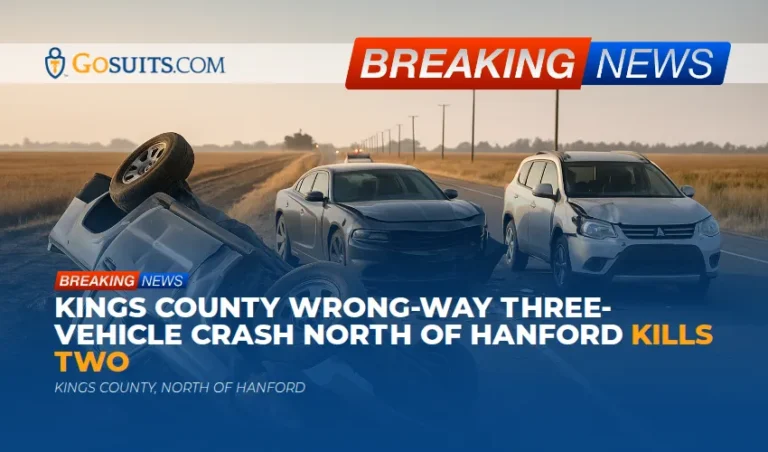
On Wednesday, in rural Kings County just north of Hanford, two people were killed in a three-vehicle collision at 12 3/4 Avenue, south of Douglas Avenue. According to the California Highway Patrol, a man driving a 2022 Dodge Charger was traveling north in the southbound lane at a high rate of speed. At the same time, a man in a GMC was driving directly to the right of the Charger, while a woman in a Mitsubishi was traveling southbound toward the Charger. CHP says the Dodge turned right into the GMC, then struck the Mitsubishi. The GMC and Dodge were pushed into a nearby dirt field, and the GMC overturned. The GMC’s driver and one passenger died at the scene, while a second passenger was transported to a regional trauma hospital with moderate injuries. CHP reported the Dodge and Mitsubishi drivers suffered minor to no injuries. The investigation remains open.
In the Central Valley, families, neighbors, and first responders feel tragedies like this deeply. The location, the time of day, and the mix of rural two-lane roads can all inform how investigators reconstruct events and, later, how insurance carriers evaluate liability. As more facts come in, it is common for collision reports to be supplemented with scene diagrams, measurements, and witness statements that help clarify fault allocation.
Location and roadway context north of Hanford
The intersection area around 12 3/4 Avenue and Douglas Avenue sits amid agricultural lands north of Hanford and west of Highway 43. Many residents know these as long, straight rural corridors with intermittent cross streets, irrigation ditches, and soft shoulders. They look quiet, but speeds can be high, and the absence of lighting or heavy traffic controls can reduce reaction time. Even in broad daylight, an unexpected vehicle traveling in the wrong lane can leave drivers in an impossible position with only seconds to respond.
Local drivers also know that in certain seasons the Central Valley can experience sudden visibility changes from dust or Tule fog. While there is no indication that visibility played a role here, this backdrop underscores why deputies and CHP officers often emphasize reduced speeds and lane discipline on county roads. On straight stretches with limited visual cues, any departure from the correct lane or safe speed can have outsize consequences.
Initial legal and safety takeaways from a personal injury perspective
Investigators cited two facts that often carry significant legal weight in California: the reported travel in the wrong lane and a high rate of speed. California’s Vehicle Code requires drivers to travel on the right half of the roadway except in limited, carefully defined circumstances. Traveling against the proper flow can be strong evidence of negligence in a civil injury or wrongful death case [3]. Separately, California’s Basic Speed Law requires that drivers never exceed a speed that is reasonable and prudent for conditions, regardless of the posted limit [2]. When a crash sequence includes lane violations and unsafe speed, those facts frequently shape insurers’ evaluations of fault.
Wrong-way travel and high-energy impacts also correlate with severe injuries. National transportation authorities have long warned about the lethality of wrong-way events, which disproportionately produce fatal outcomes compared to typical crashes [8]. Rollovers and ejections, both reported here, further raise injury severity. Federal safety data shows that wearing a seat belt greatly reduces the risk of death and ejection in rollovers; belts cut the risk of fatal injury by nearly half for front-seat occupants in passenger cars and significantly reduce ejection likelihood [4]. While individual circumstances vary, these safety principles are central to both prevention and later reconstruction.
Families commonly turn to car accident lawyers to help them interpret collision reports, witness statements, and vehicle data as these investigations develop. Skilled civil attorneys also coordinate with experts when needed to review scene measurements and damage profiles.
How multi-vehicle insurance coverage often works after a crash
Three-vehicle collisions raise immediate questions. Which insurer pays first? How are bodily injury and wrongful death claims prioritized if policy limits are limited? In California, each driver’s liability coverage becomes relevant if they are found partially or fully at fault. When one driver appears primarily at fault, claimants typically pursue that driver’s liability policy first. If multiple drivers share responsibility, each carrier may contribute in proportion to fault.
Another practical wrinkle is medical coverage while fault is sorted out. Some households carry Medical Payments coverage, some do not. Health insurers may initially pay, then assert reimbursement claims if there is a third-party recovery later. For vehicles with multiple occupants, per-person and per-occurrence policy limits can become a central constraint, and stacking benefits is generally not permitted unless very specific conditions are met under policy or statute.
For a deeper plain-language primer on how insurers sequence payouts after crashes involving more than two vehicles, this guide may help: Which insurance pays first after a multi car crash.
Because statements to insurers can be used later, it is generally wise for people to consult with an attorney before giving recorded statements or detailed narratives to adjusters. Many residents in the region choose Hanford car accident lawyers to help them understand rights and obligations early, especially when multiple policies and serious injuries are in play.

Evidence preservation steps families can start right away
High-energy collisions often generate valuable electronic and physical evidence that fades quickly. Here are priority items to preserve while CHP finalizes its report:
- Vehicle event data recorder information. Many modern vehicles store data about speed, braking, throttle, and seat belt status. Families or their representatives can send preservation letters asking owners, towing yards, and insurers not to alter or crush vehicles until data is downloaded. Federal guidance explains how event data recorders work and the types of data they may capture [9].
- Scene photographs and measurements. Early photos of tire marks, gouges, debris fields, fence or field damage, and final rest positions often help reconstruct angles and speeds. Even simple smartphone photos can be crucial if taken promptly and safely.
- Third-party video. Check for nearby ranch or home security cameras, crop processing facilities, dairies, or intersections with cameras. In rural Kings County, private cameras sometimes face the roadway. Request copies quickly; many systems overwrite within days.
- Witness information. Collect names, phone numbers, and any notes from people who saw pre-impact driving behavior or heard statements at the scene.
- Medical documentation. Keep discharge summaries, imaging reports, and provider notes. These records help link injuries to the crash and inform potential future care plans.
Where to obtain official records in Kings County
California Highway Patrol collision report
For collisions on county roads, CHP typically leads the investigation and prepares the Traffic Collision Report. Families can request the report by submitting Form CHP 190 with proper identification and proof of involvement or interest. Requests can be mailed, submitted in person to the appropriate Area Office, or requested online where available [1]. To identify the correct office, use CHP’s Find an Office directory, then contact the Hanford Area Office for instructions on report availability and fees [11].
It is common for diagram supplements, photographs, and witness statements to be available after the initial narrative is finalized. If those materials are important for civil claims, ask how to request them specifically when speaking with the Area Office.
Coroner and autopsy reports
In Kings County, the Coroner’s responsibilities are handled through the Sheriff’s Office. Next of kin can typically request autopsy and coroner investigative reports after the examination is complete and the case is cleared for release. Expect identity verification and, in some cases, modest fees for copies. Coroner records often include cause and manner of death findings that are important in wrongful death cases and for life insurance processing. If you are unsure whether the report is ready, call the Sheriff Coroner unit and ask for the case status by date and location.

Death certificates
Certified death certificates are usually issued by the Kings County Clerk-Recorder. When time is of the essence for estate or insurance matters, families sometimes also request through the California Department of Public Health’s Vital Records, which provides statewide guidance on eligibility, identification, and application methods [10].
California wrongful death and injury claim timelines
California’s wrongful death statute describes who may bring a civil action when a death is caused by the wrongful act or neglect of another. In general, eligible parties include the deceased person’s survivors and, in some situations, those who were financially dependent. The statute sets out categories of claimants and how claims may be structured [6]. Separate from who may sue is the deadline to file: for most negligence-based wrongful death and injury cases in California, the statute of limitations is two years from the date of injury or death [7]. Different deadlines can apply if a public entity is involved or if a minor is a claimant.
These timelines are strict. Preserving claims also means preserving evidence and identifying all potentially responsible parties, which in a three-vehicle sequence can include one or more drivers and, in limited cases, non-driver entities depending on the facts. While this article offers general information, each situation is unique, and early case evaluation often affects the quality of evidence available later.
Medical considerations after rollovers and ejections
First responders transported one GMC passenger with moderate injuries to a regional trauma center. In our area, Community Regional Medical Center in Fresno operates as a designated level I adult trauma center for the Central Valley, providing comprehensive trauma services and specialist coverage around the clock [5]. That level of care can be vital for high-energy, multi-impact collisions like rollovers, where injuries may include traumatic brain injury, spinal trauma, thoracoabdominal injuries, or complex fractures.
From a recovery and documentation standpoint, families can help their loved ones by keeping track of imaging, consult notes, and referrals. If symptoms evolve after discharge, prompt follow-up is essential. Ejection and rollover survivors sometimes develop delayed issues such as concussion-related cognitive symptoms, internal injuries that worsen, or psychological distress. Federal highway safety research consistently emphasizes that seat belts reduce ejection and serious injury risk, even at rural speeds [4].
Community context and recurring roadway risks near Hanford
Residents of Hanford, Armona, and the surrounding dairies and orchards know that rural road grids can feel deceptively simple. Long straightaways invite speed. Farm traffic and cross-traffic can surprise motorists near intersections like 12 3/4 Avenue and Douglas Avenue. When one driver crosses into opposing lanes, closing speeds multiply instantly, and escape paths are limited by ditches, soft shoulders, and crop fields. National safety investigators have repeatedly identified wrong-way driving as uniquely hazardous, especially when combined with speed [8].
Local public safety campaigns often focus on fundamentals: stay to the right, slow down well before intersections, and scan far ahead on unlit or minimally controlled roads. Those basics do not eliminate risk, but they buy time when another motorist behaves unpredictably.
What witnesses and nearby residents can do
If you saw pre-impact driving behavior, heard statements at the scene, or have cameras that face the roadway, your information can be essential to families and investigators. Consider these steps:
- Contact CHP promptly. Call the Hanford Area Office and reference the date, approximate time, and the crossroads. Ask how to provide a statement or footage so it becomes part of the official file [11].
- Save recordings. Do not edit or rename files in a way that changes timestamps. Copy the entire segment that includes pre-impact, impact, and post-impact moments. If your system overwrites quickly, export to a USB drive as soon as possible.
- Write down what you recall. Simple notes about lane positions, vehicle colors, speeds, and any evasive maneuvers help anchor your memory later.
Practical next steps after a fatal or serious crash
The first days are overwhelming. It helps to break tasks into manageable steps and focus on what protects health, preserves evidence, and prevents avoidable claim problems down the line:
- Prioritize medical care. Even if an injured person was discharged, new or worsening symptoms should be evaluated. Keep all discharge papers and imaging CDs.
- Request the CHP report. Submit Form CHP 190 and ask the Hanford Area Office about supplements like photographs and diagrams once they are available [1][11].
- Secure vehicles and data. If a family-owned vehicle is at a storage lot, ask for it to be held without alteration until event data can be preserved [9].
- Start a document file. Save medical bills, funeral or memorial expenses, wage loss notes from employers, and all correspondence from insurers.
- Be cautious with insurance statements. Before giving recorded statements or signing medical releases, it is generally prudent to speak with an attorney. What someone says to an adjuster can be used against them later.
- Consider bereavement and community support. Local faith communities, neighborhood groups, and regional resources in Kings County can help with practical needs in the first weeks.
Many households turn to car accident lawyers for help coordinating these steps and communicating with multiple insurers, particularly when there are fatalities and several vehicles involved.
Why timely action matters now
Crashes like this leave behind a short window to collect time-sensitive proof. Physical marks on the roadway fade quickly. Towing and storage companies often move vehicles within days, and some will dispose of them if storage fees go unpaid. Private security systems frequently overwrite footage in as little as 24 to 72 hours. Waiting can mean key facts are lost forever.
There is also a legal clock. California’s general two-year window for negligence-based injury and wrongful death claims sounds generous, but substantial work happens long before any filing. Liability investigations, identification of all insurers, policy-limit inquiries, medical documentation, and dependent support calculations can take months [6][7]. Acting early preserves options and helps reduce the chance of rushed, incomplete claims later.
Finally, clear communication can reduce disputes. Coordinating with a single point of contact, keeping a consistent file of bills and records, and documenting all insurer communications gives families better footing if disagreements arise about fault, coverage, or damages. In our region, many people find that early conversations with Hanford car accident lawyers or other seasoned advocates make the later process less chaotic and more transparent.

References
- CHP 190 Request for Collision Report – California Highway Patrol
- Laws and Rules of the Road, including Basic Speed Law – California DMV
- Vehicle Code Section 21650, Driving on Right Side of Roadway – California Legislature
- Seat Belts: Get the Facts – National Highway Traffic Safety Administration
- Designated Trauma Centers in California – California EMS Authority
- Code of Civil Procedure 377.60, Wrongful Death – California Legislature
- Code of Civil Procedure 335.1, Two-Year Statute for Personal Injury/Wrongful Death – California Legislature
- Wrong-Way Driving: Special Investigation Report – National Transportation Safety Board
- Event Data Recorder Information for Manufacturers and the Public – NHTSA
- Vital Records, including Death Certificates – California Department of Public Health
- Find an Office – California Highway Patrol
Commentary from Gosuits Hanford, California Personal Injury Attorney
Our hearts go out to everyone affected by this tragedy north of Hanford. Losing loved ones on familiar county roads is a pain no family should face. The discussion above is intended as general information to help the community understand what happens after a serious collision and how key records and timelines work in California.
From the facts reported, investigators will be focusing on lane position, speed, impact sequence, and what each driver could reasonably see and do in the moments before contact. A vehicle reported traveling in the wrong lane at a high rate of speed is a red flag in civil fault analysis, and rollover with ejection underscores how violent the dynamics were. As the CHP collision report, scene photos, and any event data are compiled, a clearer picture should emerge.
In our experience, insurance companies and, at times, corporate stakeholders use early uncertainty to their advantage. Adjusters may contact families quickly, asking for recorded statements or broad medical authorizations. Those conversations can seem routine, but small word choices are sometimes used later to limit recovery or shift blame. Liability carriers may also delay policy limits disclosures or segment claims in multi-vehicle events, which creates pressure to settle without the full picture. Knowing the order of coverage, the significance of per-person and per-occurrence limits, and how to preserve vehicle data can shift that balance back toward fairness.
That is why it is important for people to understand the option of a free consultation. Knowledge of the process, timelines, and evidence can help prevent irreversible missteps. A brief conversation with a seasoned advocate before engaging with insurance carriers can clarify next steps, reduce stress, and protect the ability to make informed decisions as the CHP investigation continues.