- What happened on Illinois Route 1 near Paris
- The location and traffic context in Edgar County
- Who responds and how crash scenes are managed on state routes
- How to obtain official records after a serious crash
- Common civil liability questions after car and semi-truck collisions
- Insurance issues unique to semi-truck crashes in Illinois
- Data snapshot and why rural highways matter
- Practical next steps following a serious crash
- Where to turn locally in Edgar County
- How fault, evidence, and timelines work in Illinois injury and wrongful death cases
- Commentary from Gosuits Paris, Illinois Personal Injury Attorney
- Time-sensitive steps to protect legal rights after a serious crash
What happened on Illinois Route 1 near Paris
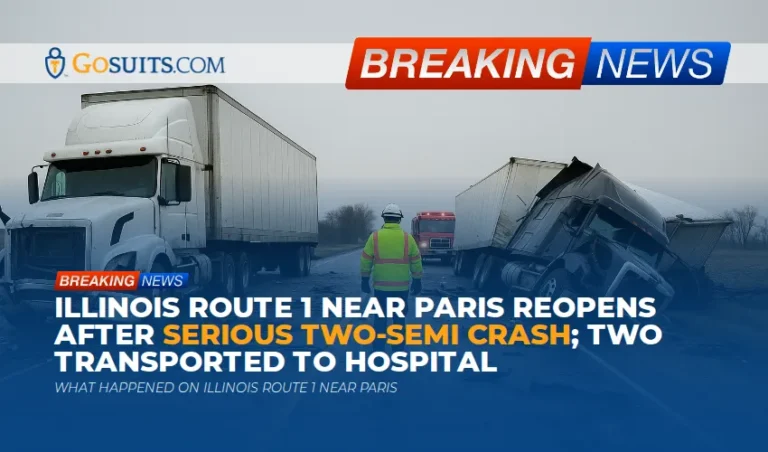
On a cold Friday morning, Illinois Route 1 just south of the Paris city limits was shut down after a serious three-vehicle collision near East 400th Road. According to initial information shared publicly by local officials, the crash happened around 7 a.m. and involved two semi-trucks and a passenger vehicle. Two people were transported to a hospital. Their conditions had not been made public at the time of the roadway closure and subsequent reopening. The Paris Fire Chief urged drivers to avoid the area and noted the severity of the incident, and the Illinois State Police indicated the roadway would remain closed for several hours to accommodate the response. By approximately 12:16 p.m., authorities reported both lanes of Illinois Route 1 had reopened.
When roads like Route 1 shut down in Edgar County, it affects not only through-traffic but also families trying to commute to work in town, students headed toward Paris high school, and farm operations moving equipment. Closures in this stretch south of the city can push drivers onto county roads that aren’t designed for higher volumes, which is why responders often ask the public to stay clear until they can make the scene safe.
The location and traffic context in Edgar County
Illinois Route 1 is a key north-south corridor through Edgar County, carrying a mix of local traffic, farm vehicles, and heavy commercial trucks. The area near East 400th Road sits just outside the Paris city limits, where rural spacing and fewer intersections can mean higher travel speeds. In winter, early-morning visibility and colder pavement can add challenges. Locals know this stretch well, from runs out to the grain elevators to trips between Paris and communities to the south.
Because of the way freight moves across east-central Illinois, it’s common to see tandem trailers and tractor-trailers along Route 1 at all hours. That’s the nature of a corridor that connects farms, manufacturing, and distribution hubs. When a crash involves two semis and a passenger car, traffic impacts can escalate quickly, especially if responders need to bring in heavy wreckers or conduct a detailed reconstruction.
Who responds and how crash scenes are managed on state routes
On state routes in Edgar County, the Illinois State Police typically lead the investigation, with local fire and EMS handling rescue, patient care, and scene safety. Traffic control and incident clearance often follow established statewide Traffic Incident Management practices to reduce secondary collisions and protect responders. IDOT collaborates when signage, detours, or specialized equipment are needed during an extended closure. For more on Illinois’ Traffic Incident Management approach, see the Illinois Department of Transportation’s information page at IDOT Travel Information.
Depending on the severity, investigators may mark and measure the roadway, document vehicle positions and damage, download electronic control module or event data recorder information when available, and interview witnesses. These steps take time, but they’re critical for accurate reporting. That’s why closures often last several hours after serious events like the one south of Paris.
How to obtain official records after a serious crash

Police crash report
The official police crash report is the foundation for insurance claims and civil case evaluations. For crashes investigated by the Illinois State Police, you can request the report through the statewide portal at isp.illinois.gov/CrashReports. Reports typically become available after the investigation is processed. You’ll need details like the date and location of the crash and the names of involved parties if known.
911 calls and dispatch logs
Audio and dispatch records can help clarify response times and scene conditions. In Illinois, many public records can be requested under the Freedom of Information Act. The Illinois Attorney General provides guidance on how FOIA works and how to file a request at illinoisattorneygeneral.gov/foia. Some sensitive materials may be withheld or redacted by law.
Coroner and autopsy reports
If a crash results in a fatality, the county coroner’s office handles the death investigation and, when authorized by law, performs or oversees an autopsy. The coroner’s office can explain what records exist and how next of kin may request copies. For certified death certificates, the Illinois Department of Public Health directs families to Vital Records. See IDPH’s death records page at dph.illinois.gov/topics-services/birth-death-other-records/death-records.html.
Road closure and incident logs
IDOT maintains travel information resources for closures and conditions. While real-time tools are often used during an incident, post-incident needs typically focus on the crash report and any supplementary documentation from investigative agencies. For authoritative travel and roadway safety information, start at IDOT’s Travel Information.
Commercial motor carrier records
When semi-trucks are involved, certain records may exist within the trucking company’s systems, such as driver qualification files, maintenance records, hours-of-service logs, and electronic logging data. Federal rules on hours of service and recordkeeping are overseen by the Federal Motor Carrier Safety Administration. A summary of those rules is available at fmcsa.dot.gov. Public safety data and research related to large truck crashes are compiled in FMCSA’s Large Truck and Bus Crash Facts series at fmcsa.dot.gov.
These trucking records are not typically released informally. Preserving and obtaining them usually requires formal legal steps. Speaking with a seasoned attorney before contacting any insurer can help ensure critical evidence is preserved through timely written requests.

Common civil liability questions after car and semi-truck collisions
Serious collisions involving a passenger vehicle and one or more tractor-trailers raise complex questions. People often ask who could be responsible and how that’s determined in Illinois. While every case is unique, investigations usually examine several potential factors.
- Driver conduct Whether any driver was speeding, failed to yield, made an improper lane change, followed too closely, or drove while fatigued or distracted.
- Commercial carrier responsibility In truck cases, the motor carrier may be responsible under principles like vicarious liability. Investigations may review driver training, dispatch pressures, hours-of-service compliance, and vehicle maintenance.
- Vehicle condition Brake systems, tires, lighting, load securement, and overall maintenance can matter greatly with heavy vehicles.
- Roadway and environment Sight lines, signage, weather, and work zones can play a role.
- Third parties Shippers, brokers, or maintenance contractors could be relevant depending on the facts.
It’s important not to leap to conclusions when the public record is still developing. In a detailed collision analysis, professionals look for more than one cause because roadway events are often a chain of decisions and conditions, not a single mistake.
Insurance issues unique to semi-truck crashes in Illinois
Truck and passenger vehicle claims operate differently. Interstate motor carriers are subject to federal financial responsibility rules, and many carry layered coverage. A federal MCS-90 endorsement may be part of a carrier’s policy. FMCSA’s financial responsibility rules and safety regulations are discussed across the agency’s resources at fmcsa.dot.gov.
From a practical standpoint, there may be multiple insurers involved: the truck’s liability carrier, a cargo insurer, a trailer owner’s insurer, and personal auto carriers for non-commercial vehicles. With multiple adjusters in the mix, recorded statements or casual remarks can be misunderstood or used out of context. Before contacting any insurance company, it’s wise to speak with an attorney in a free consultation to understand rights and obligations. What someone says to an insurer can be used against them later.
Illinois applies a comparative negligence framework to injury cases. Under Illinois statute, recovery can be reduced by a person’s percentage of fault and barred if their responsibility exceeds a certain threshold. See Illinois’ comparative fault statute at 735 ILCS 5/2-1116. An early, careful assessment of facts can prevent claims mistakes that unintentionally shift fault onto the injured.
Data snapshot and why rural highways matter
Serious truck and passenger vehicle collisions are not limited to interstates. In fact, national and state-level research frequently shows a significant share of severe large-truck crashes occur on rural roads, where higher speed limits, limited lighting, and longer emergency response times can raise risks. Illinois agencies publish crash summaries and safety materials that help communities understand patterns. For statewide roadway data resources, see IDOT’s Illinois roadway safety information at idot.illinois.gov, and for national truck and bus crash trends, FMCSA’s data series at fmcsa.dot.gov.
The stretch south of Paris, where Route 1 narrows to a typical rural profile, is familiar to anyone driving to farms or job sites before sunrise. On roads like this, even a minor misjudgment in spacing can become catastrophic when heavy trucks are involved because stopping distances are longer and maneuvering is limited. That’s why investigators take their time, and why community patience during a closure helps responders do the job safely.
Practical next steps following a serious crash
In the hours and days after a significant collision, it’s normal to feel overwhelmed. A few focused steps can help people protect their health and their rights while the facts come into focus.
- Prioritize medical care Follow through with emergency care and recommended follow-up. Keep every discharge summary, imaging result, and prescription record.
- Collect and store documents Save towing receipts, vehicle condition photos, repair estimates, and any communication from insurers.
- Preserve evidence If safe and available, photograph the vehicles, the crash scene, skid marks, and cargo markings. Keep damaged items that may demonstrate force or mechanism of injury.
- Limit statements Decline recorded statements to insurance companies until after you’ve spoken with an attorney in a free consultation. What’s said early can be taken out of context later.
- Track lost work Document missed shifts and wage impacts with employer notes or pay stubs.
- Note witnesses Write down names, phone numbers, and what each person recalls, even if you think police already collected it.
- Request the crash report When available, obtain the Illinois State Police crash report at isp.illinois.gov/CrashReports.
Where to turn locally in Edgar County
When an incident happens just outside Paris, people often need information from several agencies, sometimes quickly. Here are the typical points of contact and how they help.
- Illinois State Police The lead investigative agency on state routes. Request official crash reports at isp.illinois.gov/CrashReports.
- Paris Fire Department Often first on scene for rescue and hazards. They can explain general response timelines and safety measures from a community standpoint after public updates are released.
- Edgar County Sheriff’s Office May assist with traffic control and coordinated response in the county.
- Edgar County Coroner’s Office Handles death investigations, if any. The office can advise next of kin about processes for autopsy reports and timelines under Illinois law.
- IDOT For travel and roadway safety information during larger incidents, see IDOT Travel Information.
- Illinois Department of Public Health, Vital Records For certified death certificates requested by eligible family members, visit dph.illinois.gov.
- Hospitals serving Paris and surrounding communities Local hospitals can assist with medical records requests once patients or authorized representatives sign the appropriate releases.
If additional documents are needed, Illinois’ FOIA guidance explains how to frame and submit public records requests appropriately. See the Illinois Attorney General’s FOIA page at illinoisattorneygeneral.gov/foia.
How fault, evidence, and timelines work in Illinois injury and wrongful death cases
Illinois civil cases turn on facts and evidence, so preserving information early makes a difference. Here’s what that often looks like in heavy-vehicle collisions.
- Preservation letters A timely written request can ask involved parties to preserve relevant records like dash camera footage, electronic logging device data, driver qualification files, bills of lading, dispatch notes, and maintenance records. This is especially important where semis are involved.
- Event data and electronics Passenger vehicles may have event data recorders. Commercial tractor-trailers may have engine control modules and separate telematics. Access typically requires cooperation or formal legal steps.
- Comparative fault framework Illinois reduces recoverable damages by a person’s percentage of responsibility and bars recovery if responsibility exceeds a statutory threshold. See 735 ILCS 5/2-1116 for the statewide standard.
- Wrongful death basics If a crash leads to a fatality, Illinois law provides a civil cause of action for certain survivors, governed by the Wrongful Death Act. See 740 ILCS 180.
- Statutes of limitation Many Illinois injury and wrongful death claims must be filed within two years, but exceptions exist. Claims against certain public entities often have shorter deadlines. For example, the Local Governmental and Governmental Employees Tort Immunity Act sets a one-year limit for civil actions against local public entities, subject to specific conditions. See 745 ILCS 10/8-101. Precise timelines depend on the facts.
Each of these points is shared for general awareness. Before speaking with any insurance company, it’s prudent to schedule a free consultation with a skilled attorney to understand the specific deadlines and preservation steps that may apply to a given situation.
Commentary from Gosuits Paris, Illinois Personal Injury Attorney
We’re thinking about everyone affected by the serious crash on Illinois Route 1 south of town. When an ordinary morning turns into hours of uncertainty and road closures, it shakes a community like Paris. Please know that what follows is meant for education and general information.
From what’s publicly known, the collision involved two semis and a passenger car during the early commute window, with at least two people transported for medical care. On rural corridors like Route 1, the mix of commercial trucks and local traffic can leave very little margin for error. In cases like this, a thorough investigation typically looks at driver actions, equipment condition, dispatch and scheduling pressures, and any environmental factors that shaped visibility or reaction time.
In our experience, insurance companies and large corporations often move quickly after a crash. Adjusters may ask to record statements or push early settlements before the full picture is clear. They understand how complex truck cases can be and how confusing the process feels to families. That’s why they reach out early. Without guidance, people can unknowingly say something that shifts fault their way or agree to terms that don’t reflect long-term medical needs.
A free consultation is a simple way to understand rights before making decisions. It helps ensure critical evidence is preserved, medical follow-up is documented, and communications with multiple insurers are handled carefully. Even if someone ultimately chooses to manage things without a lawyer, that early conversation can surface the key issues and timelines.

Time-sensitive steps to protect legal rights after a serious crash
Here is what should be done promptly, why timing matters, and what outcome taking action can support.
- Obtain the police crash report when available The official report anchors insurance claims and guides next steps. Request it through the Illinois State Police portal as soon as it’s released. Doing this early helps align medical records and repair estimates with the facts in the report.
- Secure medical evaluation and follow-up Timely diagnosis creates a clear record of injuries, which insurers will scrutinize. Delays can be used to argue a condition is unrelated or less serious. Prompt care supports better health outcomes and a clearer claim record.
- Preserve vehicle and electronic data Truck and car electronic systems can overwrite data quickly. Sending preservation notices early helps keep vital evidence available for analysis. The benefit is simple: more complete facts and fewer credibility disputes later.
- Collect and organize documentation Keep all receipts, photos, wage loss notes, and communications. Organized records reduce delays in claim handling and cut down on back-and-forth that can stall progress.
- Speak with an attorney before talking to any insurer Insurance representatives may seem helpful, but early statements can be used against the person later. A free consultation first ensures an informed approach, particularly in multi-insurer truck cases.
- Be mindful of deadlines Illinois law sets strict time limits, and some claims involving public entities are shorter. Acting now helps avoid unintentional waiver of rights due to missed timelines.
Acting promptly is about control and clarity. The sooner the essential items above are in motion, the better the chance of avoiding avoidable disputes, protecting key evidence, and making informed decisions based on a complete picture rather than rushed assumptions.
Authoritative resources referenced
- Illinois State Police Crash Reports
- Illinois Department of Transportation Travel Information
- IDOT Illinois Roadway Crash Data resources
- Illinois Attorney General FOIA guidance
- Illinois Department of Public Health Vital Records, Death Records
- FMCSA Hours of Service overview
- FMCSA Large Truck and Bus Crash Facts
- Illinois Comparative Negligence statute, 735 ILCS 5/2-1116
- Illinois Wrongful Death Act, 740 ILCS 180
- Tort Immunity Act limitations, 745 ILCS 10/8-101