- What we know about the I-5 Vista Del Lago collision
- Local context around Vista Del Lago and Pyramid Lake
- How multi-vehicle freeway crashes are investigated
- Where to get official records and updates
- Rights and options after a freeway crash in California
- How fault is evaluated in multi-vehicle collisions
- Evidence families can help preserve right now
- Local support and services in the Santa Clarita Valley
- Data and safety trends relevant to I-5 collisions
- What to know before talking with insurance companies
- Commentary from Gosuits Los Angeles County, California Personal Injury Attorney
- What to do next: a practical call-to-action checklist
- Government and academic sources cited
What we know about the I-5 Vista Del Lago collision
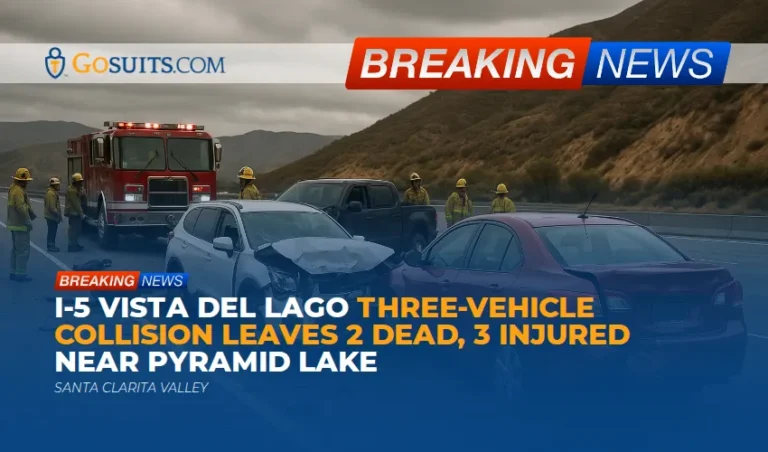
On Thursday, December 25, 2025, a three-vehicle collision on the southbound lanes of Interstate 5 near Vista Del Lago resulted in two fatalities and three people with minor injuries. According to the Los Angeles County Fire Department, first responders were dispatched at 2:56 p.m. and arrived approximately 22 minutes later. Of the eight people involved, two were pronounced deceased at the scene, three had no injuries, and three sustained minor injuries and were transported for medical care. As of roughly 3:45 p.m., 17 Fire Department personnel remained on scene as part of an incident response designated the “Gold Incident.” Further official details had not been released at the time of publication.
This stretch of I-5 is familiar to residents who drive between Castaic, Pyramid Lake, and over the Grapevine toward Kern County. It is a busy corridor for holiday travel and commercial traffic. The incident occurred in the southbound direction, near the Vista Del Lago Road area overlooking Pyramid Lake.
Local context around Vista Del Lago and Pyramid Lake
Neighbors in the Santa Clarita Valley know how quickly conditions can change near Vista Del Lago. The freeway curves and grades north of Castaic Reservoir and around Pyramid Lake often see sudden slowdowns, high speeds, and heavy traffic mixing cars, SUVs, RVs, and commercial vehicles. During winter and holiday weeks, the combination of increased travel volume and variable weather can complicate visibility and stopping distances. The Tejon Pass and Grapevine section just north of this location is also prone to wind, rain, occasional snow at higher elevations, and chain-control closures further up the slope. Caltrans and the California Highway Patrol routinely caution drivers in this corridor to slow down, increase following distance, and watch for stalled or disabled vehicles.
While the cause of this three-vehicle collision has not been publicly reported, multi-vehicle freeway crashes in this area often involve a sequence of rapid braking, lane changes to avoid slowed traffic, and short headways that do not leave adequate room to stop. Heavy traffic mid-afternoon on a holiday can amplify those risks. The specific contributing factors in this collision will be determined by investigating agencies.
How multi-vehicle freeway crashes are investigated
In Los Angeles County, freeway collisions on I-5 are typically investigated by the California Highway Patrol with support from the Los Angeles County Fire Department and other responding agencies. Here is what usually happens in a multi-vehicle incident like this:
Initial response and scene safety
Fire and EMS establish incident command, stabilize vehicles, triage patients, and coordinate medical transport. CHP secures lanes, documents vehicle resting positions, and manages traffic control. Tow and cleanup operations follow once life safety tasks are complete.
Evidence collection
Officers typically document skid or yaw marks, debris fields, and road surface conditions. They gather statements from drivers, passengers, and witnesses. If available, dashcam or nearby traffic camera footage may be sought. Vehicles may be inspected for mechanical issues and damage profiles to help reconstruct the sequence of impacts.
Collision report and determinations
CHP prepares a collision report that notes involved parties, insurance information, any preliminary fault factors, and whether violations are suspected. In fatal incidents, the Los Angeles County Department of Medical Examiner handles identification and cause and manner of death determinations, separate from collision fault analysis.

Where to get official records and updates
If families and community members need official documentation after a freeway collision in Los Angeles County, these are the primary sources and how to reach them. Use official government portals whenever possible to ensure accuracy and to protect privacy.
CHP collision report
CHP collision reports are requested using the CHP 190 form. Eligible requestors include involved parties, their legal representatives, and certain insurance carriers.
CHP 190 Collision Report Request form
To locate the appropriate CHP Area Office for I-5 near Vista Del Lago, check the statewide office directory and reference the date, time, and location provided above.
Los Angeles County Medical Examiner records
In fatal incidents, the Medical Examiner releases official findings including cause and manner of death once examinations are complete and next of kin notification has occurred. Families can request records directly through the county portal.
LA County Medical Examiner Records Requests
Certified death certificates
Certified copies of death certificates are issued through California’s Vital Records. Funeral homes can assist with ordering, or families can request directly from the state.
California Department of Public Health Vital Records
Road closures and traffic updates
To verify closures, hazards, or post-incident congestion in real time, Caltrans QuickMap provides live lane status, CHP incident icons, and camera feeds on major corridors including I-5 through the Santa Clarita Valley.
Rights and options after a freeway crash in California
When a serious collision causes injuries or a tragic loss of life, California law allows injured people and certain family members of those who passed away to pursue civil claims for damages arising from negligence. Every case is fact-specific, but the general framework for these claims includes the following.
Personal injury and wrongful death framework
Those hurt in a crash may bring claims for medical expenses, lost earnings, and other legally recognized damages. Surviving family members may bring wrongful death claims under California law, typically by a spouse, domestic partner, children, or other eligible heirs as defined in statute.
For educational reference, see the wrongful death statute at the California Legislature’s website.
California Code of Civil Procedure section 377.60

Statutes of limitation
California generally requires that personal injury and wrongful death claims be filed within two years of the incident date, with different or shorter timelines if a public entity is a defendant or for certain claims. Time limits can be complex, and exceptions may apply depending on the parties and facts. A reference to the two-year limitation appears in California’s code.
California Code of Civil Procedure section 335.1
If a public entity is involved, administrative claims usually must be filed within six months before a lawsuit can be pursued. See the Government Claims Act timing requirement.
Insurance considerations
California uses a liability fault system for traffic collisions. That means the insurer of an at-fault driver generally pays covered losses up to policy limits. Injured people may also have claims under their own policies, such as medical payments or uninsured and underinsured motorist coverages. Speaking with insurers involves recorded statements and forms that can affect later claims. It is prudent to consult with counsel first to understand rights and obligations before giving any statements.
For those seeking guidance, seasoned personal injury lawyers review coverage, evaluate potential third-party liability, and help prepare claims submissions and documentation. Families considering a fatality-related claim can learn about options from wrongful death lawyers. When collisions involve serious injury, many turn to car accident lawyers to organize evidence and communications with insurers.
How fault is evaluated in multi-vehicle collisions
Establishing fault in a three-vehicle crash on a high-speed corridor like I-5 is detail-driven. Investigators typically analyze the sequence of impacts, lane positions, and physical evidence. Here are common elements considered.
Following distance and speed
Rear-end impact patterns and stopping distances are closely examined in heavy traffic scenarios. If a chain reaction occurs, officers will look for who first failed to maintain a safe following distance, whether abrupt speed changes occurred, and whether any driver was traveling too fast for conditions.
Lane changes and signaling
Sudden lane shifts without clearance can spark multi-vehicle sideswipes or force hard braking behind. Witness statements and mirror or side panel damage can indicate lane-change dynamics.
Road and visibility conditions
Surface traction, rain, glare, or debris can play roles in loss of control or delayed reaction times. Roadway factors may mitigate or aggravate fault depending on what a reasonably careful driver would have done under similar conditions.
Comparative fault in California
California applies comparative negligence, so fault can be shared among multiple drivers. A plaintiff’s recovery can be reduced by their own percentage of fault, if any, based on the evidence. The allocation is ultimately a factual determination, often informed by collision reconstruction and the documented record.
Evidence families can help preserve right now
Preserving evidence early often makes a meaningful difference. Individuals may not control the entire scene, but they can take practical steps that protect information for later review.
- Keep all photographs and videos taken at or near the scene, including vehicle positions, license plates, skid marks, debris, and roadway condition. Save original files with timestamps.
- Record witness information such as names, phone numbers, and a short summary of what they observed. Even a few lines can help investigators follow up later.
- Secure vehicle data and damage by avoiding repairs or disposal until an inspection can occur. Modern vehicles store event data that may be relevant. An attorney can help send preservation letters to insurers and tow yards.
- Save medical records and bills from first responders, emergency departments, and follow-up care. Keep discharge summaries and imaging reports together in one folder.
- Retain communications including texts, emails, and claim correspondence with insurers. Document every call with date, time, and the name of the representative.
- Gather proof of income and expenses such as pay stubs and receipts for transportation, childcare, or other collision-related costs.
- Consult a lawyer before insurer interviews to understand what is required and how statements might affect later negotiations. What someone says to an insurer can be used against them.
Local support and services in the Santa Clarita Valley
In the aftermath of a fatal freeway crash, practical support and accurate information matter. Local institutions that serve the Santa Clarita community include:
- CHP Newhall Area oversees a significant portion of I-5 through the SCV region. The Area Office can provide guidance on collision report requests and release of vehicles once cleared. Use the statewide office directory to confirm jurisdiction for Vista Del Lago and to obtain contact details. Find a CHP Area Office
- Los Angeles County Medical Examiner handles next-of-kin notifications and official determinations in fatal incidents. Families can check status and request records through the county portal. LA County Medical Examiner Records
- California Victim Compensation Board may assist eligible victims and surviving family members with certain crime-related expenses. While most traffic crashes are not crimes, CalVCB provides general information on eligibility and application steps for qualifying events. California Victim Compensation Board
- Mental health support is available through Los Angeles County Department of Mental Health, including hotlines and referrals for grief counseling. LA County DMH Get Help Now
- Traffic updates via Caltrans QuickMap help families and commuters route around closures and understand why delays persist during investigations and cleanup. QuickMap
Locals often look to neighborhood landmarks like Castaic Junction, the Vista Del Lago Visitor Center, and the Pyramid Lake overlook to orient where an incident occurred. Monitoring updates from CHP and Caltrans can clarify when lanes are expected to reopen.
Data and safety trends relevant to I-5 collisions
Holiday periods bring higher traffic volumes and often higher serious-injury crash counts on major corridors. While it is too early to connect any broader trend to this specific incident, state and national data offer helpful context.
- California fatality trends show that speed, impaired driving, and failure to yield remain prominent factors. The California Office of Traffic Safety publishes annual data and dashboards summarizing statewide trends. See the statistics page for overview figures. OTS Statistics
- National multi-vehicle crash dynamics on high-speed interstates often involve short headways and abrupt deceleration. Federal analyses stress that even small increases in speed significantly lengthen stopping distance and crash energy. NHTSA provides ongoing research and updates on fatality estimates. NHTSA
- Real-time freeway management in California uses lane closures and traffic breaks to protect scenes and allow investigations. Caltrans and CHP coordinate to minimize secondary crashes that can occur when approaching drivers do not anticipate stopped traffic. Caltrans
For drivers who routinely commute between Valencia, Stevenson Ranch, and over the hill toward Lebec and Fort Tejon, the data reinforces what local experience already suggests: add space, reduce speed during congestion or inclement weather, and scan well ahead on curves near Vista Del Lago where traffic often bunches unexpectedly.
What to know before talking with insurance companies
Insurance carriers gather information quickly after a crash, and they may ask for recorded statements or authorizations early in the process. While cooperating with claim obligations is important, it is also important to understand the implications of each step.
- Recorded statements can shape how liability is evaluated. People sometimes guess about speeds or distances in the moment, and those guesses can be treated as admissions later. It is reasonable to wait to give a statement until after speaking with an attorney.
- Medical authorizations should be reviewed before signing. Overbroad forms can allow fishing expeditions into unrelated medical history that insurers use to dispute causation.
- Property damage vs. injury claims are often handled by different adjusters. Settling the property damage portion quickly does not require settling the injury portion at the same time.
- Document everything in a claim diary. Note claim numbers, adjuster names, promised call-backs, and any deadlines provided.
Before any insurer interview, it is wise to consult a lawyer. Early guidance can prevent misunderstandings and help position a claim for fair evaluation. People seeking legal help with negotiations often look to personal injury lawyers or car accident lawyers for counsel on timelines, medical documentation, and settlement procedures. In fatal incidents, families often consult wrongful death attorneys to understand which family members may have claims and how the damages are defined under California law.

Commentary from Gosuits Los Angeles County, California Personal Injury Attorney
Our hearts are with everyone affected by the Vista Del Lago collision. Two lives were lost, and many more were jolted by the violence and suddenness of a multi-vehicle crash. This article is offered for educational purposes and general information. It is not a substitute for personalized guidance.
From a civil-injury standpoint, multi-car freeway crashes are among the most fact-intensive matters we see. The chain of events can unfold in seconds, but responsibility is not always obvious at first glance. Determining who had the duty to yield, who followed too closely, or whether an unsafe lane change set everything in motion requires careful reconstruction and complete documentation. That is why obtaining the CHP collision report, preserving vehicle data, and gathering witness accounts early is so important.
Insurance companies and large corporations know that most people have never navigated a serious-injury or fatal crash claim. They also know the first few weeks are when memories are fresh and when injured people are still overwhelmed with medical appointments, funeral arrangements, and work disruptions. Adjusters sometimes push for quick statements or encourage early settlements that do not account for future medical needs or the full measure of loss. Knowledge gaps are often exploited in these moments. Having a seasoned advocate involved early levels the playing field, helps prevent critical mistakes, and ensures deadlines are not missed.
There is real value in a free consultation. It gives families and injured people a chance to ask questions, understand timelines, and map out immediate next steps without any commitment. Even a short conversation can clarify which records to request, what communications to avoid, and how to protect claims while focusing on healing and grief.
What to do next: a practical call-to-action checklist
The following steps help protect safety, preserve evidence, and maintain eligibility for claims. Acting with intention and documenting each step can make later processes more manageable.
- Request official records by submitting the CHP 190 form for the collision report and, if applicable, contacting the Los Angeles County Medical Examiner for records once available. Keeping copies organized from the start saves time later.
- Preserve vehicles and property by avoiding unauthorized repairs or disposal until inspections are complete. Notify any tow yard or storage facility in writing that the vehicle must be preserved pending claims review.
- Centralize medical documentation including EMS run sheets, hospital records, pharmacy receipts, and referral notes. Create a single folder and update it after every visit.
- Avoid recorded statements to any insurer until after consulting with an attorney. Early statements can be misinterpreted and used to minimize compensation.
- Track all expenses and time losses such as mileage to appointments, lost work time, and out-of-pocket costs related to the collision. A simple spreadsheet is enough.
- Note every deadline including potential two-year filing limits for personal injury or wrongful death claims and the shorter deadlines for any public entity claims. Calendar reminders reduce the risk of missing a cutoff.
- Consider counsel early to coordinate evidence preservation, insurer communications, and valuation of claims. Knowing the roadmap upfront reduces stress and error.
Acting promptly matters because physical evidence can change, witnesses become harder to reach, and statutory timelines continue to run. Even when facts are still developing, structured steps taken in the first days and weeks protect options for the months ahead.
Government and academic sources cited
California Highway Patrol CHP 190 Collision Report Request
California Highway Patrol Area Office Directory
Los Angeles County Department of Medical Examiner Records
California Department of Public Health Vital Records
California Code of Civil Procedure section 377.60
California Code of Civil Procedure section 335.1
California Government Code section 911.2
California Office of Traffic Safety Statistics