- What Happened on I-15 Near Via Rancho Parkway
- Timeline, Road Closures, and Emergency Response
- Local Impact in Escondido and North County
- Safety and Legal Context of Multi-Vehicle Freeway Collisions in California
- What To Do After a Multi-Vehicle Crash on I-15
- Who To Call for Official Information and Documents
- How Liability Is Sorted in Chain-Reaction Crashes and Insurance Implications
- Gathering and Preserving Evidence in San Diego County Crashes
- Injuries After a Pileup: Immediate Care and Delayed Symptoms
- Navigating Insurance After a Pileup on a California Interstate
- Why Acting Promptly Matters After a Multi-Vehicle Crash on I-15
- Commentary from Gosuits Escondido, California Personal Injury Attorney
- References
What Happened on I-15 Near Via Rancho Parkway
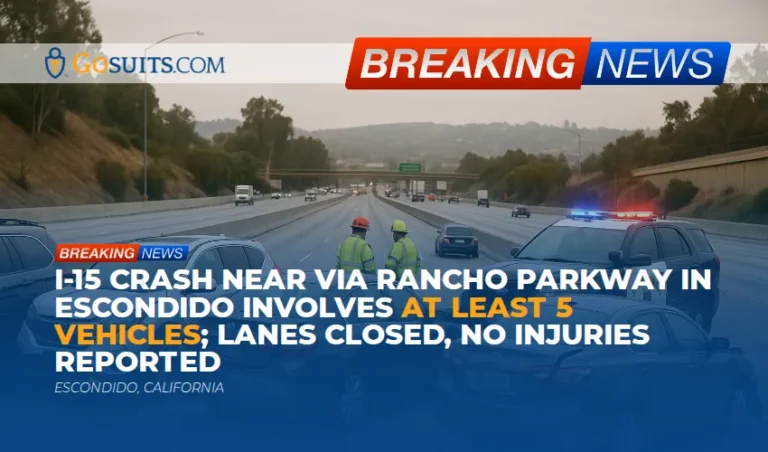
Early Tuesday morning in Escondido, a crash involving at least five vehicles led to the closure of multiple lanes on southbound Interstate 15 near Via Rancho Parkway. The initial pileup was reported shortly before 5:30 a.m. CHP noted that at least five vehicles were involved and the investigation into the cause was underway. No injuries were immediately reported at the scene. Several lanes were closed to allow emergency crews to work, and the Del Lago HOV on-ramp to southbound I-15 was temporarily shut down.
This stretch of I-15, right by the Via Rancho Parkway interchange and near the Westfield North County mall area, often sees dense pre-dawn commuter traffic from Temecula and North County heading toward Rancho Bernardo, Mira Mesa, and San Diego’s employment centers. That timing and traffic mix can make incident management and traffic diversion especially challenging on short notice.
Timeline, Road Closures, and Emergency Response
Here is what authorities shared about the sequence around this collision:
- Just before 5:30 a.m. The multi-vehicle crash was reported on southbound I-15 near Via Rancho Parkway.
- Initial closures At least three lanes were shut down for emergency response. The Del Lago HOV on-ramp to southbound I-15 was also closed.
- Alternate route guidance Motorists were advised to exit southbound I-15 at W. Valley Parkway, turn right, continue onto Del Dios Road, then turn left on W. Via Rancho to re-enter southbound I-15.
- 7:10 a.m. Caltrans reported the Del Lago HOV on-ramp reopened. As of 7 a.m., three lanes remained closed while crews worked on the scene.
- Injuries No injuries were immediately reported.
Caltrans District 11 manages this corridor, monitors its overhead cameras, and coordinates repairs and traffic management. For live, official lane status during incidents like this, the state’s traffic platform is QuickMap [3].
Local Impact in Escondido and North County
Anyone who drives I-15 through Escondido knows how quickly a lane closure can ripple. The Via Rancho Parkway interchange feeds shoppers and workers to Westfield North County and connects to neighborhoods around Kit Carson Park, Del Dios Highway, and Rancho Santa Fe. Early-morning lane closures can push traffic onto W. Valley Parkway and Del Dios Road, and backups often spill toward the Del Lago area and even north toward the Bernardo Center Drive interchange. For residents heading to Palomar Medical Center Escondido or across town toward the Escondido Transit Center, that pre-7 a.m. closure window can upend routines.
When multiple vehicles are involved, clearing debris, exchanging information, and documenting the scene can take time. Even without reported injuries, tow operations and CHP documentation often extend the disruption. The good news here is that the HOV on-ramp reopened relatively quickly, then crews turned to restoring full lane access.

Safety and Legal Context of Multi-Vehicle Freeway Collisions in California
Multi-vehicle freeway pileups can begin with a single sudden stop or a quick lane change, then grow as trailing drivers have limited time and space to react. Heavy commuter volumes, sun glare at daybreak, wet pavement after overnight drizzle, or a vehicle disabled in a lane can raise the risk of chain reactions. In these events, secondary crashes are also a documented concern while lanes remain blocked and traffic is at or near a standstill [4].
From a civil law perspective, California follows a comparative fault framework, which means liability can be shared among multiple drivers depending on each person’s conduct, the sequence of impacts, and other evidence. Sorting out responsibility after a freeway pileup is detail-intensive. It may require careful review of CHP collision diagrams, officer narratives, supplemental witness statements, dashcam footage, and any available freeway camera images. The process is rarely instantaneous, especially where several impacts occur in short succession.
Practically speaking, drivers in any multi-car crash should know about three California systems that matter after the scene clears:
- DMV collision reporting A report to the DMV is required within 10 days if anyone is injured or killed, or if there appears to be more than $1,000 in damage to any vehicle or property. The form is DMV SR 1 [1].
- CHP collision report access When CHP investigates, you can request the official collision report, typically using the CHP 190 process [2].
- Caltrans traffic operations Caltrans manages lane closures and traffic control during and after major incidents. Live updates and maps are on QuickMap [3] and District 11 pages [9].
What To Do After a Multi-Vehicle Crash on I-15
The minutes after a pileup are stressful. Here is a practical, California-focused checklist grounded in official guidance.
- Prioritize safety and move out of traffic when possible If your vehicle is operable and the scene is safe, move to the shoulder or a nearby exit per DMV guidance. Set out hazard lights and stay a safe distance from fast-moving traffic. If anyone appears seriously injured, call 911 right away [10].
- Exchange information Collect names, addresses, phone numbers, driver’s license numbers, license plates, and insurance details from involved drivers. If witnesses stopped, get their contact information too [10].
- Document the scene Take photos of all vehicles, positions on the roadway, debris, skid marks, and any visible injuries. Snap the surrounding environment, including lane markings, signage, and relevant milepost markers near Via Rancho Parkway.
- Report to CHP If CHP is on scene, cooperate with the responding officer. If no officer responds, you can still later request a collision report if one is created [2].
- Medical evaluation Even if you feel okay, consider a medical check the same day or within 24 to 48 hours. Some injuries are delayed in onset, especially soft-tissue and head injuries [11].
- DMV SR 1 filing If anyone was injured or property damage appears to exceed $1,000, submit the SR 1 to the DMV within 10 days. This filing is separate from any police or CHP report [1].
- Speak with an attorney before engaging insurers In multi-vehicle collisions, statements to insurers can affect how fault is allocated later. Consult with a qualified attorney first, then communicate with insurers with guidance.
Who To Call for Official Information and Documents
Families and involved motorists often need a few types of official records after a freeway crash. Here is where those typically come from in the Escondido area.
- California Highway Patrol, San Diego Area CHP usually handles freeway collisions in this corridor. You can request collision reports and related records through CHP using their standard process [2]. The San Diego Area Office page provides local contact details and office hours [8].
- Caltrans District 11 For lane closure timelines, traffic management details, and maintenance-related information, Caltrans District 11 manages state highways in San Diego County. General district information is publicly available [9], while live conditions are posted on QuickMap [3].
- San Diego County Medical Examiner In cases involving fatalities, the Medical Examiner’s Office manages autopsy reports and next-of-kin notifications. For family members trying to locate official findings in serious incidents, the county’s Medical Examiner site has guidance and contact information [7]. This particular incident had no injuries immediately reported, but the pathway is included for general awareness.
- Public Records Requests Certain agency records may be obtainable via the California Public Records Act. Each agency has its own process, but the statewide overview of CPRA rights is maintained by the California Attorney General [12].
How Liability Is Sorted in Chain-Reaction Crashes and Insurance Implications
In a chain-reaction crash, the question most drivers ask is, who hit whom, and when. Liability can be shared among several drivers in California. A rear-end impact does not automatically mean the trailing driver is 100 percent at fault. Investigators will look at time-distance relationships, traffic speed, sudden braking, unsafe lane changes, and whether any vehicle was stationary in a live lane. In five-car or larger events, there may be primary collisions followed by secondary impacts, especially when lanes are blocked.
Insurers often begin an allocation process that can take weeks or months, comparing physical damage patterns, airbag deployment data, vehicle telematics, and any available video. It is common for recordings from dashcams or commercial vehicle fleet cameras to clarify the sequence. When the incident occurs on a major corridor like I-15, commercial vehicles and rideshares frequently have telematics that track speed and braking inputs. That data can be crucial.
Because multiple policies may be triggered, questions arise about which coverage pays first, how medical payments coverage applies, and how subrogation works if multiple carriers dispute responsibility. For an in-depth overview of how carriers typically approach multi-car sequencing, see this resource: Which Insurance Pays First After a Multi-Car Crash.
Gathering and Preserving Evidence in San Diego County Crashes
Evidence tends to scatter quickly after a crash, especially when multiple vehicles are involved. A focused plan can make a real difference.
- Scene photos and video Capture vehicles before they are moved, if safe. Include wide shots and close-ups of each point of impact and any roadway gouges or fluid trails.
- Witness contacts Commuters heading from Escondido or Rancho Bernardo may stop briefly, then continue. Ask for names and phone numbers as early as possible.
- Dashcam and in-vehicle data Preserve your own footage. If you know another motorist had a dashcam recording, note their information and mention it to CHP and your attorney.
- Agency records Request the CHP collision report following the agency’s procedure [2]. If lane closures or traffic control setups are relevant, Caltrans District 11 maintains operational logs and posts real-time updates on QuickMap [3], [9].
- Public records requests For certain records not available by default, consider a CPRA request. Each agency has timelines and exemptions, but the statewide framework is outlined by the Attorney General [12].
Injuries After a Pileup: Immediate Care and Delayed Symptoms
Not all injuries are obvious at the scene. Adrenaline, cold early-morning air, and shock can mask pain. Some common delayed-onset symptoms include neck and back pain, headaches, dizziness, nausea, tingling or numbness in limbs, and difficulty concentrating. Concussion symptoms can be subtle and may take hours or even days to surface. Seek medical evaluation if any new symptom appears, even if you initially felt fine [11].
Keep all discharge paperwork, imaging results, and receipts. If physical therapy, chiropractic care, or specialist appointments are recommended, follow through and keep a log of dates and any work days missed. Medical records are central to documenting impact, especially in multi-vehicle claims where insurers scrutinize causation carefully.
Navigating Insurance After a Pileup on a California Interstate
Insurance questions get complicated fast when several vehicles are involved. While California uses an at-fault system, allocating fault percentages among five vehicles is not straightforward. Before giving any recorded statement to an insurer, it is wise to consult an attorney so you understand what details are important and how your words may be interpreted later.
Many people find it helpful to talk with California-based car accident lawyers who are familiar with the I-15 corridor, CHP reporting standards, and how carriers handle multi-party disputes in this region. Common talking points include medical payments coverage, rental car access while your vehicle is down, how to use your own collision coverage without prejudicing the liability investigation, and how subrogation may affect reimbursements later.
In the weeks following a pileup, you might see the following from insurance carriers:
- Reservation of rights letters These preserve the insurer’s ability to contest coverage while they investigate.
- Requests for recorded statements It is generally better to get legal guidance before participating, since liability apportionment can hinge on details.
- Repair and total loss decisions You may choose to handle repairs through your own policy for speed, then let the insurers sort fault later.
- Medical bills If you sought treatment, coordinate billing so providers use the correct coverage sequence. Keep all Explanation of Benefits documents and receipts.
Why Acting Promptly Matters After a Multi-Vehicle Crash on I-15
After a freeway pileup, time affects evidence, claims, and peace of mind. Prompt action helps preserve your position, reduces confusion, and supports a smoother insurance process.
- Secure official records quickly Request the CHP collision report as soon as it is available [2]. This report often anchors how insurers view the event, and delays can slow everything from rental car approvals to medical bill processing.
- Protect valuable footage and data Dashcam footage and in-vehicle data can be overwritten. Download your files immediately and back them up. Note time and location stamps.
- Clarify medical status early A timely evaluation documents injuries and connects them to the incident date. This helps avoid disputes about whether symptoms stem from the crash [11].
- Understand DMV deadlines If injuries occurred or property damage likely exceeds $1,000, the SR 1 must reach DMV within 10 days, independent of any police report [1].
- Coordinate insurance communications Multi-vehicle collisions often involve multiple carriers and layered coverages. Consult an attorney first, then respond thoughtfully so your statements are accurate and complete.
- Monitor Caltrans updates For those who commute daily through the I-15 and Via Rancho Parkway area, Caltrans QuickMap and District 11 updates help avoid secondary hazards and keep you on time for work or school [3], [9].
Taking these steps now can streamline what would otherwise be a frustrating and slow recovery process. The goal is to reduce uncertainty, keep your family’s routine intact, and preserve your rights under California law.

Commentary from Gosuits Escondido, California Personal Injury Attorney
Our thoughts are with everyone impacted by this morning’s multi-vehicle crash on I-15 near Via Rancho Parkway. Even when no injuries are immediately reported, these events are unsettling and can disrupt a community’s commute, school schedules, and workdays. This article is meant for general information and education about next steps and resources.
Based on what has been reported, the incident involved at least five vehicles, occurred just before 5:30 a.m., and required multiple lane closures. Pileups at that hour can develop quickly as traffic compresses on southbound I-15. When several vehicles are involved, liability is rarely simple. Primary and secondary impacts can occur in seconds, and fault may be shared among drivers depending on speeds, braking, lane changes, and a host of situational details. That is why thorough documentation, from CHP reports to photographs and any dashcam footage, is so important.
Insurance companies and large corporations have playbooks for complex, multi-vehicle claims. They know many people are unfamiliar with California procedures, such as the DMV SR 1 requirement, and they may press for recorded statements before the facts are fully understood. It is not unusual to see reservation of rights letters, conflicting fault assessments, and delays while carriers negotiate behind the scenes. These dynamics can leave individuals without clear guidance on medical billing, vehicle repairs, and rental coverage.
A free consultation can help clarify rights and responsibilities without any obligation. It is an opportunity to understand how the process works, what evidence to preserve, and how to avoid missteps that could affect liability allocation later. Knowledge levels the playing field, especially in a multi-party freeway collision where the facts need careful attention and patience.
References
- Report of Traffic Accident Occurring in California (SR 1) – California DMV
- Request a Collision Report – California Highway Patrol
- Caltrans QuickMap – California Department of Transportation
- Secondary Crashes: The Hidden Costs of Congestion – FHWA Office of Operations
- County of San Diego Medical Examiner – SanDiegoCounty.gov
- San Diego Area Office – California Highway Patrol
- District 11 – California Department of Transportation
- California Driver Handbook: Collisions – California DMV
- Signs and Symptoms of Traumatic Brain Injury – CDC
- California Public Records Act – Office of the Attorney General