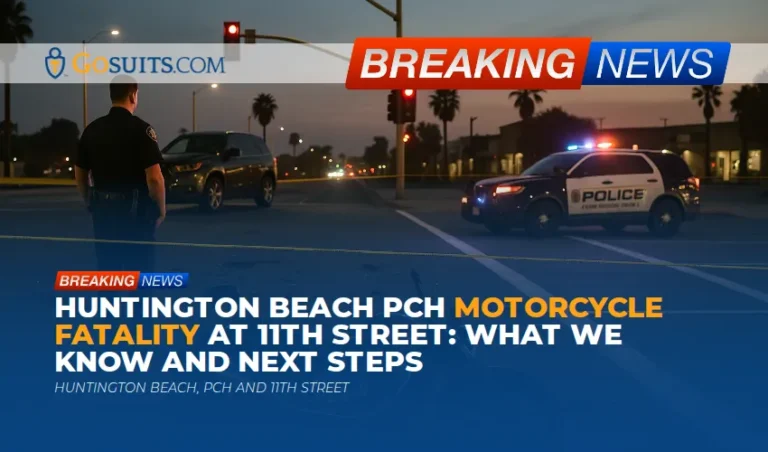
- What we know about the PCH and 11th Street motorcycle crash in Huntington Beach
- What we know about the Warner Avenue and Newhope Street pedestrian crash in Fountain Valley
- Why left-turn collisions are so dangerous for riders on PCH
- Key rights and civil liability questions that typically arise
- How families can get official records in Orange County
- Evidence to preserve now
- Insurance steps after a fatal motorcycle crash in Huntington Beach
- Community context and safety near the Huntington Beach PCH corridor
- Time limits and next steps
- What to do now: time sensitive steps
- Commentary from Gosuits Huntington Beach, California Personal Injury Attorney
- References
What we know about the PCH and 11th Street motorcycle crash in Huntington Beach
On a holiday weekend Sunday in Huntington Beach, a collision at Pacific Coast Highway and 11th Street claimed the life of a 21-year-old motorcyclist. According to Huntington Beach Police Department information shared on social media and summarized in local reporting, the crash occurred shortly after 7:30 p.m. A gray Land Rover LR3 traveling south on PCH entered a left-turn lane at 11th Street and struck a northbound red Harley-Davidson. Police found the rider unconscious in the roadway. He was transported to a nearby hospital and later died of his injuries. Coroner officials identified him as a 21-year-old resident of Pico Rivera.
Police noted there was no protected left-turn signal at that location at the time, which typically means turning drivers must yield to oncoming traffic. Officers reported the 62-year-old driver of the Land Rover, a Huntington Beach resident, remained at the scene and cooperated with investigators. The initial investigation determined the driver was not impaired by drugs or alcohol at the time. Whether the motorcyclist was impaired was not immediately known.
As of the latest public update referenced in local reports, charges had not been filed against the Land Rover driver. It is important to understand that a criminal investigation and a civil liability assessment follow different standards and timelines. Even when criminal charges are not filed, families can still pursue civil claims if the evidence shows negligence caused the loss.
HBPD asked for witnesses to come forward. If anyone observed the crash or events leading up to it, the department’s Traffic Investigator Cameron Houlston can be reached at 714-536-5670.
What we know about the Warner Avenue and Newhope Street pedestrian crash in Fountain Valley
On Monday of the same holiday weekend, a separate tragedy occurred in Fountain Valley. Shortly after 1 p.m., an adult male pedestrian walking in a crosswalk at Warner Avenue and Newhope Street was struck by a black Toyota Camry. Fountain Valley Police Department Traffic Investigator Jennifer Pratt reported that the pedestrian was taken to a nearby hospital in critical condition and was later pronounced dead.
The driver, identified publicly as a 47-year-old man with no permanent residence at the time, cooperated with police and was arrested on suspicion of driving under the influence and gross vehicular manslaughter, along with a felony drug possession charge. The identity of the pedestrian was not released pending notification of next of kin. Anyone with information is encouraged to contact the Fountain Valley Police Department Traffic Bureau at 714-593-4481.
While this second collision involves suspected DUI and potential criminal charges, families should know that civil wrongful death claims follow separate rules. DUI can often intersect with civil liability, and a violation of safety laws may carry significant implications in a wrongful death case. We discuss those civil implications more below, without speculating about the facts of either incident.
Why left-turn collisions are so dangerous for riders on PCH
People who drive PCH through Huntington Beach know that traffic patterns shift with the day, the surf report, and the season. On weekend evenings, there can be a mix of locals heading home, beachgoers leaving lots near the pier, and motorcyclists traveling up and down the coast. Left turns across oncoming lanes, particularly at intersections without protected arrows, require judgment, patience, and a clear view. California law requires drivers turning left to yield to oncoming vehicles that are close enough to be an immediate hazard [1].
Motorcyclists face unique risks. They are harder to see than larger vehicles, and their smaller profile can be underestimated by drivers judging speed and distance. Nationwide research has long noted that a common crash pattern involves a vehicle turning left in front of a motorcycle proceeding straight. NHTSA has repeatedly highlighted that motorists failing to detect and recognize motorcycles in traffic is a common cause of multi-vehicle crashes [4]. In California, the Office of Traffic Safety also tracks motorcycle fatalities and injury trends, and emphasizes driver awareness and yielding duties that protect riders [3].
If you have ever wondered what the most frequent motorcycle crash scenario looks like in practice, take a look at this resource on patterns that come up again and again: What Is the Most Common Motorcycle Accident Scenario? It provides plain-language examples that help families make sense of what investigators often examine after a serious collision.
Conditions on PCH can add complexity. At dusk, glare from the ocean side can play tricks on depth perception. Traffic gaps can be short and unpredictable as drivers exit beach lots or make quick decisions near downtown cross-streets. None of that relieves a turning driver’s duty to yield to oncoming traffic when no protected signal is provided, but it helps explain why investigators look closely at sightlines, timing, and speed estimates.
Key rights and civil liability questions that typically arise
After a turning-versus-oncoming crash, several legal issues usually come into focus. The specifics below are general California principles and not case-specific findings.
- Right of way at left turns. Without a protected arrow, a motorist turning left must yield to oncoming traffic that is close enough to be an immediate hazard. If a driver turns and a collision occurs with an oncoming vehicle proceeding straight, that can be evidence of failing to yield under California Vehicle Code section 21801 [1].
- Crosswalk duties. In the Fountain Valley crash, early reports noted the pedestrian was in a crosswalk. California Vehicle Code section 21950 requires drivers to yield the right of way to pedestrians crossing within marked crosswalks or within unmarked crosswalks at intersections, and to exercise due care for their safety [2].
- Negligence per se. When a driver violates a safety statute designed to prevent the type of harm that occurred, California Evidence Code section 669 allows a presumption of negligence if certain conditions are met. This often comes into play with violations of right-of-way rules or DUI laws in civil cases [9].
- Comparative fault. California follows pure comparative negligence. That means a court or adjuster can assign percentages of fault among the parties, and any civil recovery is reduced by a claimant’s percentage of fault. The concept is outlined in the California Civil Jury Instructions and court guidance [5].
- Wrongful death time limits. In most California wrongful death actions, the statute of limitations is two years from the date of death under Code of Civil Procedure section 335.1 [6]. Claims involving public entities can carry much shorter deadlines, which we address below.
When families feel overwhelmed by these issues, it helps to speak with seasoned motorcycle accident lawyers who can explain duty, breach, causation, damages, and how insurers analyze a record. A calm, informed conversation can clarify which steps make sense and when.
How families can get official records in Orange County
Official documents are often essential to understand what happened and to pursue insurance claims. Here is where families typically obtain them after a fatal collision in Huntington Beach or Fountain Valley.
Police traffic collision report
For the Huntington Beach intersection of PCH and 11th Street, the investigating agency is Huntington Beach Police Department. Families can request the traffic collision report through the HBPD Records Bureau once it is approved for release. The investigator listed publicly for witness tips is 714-536-5670; the Records Bureau has separate contact details, which are available through the City of Huntington Beach Police Department’s official channels.
For the Fountain Valley crash at Warner and Newhope, contact the Fountain Valley Police Department Traffic Bureau at 714-593-4481 for status and the Records Unit for report copies when available. If CHP responds to a crash on a state highway segment, some collision reports are requested through CHP offices using the CHP 190 form; more details are on the CHP’s public collision report page [7].
Coroner and death certificate
In Orange County, the Sheriff-Coroner handles postmortem examinations and coroner records. Next of kin can request copies of coroner records according to county procedures. Separately, certified death certificates are obtained through the California Department of Public Health’s Vital Records, which provides instructions for ordering certified copies for authorized individuals [8].
DMV collision reporting
California requires a driver or involved party to submit an SR-1 report to the DMV within 10 days if a crash involves injury or death. This requirement applies regardless of fault and is separate from the police report. The DMV outlines how and when to file the SR-1 and who must file it [10]. Families handling affairs for a deceased loved one should coordinate with counsel before filing to ensure accuracy.
Medical records
Hospitals and EMS providers maintain medical records associated with treatment. Authorized representatives and next of kin can request records through each provider’s Health Information Management department. Hospitals in coastal Orange County, such as Hoag Hospital in Newport Beach and MemorialCare facilities in Fountain Valley, have established processes for relatives to request records, but those processes vary and typically require proof of authority and identification.
Evidence to preserve now
Evidence can be fleeting, especially after a collision on a busy corridor like PCH. Many businesses, residences, and traffic systems maintain video for short periods before footage is overwritten. Acting quickly, and in the right way, can preserve vital details that help explain what happened.
- Witness information. Collect names and contact details for anyone who saw the crash or the moments before impact. HBPD and FVPD both asked for witnesses to come forward for these incidents.
- Nearby video. Identify gas stations, restaurants, beach parking entrances, and residential buildings near PCH at 11th Street. Politely ask about video retention policies. A formal preservation letter from counsel can help. For Warner and Newhope, the same approach applies to corner businesses and traffic-adjacent buildings.
- Vehicle data. Some vehicles store event data that captures speed, braking, and throttle position. Retrieval generally requires technical procedures. Preserve the vehicles without altering onboard systems until professionals advise next steps.
- Scene measurements. Skid marks, fluid trails, and debris fields can wash away or be swept. If safe, take clear photographs from multiple angles, including intersection lanes, sightlines for the turning vehicle, and the oncoming rider’s approach path.
- Communications. Keep all insurance correspondence, tow bills, medical paperwork, and any texts or emails related to the crash. Do not delete social media posts that mention the collision.
Time matters because many camera systems overwrite video in a matter of days. When counsel is involved early, they can coordinate preservation notices and direct requests that align with privacy and evidence rules.
Insurance steps after a fatal motorcycle crash in Huntington Beach
Insurance issues can be confusing and emotionally taxing, particularly when there has been a death. Before contacting any insurance company, it is prudent to speak with an attorney who can explain rights and responsibilities. What someone says to an insurance adjuster, even in a recorded condolence call, can be used against them later.
- Liability coverage of the turning driver. If a turning driver is found at fault, their auto liability coverage is the primary source for wrongful death claims. An attorney can request policy limit disclosures under California rules and evaluate all potentially applicable coverage layers.
- Uninsured and underinsured motorist coverage. For motorcyclists, UM and UIM coverage on their own policy can apply if the at-fault driver has no insurance or too little coverage to address the loss. Coordination with the decedent’s policy requires care because those carriers also defend their financial interests.
- Medical payments coverage. Med-pay benefits, if available on the decedent’s policy, may help cover certain medical expenses without regard to fault, although subrogation and reimbursement issues can arise.
- Wrongful death claim. Eligible heirs may bring a civil action seeking economic and non-economic damages under California law. This often includes funeral expenses, loss of financial support, and loss of companionship. Wrongful death claims are distinct from survival claims and must be analyzed carefully.
For a local perspective and a careful review of options in coastal Orange County, it can be helpful to consult with Irvine motorcycle accident lawyers who understand how carriers evaluate left-turn crashes on PCH and how to protect a family’s interests while evidence is still fresh.
Community context and safety near the Huntington Beach PCH corridor
Anyone who lives in Huntington Beach knows the rhythm of PCH. On sunny weekends, traffic stacks near the pier, beach lots by Pacific City fill up, and cyclists weave along the path. North of Main Street, the numbered avenues, including 11th Street, connect residential neighborhoods to the coast. Drivers making left turns across PCH are balancing oncoming traffic, pedestrians at the corners, and sometimes glare from the water.
City leaders and residents consistently voice concerns about visibility and speed on PCH. While Caltrans manages much of the state highway, local enforcement and education campaigns aim to reduce collisions involving vulnerable road users. It is a shared responsibility. Drivers must yield as the law requires. Riders benefit from high-visibility gear and lane positioning that maximizes conspicuity. Pedestrians should make eye contact at crossings when possible. These habits do not remove legal duties, but they can reduce risk in a complex traffic environment.
Time limits and next steps
California’s general deadline for wrongful death actions is two years from the date of death, under Code of Civil Procedure section 335.1 [6]. However, when a claim is asserted against a public entity, such as a city, county, or state agency, the Government Claims Act typically requires a written claim within six months for claims relating to personal injury or death. That deadline is strict, with specific rules for content and service. Families should seek guidance early to determine whether any public-entity issues, like roadway signals, signage, or design, are reasonably implicated. The existence of a police investigation alone does not extend these civil deadlines.
For DUI-related civil claims, violations of California’s DUI statutes can intersect with negligence per se rules in civil court if the elements are met, but each case turns on its own evidence. It is important not to equate an arrest with civil liability, since police, prosecutors, insurers, and civil courts apply different standards of proof at different stages. Careful, independent review of the record is essential.
What to do now: time sensitive steps
What should be done in the days ahead, and why does timing matter? The following steps are practical, concrete, and time sensitive.
- Secure official reports. Track the release of the police traffic collision report and request it promptly. The details and diagrams often guide next steps. Also request the medical examiner’s records when eligible. Delay can make it harder to reconstruct events.
- Preserve video and data immediately. Contact nearby businesses along PCH at 11th Street or at Warner and Newhope to ask about video retention policies. Many systems overwrite in days. Act now to prevent critical footage from disappearing.
- Organize documents. Create a dedicated folder for medical bills, funeral invoices, tow and storage charges, and all insurance letters. An organized file reduces stress and speeds up decision making.
- Do not give recorded statements without counsel. Insurers move fast to gather information. Speaking before you understand your rights can prejudice a future claim. Learn your options first.
- Calendar deadlines. Note the two-year statute for wrongful death and the six-month window for public-entity claims where applicable. Missing a deadline can foreclose claims entirely.
- Ask questions. If something is unclear, write it down and seek clarification early. Waiting often makes it harder to correct misunderstandings or locate evidence.
Commentary from Gosuits Huntington Beach, California Personal Injury Attorney
Our hearts are with the families affected by these tragedies in Huntington Beach and Fountain Valley. The purpose of this article is to share general information and community-focused guidance at a difficult time. It is not a substitute for tailored legal counsel, and we encourage families to get answers specific to their circumstances.
From a civil injury perspective, a left-turn collision at an intersection without a protected signal raises well-known questions about yielding duties and the visibility challenges that riders face along PCH. The pedestrian fatality in Fountain Valley involves a suspected DUI, which often triggers different legal and evidentiary considerations in civil cases. In both scenarios, early fact development is critical. Intersection geometry, timing of the phases, sightlines, and video can make a real difference in understanding what happened.
Insurance companies and large corporations know that the early days after a loss are chaotic. Adjusters may request recorded statements before all the facts are known. They may frame questions narrowly or ask for broad medical authorizations that go far beyond what is necessary. These tactics can disadvantage families who do not routinely navigate insurance processes. Knowledge and preparation level the playing field.
A free consultation offers immediate value. It helps families identify what evidence to preserve, who may have relevant records, and which deadlines apply. It also explains how to communicate with insurers without harming future claims. Even a short conversation can bring clarity and reduce stress while you focus on honoring your loved one.
References
- California Vehicle Code 21801 – California Legislative Information
- California Vehicle Code 21950 – California Legislative Information
- Motorcycle Safety – California Office of Traffic Safety
- Motorcycles – National Highway Traffic Safety Administration
- Civil Jury Instructions (CACI) and Civil Benchbook – California Courts
- Code of Civil Procedure 335.1 – California Legislative Information
- Collision Reports and FAQs – California Highway Patrol
- Vital Records – California Department of Public Health
- Evidence Code 669 – California Legislative Information
- Accident Reporting SR-1 – California DMV