- Overview of the Houston area incident and the monks’ walk
- Where and when: Fort Worth to Dayton and onward
- Police statements and what is known so far
- Safety and legal context for pedestrians and escort vehicles on Texas highways
- Potential civil liability in a truck accident involving pedestrians
- How to obtain official reports and records in Texas
- Insurance issues after a truck accident in the Houston area
- Preserving evidence and protecting your rights
- Community safety reflections for processions and peace walks
- What to do next: time sensitive steps
- Commentary from Gosuits Houston, Texas Personal Injury Attorney
Overview of the Houston area incident and the monks’ walk
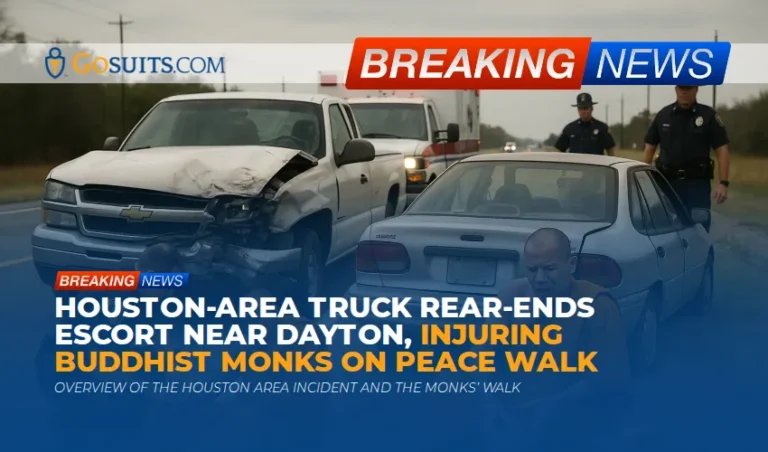
A group of Buddhist monks walking from Fort Worth to Washington, D.C., on a peace-focused journey encountered a serious setback near Dayton, Texas, northeast of Houston. According to contemporaneous statements, the convoy’s escort vehicle, traveling slowly with hazard lights engaged on the side of a highway, was rear-ended by a truck. The impact pushed the escort into two monks, injuring both. One monk suffered substantial leg trauma and was airlifted to a Houston hospital, while the other was transported by ambulance to a suburban Houston facility. The group has continued its trek and has since reached Georgia, with plans to pass near major Southeastern cities before arriving in the nation’s capital.
The incident highlights a challenge many Texans understand: stretches of highway around Liberty County and the wider Houston region can be unforgiving for pedestrians and support vehicles, especially where shoulders are narrow, traffic speeds are high, and visibility changes quickly with traffic flow and weather.
Where and when: Fort Worth to Dayton and onward
The monks began their walk in Fort Worth on October 26, traveling primarily along major corridors through Texas before the collision occurred last month near Dayton in Liberty County, part of the Greater Houston area and along the busy U.S. 90 corridor. After medical treatment, the group continued its journey and has now made it through Georgia, marking day 66 with a planned gathering in Decatur. They expect to move north through parts of the Carolinas and Virginia on their way to Washington, D.C.
Seasonally, late fall and early winter bring shorter days and fluctuating weather across Southeast Texas. Anyone who drives near the Trinity River bottomlands or along U.S. 90 knows how conditions can shift from bright sun to glare at dusk in minutes. That context matters when thinking about driver reaction time, safe following distances, and the responsibilities of both drivers and pedestrians sharing the margins of high-speed roads.
Police statements and what is known so far
Dayton’s interim police chief explained that the truck driver reportedly failed to recognize how slow the escort vehicle was moving and attempted to steer around it, but did not do so in time. The truck hit the rear left of the escort vehicle, which in turn struck two monks who were walking alongside. One monk’s leg injuries were described as significant, and early statements from the group indicated multiple surgeries were anticipated with a positive prognosis for recovery.
In Texas, crashes involving injury typically prompt an officer’s crash report, commonly called a CR3. Texas law requires an officer to submit a report when a crash causes injury, death, or at least $1,000 in damage [6]. These reports become important records for insurance reviews and any civil claims that may follow.

Safety and legal context for pedestrians and escort vehicles on Texas highways
Texas law addresses how pedestrians should navigate roadways. If a sidewalk is available and usable, a pedestrian should not walk along the roadway. If there is no sidewalk, the pedestrian should walk on the left side of the roadway or on the shoulder facing oncoming traffic, when practicable [1]. That rule exists to maximize visibility and reaction time for both the person walking and the approaching driver.
At the same time, drivers in Texas have a continuing duty to operate at a speed that is reasonable and prudent under the circumstances, considering actual and potential hazards on the roadway. Drivers must control speed to avoid collisions and must reduce speed as necessary when faced with special hazards, including pedestrians or stopped or slow-moving vehicles on or near the roadway [2]. Drivers must also maintain a safe following distance sufficient to avoid colliding with a vehicle ahead, accounting for speed, traffic, and conditions of the highway [3].
On high-speed corridors around Greater Houston, that mix of responsibilities can be tested. A slow-moving escort vehicle, even with hazard lights activated, can catch a fatigued or distracted driver off guard. For commercial motor vehicles, federal hours-of-service rules and other safety regulations are designed to reduce risks by limiting fatigue and requiring proper logging and oversight [8]. When a truck is involved in a collision that injures pedestrians, compliance with those federal and state safety rules becomes an important part of any subsequent investigation.
Texas also consistently tracks pedestrian injuries and fatalities, and state safety campaigns encourage drivers to watch for people on foot, particularly near driveways, intersections, and shoulders where walkers may be present even if pedestrian infrastructure is limited [5]. Nationally, federal agencies publish analyses showing the heightened risks pedestrians face when struck by larger, heavier vehicles, including commercial trucks [7].
Potential civil liability in a truck accident involving pedestrians
From a personal injury perspective, evaluating potential liability in a truck accident that injures pedestrians requires careful fact development. Investigators and attorneys often look at:
- Driver behavior and lookout Did the truck driver maintain a proper lookout, adjust speed for a slow or stopped vehicle ahead, and keep a safe following distance, as Texas law requires [2] [3]?
- Visibility and lighting What were the lighting conditions, time of day, and sight lines? Even with hazard lights, did traffic speed or roadway curvature reduce reaction time?
- Commercial compliance If a commercial motor vehicle was involved, were hours-of-service limits, vehicle maintenance, and other federal safety requirements met [8]?
- Escort procedures How was the escort vehicle positioned, and were any cones, signage, or additional markings used? While special traffic control devices are not always required for walking groups, their use can influence visibility.
- Comparative responsibility Texas applies proportionate responsibility rules. In an injury case, a claimant’s recovery can be reduced by their percentage of responsibility, and recovery is barred if that percentage exceeds 50 percent [10].
These factors are not about blame for its own sake. They simply reflect how Texas civil law analyzes the duties of each party and how insurers and courts determine fault shares after a crash.
For people on foot in Texas who are struck by a vehicle, understanding specific rights can be empowering. Our knowledge base article on Pedestrian rights in car accidents in Texas provides practical context about legal protections, fault, and next steps when injuries occur along roadways.
How to obtain official reports and records in Texas
After a crash with injuries, official documents help families and community members understand what happened. In Texas, the following records are commonly sought:
- Officer’s crash report (CR3) If an officer investigated, a report is typically filed with the state under Transportation Code section 550.062 [6]. You can request a copy through the Texas Department of Transportation’s crash reports and records portal. Availability depends on completion and eligibility rules established by state law and agency policy [4].
- Supplemental narratives and diagrams Officers sometimes create diagrams or add narrative supplements. Those may be included with the report or released upon request consistent with state rules.
- EMS and hospital records Injured individuals can request their own medical records directly from emergency medical providers and hospitals that rendered care. Hospitals often require photo identification and a signed authorization.
- 911 audio and CAD logs Non-emergency request channels in many Texas jurisdictions allow citizens to request communication center records, subject to redaction under the Texas Public Information Act. Response times and availability vary by agency.
- For fatal crashes In counties without a medical examiner system, Texas law provides for inquests by a justice of the peace under the Code of Criminal Procedure. In counties with a medical examiner, records are typically maintained by that office [11].
If you plan to request records, note that agencies can require proof of involvement or a permissible purpose under Texas law before releasing certain documents. Always check the specific record custodian’s instructions, timelines, and fees.

Insurance issues after a truck accident in the Houston area
Crashes involving a large truck often present multiple insurance layers. Texas is an at-fault state, so the liability insurer for the driver who caused the crash is typically the first target for claims. Commercial motor carriers operating in interstate commerce must maintain federally mandated minimum financial responsibility. For many carriers transporting nonhazardous property, the minimum is generally $750,000, with higher limits for certain cargo types, all regulated under federal law [9].
In a scenario like a shoulder-side truck accident, potential coverages can include:
- Truck liability coverage Insures the at-fault commercial driver and motor carrier, subject to investigation and defenses.
- Escort vehicle coverage If the escort had liability, medical payments, or personal injury protection coverage, those provisions may be relevant depending on policy language and state law.
- Uninsured or underinsured motorist coverage If the pedestrians or the escort vehicle’s policy carried UM or UIM, those benefits can come into play if the at-fault coverage is unavailable or insufficient.
- Health insurance subrogation Health insurers who paid medical bills may seek reimbursement from any liability recovery, subject to Texas law and policy terms.
Insurers will move quickly to take statements and shape the narrative of a truck accident. It is prudent to speak with a seasoned attorney before giving any recorded statement to any insurer. What someone says early on can be used against them later, particularly when facts are still developing and injuries are evolving.
Preserving evidence and protecting your rights
Evidence preservation is critical in any serious roadway incident, but the need is amplified in a truck accident because commercial carriers control important data sources. Timely steps can include:
- Spoliation notice Sending a preservation letter to the motor carrier and any third-party maintenance or logistics companies to preserve data such as event data recorder information, dashcam footage, telematics, and inspection logs.
- Driver and dispatch records Hours-of-service logs, dispatch communications, and bill of lading documents may show how long a driver had been operating and whether rest breaks were taken per federal rules [8].
- Escort vehicle records Any dashcam video, hazard light function checks, and GPS breadcrumb data can help corroborate speed, positioning, and timing.
- Scene documentation Photographs of skid marks, debris fields, shoulder width, and line-of-sight at the point of impact can help accident reconstruction professionals model the collision.
- Medical documentation Consistent treatment records help illustrate the mechanism of injury, severity, and recovery trajectory. That is essential for any injury claim evaluation.
Many of these steps are time sensitive. Commercial carriers often rotate trucks back into service, overwrite electronic data, or allow onboard cameras to loop and delete older segments if no preservation request is in place.
Community safety reflections for processions and peace walks
Communities across the Houston region often support processions and awareness walks. On neighborhood streets, it may be simple to stage a route with crossing guards, reflective gear, and clear signage. On high-speed corridors, the risk profile changes. National and state guidance emphasizes visibility, predictability, and separation wherever possible. While there is no single formula, helpful measures can include:
- High visibility apparel and lighting Reflective vests, headlamps, and flashing lights can improve conspicuity, especially at dawn or dusk.
- Advance warning Placing signs or cones in advance of an escort vehicle, when practical and lawful, can give approaching drivers more time to react.
- Routing choices Favoring frontage roads or wider shoulders during segments near major highways can reduce exposure to fast-moving traffic.
- Spacing and formation Single file or tight formations on shoulders, rather than spilling into lanes, can help maintain separation from traffic.
- Rest and timing Scheduling breaks and avoiding low-visibility windows can reduce fatigue and improve decision making for everyone involved.
Texas safety campaigns continue to urge drivers to watch carefully for people walking near roadways, particularly in areas without sidewalks, and to adjust speed for conditions to avoid collisions [5]. Federal safety agencies also underscore how vehicle size and speed increase injury severity for pedestrians, reinforcing the need for caution when large trucks approach an atypical traffic situation near a shoulder [7].
What to do next: time sensitive steps
When a roadway incident injures one or more people during a walking event or procession, early decisions can affect outcomes for months or years. The following practical steps can help keep options open while facts come into focus:
- Prioritize medical care Follow the treatment plan and keep all appointments. Save bills, discharge summaries, and receipts. Delays or gaps in care can create questions about causation and the extent of injuries.
- Request official records Obtain the officer’s crash report through TxDOT’s crash reports portal once available [4]. If 911 audio, CAD logs, or supplemental diagrams exist, inquire through the appropriate records channels.
- Preserve physical and digital evidence Save clothing, footwear, and any damaged devices or gear. Back up photos, GPS data, and messages related to the day’s route and conditions.
- Be cautious with insurance communications Contact an attorney first before giving statements to any insurer. Early recorded statements can be taken out of context or used to minimize injuries or shift fault.
- Calendar key deadlines In Texas, many personal injury claims must be filed within two years of the incident under Civil Practice and Remedies Code section 16.003 [12]. Some claims against government entities have much shorter notice rules. Tracking the correct deadline is essential.
- Think long term Document missed work, activity limitations, and how injuries affect daily life. Keep a simple journal. These details can be valuable when measuring pain, impairment, or future care needs.
Taking action sooner tends to preserve more information and reduces the risk of data loss. That urgency matters in any serious truck accident, especially where multiple companies may control critical logs, camera footage, and maintenance records.

Commentary from Gosuits Houston, Texas Personal Injury Attorney
Our hearts are with the injured monks and everyone walking alongside them. This update is shared for educational purposes and general information, with respect for the individuals and communities involved.
Based on what has been publicly described, a slow-moving escort vehicle with hazard lights was rear-ended by a truck near Dayton, and two pedestrians were injured when the escort was pushed into them. From an injury law standpoint, that immediately raises questions about speed control, safe following distance, visibility, and whether the commercial driver’s actions matched the conditions on the highway at that time. Those are the nuts and bolts of how civil responsibility gets evaluated in Texas.
Insurance companies and large motor carriers often move quickly in the aftermath of a roadway event. They may seek recorded statements, request broad medical authorizations, or attempt to resolve claims before the full scope of injuries is known. That is not unusual, but it can put people at a disadvantage. Without a clear picture of the medical trajectory or an understanding of the data that commercial carriers maintain, it is easy to underestimate both present and future needs.
A free consultation offers a low-pressure way to learn about rights, timelines, and what evidence matters most after a truck accident. It can also help level the playing field so decisions are made with information, not urgency.
References
- Texas Transportation Code Chapter 552 Pedestrians – Texas Legislature Online
- Sec. 545.351 Maximum Speed Requirement – Texas Transportation Code
- Sec. 545.062 Following Distance – Texas Transportation Code
- Crash Reports and Records – Texas Department of Transportation
- Pedestrian Safety – Texas Department of Transportation
- Sec. 550.062 Officer’s Accident Report – Texas Transportation Code
- Large Trucks – National Highway Traffic Safety Administration
- Summary of Hours of Service Regulations – FMCSA
- 49 CFR Part 387 Minimum Levels of Financial Responsibility – eCFR
- Texas Civil Practice and Remedies Code Chapter 33 Proportionate Responsibility – Texas Legislature Online
- Texas Code of Criminal Procedure Chapter 49 Inquests Upon Dead Bodies – Texas Legislature Online
- Sec. 16.003 Limitations Period for Personal Injury – Texas Civil Practice and Remedies Code