- What we know about the Highway 99W bus crash in Tehama County
- Where and when it happened
- Agencies responding and current status of the investigation
- Community impact and local context along Highway 99W
- Rights of injured bus passengers and families after a fatal crash in California
- Potential civil liability: pickup driver, public transit, and third parties
- Evidence to secure immediately after a major transit collision
- How to obtain key records: police report, coroner and autopsy, and public records
- Insurance considerations after a multi fatality crash involving a public bus
- What to do next
- Support and resources in Tehama County and the North State
- Commentary from Gosuits Richfield, California Personal Injury Attorney
- References
What we know about the Highway 99W bus crash in Tehama County
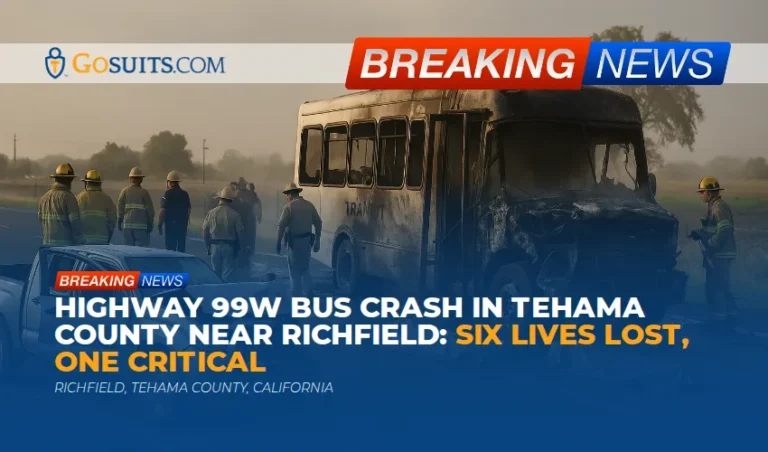
Authorities report a devastating head on collision on Highway 99W near Richfield in Tehama County that left six people dead and one person critically injured. According to early information shared by officials, the driver of a gray Toyota Tacoma traveling southbound is believed to have crossed the center line and struck a Tehama County public transit bus head on around 10 a.m. The pickup driver died at the scene. The bus driver and four passengers were also pronounced dead on scene. One bus passenger was airlifted to a regional medical center with major injuries. Local fire crews responded and the bus ignited immediately after impact, adding to the danger and complexity of the rescue and investigation effort. Road closures on 99W between Gyle Road and Sonoma Avenue were put in place and later lifted as investigators completed on scene work.
Officials have stated that vehicle speed at the time of impact is unknown, and it remains unclear whether impairment played any role. Identification of those involved is ongoing, and authorities have asked anyone with information about the bus occupants to contact the county coroner’s office. Public transit operations for the county’s TRAx service were temporarily suspended out of respect for those affected, with plans to resume when operationally ready.
Where and when it happened
The collision occurred late morning on a weekday along Highway 99W in the Richfield area of Tehama County. This stretch of 99W runs through the northern Sacramento Valley between Corning and Red Bluff, bordered by orchards, rural homesteads, and agricultural operations. It is a familiar route for county residents who commute to jobs, medical appointments, schools, and retail centers in Corning, Red Bluff, and Chico. The timing, mid morning, typically means moderate traffic that includes local drivers, farm vehicles, and county transit buses ferrying riders between towns. The immediate response affected traffic flow for several hours, with detours and slowdowns across nearby segments of 99W.
Agencies responding and current status of the investigation
Multiple agencies responded, including the California Highway Patrol for collision investigation and traffic control, the Tehama County Fire Department for fire suppression and rescue, and local EMS. The county coroner is leading the process of identification and next of kin notification. CHP crash investigations generally involve on scene measurements, witness interviews, vehicle inspections, and post crash analysis to determine sequence of events. Families can typically obtain the official Traffic Collision Report through CHP once it is complete, which can take several weeks in a major incident [1].
Because a county transit bus was involved, the public agency will conduct internal reviews focusing on vehicle condition, operator training and duty status, route planning, and compliance with safety programs. Federal oversight for public transportation safety frameworks occurs through the Federal Transit Administration’s Public Transportation Agency Safety Plan requirements, which guide how transit agencies manage risk and investigate significant events [10].

Community impact and local context along Highway 99W
Highway 99W is a lifeline through the North State. Residents from small communities like Richfield often rely on TRAx to reach medical care, jobs, and services. With Enloe Medical Center in Chico and other regional hospitals serving as higher level trauma resources for serious injuries, helicopter transports are not unusual for major collisions in this corridor. Winter brings unique hazards in the Sacramento Valley, including patchy tule fog and slick morning roadways, while harvest seasons add heavier truck activity. While authorities have not indicated weather or cargo contributed here, those context factors are part of the broader safety picture locals think about year round.
Nationally, rural roads like 99W carry a disproportionate share of fatal crashes compared with urban roads, even though they see less total traffic. NHTSA reports that rural areas represent a significant portion of traffic fatalities each year due to higher speeds, longer emergency response times, and more head on and roadway departure collisions [8]. This tragic incident resonates deeply in a county where neighbors often know each other and where local transit is more than a convenience. It is a critical connector.
Rights of injured bus passengers and families after a fatal crash in California
California law provides avenues for injured passengers and the families of those killed to bring civil actions seeking accountability and lawful compensation for losses caused by negligence. In general terms, two types of civil claims may apply after a fatal crash. A wrongful death claim allows certain surviving family members to pursue damages for the loss of their loved one under California Code of Civil Procedure section 377.60 [4]. A separate survival action allows the decedent’s estate to recover damages the person could have sought had they lived, under section 377.30 [5]. The availability and scope of these claims depend on the facts and the relationships involved.
Many families turn to car accident lawyers to help coordinate medical records, collision reports, insurance communications, and the expert analysis these cases often require. While each situation is unique, having a seasoned advocate manage deadlines and communications helps families focus on grieving and healing without risking their legal rights through honest but harmful mistakes.
When a public transit agency is a potential party, California’s Government Claims Act imposes a short administrative claim deadline to preserve the right to sue later. For personal injury or wrongful death, a claim typically must be presented within six months of the incident, with limited exceptions, under Government Code section 911.2 [3]. This is not a court lawsuit but an initial notice and claim submission process to the public entity. Missing this step can jeopardize the ability to file a civil action later, so timing and accuracy matter.
Potential civil liability: pickup driver, public transit, and third parties
Investigators will piece together how and why the Toyota Tacoma crossed into oncoming lanes. If a driver’s negligence caused the head on collision, that driver’s estate and applicable insurance could be responsible for the harms suffered by occupants of the bus. In head on events, liability questions often focus on roadway departure, distraction, fatigue, impairment, medical emergencies, or sudden mechanical failures. Without completed reports, speculation is not helpful. But the framework investigators use is consistent across crashes in California.
If evidence suggested the bus contributed to the severity of injury due to a mechanical issue, inspection lapse, or other operational factor, the public transit agency’s potential exposure would be considered within California’s laws governing public entities. Agencies also evaluate their own training, supervision, and adherence to their safety plan obligations. Post crash fires add another layer of analysis, because NTSB has long warned about the dangers of bus fires and the importance of quick evacuation and fire risk mitigation strategies [9].
Third party liability can also arise in rare circumstances. Examples include roadway defects, improper work zone control, or a defective component on either vehicle. Where a roadway maintenance or design issue is plausibly involved, families should be aware that claims against public entities demand attention to the Government Claims Act deadlines mentioned above [3].

Evidence to secure immediately after a major transit collision
Building a clear record of what happened is essential. Important sources of evidence can be lost quickly after a bus crash with fire. Think about these categories and act fast:
- Official collision records: Request the CHP Traffic Collision Report when it is available. For major incidents, reports may include diagrams, measurements, and narrative analyses that are foundational for civil claims [1].
- Transit agency documents: Public transit agencies typically maintain operator training files, duty logs, onboard video, and maintenance records. Preservation letters can be used to ask the agency to retain all relevant materials pending claims.
- Vehicle data and inspections: Modern vehicles may store event data that can be downloaded. Fire can damage these modules, and timely spoliation notices help safeguard what remains.
- Witness information: Early contact information and brief statements from independent witnesses can be critical. In rural corridors like 99W, farm workers or nearby residents may have seen smoke, heard the impact, or observed erratic travel before the collision.
- Scene photographs and video: Caltrans or local CCTV may capture traffic flow, and private businesses along the route often have exterior cameras. Timesensitive requests can make the difference. For a practical walkthrough, see Request CCTV Footage After a California Car Accident.
If families plan to pursue claims, it is generally best to speak with an attorney before contacting any insurance carrier. Statements to insurers are recorded and can be used later to limit or challenge claims.
How to obtain key records: police report, coroner and autopsy, and public records
CHP Traffic Collision Report. The California Highway Patrol provides a process to request Traffic Collision Reports after they are completed. You can obtain a copy if you are an involved party or the legal representative of someone involved. CHP outlines how to submit requests, fees, and identification requirements on its website [1]. Separately, California’s DMV requires an SR 1 report to be filed by drivers or their representatives within 10 days if anyone is injured or killed, or if property damage exceeds $1,000, regardless of fault [2]. Families should speak with counsel about whether and how the SR 1 applies in a fatality scenario, especially when the driver is deceased or incapacitated.
Coroner and autopsy information. In California counties, the coroner or sheriff coroner handles identification and cause of death determinations. The Tehama County coroner’s office can provide guidance to next of kin regarding identification and the process for requesting death certificates or available autopsy records consistent with state law. While records involving decedents have privacy and evidentiary considerations, next of kin are generally permitted some access. Families can start by contacting the county coroner through the sheriff coroner office to understand requirements and timelines.
Public records. Many government records are obtainable through the California Public Records Act, with exceptions for active investigations and privacy. Requests to the county or state agencies involved should be clearly framed and limited to what is needed. California Government Code provisions govern access and exemptions [11]. Note that investigative records are often exempt while a case is open.
Insurance considerations after a multi fatality crash involving a public bus
Insurance questions after a bus collision are complex, especially when a public agency is involved alongside a private driver. For a private pickup, applicable coverages might include liability, medical payments, and underinsured motorist coverage on affected passengers’ policies. For the transit bus, public agencies frequently participate in self insured risk pools with coverage designed to handle large exposure events. Federal rules establish minimum coverage levels for for hire passenger carriers, for example, up to 5,000,000 in financial responsibility for certain passenger capacities under 49 CFR 387.33, though public entities can structure protection differently [7].
Families often find that navigating multiple insurers, claim forms, and deadlines is its own burden while they grieve. Working with car accident lawyers can reduce the chance of missing a critical notice requirement or inadvertently making a statement that narrows available benefits. Remember, what someone says to an insurer can be used later to limit recovery.
When claims involve a county transit agency, California’s Government Claims Act requires a written claim to the public entity as a prerequisite to any lawsuit, typically within six months from the date of the incident [3]. Separate private insurance claims may have different timelines. If a lawsuit is appropriate later, families should expect insurers to scrutinize every element of the claim, from liability to causation to damages. Having support from car accident lawyers in Richfield who understand rural crash dynamics and public entity claim procedures can help keep the process on track.
What to do next
In the immediate aftermath of a tragedy like this, clarity and timing matter. Here is a neutral, time sensitive roadmap focused on preserving rights and information. This is not legal advice.
- Document everything now. Keep a notebook of dates, agencies contacted, badge numbers, and what was discussed. Save receipts, funeral expenses, and travel costs tied to the incident.
- Request official records as they become available. Track when the CHP report will be ready and how to request it [1]. Record the case or incident number whenever provided.
- Preserve digital evidence. Ask nearby businesses or property owners along 99W to preserve any camera footage from the morning of the crash. Some systems overwrite video within days.
- Coordinate medical records. For survivors, ask hospitals and providers about obtaining treatment records and imaging. Consistent, complete medical documentation is essential for any injury claim.
- Do not give recorded statements to insurers before a consultation. Insurance adjusters often reach out quickly. Waiting to understand rights and obligations helps avoid statements that can be taken out of context later.
- Calendar critical deadlines. If a public entity may be involved, note the six month administrative claim window under California law [3]. Also note any life insurance or employer benefit deadlines for claims paperwork.
- Lean on community support. Local faith leaders, counseling services, and county resources can help with immediate emotional and practical needs. Accepting short term help often makes the long term process more manageable.
Support and resources in Tehama County and the North State
Local responders and institutions have deep roots along Highway 99W, and they understand both the emotional toll and the practical steps that follow a major crash. Here are agencies and offices commonly contacted after a fatal collision:
- California Highway Patrol, Area Office serving Tehama County. For collision report status, involved party instructions, and property release procedures. CHP’s statewide collision report request information outlines eligibility and process [1].
- Tehama County Sheriff Coroner. For decedent identification, death certificates, and autopsy related questions where permitted by law. The coroner’s office coordinates next of kin notifications and provides guidance on timelines and documentation needed.
- Tehama County Public Works and TRAx Transit. For transit service updates and any public announcements related to the event. Public agencies also receive Government Claims Act submissions pursuant to California statutes [3].
- California DMV. For SR 1 accident reporting requirements that may apply to involved drivers or representatives in injury or fatality incidents [2].
- Victim support and counseling services. County health and community partners often coordinate crisis counseling and grief resources following mass casualty events. Local hospitals and faith based organizations are good first points of contact.
On the federal policy front, the U.S. Department of Transportation and NHTSA continue to publish safety research that helps the public understand risks and prevention strategies on rural roads, including the North State’s two lane highways [8] [6]. NTSB safety alerts on bus fires emphasize evacuation readiness and maintenance practices that reduce the likelihood of catastrophic post crash fires [9]. While these reports look national in scope, the lessons are directly relevant to corridors like 99W.

Commentary from Gosuits Richfield, California Personal Injury Attorney
Our hearts are with everyone in Tehama County affected by this terrible Highway 99W crash. Six lives lost and a community shaken before lunchtime on a weekday is hard to comprehend. Please know this commentary is for general information and education. It is not a substitute for speaking with a lawyer about any specific situation.
From what officials have shared so far, this appears to be a head on collision where a pickup crossed into the oncoming lane and struck a county transit bus. Investigators will confirm the cause through vehicle inspections, measurements, and witness statements. In similar cases, the law looks at whether a driver’s negligence set the tragic sequence in motion, while also examining whether any mechanical or operational issues increased the severity of the outcomes. Fires that erupt immediately after impact complicate escape, and they are a known bus safety risk that investigators evaluate closely.
In events like this, families often face a maze of insurance adjusters and forms while still waiting for official reports. Insurance companies and risk managers work these cases every day. They understand how to frame liability, question causation, and minimize damages. People encountering this system for the first time do not. Adjusters may request recorded statements quickly, encourage fast releases, or portray deadlines in a way that nudges people to accept less clarity than they deserve. That is why it is important to get a free consultation before speaking with insurance companies or signing anything. Understanding the California Government Claims Act timeline and how it interacts with private insurance claims can prevent unintentional forfeiture of rights.
Grief makes paperwork feel impossible. Still, preserving evidence and meeting early deadlines make a real difference later. Even a short conversation with a skilled advocate can help map out the right order of steps and lighten the load during an awful time.
References
- Traffic Collision Reports and Requests – California Highway Patrol
- Traffic Accident Reporting Requirements SR 1 – California DMV
- Government Code 911.2: Time for Presenting Claims – California Legislature
- Code of Civil Procedure 377.60: Wrongful Death – California Legislature
- Code of Civil Procedure 377.30: Survival Actions – California Legislature
- Overview of Motor Vehicle Traffic Crashes in 2022 – NHTSA
- 49 CFR 387.33: Financial responsibility for for hire passenger carriers – eCFR
- Traffic Safety Facts 2021: Rural/Urban Comparison – NHTSA
- Safety Alert SA 073: Preventing Bus and Motorcoach Fire Tragedies – NTSB
- Public Transportation Agency Safety Program – Federal Transit Administration
- Government Code 7922.500: California Public Records Act – California Legislature