- What happened on Highway 49 near Placerville
- When and where the collision occurred
- Vehicles and people involved
- Road closures and the immediate response
- Weather and roadway conditions in El Dorado County
- Why head-on crashes happen on two-lane highways
- What investigators typically look for after a head-on collision
- How families can obtain official records
- Insurance and claims landscape after a fatal head-on collision in California
- Local insight: driving Highway 49 during storm season
- Practical steps to take in the first week
- Call-to-Action: Why timely action matters right now
- Commentary from Gosuits Placerville, California Personal Injury Attorney
- References
What happened on Highway 49 near Placerville
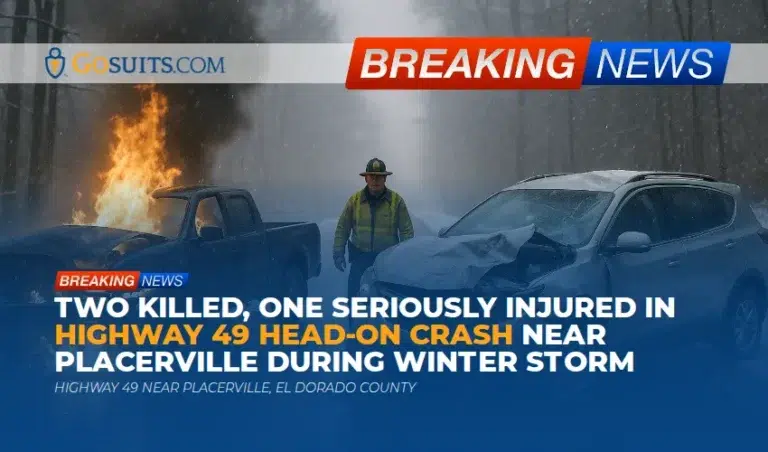
Two people were killed and a third was seriously injured in a head-on collision Monday afternoon on Highway 49 in El Dorado County. According to the California Highway Patrol’s Placerville Area, the crash occurred shortly after 5 p.m. just north of Crystal Boulevard, south of Placerville and near the Diamond Springs area. A Chevy F-10 pickup and a silver Ford Edge SUV collided head-on. The pickup, which had two people inside, caught fire after impact. Both occupants of the Chevy were pronounced dead at the scene. The Ford’s driver sustained major injuries and was transported to a nearby hospital for treatment. The cause is under active investigation.
CHP closed Highway 49 in both directions for several hours and estimated reopening around 7:45 p.m. The collision coincided with a significant winter storm bringing heavy rain to the Sacramento Valley and snow to the Sierra Nevada and foothills. In the Placerville corridor, that mix often creates rapidly changing conditions that can turn a routine drive into a serious hazard.
When and where the collision occurred
The head-on crash happened a little after 5 p.m., just north of Crystal Boulevard along Highway 49. This stretch runs between Diamond Springs and Placerville, threading through foothill neighborhoods with a mix of commercial and residential driveways, side roads, and rolling curves. In late afternoon, traffic tends to be steady with commuters heading home from Placerville and service vehicles moving between Diamond Springs, El Dorado, and the Highway 50 interchange.
Timing matters in understanding visibility and traffic density. Around 5 p.m. during winter, drivers often contend with dusk lighting, wet pavement, glare from oncoming headlights reflecting on rain, and, at higher elevations, quickly dropping temperatures. Those conditions can make lane position and speed control more challenging than usual.
Vehicles and people involved
Officials described the involved vehicles as a Chevy F-10 pickup and a silver Ford Edge SUV. The Chevy carried two occupants who were both pronounced deceased at the scene after their vehicle caught fire. The Ford’s driver suffered major injuries and was taken to a hospital for care. At the time of reporting, authorities had not released the names of those who died, pending coroner procedures and notification of next of kin.
In incidents like this, next steps often include collision reconstruction by CHP, coordination with the El Dorado County Sheriff’s Coroner Division, and requests for official reports by families, insurers, or legal representatives. CHP’s Placerville Area Office is the local point of contact for collision reports and investigation updates [1], [2].
Road closures and the immediate response
Highway 49 was closed in both directions following the crash, with officials projecting the closure to last until at least 7:45 p.m. Temporary closures like this allow first responders to provide medical aid, suppress vehicle fires, and secure the scene for thorough documentation. Caltrans can also be called to assist with traffic control and cleanup. Drivers heading between Auburn Lake Trails, El Dorado, and downtown Placerville likely saw detours and delays. For real-time closures in the future, Caltrans QuickMap is a helpful public tool [9].

Weather and roadway conditions in El Dorado County
The crash coincided with a strong winter storm bringing heavy Valley rain and Sierra foothill snow. On foothill highways like 49 and nearby 50, rainfall often reduces visibility and increases stopping distances. On curves, wet pavement can reduce tire traction, especially where oil and debris build up at intersections or low spots. In higher elevations toward Placerville and Camino, temperatures can dip and create slushy patches or even black ice overnight, compounding risk. The National Weather Service Sacramento office routinely warns that such storms can quickly worsen driving conditions in the foothills [8].
National roadway safety data consistently show that weather is a contributing factor in a large share of crashes. Federal highway researchers estimate that about one in five vehicle crashes nationwide are weather-related, with wet pavement and rainfall being among the most common conditions involved [7]. On a two-lane route like 49, that can translate into longer braking distances and more difficulty holding lane position on tight bends.
Why head-on crashes happen on two-lane highways
Head-on collisions on two-lane roads usually involve some deviation from one’s lane, even momentarily. Investigators often consider factors like:
- Speed unsafe for conditions. California’s Basic Speed Law requires driving at a safe speed for conditions, even if that is below the posted limit [6].
- Reduced visibility. Rain, dusk light, and headlight glare can obscure centerlines, especially where paint is faded.
- Hydroplaning or loss of traction. Standing water can cause a vehicle to slide, particularly with worn tires or sudden steering inputs.
- Curve negotiation. On rolling foothill roads, misjudging a curve radius can lead to drifting across the center.
- Driver distraction, fatigue, or impairment. These are common contributors in severe crashes, though any specific cause remains subject to investigation.
- Mechanical issues. Tire failures or steering problems may contribute in rare cases.
While some head-on collisions are linked to overtaking maneuvers, many occur without any attempted pass. A momentary lapse or a sudden swerve to avoid debris can be enough, especially when roads are slick.
What investigators typically look for after a head-on collision
CHP investigators and reconstruction specialists generally focus on evidence that helps pinpoint vehicle positions, speeds, and driver inputs before impact. Common elements include:
- Scene documentation. Measurements of skid marks, yaw marks, gouges, fluid trails, and final rest positions.
- Vehicle inspections. Damage profiles indicate direction and angle of force. Tire conditions, steering linkages, and brakes may be examined.
- Electronic data. Many vehicles record pre-crash data such as speed, throttle, and braking in event data recorders, which can be downloaded under proper legal process.
- Weather and lighting. Investigators note precipitation, visibility, and ambient light conditions at the time of the crash.
- Witness statements. Observations on lane position, erratic driving, or sudden hazards can be crucial.
- Cell phone records. In some investigations, usage data may be relevant where distraction is suspected.
Because the cause of this collision remains under investigation, it would be premature to attribute fault. That said, the mix of rain, dusk light, and foothill curves is a familiar combination that often requires extra caution from all drivers.
How families can obtain official records
After a fatal crash, families often face an urgent need for official documents for insurance, probate, and other practical matters. Here are the most common records and where to request them in El Dorado County and statewide:
CHP Traffic Collision Report
The initial police report is maintained by the California Highway Patrol when a crash occurs within its jurisdiction. For incidents handled by the CHP Placerville Area Office, requests can be submitted using CHP’s collision report request process and form. The report typically includes a diagram, statements, and the officer’s narrative [1], [2].
- Who can request. Involved parties or their authorized representatives, including immediate family for decedents.
- What you may need. Date, time, location, driver names if known, and report number if available.
- Why it matters. Insurers and legal representatives rely on the report to understand basic facts and to begin their own reviews.
Coroner and autopsy records
The El Dorado County Sheriff’s Office, Coroner Division, handles death investigations in the county. Families can contact the Coroner regarding autopsy status, identification processes, and release of decedents to funeral homes. Policies govern what documents can be released and when, especially while an investigation is ongoing [3].
Death certificates
Certified death certificates are generally obtained through the county or the California Department of Public Health. These are necessary for insurance claims and estate matters. The state provides guidance on how to request certified copies and who is eligible to receive them [4].
DMV accident reporting
California requires an SR-1 accident report to the DMV when a crash results in injury, death, or sufficient property damage, regardless of fault. Many people are unfamiliar with this requirement until they need it. The DMV provides instructions and forms online, and late submission can cause complications with licensing or insurance [5].
Roadway and maintenance data
In certain cases, families or their representatives may later seek roadway maintenance logs or traffic control records from Caltrans if there is a question about signage, striping, or drainage. Those requests are typically managed through public records processes and are separate from a CHP collision report.
Insurance and claims landscape after a fatal head-on collision in California
When a crash leads to serious injuries or death, multiple layers of insurance may be involved. Understanding them early can prevent avoidable missteps.
- Liability coverage. The at-fault driver’s auto liability policy is typically the first source of coverage for injuries and wrongful death damages. In a head-on collision, liability may turn on lane position, speed for conditions, and other factors that an investigation will clarify.
- Uninsured and underinsured motorist (UM/UIM). If the at-fault driver has low or no coverage, an injured person’s or decedent’s household UM/UIM policy can be critical. Policies differ, and claim timing matters.
- Medical payments (Med Pay). Some policies include no-fault medical payment benefits that can help with early bills regardless of fault.
- Property damage and total loss. Vehicle valuations, gap coverage, and rental reimbursement can come into play for the surviving driver.
- Wrongful death and survival actions. California allows certain family members to bring a wrongful death claim, and the decedent’s estate may bring a survival action for particular harms suffered before death. These are distinct claims with different rules and proof requirements.
Many people try to handle all of this directly with insurers. That can be overwhelming in the best of times, and even more so after a tragedy. Seasoned car accident lawyers can help protect claim rights, coordinate with the investigation timeline, and organize documentation while families focus on immediate needs.
Before giving recorded statements or signing medical or authorization forms for an insurer, it is wise to speak with an attorney first. Statements given early can be used later and may be interpreted in ways that cause problems down the road. Insurers may also ask for broad releases that are not necessary at the early stage.
Local insight: driving Highway 49 during storm season
People who live or work around Placerville know that Highway 49 is a lifeline through the Gold Country. Between Diamond Springs, El Dorado, and the turn toward Coloma, the road narrows in places, winds through tree cover, and rises and falls with the terrain. In storm cycles that bring Valley rain and Sierra snow, the foothills can swing between wet pavement at one milepost and slushy conditions a few miles up the grade.
Local drivers often say that late afternoon can be the toughest time to see the centerline and oncoming traffic. Headlight glare on a wet windshield, wipers on high, and tail lights reflecting off the roadway all make it harder to judge distance and lane position. During those windows, extra space, lower speeds, and steady inputs can make the difference.
For those seeking to understand evidence that may support a claim arising from a crash like this, you may find this resource helpful: what to do after a california car accident.
Practical steps to take in the first week
Every situation is different, yet a few practical steps tend to help preserve information and reduce stress later.
- Request the CHP Traffic Collision Report. Start the request with the CHP Placerville Area or through CHP’s public records channels so you are in line once the report is ready [1], [2].
- Coordinate with the Coroner’s Office. The El Dorado County Sheriff’s Coroner Division can provide status updates on identification, autopsy, and release to funeral homes [3].
- Order certified death certificates. These will be needed for many tasks, from life insurance to estate matters [4].
- Preserve personal property. If belongings were in the vehicle, ask where the vehicles were towed and how to retrieve items once authorized.
- Document injuries and care. For the surviving injured driver, keep a treatment journal, list all providers, and save all bills and receipts. UC Davis Medical Center in Sacramento is a Level I trauma center that often treats the region’s most serious injuries [10].
- Check for UM/UIM coverage. Review auto policies for uninsured or underinsured motorist benefits and medical payments. Policy language varies and can be confusing.
- Avoid early recorded statements to insurers. Consult an attorney first. What is said early can be cited later, sometimes out of context.
- Monitor weather and road status if traveling the area. Use the National Weather Service Sacramento page and Caltrans QuickMap before heading back through the corridor [8], [9].
In the foothills, working with Placerville car accident lawyers who understand the local roadway geometry and seasonal hazards can help families anticipate both evidence needs and timing issues in a case.
Call-to-Action: Why timely action matters right now
Here is the single most useful step to prioritize: arrange a free consultation with a qualified personal injury attorney before engaging with any insurance company. An early conversation can prevent avoidable mistakes and set a plan for gathering critical records, from the CHP report to medical documentation. It also creates a clear point of contact so insurers do not pressure people for statements or signatures during a vulnerable time.
Why act now? Two reasons stand out. First, important evidence can disappear quickly. Vehicles get repaired or salvaged, event data recorders may be overwritten, and video from nearby businesses or homes is often deleted within days unless preserved. Second, claim deadlines and notice requirements start running immediately, including the DMV SR-1 injury and damage reporting rules that apply regardless of fault [5]. Acting promptly increases the chance that key facts are preserved for a future claim.
What is the expected outcome of acting quickly? Better documentation, fewer disputes over missing evidence, and a clearer understanding of insurance layers like UM or UIM that may apply. This does not guarantee any result, but it puts the process on a firmer footing at a time when clarity is hard to come by.

Commentary from Gosuits Placerville, California Personal Injury Attorney
Our hearts go out to everyone affected by this tragedy on Highway 49. Losing loved ones or facing a life-changing injury is devastating. This overview is intended for community awareness and general information. It is not a substitute for tailored guidance about any individual situation.
From what is publicly reported, a head-on crash during a strong winter storm raises familiar safety issues we see in the foothills each year. Rain, dusk lighting, and tight curves on two-lane roads demand lower speeds and increased following distances. Whether the proximate cause involves traction loss, lane drift, visibility, or something else, a careful review of scene evidence, vehicle data, and weather will be necessary before anyone can reach responsible conclusions.
After serious collisions, insurance companies move quickly. They may ask for recorded statements, broad medical authorizations, or early settlements before the full picture is known. Large carriers sometimes frame questions in ways that minimize responsibility or shift blame based on incomplete facts. Corporations count on people being overwhelmed, especially right after a loss. That imbalance is real, and it is why early guidance can be so important.
A free consultation gives people a chance to understand the process, the types of claims that may exist, and the documents to gather, without pressure. It also helps set boundaries with insurers so that necessary information is provided at the right time and in the right form. No one should have to navigate this alone, especially when the law, medicine, and insurance all collide at once.
References
- California Highway Patrol Placerville Area Office – CHP
- Requesting Traffic Collision Reports – California Highway Patrol
- El Dorado County Sheriff’s Office, Coroner Division – edcgov.us
- Vital Records: Birth, Death, Fetal Death, Still Birth – California Department of Public Health
- Accident Reporting Requirements and SR-1 – California DMV
- California Driver Handbook: Speed Limits and Basic Speed Law – California DMV
- How Do Weather Events Impact Roads? – Federal Highway Administration
- National Weather Service Sacramento Office – weather.gov
- Caltrans QuickMap Road Conditions and Closures – dot.ca.gov
- UC Davis Health Trauma Center Information – UC Davis Health
- Traffic Safety Quick Stats – California Office of Traffic Safety