- What happened at Washington Street and Atkinson Road
- When and where the collision occurred
- Local context around this intersection
- How Illinois police investigate serious intersection crashes
- Illinois laws that matter in left-turn and signalized intersection crashes
- Potential civil liability and insurance paths after this crash
- Evidence to preserve near Washington and Atkinson
- How to obtain the official police report
- How to obtain coroner and autopsy records in Lake County
- Medical records and HIPAA releases after a crash
- Safety and infrastructure takeaways for the Grayslake community
- Next steps and why acting soon matters
- Commentary from Gosuits Grayslake, Illinois Personal Injury Attorney
- References
What happened at Washington Street and Atkinson Road
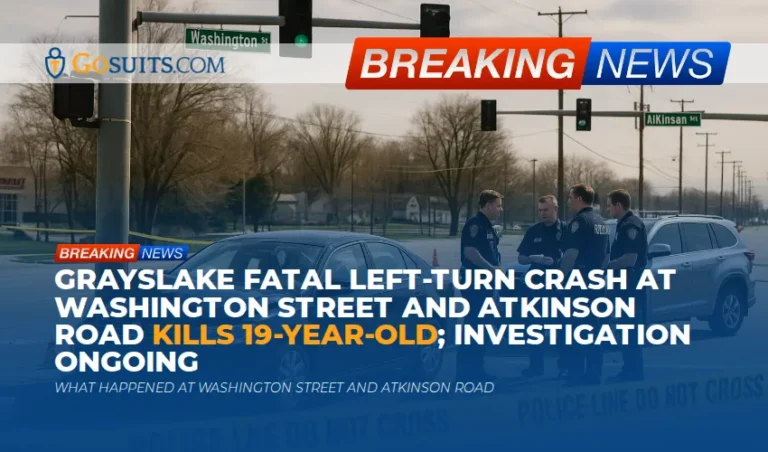
On Monday afternoon in Grayslake, a black Volkswagen traveling eastbound on Washington Street collided with a westbound Toyota SUV that was attempting to turn south onto Atkinson Road. After the impact, the Volkswagen struck a traffic light pole. Both drivers were transported to area hospitals. The 19-year-old man driving the Volkswagen was pronounced deceased at Advocate Condell Medical Center in Libertyville. The 86-year-old woman driving the Toyota sustained non-life-threatening injuries and was hospitalized for care. Police noted the investigation was ongoing as of Monday evening.
Officials have not publicly attributed fault and have not released additional causation details. In the early hours and days after a serious collision like this, investigators typically focus on documenting the scene, securing video and physical evidence, identifying independent witnesses, and reconstructing vehicle movements. That process is especially careful at signalized intersections with turn phases, where right-of-way can hinge on timing, lane position, and signal indication.
When and where the collision occurred
The crash happened around 2:15 p.m. at the intersection of Washington Street and Atkinson Road in far north suburban Grayslake. This is a signalized intersection on a major east-west corridor in Lake County, with dedicated left-turn lanes and steady daytime commuter and local traffic. Given the time of day, traffic volumes often include school pickups, mid-shift commuters, and daytime deliveries, which can add turning movements and lane changes approaching signals.
Local context around this intersection
For those who live or work nearby, Washington Street serves as one of Grayslake’s primary arteries, connecting neighborhoods, shopping areas, and regional routes between Round Lake and Gurnee. Atkinson Road runs north-south and feeds residential subdivisions and business corridors. Intersections like Washington and Atkinson are designed to manage heavy turning movements safely, but even small timing mistakes or visibility issues can lead to severe outcomes, as the community has sadly seen here.
In Lake County, many signalized intersections use protected and permissive left-turn phases depending on time of day and traffic programming. That means on some phases drivers may turn only on a green arrow, while at other times they may turn on a circular green after yielding to oncoming traffic. The difference matters. If you pass through this area regularly, you know the light cycles can feel quick at peak times. That is by design to push traffic through, but it leaves little margin for error if a turn is misjudged.
How Illinois police investigate serious intersection crashes
When a fatality occurs, investigators in Illinois typically employ a thorough collision reconstruction process. That can include:
- Scene documentation: Measurements of skid marks, gouges, vehicle rest positions, and pole impacts; mapping the intersection and signal heads; and logging debris patterns that suggest angles and speeds.
- Signal timing review: Obtaining timing charts and logs for Washington and Atkinson to determine phase status at the moment of impact, where available. Signal timing is often managed by county or municipal transportation departments, such as the Lake County Division of Transportation or a village traffic engineer.
- Vehicle inspections: Assessing damage profiles, checking airbag modules, and reviewing electronic data recorder information when available.
- Witness interviews: Locating neutral witnesses and collecting accounts while memories are fresh.
- Video capture: Seeking traffic camera, nearby business, and doorbell camera footage before it is overwritten. Traffic cameras and private video systems often have short retention windows.
Crash statistics from federal and state agencies show that intersections remain a significant source of serious injuries and deaths, especially involving left turns and permissive turn phases. Federal highway safety resources identify that a large share of intersection crashes are related to inadequate gap selection during left turns and misinterpretation of signal indications. These general patterns inform how investigators analyze situations like the one at Washington and Atkinson [10] [11].
Illinois laws that matter in left-turn and signalized intersection crashes
Illinois law gives clear guidance about who must yield at intersections and during left turns. Key rules include:
- Left turns must yield: A driver intending to turn left must yield the right-of-way to any vehicle approaching from the opposite direction that is so close as to constitute an immediate hazard. This rule still applies when the turn is made on a circular green, as opposed to a green arrow. See 625 ILCS 5/11-902 [1].
- Obedience to traffic control signals: Drivers must comply with traffic signal indications and may proceed only as authorized by the signal at their approach. See 625 ILCS 5/11-306 [2].
- Comparative negligence: Illinois follows modified comparative negligence. If more than one party is at fault, liability is apportioned by percentage, and a plaintiff’s recovery is barred only if that plaintiff is more than 50 percent at fault. See 735 ILCS 5/2-1116 [3].
- Wrongful death and survival claims: If a death is caused by a wrongful act or neglect, the decedent’s next of kin may pursue a claim under the Wrongful Death Act, and the estate may also pursue a Survival Act claim for harms the decedent suffered before death. See 740 ILCS 180 and 755 ILCS 5/27-6 [4] [5].
Because these rules are precise and fact-driven, outcomes often depend on reliable evidence of signal status, vehicle speeds, and gap acceptance. This is why preserving scene data, vehicle data, and video matters from day one.
For those seeking guidance, speaking with seasoned car accident lawyers who handle Illinois intersection cases can help clarify how these laws apply to the specific facts. Illinois law is unforgiving about deadlines, and the earliest decisions about evidence collection can shape everything that follows.
Potential civil liability and insurance paths after this crash
With one fatality and one injury, there are multiple civil law considerations. The core issues usually include who had the right-of-way, whether either driver failed to yield, and whether other factors contributed, such as visibility, signal timing, or roadway design. Here are common paths that arise in Illinois cases like this:
- Claim by the injured driver: The westbound Toyota driver, if not primarily at fault, may bring a bodily injury claim against the liability policy of the opposing driver’s vehicle. Damages can include medical expenses, pain and suffering, and other legally recognized losses. If responsibility is disputed, comparative negligence may reduce the recovery proportionally [3].
- Wrongful death and survival claims for the deceased teen: The estate can advance a Survival Act claim for conscious pain and suffering before death and a Wrongful Death Act claim on behalf of next of kin for losses such as grief and loss of society [4] [5]. Insurance coverage analysis typically includes the at-fault driver’s liability limits, potential underinsured motorist coverages, and any additional applicable policies.
- Potential public entity issues: If evidence suggests a traffic signal malfunction or a hazardous condition tied to public maintenance or design, claims against a governmental entity may be explored. Illinois’ Local Governmental and Governmental Employees Tort Immunity Act imposes a one-year statute of limitations for actions against local public entities and their employees. See 745 ILCS 10/8-101 [12].
Even when fault appears straightforward, insurance companies often contest liability percentages or minimize injuries. In our experience, insurers quickly request recorded statements and push for early, low valuations before a full picture of medical needs and life impact emerges. It is common and it is strategic.
Given the local nature of this crash, those navigating the aftermath may benefit from the perspective of Grayslake car accident lawyers who understand Lake County road operations and how to pursue evidence from local agencies.
If you are learning about Illinois doctrines that can affect fault evaluation at intersections, this resource may help: Last Clear Chance Rule in Illinois Car Accidents. While it does not apply to every case, it is part of the broader framework lawyers consider when fault is contested.
Evidence to preserve near Washington and Atkinson
Time matters for preserving proof. If anyone connected to this incident is trying to safeguard information, consider the following:
- Traffic signal timing and logs: Identify which agency controls Washington and Atkinson for timing and maintenance. In Lake County, the Division of Transportation can be a starting point. Formal requests should be made as soon as possible because operational data and logs may rotate or be overwritten [9] [13] [14].
- Nearby video: Businesses, residential doorbells, and traffic cameras may capture crucial frames, especially for lane position and signal status. Many systems overwrite within days.
- Vehicle electronic data: Event data recorders can store pre-crash speeds, brake application, and throttle. Prompt steps are often required to secure vehicles and prevent spoliation.
- Scene photos and measurements: Even days later, photographs of signal heads, sightlines, and lane markings can help experts reconstruct the event.
- Medical documentation: Immediate and follow-up medical records, imaging, and provider notes create the backbone of injury proof. Keep all discharge instructions and bills organized.
When in doubt, have counsel issue preservation letters to relevant parties and agencies to reduce the risk of critical information disappearing.

How to obtain the official police report
Illinois crash reports are generated by the responding agency. For a Grayslake incident, that is often the Grayslake Police Department, though multi-agency response can occur. Here are public pathways commonly used in Illinois:
- Illinois State Police crash reports: Some reports can be accessed through the Illinois State Police crash portal. If the report was filed by ISP or otherwise made available, the portal provides a structured way to search and purchase reports [6].
- Freedom of Information Act requests: Illinois FOIA provides a process to request records from local public bodies. For municipal police reports, you can submit a request to the records department of the municipality. The Illinois Attorney General provides FOIA guidance, templates, and statutory timelines [13].
- Timelines and exemptions: Active investigations can delay release of certain details, and sensitive information may be redacted. FOIA frameworks explain these exemptions and how to appeal if needed [13].
Order the report as early as you can. It often includes the primary narrative, diagram, involved parties, witness contact information, and cited statutes, all of which can guide further evidence collection.
How to obtain coroner and autopsy records in Lake County
Because this crash involved a fatality, coroner records may exist. The Lake County Coroner’s Office manages medicolegal death investigations for the county. Families may request records directly from the coroner’s office, which typically provides instructions, required forms, and fee schedules for autopsy reports, toxicology, and related documents [7].
For official death certificates, the Illinois Department of Public Health maintains procedures and eligibility rules. Their guidance covers who may request a certificate, how to order, and what identification is required. This is often needed for estate administration and insurance claims [8].
Medical records and HIPAA releases after a crash
Hospitals treating crash victims in Lake County, including trauma centers, maintain medical records that can be requested with proper authorization. The U.S. Department of Health and Human Services outlines the right of access under HIPAA, including reasonable timelines, allowable fees, and the ability to direct records to a designated representative. Understanding these rules can help families and injured individuals obtain imaging, physician notes, and discharge summaries without unnecessary delay [9].
If multiple providers were involved, request records from each, including emergency transport if applicable. Keep all records and bills together and track dates of service. This is essential to document injuries, treatment plans, and prognosis in any insurance claim or lawsuit.
Safety and infrastructure takeaways for the Grayslake community
Intersection crashes continue to be a substantial share of severe traffic injuries in the U.S., with left-turn conflicts a recurrent hazard at signalized intersections. Federal roadway safety resources emphasize several interventions and behaviors that reduce risk:
- Protected left-turn phases: Using a green arrow for left turns reduces conflicts compared to permissive left turns on circular greens. Transportation agencies calibrate these based on volumes and crash history [10].
- Clear sight triangles: Trimmed vegetation, aligned signal heads, and unobstructed approaches help drivers see oncoming traffic at a glance [10].
- Driver behavior: Accepting adequate gaps for left turns and avoiding entry on late yellow significantly lowers crash probability. State crash fact summaries regularly highlight intersection-related severity patterns and seasonal variations [11].
If you drive Washington Street daily, you know timing is tight at peaks. Consider waiting one more cycle if a gap feels tight or if an oncoming vehicle’s speed is uncertain. That small choice can make a life-saving difference.
The Illinois Secretary of State’s Rules of the Road is a practical refresher on signal rules, right-of-way, and defensive strategies. It is a good community habit to revisit it periodically, especially for teen drivers and older adults adapting to changing reaction times and visibility needs [15].
Next steps and why acting soon matters
After a severe intersection crash in Lake County, several practical steps can protect rights and reduce stress:
- Secure the police report: Use the ISP portal if available or submit a FOIA request to the municipal agency. The report is the anchor for most insurance evaluations [6] [13].
- Preserve evidence: Ask for signal timing data and any available maintenance logs from the responsible transportation agency. Quickly canvass for cameras within line-of-sight of Washington and Atkinson. Retention windows can be short [14].
- Organize medical documentation: Request hospital and clinic records through HIPAA-compliant authorizations and keep copies of all bills and prescriptions [9].
- Approach insurers carefully: Do not rush recorded statements. What is said early can be used to dispute liability or minimize injuries later. It is wise to contact an attorney first, get a free consultation to understand rights, and then plan communications with insurers accordingly.
- Calendar deadlines: In Illinois, most personal injury and wrongful death claims have a two-year statute of limitations. If any claim involves a local public entity, a one-year limit may apply under the Tort Immunity Act [12].
Why act now? Evidence fades quickly. Traffic logs rotate, vehicles get repaired or salvaged, and witnesses become harder to reach. Early organization and clear documentation can materially change how claims are evaluated and resolved.

Commentary from Gosuits Grayslake, Illinois Personal Injury Attorney
Our hearts are with everyone affected by the crash at Washington and Atkinson. A young life was lost, and another community member was hurt. That is devastating. This overview is meant for general information and education. It is not a substitute for advice about any person’s unique situation.
From what has been publicly reported, this collision happened during a left-turn movement at a signalized intersection. In Illinois, these are fact-intensive cases. Investigators will focus on the left-turn yield rule, signal status, timing, and whether either driver could or should have avoided the impact with an extra moment of caution. The pole strike after the initial collision also raises questions about impact forces and trajectories, which reconstruction often clarifies.
Insurance companies know the first few days set the tone. They commonly request recorded statements before people have the police report or medical clarity. Adjusters sometimes suggest shared fault percentages that are not grounded in the actual signal timing or scene geometry. Corporations and insurers operate on information advantages, and they use early statements to shape liability narratives and reduce payouts. It is a familiar playbook that strains families already dealing with grief or pain.
A free consultation can level the field. It helps people understand how Illinois law allocates fault at signals, what evidence to preserve, how medical proof should be organized, and which deadlines apply, including the one-year limit for claims against local entities in some situations. Knowing these points early can prevent avoidable missteps and reduce the chance of important evidence going missing.
References
- 625 ILCS 5/11-902 Left Turns – Illinois General Assembly
- 625 ILCS 5/11-306 Traffic Control Signals – Illinois General Assembly
- 735 ILCS 5/2-1116 Comparative Negligence – Illinois General Assembly
- Illinois Wrongful Death Act, 740 ILCS 180 – Illinois General Assembly
- 755 ILCS 5/27-6 Survival Act Claims – Illinois General Assembly
- Illinois State Police Crash Reports – ISP
- Lake County Coroner’s Office – Lake County, IL
- Death Records – Illinois Department of Public Health
- Individuals’ Right under HIPAA to Access Health Information – HHS
- Intersection Safety – Federal Highway Administration
- Crash Facts and Statistics – Illinois DOT
- 745 ILCS 10/8-101 Statute of Limitations for Public Entities – Illinois General Assembly
- Freedom of Information Act in Illinois – Illinois Attorney General
- Lake County Division of Transportation – Lake County, IL
- Illinois Rules of the Road – Illinois Secretary of State