- What happened in Glendale and where it occurred
- Injuries reported and emergency response
- Who is investigating and what comes next
- Safety and legal context of train and car collisions at crossings
- Potential civil liability issues in a train and car collision
- Where families can get official records and practical help
- Insurance and claims considerations after a fatal train and car collision
- Community safety reminders for Glendale rail crossings
- Time sensitive steps people can take now
- Commentary from Gosuits Glendale, California Personal Injury Attorney
- References
What happened in Glendale and where it occurred
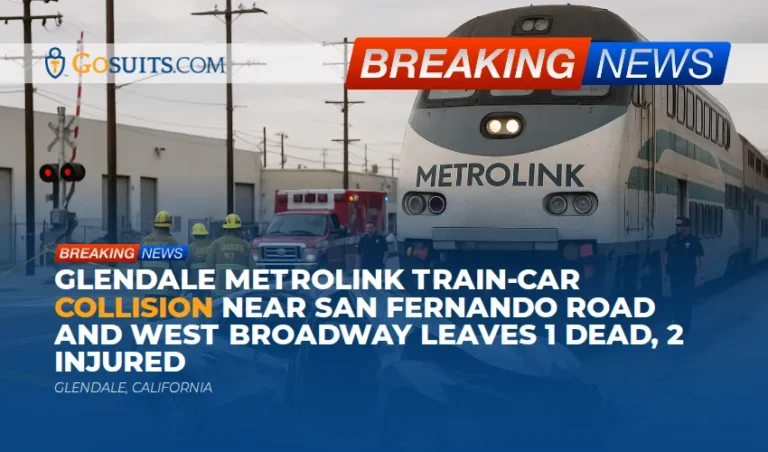
On a clear Wednesday morning around 9 a.m., a Metrolink commuter train traveling the Antelope Valley Line struck a car between the Burbank and Glendale stations. Authorities indicated the crash took place near San Fernando Road and West Broadway, on the busy rail and roadway corridor that parallels the Los Angeles River through Glendale’s industrial and commercial blocks. That stretch is not far from the Glendale Transportation Center, the Americana at Brand, and the Glendale Galleria, and it sits at the daily crossroads of motorists, pedestrians, and train commuters heading to and from downtown Los Angeles.
According to officials at the scene, the train involved was Metrolink train 206. The crossing protection equipment and the precise circumstances of the impact were not immediately detailed by investigators on site. After the collision, rail service was disrupted while responders worked and investigators began documenting the scene. The train was later permitted to proceed into Glendale with its passengers, but the tracks in the area remained closed for a period while the investigation continued.
Injuries reported and emergency response
One person inside the car was pronounced dead. Another occupant of the vehicle and a bystander were transported to area hospitals. Glendale Fire Department and Los Angeles County Fire Department personnel assessed additional patients from the train, with at least two passengers evaluated and treated at the scene before the train moved on. The Los Angeles County Medical Examiner’s office arrived later in the morning to take jurisdiction for the decedent and begin standard procedures for post-incident examination and identification.
When tragedies happen at a crossing, the response often involves several agencies at once. In Glendale and along the San Fernando Road corridor, it is common for Glendale Police Department to secure the scene, for Glendale Fire Department and LA County Fire Department to manage medical care and hazards, and for regional rail stakeholders to assist with rail safety and service coordination.
Who is investigating and what comes next
The Glendale Police Department is the lead investigating agency for this collision, which is typical for serious injury or fatal crashes within city limits. While the police investigation focuses on the crash scene, traffic control devices, witness interviews, and physical evidence from both the vehicle and the train, several other processes can occur in parallel.
First, railroads and transit operators have federal reporting obligations for certain deaths, injuries, and damages. Those reports are made to the Federal Railroad Administration under federal accident and incident reporting rules [2]. Second, depending on the facts, state rail safety regulators may review the crossing’s characteristics and any involved warning systems. In California, rail crossing safety engineering and oversight is part of broader rail safety efforts at the state level as well as federal initiatives through the U.S. Department of Transportation. The federal government funds and guides safety improvements at public rail crossings under the Section 130 Rail-Highway Crossings Program [3].
On the transportation safety side, the National Transportation Safety Board has long studied the human factors, signaling, and vehicle dynamics that make highway-rail grade crossing crashes especially severe. While not every crash triggers an independent NTSB investigation, the Board’s published safety materials provide helpful context for why these collisions are often deadly even at moderate train speeds [4].
Safety and legal context of train and car collisions at crossings
Highway-rail grade crossings are uniquely hazardous places. Trains cannot stop quickly, motorists can misjudge speeds and distances, and even brief decision-making errors can have irreversible consequences. Federal safety agencies emphasize that passive and active warnings only work if road users notice them and comply. FRA and FHWA materials stress engineering solutions like gates, flashing lights, improved sight lines, and median separators, but they also emphasize driver behavior and enforcement as a critical safety layer [1] [3].
California law requires drivers to stop and remain stopped at railroad crossings when a gate is lowered or when a signal device warns of an approaching train. The California Vehicle Code makes it unlawful to proceed through lowered gates or to drive around lowered or lowering gates [5]. These rules reflect the reality that trains cannot swerve and need long distances to come to a stop.
In the aftermath of any crossing collision, investigators typically look at three broad categories of information. First is the functioning of warning devices such as gates, lights, and bells, including whether they activated and for how long. Second is the train’s movement data, horn use, and the crew’s actions. Third is the conduct of roadway users. Federal rules require railroads to maintain and report safety data about incidents, and modern locomotives are equipped with event recorders that can supply speed, braking, and other parameters [2] [12].
Potential civil liability issues in a train and car collision
From a personal injury and wrongful death perspective, fault analysis in a train and car collision is fact intensive and depends on physical evidence and reliable witness accounts. Potential civil liability can involve multiple parties and theories, including:
- Driver conduct at the crossing. Whether a driver stopped, obeyed gate arms and flashing lights, and exercised reasonable caution is often central. California’s statutory rules and common law duties both matter [5].
- Warning device performance and maintenance. The functionality, timing, and visibility of crossing signals and gates can be scrutinized. Relevant records may include inspection logs, maintenance histories, diagnostic downloads, and agency correspondence related to the crossing [1] [3].
- Train operations and data. Locomotive event recorders can show train speed, horn usage, and braking profiles. Some locomotives also have forward-facing cameras. Event recorder requirements are set in federal regulation [12].
- Roadway design and visibility. Sight distance, roadway approach angles, and signage can contribute. While many improvements are federally supported, actual conditions at each crossing can vary widely [3].
- Injuries to bystanders and passengers. People struck by debris or harmed during evacuation may have claims that are evaluated separately from the vehicle occupants, depending on their role and location at the time of impact.
Families often ask whether pursuing claims after a train and car collision is different from a typical traffic crash. The presence of a public entity or transit operator can add steps, including compliance with California’s Government Claims Act deadlines for presenting claims before any lawsuit is filed. More on timing appears below [6].
Where families can get official records and practical help
Within days and weeks of a fatal collision, obtaining accurate, official records is critical. These records help families understand what happened and preserve their rights in any civil claims. Here are the core sources and how they typically help in Los Angeles County and Glendale.
Glendale Police Department collision report
The Glendale Police Department is the lead investigating agency. Its traffic investigators prepare the primary collision report, scene diagrams, and photo logs. Families or their authorized representatives can request the report through the Glendale Police Department’s Records Bureau. The City of Glendale’s police department page provides general information on services and records access [9].
Los Angeles County Medical Examiner-Coroner
The Medical Examiner determines cause and manner of death and maintains the official death investigation file. Families can inquire about status and, once available, request copies of the autopsy report and toxicology. The Los Angeles County Medical Examiner’s website has public guidance and contact routes for records requests [8].

Railroad and crossing data
Public data tools maintained by the FRA can help identify the crossing and review historical information. The FRA’s crossing inventory database allows searches by location to see crossing characteristics and control types. This can be useful to understand whether a crossing is public or private and what protection it uses [11].
911 audio, CAD logs, and public records
California’s Public Records Act gives the public a right to request many government records. While some sensitive materials may be exempt or delayed during an active investigation, families can often request non-exempt dispatch logs, certain scene photos, and communications related to roadway closures or signal maintenance. The statutory framework for access appears in the Government Code at sections 6250 and following [7].
Medical transport and treatment records
Hospitals and EMS providers maintain their own records. Glendale-area transports often go to regional trauma centers depending on injury severity and routing. Each provider has a medical records department with HIPAA procedures for authorized family release.
Families sorting paperwork after a sudden loss can feel overwhelmed. A practical, plain-language checklist can help organize what to gather and when. This guide may help: Los Angeles Wrongful Death Paperwork Checklist for Families.
Insurance and claims considerations after a fatal train and car collision
Insurance questions can get complicated quickly when a passenger rail vehicle and a private automobile are both involved. These are common areas people ask about, along with general considerations that often arise in Southern California collisions.
- Government Claims Act timing. If a claim may involve a public entity, California’s Government Claims Act generally requires a written claim within six months for claims relating to personal injury or wrongful death. Filing deadlines are strict and are set by statute [6].
- Private auto insurance issues. Claims may implicate the private driver’s liability coverage, as well as uninsured or underinsured motorist coverage for injured occupants who were not at fault. Medical payments coverage can also come into play for immediate expenses, depending on the policy.
- Multiple claimants and limited limits. When several people are injured, policy limits can be quickly exhausted. This is especially important in collisions involving trains because injuries may affect vehicle occupants, bystanders, and passengers.
- Preserving critical evidence. Locomotive event recorder data, any forward-facing camera footage, crossing diagnostic logs, and nearby CCTV are often time sensitive. Some data can be overwritten in days or weeks. Early, written preservation requests are key [12].
- Do not rush recorded statements. People often feel pressured to give a recorded statement to an insurer within hours. What someone says can be used against them later. It is wise to consult an attorney first to understand rights and obligations before speaking with insurance adjusters.
Families coping with a fatality often need guidance on long-term decisions such as succession-related paperwork, claims paperwork, and whether to pursue civil action. Speaking with seasoned wrongful death attorneys can help people understand general options, typical timelines, and potential pitfalls without committing to any immediate step.
When a loss occurs within Glendale city limits, many people look for local support and guidance. Consulting with Los Angeles wrongful death attorneys can provide context on how claims generally move forward in Los Angeles County courts and how the Government Claims Act’s six-month notice requirement can affect strategy and timing [6].
Community safety reminders for Glendale rail crossings
Daily life in Glendale includes regular train movements along the corridor between Burbank and downtown Los Angeles. Whether you drive down San Fernando Road to reach the 5, walk to lunch around Brand Boulevard, or commute by rail from the Glendale Transportation Center, these reminders from federal and state safety materials are worth keeping close [1] [3] [5].
- Assume a train is coming at any active track. Trains can be quiet and can approach faster than they appear. Never stop on the tracks.
- Respect gates and flashing lights. Do not drive around lowered or lowering gates, and do not enter a crossing until there is room to clear completely on the other side [5].
- Watch your sight lines. Buildings, parked trucks, and curves along industrial blocks near crossings can hide oncoming trains until late. Slow down and scan.
- Give yourself an exit. In heavy traffic near West Broadway or across San Fernando Road, avoid stopping on the tracks when queues back up.
- If your vehicle stalls on the tracks, get out and move away immediately. Many crossings post an emergency notification number. If you can, call the number on the blue Emergency Notification System sign to report a stuck vehicle at a crossing, then dial 911.
- On foot or bike, cross only at designated locations. Trespassing on tracks away from legal crossings is dangerous and illegal.
Time sensitive steps people can take now
In the days after a rail and vehicle collision, acting with intention can make a meaningful difference, especially where evidence and deadlines are concerned. Here are focused tasks that can protect information and help clarify what happened.
- Secure official reports and status updates. Request the Glendale Police Department collision report when available and monitor the Medical Examiner’s case status. These records become the foundation for understanding the facts.
- Preserve video and data immediately. Send written preservation requests for any nearby CCTV, crossing diagnostics, locomotive event recorder data, and forward-facing camera footage. Many systems automatically overwrite data in as little as 7 to 30 days.
- Document the scene and vehicle condition if possible. If the vehicle is released from evidence, photograph all sides, undercarriage, interior, and any impact points before repairs or salvage. Keep all parts and do not authorize disposal without considering future inspection needs.
- Track medical care and expenses. Start a simple log of appointments, travel, invoices, and out-of-pocket costs for any injured person. Save discharge papers and imaging CDs.
- Avoid early recorded statements. Before calling any insurance company, consult an attorney to understand what information must be given and what can wait. Statements and forms can affect later options.
- Calendar key deadlines. If a public entity could be involved, note the six-month Government Claims Act timeline that can apply to personal injury or wrongful death claims in California [6].

Commentary from Gosuits Glendale, California Personal Injury Attorney
Our hearts go out to everyone affected by this collision. A morning commute turned tragic near the heart of Glendale, and the ripples through families, coworkers, and neighbors are real. This article is shared for education and general information.
From a personal injury standpoint, a train and car collision raises urgent questions about crossing protection, visibility, and timing. These cases require careful reconstruction. Investigators will look closely at the performance and timing of gates and lights, the train’s speed and horn use, and the actions of road users. Preserving locomotive event recorder data and any forward-facing camera footage is critical, along with any nearby business CCTV along San Fernando Road.
In our experience, insurance carriers and large organizations often move quickly to manage exposure. Adjusters can ask for recorded statements before families have key facts. Claims departments may cite policy language to narrow benefits. Public entities may lean on strict claim-presentment rules. None of that is unusual, but it can feel overwhelming in the face of a sudden loss. Understanding what must be shared, what can wait, and how to request preservation of evidence can help level the field.
A confidential, no-cost consultation can be valuable in moments like this. It gives people space to ask questions, understand typical timelines, learn about Government Claims Act requirements, and consider options without committing to any immediate course. Even one conversation can help people avoid common missteps, especially around recorded statements and time-sensitive evidence.
References
- Highway-Rail Grade Crossing Safety – Federal Railroad Administration
- 49 CFR Part 225: Railroad Accidents and Incidents – eCFR
- Rail-Highway Crossings (Section 130) Program – Federal Highway Administration
- Rail-Highway Crossing Safety Issues – National Transportation Safety Board
- California Vehicle Code Section 22451: Obedience to Railroad Crossings – California Legislature
- California Government Code Section 911.2: Time for Presentation of Claims – California Legislature
- California Public Records Act, Gov. Code 6250 et seq. – California Legislature
- Los Angeles County Medical Examiner-Coroner – County of Los Angeles
- Glendale Police Department – City of Glendale
- FRA Office of Railroad Safety: Grade Crossings – Federal Railroad Administration
- FRA Highway-Rail Crossing Locator – Federal Railroad Administration
- 49 CFR 229.135: Event Recorders – eCFR
- California Driver Handbook – California DMV