- What We Know About the Glendale I 5 Freeway Collision
- Location and Community Context Near Colorado Street
- Legal Issues When a Government Vehicle Is Involved
- How Liability May Be Determined in a Three Vehicle Crash
- Where to Get Official Records and Who to Call
- Medical Care, Documentation, and Common Injuries After a Rollover
- Insurance Layers That May Apply
- Timelines and Deadlines That Affect California Claims
- What to Expect From a CHP Investigation
- Safety Notes for Drivers at I 5 and Colorado Street
- Next Steps: Why Acting Soon Matters
- Commentary from Gosuits Glendale, California Personal Injury Attorney
- References
What We Know About the Glendale I 5 Freeway Collision
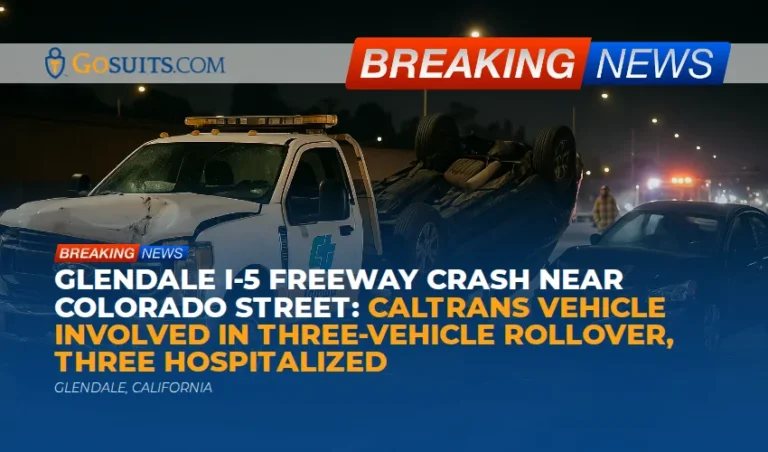
Late Thursday night, around 10:24 p.m., California Highway Patrol officers responded to a three vehicle collision on the northbound Golden State 5 Freeway near the Colorado Street interchange in Glendale. According to CHP, one of the vehicles involved belonged to the California Department of Transportation, commonly known as Caltrans. At least one vehicle overturned. Los Angeles Fire Department paramedics transported three individuals to a local hospital. Their conditions were not immediately available when the incident was reported. These details help set the scene and underscore the kind of evidence that will matter later, such as the precise location on the northbound side and the presence of a government vehicle on or near active lanes.
When a crash occurs on a state freeway within Glendale city limits, CHP typically leads the traffic investigation while LAFD handles medical response and fire suppression. The combination of a late hour, an interchange area with complex merging, and an overturned vehicle points to the likelihood of significant debris fields and multi lane impact points. That makes prompt evidence preservation especially important once it is safe to do so.
Location and Community Context Near Colorado Street
People in Glendale know the northbound stretch of I 5 at Colorado Street well. It is a transition zone where drivers are either coming up from the Los Angeles River corridor past Atwater Village or moving toward the Glendale Boulevard and 134 split. You can feel traffic patterns change quickly at night as lanes open up and speeds rise, even as occasional Caltrans activity or incident response can narrow shoulders.
Local commuters leaving evening events at the Americana at Brand or Glendale Galleria sometimes enter the freeway in batches, which can create waves of acceleration and braking. Add in the frequent nighttime maintenance windows favored to minimize daytime congestion and you have a setting where an official vehicle might be present near the shoulder, a ramp, or a closure taper. These are ordinary realities of Glendale freeway life, but they raise special safety and legal questions when something goes wrong.
Legal Issues When a Government Vehicle Is Involved
Any freeway crash can trigger complex claims. When a Caltrans vehicle is involved, additional rules come into play because public entities in California are governed by the Government Claims Act. Before most lawsuits for personal injury can be filed against a state agency, a written claim generally must be presented within a short statutory period, often six months from the date of injury. The rules and exceptions are set by statute and are strict [1] [2].
Here are several legal questions that commonly arise after a crash that includes a public agency vehicle:
- Was the Caltrans vehicle actively working or stationary at the time of the collision, and did its driver comply with work zone or roadside safety protocols recognized by state and federal guidance [3]?
- Were temporary traffic control devices like cones, signs, or arrow boards properly placed and visible at night if work or a closure taper was in progress [3]?
- Was another driver’s negligence the primary cause of the impact sequence, with the Caltrans vehicle simply a secondary contact due to chain reaction forces?
- Are there potential vicarious liability questions if any non state contractors or subcontractors were present and directing traffic control?
Complex, multi party crashes are one reason many people consult seasoned counsel before dealing with insurance carriers. Talking to car accident lawyers who regularly handle freeway collisions can help you understand how public entity claims interact with private auto insurance and what proof best supports each theory of liability.

How Liability May Be Determined in a Three Vehicle Crash
Liability analysis starts with the basics and then gets technical as needed. On a Glendale freeway at night, investigators will first secure the scene and document the vehicle rest positions, gouge marks, fluid trails, and debris fields. They will identify first points of impact and, where possible, determine a movement path for each vehicle leading up to the final positions. Photographs, scene diagrams, and measurements are routine parts of this work and can become the backbone of how fault is allocated later.
Useful evidence in a crash with an overturned vehicle and a government fleet vehicle may include:
- CHP collision report and supplemental diagrams. These capture statements, witness information, and the officers’ initial factual observations about lanes affected, lighting, and roadway conditions.
- Event Data Recorder information from some passenger or fleet vehicles, which can document speed, braking, and seat belt status seconds before impact. Preservation requests need to be sent quickly if EDR data could be overwritten by subsequent use or power cycling.
- Dashcam or body worn camera video from first responders and any involved fleet units. Government and commercial fleets often run continuous dashcams that can capture critical angles of a night time crash.
- Work zone documentation if Caltrans or a contractor had an active operation nearby. Plans should show taper length, sign spacing, and lighting requirements. Federal work zone guidance provides a framework agencies follow to minimize risk to traveling motorists and crews [3].
- Traffic camera and third party video. Some interchanges and nearby streets have cameras managed by transportation agencies. Prompt requests are important because video retention can be short.
For readers who want a practical checklist tailored to greater Los Angeles when a large or government vehicle is involved, this resource can help: Los Angeles commercial vehicle crash checklist.
Independent witnesses matter in multi vehicle freeway collisions where each driver’s view can be limited by darkness, glare, or the surprise of a sudden rollover ahead. So do physical facts that do not change, like skid lengths or where glass and plastic fragments landed across lanes. The more those objective markers are documented promptly, the fewer disputes there tend to be later.
Where to Get Official Records and Who to Call
Several agencies and institutions may have records that help families understand what happened and what to do next. The following is a quick guide to who typically holds what, and when to contact them. Inline references point to publicly available government or academic sources for general process information where available.
- California Highway Patrol collision report. CHP prepares the official traffic collision report for freeway crashes. Requests are generally made through the local CHP Area Office that handled the investigation using the Application for Release of Information form commonly known as CHP 190. Guidance and forms are provided by CHP [4]. The CHP Computer Aided Dispatch incident log, which provides time stamped call entries, can also be useful for timelines [5].
- Caltrans lane closure logs and traffic conditions. If lane closures or maintenance were active, Caltrans may have related logs. The agency’s traveler information system can provide context about real time conditions at the time of a crash [6].
- Hospital and EMS medical records. Patients have a right under federal law to access their medical records, including emergency department records and imaging. This includes records from Los Angeles County designated trauma centers where applicable [7] [8].
- Los Angeles Fire Department patient care reports. If LAFD transported or treated someone, a patient or their legal representative can typically request the EMS report. Contact the LAFD EMS records unit for instructions. Because this is a city service, requests often require proof of identity and a HIPAA authorization.
- Coroner’s records. If a crash involves a fatality elsewhere in the county, next of kin may contact the Los Angeles County Department of Medical Examiner for investigative status, reports, and release information [9]. This Glendale incident did not report fatalities at the time of publication, but the resource is listed for completeness.
- DMV accident reporting. California requires certain accidents to be reported to the DMV within a short time, usually 10 days, using a specific form if there are injuries or sufficient property damage. The DMV explains the general requirements and forms on its official site [10].
It is wise to organize requests and keep copies of everything submitted. If a public entity could be involved in a civil claim, the timing of these requests should be coordinated with any claim presentation deadlines under state law [1] [2].
Medical Care, Documentation, and Common Injuries After a Rollover
Overturned vehicles change injury patterns. Even at city freeway speeds, rollovers can transmit complex rotational forces to the head, neck, and torso. It is common for emergency clinicians to screen for traumatic brain injury, cervical spine injury, chest trauma, and internal bleeding after such events. NHTSA reminds the public that rollovers, while relatively infrequent compared to other crash types, are more likely to result in serious or fatal injuries, particularly when seat belts are not in use [11] [12].
From a recovery and documentation standpoint in the Glendale area:
- Follow through with trauma or ER discharge instructions and schedule follow up with a primary care or specialist provider as recommended. If symptoms evolve in the first 48 hours, return for care.
- Collect and store records from the hospital, urgent care, imaging centers, and physical therapy. Keep a simple journal of pain levels and functional limitations. This helps bridge the gap between snapshots in the medical chart and daily life impact.
- Track out of pocket costs and missed work. Save receipts and keep a calendar log of missed shifts or reduced duties. These materials support wage loss and expense claims later.
Where care is rendered at a Los Angeles County designated trauma center, the County’s trauma system resources offer helpful context about the types of facilities that may provide the highest level of emergency care in the region [8].

Insurance Layers That May Apply
Serious multi vehicle freeway crashes often involve multiple insurance layers and policy types:
- Private auto liability for the driver who is found responsible for causing the crash.
- State or public entity coverage related to a Caltrans vehicle, subject to Government Claims Act claim procedures and immunities.
- Uninsured or underinsured motorist coverage on a victim’s own policy, if the at fault driver is uninsured or insufficiently insured.
- Medical payments coverage that may help with immediate out of pocket medical costs, depending on the policy.
- Health insurance subrogation or liens if a health plan covers treatment and later seeks reimbursement from any settlement or judgment.
- Workers’ compensation if any injured person was on the job at the time, including rideshare or delivery drivers passing through Glendale.
Because statements to an insurer can be recorded and used later, individuals frequently choose to speak with an attorney first before contacting any insurance adjuster. What someone says about pain levels, pre existing conditions, or how the crash unfolded can affect how insurers value a claim later on.
In complex freeway collisions with public and private actors, guidance from Glendale car accident lawyers can help people map out which coverage applies first, how to avoid gaps, and when to send time sensitive notices.
Timelines and Deadlines That Affect California Claims
California law sets strict timeframes. Two often relevant timelines are:
- Government Claims Act deadlines. To pursue most personal injury claims against a California public entity, a written claim generally must be presented within six months of the injury date. Missing this window can bar the claim except in limited circumstances [1] [2].
- DMV reporting duty. California drivers must report certain crashes to the DMV within 10 days, typically when there are injuries, fatalities, or qualifying property damage. The DMV outlines these thresholds and the required form on its official site [10].
Other deadlines may apply depending on the facts, including time limits imposed by specific insurance policies for medical payments or uninsured motorist claims. Calendar these dates early and confirm them with a legal professional familiar with California procedures. For more background on public entity claims in this region, you may find this resource useful: Claims Act deadline in Los Angeles Gosuits Injury Lawyers.
What to Expect From a CHP Investigation
After a freeway collision in Glendale, CHP typically controls traffic, documents the scene, and interviews involved parties and witnesses. If a collision triggers criteria for a deeper technical review, specialized teams within CHP can conduct more advanced analyses. CHP’s operations include a process for major incident review, and in severe cases statewide multidisciplinary teams may be assigned. While not every crash receives that level of response, knowing that specialized resources exist can reassure families that serious incidents receive careful attention. The starting point for most families remains the standard CHP collision report and any available supplemental documents.
CHP’s Computer Aided Dispatch publicly viewable log can corroborate time stamps, lane closures, and medical response intervals, which often matter in reconstructing chain reaction events [5]. If you believe additional technical data exists, like fleet dashcam footage or EDR data, consider sending preservation requests promptly through appropriate channels.
Safety Notes for Drivers at I 5 and Colorado Street
Residents know that night driving here can be deceptively quick. A few reminders tailored to this corridor:
- Expect sudden slowdowns. Traffic can stack near the interchange, then surge. Maintain ample following distance and scan ahead for unusual light patterns that may signal a work zone or incident response.
- Watch for shoulder activity. Caltrans and emergency responders sometimes operate near the gore point or on the right shoulder at night to reduce peak hour disruption. Respect arrow boards and give roadside crews the widest possible berth.
- Mind ramp merges. Colorado Street and nearby ramps can feed vehicles in tight packs. Smooth accelerator input and courteous zipper merges help avoid hard braking that cascades through lanes.
- Secure loose cargo. Debris on the freeway at night is especially dangerous. Check tie downs and keep loads within legal limits.
These are small habits, but on a busy corridor that connects Glendale with neighborhoods like Atwater Village, Elysian Valley, and Burbank, they make a daily difference.
Next Steps: Why Acting Soon Matters
When a freeway collision involves multiple vehicles and a public agency fleet unit, timing and organization are everything. The following steps are framed for any Southern California reader who may one day face an unexpected crash. They are not directed to any specific person or family.
- Prioritize medical follow up. Early evaluation and treatment protect health and also create a clear record of injuries and causation. Delays give insurers room to argue that symptoms are unrelated.
- Preserve evidence proactively. Photos, vehicle damage images, and contact information for witnesses often fade with time. If a public entity may be involved, request that relevant video or data be preserved promptly.
- Collect official records. Obtain the CHP collision report and any available incident logs. These documents stabilize the basic facts and help align later expert work.
- Document financial impact. Track medical expenses, missed work, and other losses. It is easier to subtract non crash expenses later than to recreate missing records months down the line.
- Consult an attorney before speaking with insurers. Insurance adjusters may seek recorded statements quickly. An early legal consult helps people understand what to share, when, and how to avoid unintentional statements that can be used against them later.
- Calendar legal time limits. California’s short deadlines for claims involving public entities make a simple calendar your friend. Confirm dates and requirements for any claim presentation or lawsuit filings.
Start organizing your records today Schedule a free consultation to learn your rights Request your official collision report

Commentary from Gosuits Glendale, California Personal Injury Attorney
Our hearts are with everyone hurt in the I 5 and Colorado Street crash. Articles like this are for education and general information. They cannot replace advice tailored to the facts of a particular incident.
From a civil injury perspective, three vehicle freeway collisions at night are inherently complex. The reported rollover raises questions about speed, spacing, and reaction time in the moments before impact. The involvement of a Caltrans vehicle means investigators and any future claim evaluators will also look closely at whether traffic control or positioning near the shoulder followed established safety practices for nighttime operations. Those facts matter most, not assumptions made in the first 24 hours.
Insurance carriers and large institutions often move fast after incidents like this. Adjusters may request recorded statements, medical authorizations, or quick resolutions before the full picture is known. Corporations and agencies understand the rules. They also know many people do not. That information gap can affect how fault is framed and how losses are valued, especially when multiple policies and a public entity are in the mix.
That is why a free consultation is so important. It gives people a clear, no pressure way to learn about deadlines, evidence preservation, and how to navigate government claim procedures while protecting their rights. Even a short conversation early on can prevent avoidable missteps that are tough to fix later.
References
- California Government Code section 911.2 Claim Presentation Deadline – California Legislative Information
- California Government Code section 945.4 Prerequisite to Suit Against Public Entity – California Legislative Information
- Work Zone Safety and Mobility – Federal Highway Administration
- Records and Forms, including CHP 190 Application for Release of Information – California Highway Patrol
- Computer Aided Dispatch (CAD) Incident Page – California Highway Patrol
- QuickMap Real Time Traffic and Lane Closures – Caltrans
- Your Right to Access Your Health Information – U.S. Department of Health and Human Services
- Los Angeles County Trauma System and Trauma Centers – Los Angeles County Department of Health Services
- Los Angeles County Department of Medical Examiner – Los Angeles County
- Vehicle Accidents Information and Reporting – California DMV
- Rollover Safety Overview – National Highway Traffic Safety Administration
- Seat Belts: Get the Facts – National Highway Traffic Safety Administration