- Gainesville pedestrian fatality on US 82: what we know
- Where the crash happened and why this stretch of US 82 matters
- What investigators typically examine in a pedestrian SUV collision
- Texas rules for pedestrians and drivers at night
- Potential civil liability and insurance layers after a pedestrian death
- Steps to preserve evidence in the first days and weeks
- How to obtain police reports, crash records, death certificates, and autopsy information in Texas
- Grief, community support, and practical next steps in Gainesville
- How insurance companies respond to fatal crashes and how to protect yourself
- Time limits and who may bring a claim in Texas
- Caution before speaking with insurers or posting online
- Call to action: steps to take in the next 7 to 14 days
- Commentary from Gosuits Gainesville, Texas Personal Injury Attorney
- References
Gainesville pedestrian fatality on US 82: what we know
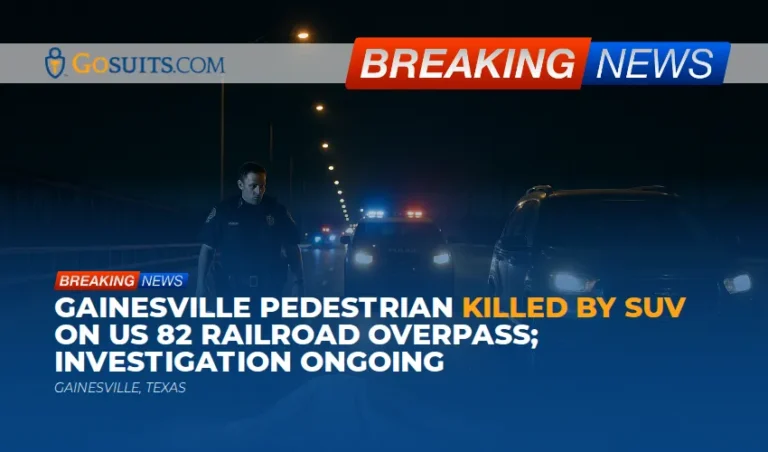
On Wednesday night in Gainesville, a pedestrian was struck by an SUV on the railroad overpass in the 100 block of East U.S. Highway 82. Gainesville Police reported that the pedestrian, identified publicly as a 36-year-old Gainesville resident, was walking in the lane of traffic when the collision occurred. He was transported to North Texas Medical Center, where he passed away from his injuries. Police stated the SUV driver remained at the scene, and the investigation is ongoing. This summary reflects the information Gainesville Police shared with local media. As with all active investigations, details may be updated as officials analyze roadway evidence, vehicle data, and witness accounts.
Where the crash happened and why this stretch of US 82 matters
Residents know the 100 block of East US 82 as the portion that crests the railroad overpass just east of the Gainesville square. Traffic here can be quick to bunch up, especially in the evening when commuters head back toward neighborhoods south of I-35 or east toward small communities in Cooke County. The overpass narrows visibility, there is little shoulder in places, and drivers can be focused on the slope and merging vehicles as they enter or exit the corridor. At night, all of those factors make it harder to see someone on foot in the travel lane.
Gainesville does not have the same level of continuous sidewalks along US 82 that you might find closer to Denton or the Dallas urban core. When someone ends up walking near or on the roadway in this area, the risks rise quickly, particularly in darkness or low light. Locals also understand that truck traffic from nearby industrial sites and rail activity can add another layer of complexity to nighttime driving around the overpass.
What investigators typically examine in a pedestrian SUV collision
When a pedestrian is struck on a highway overpass, investigation teams typically move through a standard but thorough checklist. While we do not have the final Gainesville Police findings yet, these are among the issues departments across Texas evaluate in similar circumstances:
- Scene measurements and lighting conditions including the exact lane position, presence of any shoulder, the angle of approach, and whether streetlights were functioning or present.
- Vehicle condition and data such as headlight settings, windshield visibility, and available event data recorder information that can sometimes show pre-impact speed and brake application.
- Driver statements and impairment screening with attention to distraction, visibility, and any hazards perceived before impact.
- Witness accounts and 911 timing to determine how quickly events unfolded and whether anyone observed earlier behavior relevant to the moment of impact.
- Roadway design and maintenance factors including signage, lane markings, pavement condition, and the physical constraints of the overpass.
- Pedestrian clothing and visibility such as dark attire, reflective material, or the use of a flashlight, which can weigh into nighttime visibility analysis.
In many pedestrian crashes, visibility and reaction time drive the outcome of a forensic reconstruction. On a grade like the US 82 railroad overpass, cresting the hill can shorten sight distances, which investigators will factor into their analyses.
Texas rules for pedestrians and drivers at night
Texas law assigns duties to both drivers and pedestrians. Pedestrians must use available sidewalks when provided, and if there is no sidewalk, they should walk on the left side of the roadway or shoulder facing oncoming traffic, as practicable. These duties come from the Texas Transportation Code, including the general rules that govern pedestrian use of roadways and sidewalks [1]. Drivers must exercise due care to avoid colliding with pedestrians, give warning by sounding the horn when necessary, and take proper precaution if they see someone who appears confused or incapacitated.
When crashes happen at night, the law does not change, but the practical safety expectations do. Headlights, speed selection for available sight distance, and careful scanning become even more critical. Federal and state safety agencies emphasize that low light significantly increases pedestrian crash risk, and highlight measures to improve visibility and driver detection at night, including reflective materials and enhanced roadway markings [5], [6].
For a deeper look at how rights and duties interact in these situations, see Pedestrian Rights in Car Accidents in Texas. The specifics of roadway design, signal control, and where a person was walking relative to the lanes can all affect how responsibility is analyzed.

Potential civil liability and insurance layers after a pedestrian death
In a pedestrian fatality, potential civil liability is typically considered through the lens of negligence. Factfinders assess whether the driver used ordinary care under the circumstances, whether the pedestrian’s actions contributed, and whether any roadway or third-party factors played a role. Texas follows a proportionate responsibility framework. If a claimant is found to be more than 50 percent responsible, recovery is barred, and if 50 percent or less, recoverable damages are reduced by the person’s percentage of responsibility [9]. These are complex issues, and each case turns on the specific facts and the available evidence.
Insurance coverage often comes from several directions:
- Driver’s liability insurance is the primary layer that may respond to bodily injury or death caused by the driver’s negligence. Texas requires minimum liability coverage, though many policies carry higher limits.
- Uninsured or underinsured motorist coverage on the decedent’s own auto policy, if any, can be an important safety net when a driver lacks sufficient coverage. Texas insurers offer UM or UIM, and policyholders can accept or reject it in writing. Consumer information is available from the Texas Department of Insurance [8].
- Personal Injury Protection or medical payments coverage, if purchased, may also provide benefits regardless of fault, subject to policy terms. TDI explains how these coverages work and how claims are evaluated [8].
Families often consult wrongful death lawyers to understand these layers and how they may apply. Even when liability appears clear or unclear, an early review of policy limits, exclusions, and notice requirements can prevent coverage disputes later.
Steps to preserve evidence in the first days and weeks
Evidence can disappear quickly after a roadway fatality, especially on a high-traffic corridor like US 82. Timely action helps ensure that what happened is captured accurately.
- Request preservation of vehicle data and dashcam footage. Many vehicles store short windows of speed and braking information. Some drivers and nearby fleet vehicles run dashcams that overwrite within days.
- Identify potential cameras. While US 82 does not have block-by-block traffic cameras like big-city arterials, nearby businesses, rail infrastructure, or TxDOT cameras may have captured fragments of the approach or aftermath. Ask in writing for preservation.
- Secure 911 audio and CAD logs. Dispatch recordings and computer-aided dispatch timelines can help corroborate sequence and timing. These are subject to public information rules and certain exceptions in Texas [7].
- Document the scene. Photographs of lighting, signage, lane markings, and any debris are essential. Return at the same hour of night, if safe, to capture conditions similar to the crash window.
- Locate witnesses. People who commute that stretch, employees at late-night businesses, or first responders may remember specific details that never make it into short news summaries.
- Obtain the official crash report. In Texas, crash reports are maintained through state systems and can be requested by eligible parties [2], [3].
When a loved one has died, these tasks can feel overwhelming. Delegating preservation requests and record retrieval to a trusted representative can reduce stress and safeguard critical proof.
How to obtain police reports, crash records, death certificates, and autopsy information in Texas
Several essential records can help families understand what happened and support civil claims. Here is where to start and what to know, based on Texas law and agency guidance.
Police crash report
Texas crash reports are maintained in statewide systems. The Texas Department of Public Safety provides guidance on requesting crash reports and certified records to eligible requestors, including involved parties and legal representatives [2]. The report number, crash date, and location will help locate the file. Reports are generally available after the investigating agency completes and submits the file.
TxDOT crash records and data
TxDOT maintains statewide crash data and provides public information on how crash reports are processed and who can purchase them. TxDOT’s safety and crash-records resources explain eligibility and timing, which can vary depending on agency workloads and the complexity of the investigation [3].

Death certificate
Death certificates in Texas are issued through the Texas Department of State Health Services Vital Statistics Section. Immediate family members and legal representatives can request certified copies following the state’s procedures [4]. The death certificate will include the manner and cause of death as certified by the physician or medical authority.
Autopsy and inquest information
Texas law provides that in certain deaths, including those occurring under suspicious or unnatural circumstances, an inquest is conducted by a justice of the peace or medical examiner. The Code of Criminal Procedure sets out when an inquest is required and the authority to order an autopsy [10]. In practice, smaller counties may rely on regional medical examiner facilities to perform autopsies ordered during an inquest. Family members can ask the justice court or the county office overseeing inquests about requesting copies of reports. Some information may be restricted during an active investigation, and portions may be redacted under public information exceptions [7].
911 audio, CAD logs, and supplemental materials
Dispatch audio, CAD printouts, photographs, and body-worn camera footage may be available through written requests under the Texas Public Information Act, subject to statutory exceptions for privacy and ongoing investigations [7]. When making requests, include dates, times, location specifics, and incident numbers if known. Note that some agencies charge fees for duplication or redaction work.
Grief, community support, and practical next steps in Gainesville
News like this hits hard. Gainesville is a tight-knit place, and many of us cross that US 82 overpass daily to grab groceries or head toward the square. When someone in our community is lost, neighbors step up, churches mobilize, and workplaces rally around the family. At the same time, the paperwork, calls, and decisions can pile up fast.
Here are a few practical steps that community members often find helpful after a roadway loss:
- Designate a point person. Choose one family representative to communicate with investigators and medical staff, so information flows smoothly and consistently.
- Write down timelines. Even simple notes of when calls came in, who responded, and what was said can make later decisions easier.
- Collect personal effects carefully. If items are released from the scene or the hospital, photograph them before storage and keep them in a secure place.
- Seek emotional support. Grief counseling through local faith communities, regional support groups, or county resources can make a difference. It is normal to need help, and it is okay to ask.
Residents also discuss roadway safety after tragedies like this. While every crash is unique, the combination of night driving, the overpass grade, and limited pedestrian refuge on US 82 has been a long-standing concern. State and local dialogue about lighting, signage, and safe crossings can honor those lost by reducing similar risks going forward.
How insurance companies respond to fatal crashes and how to protect yourself
Following a fatal pedestrian crash, insurance carriers move quickly to gather statements and evaluate exposure. Adjusters may contact family members early, sometimes before all facts are known, and ask for recorded interviews. They may request medical authorizations and attempt to discuss settlement value concepts before anyone has had a chance to digest the official findings. State consumer guidance underscores your rights in the claims process, including your right to understand what coverage applies and to receive fair claim handling under Texas law [8].
Consider these guardrails as you navigate early insurer outreach:
- Consult an attorney first. Before giving any recorded statement or signing documents, speak with a qualified attorney. What you say to the insurance company can be used against you later if facts are disputed.
- Limit authorizations. Broad medical or records releases can sweep in unrelated history. Narrowly tailor any authorization to the records truly needed for the claim.
- Do not discuss fault prematurely. Apportionment of responsibility in Texas is complex and depends on evidence that may not be available in the first days. Premature concessions can complicate the claim under proportionate responsibility rules [9].
- Document all communication. Keep a log of calls, emails, and letters from insurers. Save envelopes and note dates.
Families often turn to wrongful death lawyers to manage these communications, request preservation of evidence, and evaluate all available coverage before any negotiation begins.
Time limits and who may bring a claim in Texas
Texas law imposes deadlines on civil actions. Wrongful death claims are generally governed by the Texas Civil Practice and Remedies Code. In many cases, suit must be filed within two years, though specifics can vary based on the claim type and parties involved [11]. Wrongful death and survival statutes define who may bring claims and what categories of damages may be recoverable [12]. If a governmental entity is involved, different notice requirements and shortened deadlines can apply under separate statutes, so prompt evaluation is important.
Because facts and timelines differ, it is important for claimants to get case-specific guidance early rather than relying on generalized summaries. The clock can run while investigations are still pending.
Caution before speaking with insurers or posting online
In the days after a loss, friends and family naturally share memories, posts, and photos. Remember that public social media content is often scraped by insurance investigators and may be used in ways that feel unfair or out of context. Consider tightening privacy settings and pausing public posts related to the incident until you have had a chance to review potential implications.
The same caution applies to direct outreach from an insurer representing the driver. Do not feel pressured to provide immediate recorded statements. A brief, polite response that you will have a representative get back to them is enough while you arrange counsel. Taking this step protects against misunderstandings and preserves your ability to present the facts clearly.
Call to action: steps to take in the next 7 to 14 days
There are time-sensitive actions that materially affect how a pedestrian fatality case unfolds. Acting promptly helps preserve the truth of what happened and protects legal rights later.
- Send preservation letters now. Ask the investigating agency, any known insurers, and potential nearby businesses to preserve all video, photographs, 911 audio, CAD logs, and vehicle data. Many systems automatically overwrite within days.
- Request official records on a rolling basis. Submit requests for the police crash report and dispatch materials, and note that updates or supplements may be filed later as the investigation develops [2], [7].
- Collect family policy information. Locate any auto insurance policies for the decedent, including UM or UIM and PIP endorsements. Understanding coverage early avoids missed notice requirements [8].
- Document the location conditions. If safe, capture nighttime photos and video from the perspective of both a driver and a pedestrian on the overpass. Use caution and do not replicate dangerous behavior.
- Speak with a qualified attorney before any insurer call. A free consultation can clarify immediate next steps, including whether to give statements, how to route communications, and what to avoid saying.
Taking these steps within the first two weeks can shape the record that will ultimately drive any resolution, whether through negotiation or litigation.

Commentary from Gosuits Gainesville, Texas Personal Injury Attorney
Our hearts are with the family and friends affected by this loss. Sharing these details is meant to inform and support the community, not to intrude on grief. Every crash is different, and what follows is general information meant for education.
From a civil injury perspective, a nighttime pedestrian collision on the US 82 railroad overpass raises immediate questions about sight distance, lighting, vehicle speed selection for conditions, and pedestrian positioning relative to the lanes. Investigators will weigh driver conduct alongside pedestrian duties under the Transportation Code, and that balance will guide any liability analysis. Because the driver remained at the scene and an investigation is ongoing, it is prudent to let the forensic work run its course while preserving all available evidence in the meantime.
Insurance carriers and large corporations know these cases can be confusing in the early days. They often move fast to secure recorded statements, broad authorizations, and early concessions on responsibility. That speed is not for the family’s benefit, it is to shape the claim record. People do not always realize that casual comments can be quoted later, out of context, and used to reduce or deny compensation. Seasoned advocates push back by controlling the flow of information, insisting on full preservation of data, and carefully analyzing every coverage layer before any talk of resolution begins.
Obtaining a free consultation early matters. It levels the playing field, helps families understand how Texas law allocates responsibility, and clarifies what to do next, such as sending preservation notices, requesting the right records, and managing insurer outreach. It also gives space to grieve while someone handles the paper and process. Even if no claim is pursued, a short conversation can prevent missteps that are hard to undo later.
References
- Texas Transportation Code Chapter 552, Pedestrians – Texas Legislature Online
- Crash Reports and Records – Texas Department of Public Safety
- Pedestrian Safety Campaign – Texas Department of Transportation
- Death Certificates – Texas Department of State Health Services
- Pedestrian Safety – National Highway Traffic Safety Administration
- Crosswalk Visibility Enhancements – Federal Highway Administration
- Overview of the Public Information Act – Office of the Texas Attorney General
- Auto Insurance Help for Consumers – Texas Department of Insurance
- Proportionate Responsibility, Chapter 33 – Texas Legislature Online
- Code of Criminal Procedure, Chapter 49, Inquests and Autopsies – Texas Legislature Online
- Limitations of Personal Actions, Section 16.003 – Texas Legislature Online
- Wrongful Death, Chapter 71 – Texas Legislature Online