- What we know about the Frisco sledding accident
- North Texas context, winter weather, and neighborhood conditions
- Where families can request official records in Collin and Denton Counties
- Texas civil claims after a fatal or catastrophic injury
- Potential civil liability in a vehicle-towing-sled scenario
- Insurance coverage that may apply and early claim considerations
- Evidence to preserve and why winter conditions matter
- Grief, trauma, and local support considerations
- Communicating with insurers and on social media
- Time-sensitive steps a household can take this week
- Why timely action matters now
- Commentary from Gosuits Frisco, Texas Personal Injury Attorney
- References
What we know about the Frisco sledding accident
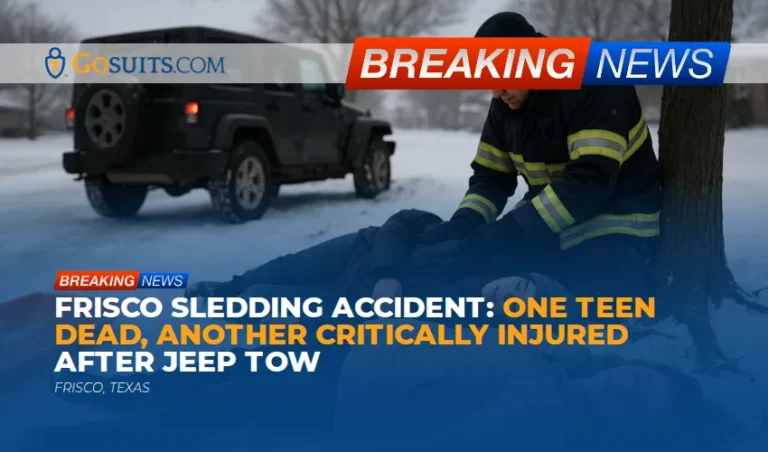
On a snowy Sunday in Frisco, a Jeep Wrangler reportedly pulled two sixteen-year-old girls who were sledding through a neighborhood. According to initial statements, something went wrong, and the teens struck a curb and a tree. Both were rushed to a hospital. One tragically died, and the other remains in critical condition. The Jeep’s driver was also 16. As of the latest update, police did not announce whether the driver will face criminal charges. Those details may evolve as investigators complete interviews, review scene evidence, and consult medical records. Frisco sits at the northern edge of the Dallas-Fort Worth metro area, where winter weather can move in quickly and leave neighborhood streets icy and unpredictable.
Some local readers also noted a separate cold-related death in Austin over the same weekend. City officials there highlighted the availability of emergency warming resources, including requests for help through the city’s 3-1-1 service. That tragic report underscores how extreme cold can create compounding risks across North Texas, from roadway conditions to exposure for vulnerable residents.
North Texas context, winter weather, and neighborhood conditions
Frisco neighborhoods from Panther Creek to the communities off Eldorado Parkway and Preston Road are no strangers to rapid weather changes. A day can begin with a brief thaw, then refreeze by night. Curbs that are ordinary in dry weather can become unforgiving hazards when snow hides edges and ice limits steering and braking. Many families enjoy sledding at places like Frisco Commons Park or smaller neighborhood greens when snow falls. Yet towing a sled behind a vehicle, even at low speeds, creates forces and stopping distances that most drivers and riders cannot accurately judge on icy surfaces.
Street layouts in residential areas around Lebanon Road, Teel Parkway, and Warren Sports Complex often include traffic-calming features such as curves, landscaped medians, and trees near sidewalks. Under winter storm conditions, those features can limit visibility or become collision points if a sled or vehicle loses traction. Even when a group believes they have picked a quiet street, conditions can change with a single patch of black ice or a misjudged turn.
Where families can request official records in Collin and Denton Counties
In the days after a serious incident, official records help clarify what happened. Different agencies hold different pieces of the record, and it is common to need more than one document.
Police crash report and supplemental records
In Texas, law enforcement crash reports are centrally distributed through the Texas Department of Transportation’s Crash Records Information System. Requests for the official CR-3 crash report usually go through TxDOT’s online portal once the report is approved and available [1]. Families can also contact the Frisco Police Department’s records unit for incident numbers, call-for-service logs, and guidance on the timeline for release of documents [2].

Medical Examiner and autopsy documentation
Frisco spans Collin and Denton Counties. Depending on where the decedent was pronounced and which agency has jurisdiction, either the Collin County Medical Examiner or Denton County Medical Examiner may hold the autopsy file. Next of kin typically can request the final autopsy report once complete, along with toxicology and associated case records if available [3] [4].
EMS and fire department records
If Frisco Fire Department responded, there may be pre-hospital care reports and times logs. The City of Frisco manages public information requests under Texas law. The city’s portal provides instructions for requesting EMS records consistent with privacy requirements [5].
Hospital records
Hospitals that commonly treat serious injuries for Frisco residents include facilities in Frisco and nearby Plano. Medical records departments can advise next of kin about authorizations needed. Hospitals may also have social workers who coordinate with families following critical incidents.
A practical tip, write down the police incident number, date and time, and the exact street or neighborhood where the crash occurred. That helps agencies find and confirm the correct file, especially when an event spans multiple responding agencies.
Texas civil claims after a fatal or catastrophic injury
In Texas, families may have paths under the wrongful death statute and the survival statute. Wrongful death claims allow certain surviving family members to bring a civil claim based on losses they suffered due to a death caused by another’s wrongful act, neglect, or carelessness. The survival statute preserves the decedent’s own claim that would have existed had they survived, and it becomes part of the estate. These are distinct but often related claims that can proceed together when appropriate [6].
Early conversations with wrongful death attorneys can help a family understand which claims might apply, who has standing to bring which claim, and what damages categories are typically considered in Texas. Those categories may include mental anguish, loss of companionship and society, loss of guidance and support, funeral and burial costs, and, under the survival action, pain and suffering experienced by the decedent before passing, along with medical expenses attributable to the injury. Every case turns on its facts, the available insurance, and the legal standards that govern liability and damages.
Texas uses a proportionate responsibility system for negligence claims. That means a finder of fact can assign percentages of responsibility among those involved. A claimant who is 51 percent or more responsible generally cannot recover, while damages can be reduced by a claimant’s percentage of responsibility if it is 50 percent or less. While proportionate responsibility is a legal framework that must be applied to the evidence, families should be aware that insurance carriers often invoke it to argue for reduced payouts [7].
For families seeking to understand how damages are evaluated in these cases, this overview may be useful, How do you value someone’s life in a wrongful death lawsuit. It explains common categories courts consider and why no two cases are the same.

Potential civil liability in a vehicle-towing-sled scenario
When a motor vehicle tows a sled, tube, or similar device, several liability questions commonly arise. These are general considerations and not an analysis of any person’s fault in this particular event.
- Negligence of the driver. Did the driver act as a reasonably prudent person would under similar conditions. That can include speed, following the planned path, awareness of curbs and trees, and decisions made given snow and ice.
- Road and environment conditions. Icy surfaces, hidden curbs, and low-light conditions can change stopping distances and steering control. An icy patch can extend stopping distance far beyond a driver’s expectations.
- Negligent entrustment and vehicle ownership. If a minor operated the Jeep, questions can arise about who owned the vehicle and whether an adult knew or should have known about any risk in permitting its use. Texas recognizes negligent entrustment as a theory in appropriate circumstances based on facts developed in discovery.
- Supervision and planning. The decision to tow people behind a vehicle is often made informally. Civil analysis can examine who organized the activity, whether any adults participated, where the activity took place, and whether there were safer alternatives.
- Comparative responsibility. Texas juries can weigh conduct by multiple participants. Insurance carriers often spotlight this doctrine during negotiations to reduce claim value, but the actual application depends on the evidence.
Because fact development is critical, families often start with a timeline that includes text messages, photos, and short video clips from the day. Those can clarify who made plans, the exact route used, and what conditions looked like at the scene.
Insurance coverage that may apply and early claim considerations
In incidents involving a Jeep and riders, the first policy reviewed is typically the automobile liability coverage for the vehicle’s owner. Liability coverage is designed to pay for bodily injury and property damage to others when the insured is legally responsible. Texas policies may also include medical payments or Personal Injury Protection coverage. PIP in Texas follows the insured and can help with reasonable medical expenses and certain non-medical costs within policy limits, regardless of fault. Coverage depends on the specific policy purchased and any exclusions that apply [8] [9].
Other coverages can come into play. Homeowners or renters insurance sometimes responds to negligent supervision or non-auto negligent acts, but many policies exclude losses arising out of the operation and use of a motor vehicle. Umbrella policies may add limits but usually sit on top of underlying auto and home policies. The fine print matters.
It is common for insurance adjusters to ask for recorded statements quickly. Before speaking with any insurer, it is prudent to consult a lawyer. What someone says early can be used later to challenge liability, minimize injuries, or argue comparative responsibility. A short initial conversation with wrongful death attorneys can help households understand the types of questions they may face and how to request breathing room while they gather records.
For those who prefer local guidance, an initial visit with Dallas wrongful death attorneys can also help identify which county’s Medical Examiner has jurisdiction, how to request the CR-3 crash report, and what supporting documentation to assemble for any potential claim.
Evidence to preserve and why winter conditions matter
Winter conditions in Frisco and the broader Dallas-Fort Worth area change the way investigators, insurers, and courts look at an incident. Preservation of time-sensitive evidence is important.
- Doorbell and exterior cameras. Many Frisco homes near The Star, Stonebriar Centre, and along Preston Road corridors have residential cameras that capture street views. Footage often overwrites within days. A polite, same-day ask can save critical video.
- 911 audio and CAD logs. Dispatch audio and computer-aided dispatch logs can show response times, caller statements, and observed conditions on arrival. These can be requested through public records processes.
- Vehicle data. Modern vehicles may store limited event data related to speed and braking. Whether that exists, and how to access it, requires technical steps and sometimes a preservation letter to the insurer or owner.
- Photos and measurements. Images of the curb, tree alignment, tire tracks in snow, and sled position can matter. Even if snow later melts, contemporaneous photos can show angles and distances that help reconstruction.
- Weather records. National Weather Service and local observations can document temperature swings and precipitation near the time of the incident, which can inform traction and visibility analysis.
Once a household has the police incident number, it can be easier to coordinate with insurers who will assign claim numbers to match, set property inspections, and begin coverage analysis.
Grief, trauma, and local support considerations
When a teen dies, the entire community feels it. Schools in the Frisco Independent School District often mobilize counseling resources, and faith communities in neighborhoods from Newman Village to the area west of the Dallas North Tollway come together to support classmates and siblings. In the hospital setting, social workers are trained to help families navigate practical needs like work notes, counseling referrals, and connecting to local bereavement groups.
In winter emergencies across North Texas, cities open warming resources. Austin officials highlighted their 3-1-1 system for accessing shelter and transportation during the recent cold snap [10]. In the Dallas-Fort Worth area, local governments and transit providers sometimes offer similar resources when temperatures drop. Awareness of these services can help neighbors look out for one another during severe weather.
Communicating with insurers and on social media
Social media posts created in the hours after a tragedy are understandable, but they can also be taken out of context. Insurers routinely review online accounts. It is often wise to limit posts that speculate on causes or that share images of the scene before speaking with counsel.
When insurers call, be polite, take down their name and claim number, and let them know that you will respond after you have consulted with an attorney. Written requests for documents or authorizations should be reviewed carefully, because broad medical authorizations may allow access to records unrelated to the event.
Time-sensitive steps a household can take this week
There is a lot to juggle after a loss or a life-threatening injury. A short, prioritized list can help households move steadily without feeling overwhelmed.
- Collect incident identifiers. Note the police incident number, date, time, and nearest cross streets. Keep the names of responding agencies together in one place.
- Preserve photos and video. Save originals from phones. Ask neighboring homes for doorbell footage the same day if possible.
- Request official records. Submit a TxDOT CR-3 request once available [1], contact Frisco Police Records for guidance [2], and identify which Medical Examiner’s Office holds jurisdiction [3] [4].
- Secure the sled and related equipment. Keep the sled, tow rope, and any connectors. Do not repair, wash, or alter items until an attorney advises.
- Document medical care. Keep hospital wristbands, discharge summaries, and billing statements in a folder.
- Consult an attorney before speaking to insurers. An early consultation can help you understand rights, how proportionate responsibility might be raised by carriers, and what to expect from recorded statement requests.
- Track expenses and missed work. Start a simple spreadsheet. Label entries with date, amount, and reason.
For additional context on early claim organization, you may find this practical piece useful, Collecting Evidence for a Personal Injury Lawsuit, which outlines a method to keep materials organized from day one.
Why timely action matters now
What is the exact step to take. Gather and secure the key records and physical items that define the event, then seek a free consultation with a qualified attorney before any insurer interviews or recorded statements. That sequence helps protect critical evidence and reduces the risk of early statements being used to minimize injuries or shift responsibility later.
What outcome or benefit could follow. With documentation in hand, an attorney can quickly identify which policies may respond, what claims may exist under Texas wrongful death and survival statutes, and how proportionate responsibility could be argued based on the evidence. That early assessment often shortens investigations, avoids loss of neighborhood camera footage, and reduces interruptions from adjuster calls.
Why the urgency. Texas agencies release crash reports on a set timeline, but residential footage, vehicle data, and even tire tracks in snow can disappear within days. Insurers also move quickly to contact involved households. Acting now preserves options, clarifies the facts, and sets a foundation for informed decisions in the weeks ahead.

Commentary from Gosuits Frisco, Texas Personal Injury Attorney
First, our hearts are with the teenagers, their families, and everyone in the Frisco community who is hurting. Losing a young person is a grief that ripples through classrooms, teams, and entire neighborhoods. This note is for educational purposes and general information, and it is not a substitute for case-specific guidance.
Second, based on the public details, this was a neighborhood outing that turned tragic in an instant. Towing a sled behind a vehicle on icy streets introduces risks that most people underestimate, especially when visibility is limited and curbs or trees are nearby. From a civil perspective, investigations will look at driver decisions, route selection, and the winter conditions that affected traction and stopping distance.
Third, insurance carriers and sometimes corporate claim departments rely on early interviews, broad medical authorizations, and proportionate responsibility arguments to chip away at claims. People who have never been through a catastrophic loss often do not realize how quickly statements can be used out of context, or how seemingly simple forms can open up years of medical history that an adjuster later tries to use to discount the injury.
Fourth, that is why a free consultation matters. It gives households space to ask questions, learn how wrongful death and survival claims work in Texas, and get practical steps for preserving evidence. A brief conversation can set expectations, identify the agencies to contact for reports, and help manage communications with insurers so that families can focus on healing and remembrance.
References
- Purchase Crash Reports – Texas Department of Transportation
- Reports and Open Records – City of Frisco Police Department
- Medical Examiner – Collin County Texas
- Medical Examiner – Denton County Texas
- Fire Department and EMS Records – City of Frisco
- Texas Civil Practice and Remedies Code Chapter 71, Wrongful Death and Survival
- Texas Civil Practice and Remedies Code Chapter 33, Proportionate Responsibility
- Auto insurance coverages – Texas Department of Insurance
- Personal Injury Protection coverage in Texas – Texas Department of Insurance
- Austin 3-1-1 – City of Austin