- What we know about the Fort Worth I-20 crash
- Why high-speed interstate crashes in DFW are so dangerous
- First 72 hours: practical steps families can take
- Where to obtain official records in Fort Worth and statewide
- Understanding potential liability and insurance after a serious crash
- If a semi or 18-wheeler was involved
- Common injuries after a high-speed collision
- Deadlines and Texas laws that may apply
- How insurers approach serious and wrongful death claims
- What to say and not say to insurers
- Important next steps and why time matters
- Commentary from Gosuits Fort Worth, Texas Personal Injury Attorney
What we know about the Fort Worth I-20 crash
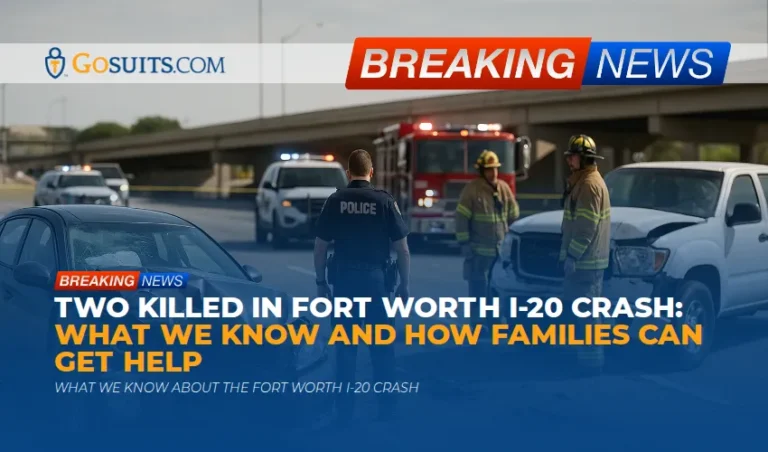
Local news reports indicate that two people were killed in a Fort Worth crash that led authorities to shut down parts of I-20 while first responders and investigators worked the scene. Closures like this are common when law enforcement needs space to render aid, document evidence, and reconstruct what happened. The exact causes and the identities of those involved are not publicly available at this time. Typically, the Fort Worth Police Department and crash reconstruction teams manage these scenes, with support from the Texas Department of Transportation for traffic control and detours.
I-20 is a major east-west corridor through Tarrant County, running past neighborhoods and landmarks many locals know well, including Benbrook, Wedgwood, Hulen Mall, Cityview, Eastchase, Woodhaven, and into Arlington. When a serious collision happens near a busy interchange like I-20 at I-35W or near Loop 820, ripple effects can be felt for miles. That is especially true during holiday travel or rush-hour windows when traffic is dense.
Why high-speed interstate crashes in DFW are so dangerous
Crashes on limited-access highways like I-20 are often severe because of speed, vehicle size differences, and the potential for secondary collisions. National data consistently shows that speed increases both crash risk and injury severity. According to federal safety researchers, higher impact speeds correlate with greater fatality risk, particularly in multi-vehicle crashes. For broader context on fatal crash data, see the National Highway Traffic Safety Administration’s Fatality Analysis Reporting System at NHTSA FARS.
In Texas, the annual burden from roadway fatalities remains significant. TxDOT publishes statewide crash statistics each year, noting trends like speed involvement, failure to control speed, and impaired driving. For statewide crash facts and yearly summaries, TxDOT’s traffic-crash data resources are here: TxDOT Annual Crash Report and Crash Facts.
For those who commute across I-20 between Fort Worth and Dallas, it is common to see a mix of passenger vehicles with heavy commercial traffic. The presence of semis, tractor-trailers, and big rigs adds complexity, given their longer stopping distances and greater mass. Even a split-second decision can cascade into a multi-vehicle collision across several lanes.
First 72 hours: practical steps families can take
If a loved one was involved in a serious Dallas car accident on I-20, the first few days are often overwhelming. It helps to focus on essential tasks that can preserve information and protect rights down the line.
- Prioritize medical care and follow-up. If anyone survived with injuries, get them evaluated and follow the treatment plan. Keep discharge summaries, imaging results, and prescriptions.
- Safeguard evidence early. Save phone photos, dash-cam footage, and any witness contact info. If a vehicle is being towed or stored, note the storage lot and request that it not be altered without documentation.
- Identify investigating agencies. In Fort Worth, that is usually the Fort Worth Police Department’s Traffic or Patrol divisions. For crashes on a freeway, the Texas Department of Public Safety may assist.
- Request the official crash report. In Texas, the Peace Officer’s Crash Report is a CR-3. These are generally obtained through TxDOT’s Crash Records system once available. See details below.
- Consider a preservation letter. If a semi, 18-wheeler, or company vehicle may be involved, a written request to preserve evidence can be important. This includes black box data, driver logs, and maintenance records.
- Before speaking with insurance, consider consulting a seasoned personal injury attorney. Statements given early can be used against you later by insurers, and Texas law on proportionate responsibility can be nuanced.
Where to obtain official records in Fort Worth and statewide
Families often need several official documents for insurance, probate, and potential civil claims. Here are key places to start in Tarrant County and Texas.
Crash reports and scene documentation
- Texas Peace Officer’s Crash Report CR-3. TxDOT manages public access to crash reports statewide once they are submitted by law enforcement. Learn how to request a report at TxDOT Crash Reports.
- Fort Worth Police Department records. For incident numbers, supplemental narratives when available, and open records requests, start with the City of Fort Worth’s police pages: Fort Worth Police Department. For general open-records guidance, the city portal is here: City of Fort Worth Open Records.

Medical examiner and vital records
- Tarrant County Medical Examiner’s Office. For autopsy reports and related determinations, visit the county’s official page: Tarrant County Medical Examiner.
- Death certificates. Certified copies are issued by the Texas Department of State Health Services, Vital Statistics: Texas DSHS Vital Statistics.
State-level safety and data resources
- NHTSA fatality and crash data. For national-level safety trends: NHTSA FARS.
- TxDOT traffic crash data and annual facts. For Texas-wide crash metrics: TxDOT Crash Facts.
Understanding potential liability and insurance after a serious crash
Texas uses a fault-based system for roadway collisions, including a Dallas car accident or a Dallas car accident on I-20. Liability may involve one or multiple parties. The specific facts of the crash, vehicle data, roadway conditions, and driver behavior all matter.
Possible at-fault parties
- Another driver for unsafe speed, distraction, impairment, or failure to maintain lane.
- An employer or commercial carrier if a company vehicle or tractor-trailer was involved, based on principles like respondeat superior and negligent hiring, training, or supervision.
- A roadway or construction contractor if a poorly designed or marked work zone contributed.
- A vehicle or component manufacturer if a defective part caused a loss of control, braking failure, or fire. Product claims can be complex and evidence-heavy.
Comparative fault and why wording matters
Texas applies proportionate responsibility. In simplified terms, a claimant who is 51 percent or more at fault cannot recover damages, and any recovery is reduced by their percentage of responsibility. See the statutory framework at the Texas Civil Practice and Remedies Code Chapter 33: Tex. Civ. Prac. & Rem. Code ch. 33. How a statement is phrased early on can influence how insurers assign fault later, which is one reason many people choose to speak with counsel before recorded statements.
Insurance basics in Texas
- Minimum liability limits in Texas are often referred to as 30/60/25. The Texas Department of Insurance explains required coverages and options at TDI Auto Insurance.
- UM/UIM coverage can apply if an at-fault driver is uninsured or underinsured. Insurers must offer it in writing, and it can be declined, but many policies include it.
- PIP and MedPay may provide limited medical or income benefits regardless of fault, depending on the policy.
Wrongful death and survival claims
When a fatal collision occurs, Texas law provides for two related civil claims. The wrongful death claim belongs to specific family members, and the survival claim belongs to the estate of the decedent for the harms the person suffered before passing. Who can bring the wrongful death claim and what damages may be available are governed by statute. Families can review the legal framework at Tex. Civ. Prac. & Rem. Code ch. 71.
Even in a serious Dallas car accident or a Fort Worth highway collision, the unique facts control. It is common for multiple insurance policies to become relevant, along with questions about employer liability if a driver was working at the time of the crash.
If a semi or 18-wheeler was involved
When a tractor-trailer or big rig is part of a collision on I-20, investigators often look beyond the moment of impact. Was the driver over hours, fatigued, or distracted. Was the truck properly maintained. Were loads secured and within weight limits. Federal motor carrier rules set minimum safety standards. A helpful overview of the hours-of-service rules is available from the Federal Motor Carrier Safety Administration: FMCSA Hours-of-Service.
In a trucking case, evidence can include the truck’s engine control module data, electronic logging device records, dash cameras, pre-trip inspections, maintenance logs, and dispatch communications. Preserving this material quickly is crucial. If a Dallas truck accident involves catastrophic injury or wrongful death, families sometimes send a written preservation notice to the carrier to prevent deletion or overwriting of key files.
Common injuries after a high-speed collision
Interstate collisions tend to produce complex trauma. The list below is not exhaustive but can help families understand why follow-up care is so important.
- Brain injury. Concussions and more severe tbi can present with delayed symptoms, including headaches, dizziness, confusion, and sleep changes. Imaging can be normal initially, so monitoring is important.
- Spinal injuries. Disc herniations, compression fractures, or ligament injuries can manifest as radiating pain, numbness, or weakness.
- Orthopedic trauma. Fractures, joint injuries, and soft tissue damage often require months of therapy.
- Internal injuries. High-energy impacts can injure organs without obvious external signs.
- Psychological harm. PTSD, anxiety, and sleep disturbance are common after a violent crash, whether in a car, motorcycle accident, or pedestrian accident on a frontage road.
Documenting every appointment, diagnosis, and work restriction helps build a clear picture of the harm caused. That is true for a Dallas car accident on Central Expressway, a Fort Worth crash on I-20, or a wreck anywhere across North Texas.
Deadlines and Texas laws that may apply
Texas law imposes deadlines that can be strict. These time limits can be complicated by factors like a governmental defendant or a minor claimant. The following is general information and not tailored to any specific case.
- Statute of limitations. Many personal injury and wrongful death claims in Texas have a two-year limitations period. See Tex. Civ. Prac. & Rem. Code § 16.003. Calculating the correct deadline can require close attention to the facts.
- Governmental units. If a city, county, or state agency is potentially responsible, the Texas Tort Claims Act may apply, including special notice requirements and liability caps. See Tex. Civ. Prac. & Rem. Code ch. 101. Cities can also have shorter notice deadlines in their charters.
- Comparative responsibility. As noted above, proportionate responsibility rules can significantly affect recovery. See Chapter 33.
How insurers approach serious and wrongful death claims
Insurance companies investigate quickly. They collect statements, evaluate police reports, inspect vehicles, and secure footage when available. In a severe or fatal collision, a liability carrier may reach out to families early with expressions of sympathy and requests to talk. That conversation can feel informal, but adjusters are gathering information to evaluate defenses and leverage.
In truck cases, commercial carriers often activate rapid-response teams that include investigators and scene experts within hours. If the crash involves a company vehicle on I-20, that team may visit the scene, measure skid marks, and download truck data before many families even know how to request it. The timing disparity is one reason people consider getting guidance before speaking on the record.
What to say and not say to insurers
If a claim is likely, it is generally prudent to consult an attorney first prior to contacting the insurance company. What someone says to an insurer can be used against them later, particularly on disputed-fault questions. If you do speak to an insurance representative, consider these tips:
- Stick to facts, not guesses. If you do not know, say so. Avoid estimating speeds or distances unless you are sure.
- Be cautious with recorded statements. Ask whether the call is being recorded and consider declining until you have legal guidance.
- Do not sign blanket authorizations. Medical releases should be narrow and specific to the incident.
- Document every contact. Save letters and emails, and keep a call log with dates and names.
Important next steps and why time matters
Below is a practical, time-sensitive roadmap that helps protect information and options after a serious interstate collision.
- Secure the official incident number. It is your anchor for reports, records, and follow-ups with Fort Worth authorities.
- Request the CR-3 crash report as soon as it becomes available. The report is foundational for insurance and any civil claims.
- Preserve vehicles and electronic data. That includes dash-cam video, telematics, and, in truck cases, ELD and ECM data. Early preservation reduces the risk of overwriting or loss.
- Centralize medical and expense records. Keep all bills, EOBs, and proof of out-of-pocket costs together to avoid gaps later.
- Map all insurance coverages. Identify policies for all involved vehicles, plus any household UM/UIM that may apply.
- Calendar legal deadlines. This includes the statute of limitations and any municipal notice requirements that might apply.
- Consult a qualified attorney promptly. A free consultation can clarify coverage, deadlines, and next best steps before anyone gives statements. Acting early helps level the playing field with insurers and corporations that move fast to protect their interests.
Commentary from Gosuits Fort Worth, Texas Personal Injury Attorney
Our hearts go out to everyone affected by the fatal crash on I-20 in Fort Worth. Losing loved ones or facing life-changing injuries on a busy interstate is a pain no family should have to bear. This write-up is meant for general information, drawn from public safety resources and Texas statutes, so the community can better understand what happens after a deadly collision and where to find official records.
From a civil-injury perspective, a closure of multiple lanes on I-20 typically signals a very serious collision and a detailed investigation. In the DFW area, interstate crashes often involve complex factors like speed, visibility, lane changes, and sometimes commercial vehicles that require special scrutiny. Multiple agencies may be involved, from Fort Worth Police to TxDOT and, when needed, the Tarrant County Medical Examiner. Determining who is responsible can take time because investigators need a complete picture of events.
Insurance companies and large corporations are well organized. They move quickly to collect evidence and shape the narrative of what happened. Families, on the other hand, are thrust into grief and logistics, which makes early decisions especially tough. Recorded statements, broad medical authorizations, and quick settlement offers can seem straightforward but may undervalue the long-term effects of a brain injury, spinal harm, or the profound damages tied to a wrongful death. Knowing what to ask for, what to preserve, and what timelines apply helps keep leverage where it belongs.
It is important for anyone affected by a severe highway collision to consider obtaining a free consultation before speaking to any insurer. One conversation can help clarify rights, identify available coverages such as UM or UIM, and outline the steps to secure crucial evidence, especially if an 18-wheeler, semi, or company vehicle is part of the event. A calm, informed approach in the first days and weeks can make a lasting difference.
Local context and community focus
Fort Worth’s stretch of I-20 is a major lifeline for residents moving between neighborhoods like Benbrook, Wedgwood, and Meadowbrook, and for workers commuting toward Arlington or Dallas. Construction zones, holiday traffic, and unpredictable weather can increase risks. Smaller episodes of congestion near the Hulen Mall and Bryant Irvin exits often lead to sudden slowdowns. Even on clear days, the mix of local traffic and long-haul tractor-trailers is a challenge.
While this article centers on interstate collisions, the same general principles apply to serious roadway incidents across North Texas. Whether a wreck happens on I-20 in Fort Worth, Central Expressway in Dallas, or a frontage road in Arlington, the legal and practical steps remain similar. In the aftermath of a crash that causes significant personal injury or a wrongful death, careful documentation and a measured approach to insurance communications are key.

Related scenarios across DFW
- Multi-vehicle pileups during low-visibility mornings or sudden storms, particularly near interchanges.
- Rear-end collisions cascading through lanes during bottlenecks or work-zone merges.
- Commercial vehicle incidents involving a tractor-trailer, big rig, or 18-wheeler where stopping distance and load securement matter.
- Severe single-vehicle impacts leading to rollovers or median strikes, sometimes with ejection or head injury.
- Motorcycle accident cases where a rider is struck during a lane change or rapid deceleration event.
Safety reminders for I-20 travelers
Because interstates are unforgiving at speed, even small habits can reduce risk: leave more following distance than you think you need, signal lane changes early, and keep an eye on shoulders for stalled vehicles or emergency responders. In construction and lane-shift areas, lower speed helps you maintain control and buy reaction time. During holiday weeks when out-of-town drivers are unfamiliar with exits and merges, patience really does save lives.
For systemic safety improvements, TxDOT’s public crash-data pages are a good window into the patterns that put people at risk and the interventions that might help. Look to TxDOT Annual Crash Facts for yearly trends and to NHTSA FARS for national figures.
How this applies to North Texas claims outside Fort Worth
Though this tragedy occurred in Fort Worth, the same civil principles apply across the Metroplex. A Dallas car accident on LBJ, a truck collision on I-30 in Arlington, or a severe crash on the Bush Turnpike each raises similar questions about fault, insurance, and damages. Families dealing with a wrongful death anywhere in the region face the same need for timely records, careful communication with insurers, and a clear understanding of Texas deadlines.
Personal injury law is about people, not just paperwork. North Texas has seen its share of heartbreaking losses from collisions, and communities from Fairmount to River Oaks feel them. If you are reading this on behalf of a neighborhood or a church group looking to support a family, consider organizing practical help like meal trains and rides, and share the official links above so they have a path to the records they will need.