- What we know about the Highland and Del Rosa crash
- Where the investigation stands and how crash scenes are processed
- Local context around Highland and Del Rosa in San Bernardino
- How families can obtain official records and documents
- General legal rights after a fatal multi-vehicle crash in California
- Who may be liable in a multi-vehicle fire crash at an intersection
- Evidence that often determines fault in complex collisions
- Insurance considerations in California after a multi-vehicle crash
- Practical next steps in the first days and weeks
- Community support and safety reflection
- Why timely action matters
- Commentary from Gosuits San Bernardino, California Personal Injury Attorney
- References
What we know about the Highland and Del Rosa crash
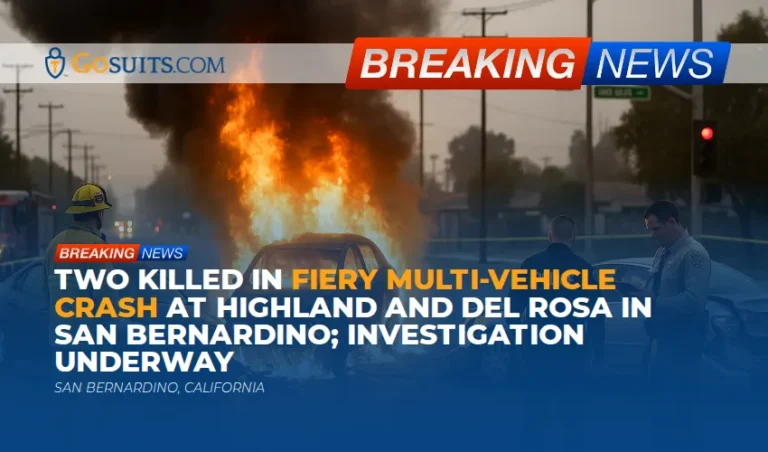
On Wednesday morning in San Bernardino, a fiery multi-vehicle collision at Highland Avenue and Del Rosa Avenue claimed two lives. According to the initial public updates, firefighters reached the intersection around 7:15 a.m. and found three vehicles burning with occupants trapped inside. Two people in separate vehicles were pronounced deceased at the scene, and a woman with minor injuries was transported to a nearby hospital. The cause of the crash has not been announced, and Highland and Del Rosa were closed in all directions for the on-site investigation.
At this time, no official determination has been shared about what triggered the collision, how the vehicles came to ignite, or whether any mechanical issues or traffic violations were involved. That level of analysis typically follows after scene documentation, witness interviews, and review of physical and digital evidence. These steps can take days or weeks, especially when multiple vehicles and a fire are involved.
For residents, this intersection sits on San Bernardino’s east side and is a familiar morning commute route. The timing at 7:15 a.m. meant traffic impacts were felt across adjacent streets as responders managed the scene and protected the public during active fire suppression and recovery.
Where the investigation stands and how crash scenes are processed
When a fatal collision occurs within city limits, the local police department typically leads the crash investigation, with support from the fire department and emergency medical personnel. In San Bernardino, that often includes thorough scene mapping, vehicle inspections, and coordination with the county coroner’s division for next-of-kin notification and official identification. If the crash involves unique complexities such as vehicle fires, investigators may bring in specialized tools and consult with forensic experts to understand how the blaze started and spread.
Investigators commonly work through a structured process. They secure the scene to prevent secondary crashes, check for hazards like leaking fuel, and ensure any remaining fire risk is controlled. They then photograph the scene, note debris fields and skid or yaw marks, and recover vehicle data modules where feasible. Witness statements, 911 call records, and any nearby traffic or security camera footage are pursued. If a commercial vehicle or employer-owned car is involved, that can add another layer of document gathering, from driver logs to vehicle maintenance records.
In some serious or complex collisions, specialized teams perform advanced reconstruction. It is not unusual for the roadway to remain closed for hours while these tasks are completed. That was the case here, as Highland and Del Rosa remained closed in all directions during the morning response and investigation.
Local context around Highland and Del Rosa in San Bernardino
Residents know Highland Avenue as a busy east-west corridor running across the city, with Del Rosa Avenue carrying north-south neighborhood traffic. Morning volumes can be significant as people head to work, school, and nearby freeway access. Anytime there is a multi-vehicle collision in this corridor, especially one involving fire and occupant entrapment, the ripple effects reach far beyond the intersection itself. Nearby businesses and neighborhood streets can experience detours, and emergency access is carefully managed to ensure safety for everyone in the area.
Because this crash happened during the morning rush, the timing likely affected everything from school drop-offs to east-side employer shift changes. First responders in San Bernardino are trained to balance the immediate lifesaving efforts with the need to stabilize the area and reopen roads as soon as it is safe.
How families can obtain official records and documents
Police traffic collision report
Fatal crash reports are typically handled by the investigating law enforcement agency. For city streets in San Bernardino, that is often the local police department. Families or their authorized representatives can request traffic collision reports once they are completed. While state highways fall under the California Highway Patrol, CHP also publishes statewide guidance and a form used to request collision reports for CHP-investigated crashes. The CHP information and request form are available online [1]. If the local police department investigated, their records division will provide instructions for obtaining the report once it is released.
Coroner and autopsy information
In San Bernardino County, the Sheriff’s Department Coroner Division handles identification, cause and manner of death determinations, and notifications to family. Information about the coroner’s process and how to request records is provided by the County on its official site [2]. Families are typically contacted by the coroner’s office before any public release of a decedent’s identity.
Death certificates
Certified copies of death certificates are issued through the San Bernardino County Assessor-Recorder-Clerk. The County hosts instructions and requirements for ordering death certificates, including who is eligible to request them and what identification is required [3]. Many legal and estate steps will require certified copies, so it helps to order a few.
DMV accident reporting
California requires drivers to report certain crashes to the DMV within 10 days by filing an SR 1 form when there is injury, death, or property damage above a specified threshold. The DMV publishes the SR 1 collision reporting requirements and the form itself [4]. Although this duty falls on drivers, families sometimes help an injured or grieving driver complete the paperwork. When in doubt, review DMV guidance and check whether the incident triggers reporting.
Medical records and patient information
Hospitals typically limit patient status to protect privacy, but authorized family members can request medical records for a loved one. Federal guidance from the U.S. Department of Health and Human Services explains the rights of patients and personal representatives to access medical records under HIPAA [5]. If a loved one passed away, estates and authorized representatives often work with providers to obtain necessary records for insurance and legal matters.
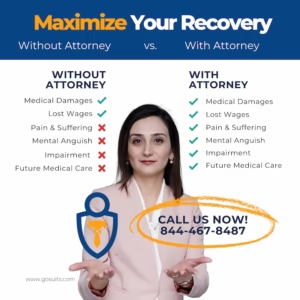
General legal rights after a fatal multi-vehicle crash in California
Families commonly ask what legal avenues exist after a deadly collision. In California, two civil claims often come up in this context. The first is a wrongful death claim, which may be brought by eligible survivors for losses they personally suffer due to a loved one’s death. The California Code of Civil Procedure outlines who may bring a wrongful death action and what it covers [6]. The second is a survival action, which preserves certain claims the decedent could have pursued if they had lived, such as medical bills incurred before death and sometimes punitive damages if the law permits. Survival actions are authorized under a related statute [7].
California’s general statute of limitations for wrongful death is two years from the date of death, subject to exceptions that can shorten or extend deadlines in some scenarios [8]. It is important not to assume the deadline without reviewing the facts of the specific case. Claims involving public entities, for example, may require a government claim within a much shorter time frame before any lawsuit can be filed.
California’s negligence framework requires showing duty, breach, causation, and damages. Civil Code section 1714 confirms a person’s responsibility for injuries caused by lack of ordinary care in managing their person or property [9]. Where several drivers may share fault, California’s comparative fault principles can apportion responsibility based on each party’s share of negligence. This affects how damages may be allocated across multiple defendants.
Who may be liable in a multi-vehicle fire crash at an intersection
Because investigators have not released a cause, it would be inappropriate to draw conclusions about fault in this tragedy. In general, however, multi-vehicle intersection crashes can involve several potential sources of liability.
- Negligent driving at an intersection Intersection collisions can stem from failing to yield, running a red or yellow signal, distracted driving, or speeding into an occupied crossing.
- Employer responsibility for on-the-job driving If a driver was working at the time, a business can sometimes be responsible for the driver’s negligence under respondeat superior. This depends on whether the driver was acting within the scope of employment.
- Vehicle defects and recalls Fires may raise questions about fuel systems, electrical systems, or post-collision fire propagation. If a defect contributed to injury or severity, potential product claims can be explored after a forensic vehicle inspection.
- Roadway design or signal timing issues In rare cases, a public entity’s design, maintenance, or signal timing can be examined. Claims against government entities have special notice rules and shorter deadlines, so they should be evaluated promptly if evidence points that way.
None of these categories apply automatically. Liability is a fact-driven analysis that relies on thorough evidence and credible reconstruction. When fires occur, preserving what remains of the involved vehicles for inspection becomes especially important.
Evidence that often determines fault in complex collisions
Even before an official report is ready, certain pieces of evidence are time sensitive. Much of this is routine in a multi-vehicle case and can be pursued by families or, more commonly, by their representatives.
- Event data recorders Many modern vehicles store data on speed, brake application, seat belt use, and more shortly before and during a crash. NHTSA’s Event Data Recorder resources describe how EDRs work and why they matter for investigations [10].
- Intersection, business, and home cameras In busy corridors like Highland Avenue, nearby businesses and residences may have cameras that capture traffic approaches and signal phases. Video footage can be overwritten within days, which is why prompt requests are vital.
- Witness statements and 911 audio Identifying and interviewing witnesses early helps preserve memory. 911 recordings and dispatch logs can also provide timing and initial observations.
- Physical scene mapping Skid marks, debris patterns, point of rest for vehicles, and the location of burn patterns can help reconstruct the sequence of impacts.
- Vehicle fire forensics Specialists assess fire origin and progression. That can clarify whether flames were primarily post-impact or whether a preexisting electrical or fuel system issue contributed.
Insurance adjusters also conduct their own inquiries. However, their focus is on evaluating claims rather than building a complete forensic picture. Independent preservation of evidence ensures that families and injured survivors have access to the same or better material for any civil claim.
Insurance considerations in California after a multi-vehicle crash
Insurance becomes complicated quickly when three or more vehicles are involved. Questions arise about which policy pays first, how multiple liability policies interact, and whether underinsured motorist coverage applies when damages exceed at-fault limits. For a deeper dive on priority of payments and coordination among insurers, see Which Insurance Pays First After a Multi Car Crash.
California’s minimum auto liability limits increased by legislation for policies issued or renewed on or after January 1, 2025. The change was enacted by SB 1107, which raised the minimum limits above the long-standing 15,000 and 30,000 bodily injury levels [11]. Updated minimums are intended to better reflect current medical and economic costs. Even so, severe injuries and fatal crashes often exceed minimums, making the at-fault driver’s coverage only a starting point in serious cases.
Uninsured and underinsured motorist coverage can be critical when the at-fault driver has low limits or none at all. The California Department of Insurance publishes consumer guidance on UM and UIM coverage, how it works, and why it matters [12]. Medical payments coverage and collision coverage may also come into play for immediate expenses and vehicle damage while liability is being sorted out.
Speaking with car accident lawyers early can help clarify potential sources of recovery, from multiple drivers and employer policies to product liability avenues if evidence suggests a defect contributed to the outcome. The right strategy often involves stacking or sequencing claims in a way that preserves options while the investigation unfolds.
Practical next steps in the first days and weeks
When a crash like this happens close to home, the first days are overwhelming. There is no perfect checklist, but there are steps that can help families and survivors protect their well-being and their rights while allowing the investigation to proceed.
- Confirm the investigating agency and note your report number Ask which agency is in charge and request the incident or DR number. This makes it easier to track the report’s status and request records later.
- Coordinate with the county coroner’s office The coroner will handle identification and next-of-kin notifications. They can guide families on obtaining records and what to expect in the process [2].
- Preserve tangible items and documents Keep any personal items from the vehicles, receipts, medical paperwork, and insurance letters in one place. Take photos of injuries and vehicle damage when feasible.
- Identify potential video sources If a nearby business or residence might have recorded the intersection approaches, note the location immediately. Footage is often overwritten within days.
- Be cautious with insurance communications If an insurer or company representative calls, be polite but careful. Consider consulting a lawyer first. What is said early on can be used later.
- Mind the DMV reporting rules If a driver involved must file the SR 1 with DMV due to injury, death, or qualifying property damage, review the state’s instructions and deadlines [4].
Given the complexity and stakes of a three-vehicle fatal crash, many families choose to consult with Los Angeles car accident lawyers before contacting any insurance company. That step helps prevent avoidable misstatements, preserves key evidence, and sets a plan for how to approach multiple overlapping policies.
Community support and safety reflection
San Bernardino has endured hard losses on its roads. A fire-involved crash at a neighborhood intersection like Highland and Del Rosa touches so many in the Del Rosa area and beyond. The tragedy underscores how quickly a routine morning can change and how vital our first responders are when seconds count. The U.S. Fire Administration has long noted the dangers and unpredictability of highway vehicle fires, which can spread rapidly and complicate rescue efforts [13].
Local drivers can help by slowing through intersections, watching signal changes closely, and leaving extra space during heavy commute periods. These habits reduce the likelihood of chain reactions and give everyone a better chance to avoid a sudden hazard.
Why timely action matters
What should be done now Document the essentials and preserve options. Identify the investigating agency and report number. Secure medical records for the injured survivor. Track funeral and related costs. Start a simple file for correspondence and bills. If a vehicle is being stored, ask the yard in writing to preserve it without alteration so that any fire-related inspection can occur later.
Why it matters Evidence disappears quickly. Video overwrites. Vehicles can be crushed or repaired. Witnesses become harder to reach. Insurance companies begin their own investigations and may ask for statements or medical authorizations that affect later claims. Acting promptly helps maintain leverage and clarity.
When to speak with professionals Before any insurance statement, consider a free consultation with a qualified attorney to understand rights and responsibilities. This is important because statements taken early can be used later in ways that are hard to undo. An attorney can also help coordinate with insurers so benefits like UM or med pay can be accessed without jeopardizing broader claims.
What outcome timely steps support Early organization reduces stress and confusion, supports accurate claim valuation, and helps ensure all responsible parties are identified. It also minimizes avoidable delays when reports are released and next steps depend on precise information.
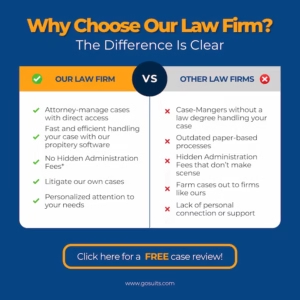
Commentary from Gosuits San Bernardino, California Personal Injury Attorney
Our hearts go out to everyone affected by the deadly collision at Highland and Del Rosa. Two lives lost and a third person injured in a morning commute is devastating for families and for our community. This article is meant to provide general information so people can better understand the path ahead while the investigation unfolds.
Based on what has been publicly shared, investigators are still determining how this multi-vehicle fire crash occurred. Intersection collisions can involve split-second decisions, complex vehicle dynamics, and evidence that must be carefully preserved. Fires add another layer of difficulty. That is why scene control, quick rescue efforts, and methodical documentation are so crucial.
Insurance carriers, fleet owners, and large corporations have processes designed to protect their financial interests. They know the systems and the timelines. People caught up in tragedies like this often do not. Adjusters might request early recorded statements, sweeping medical authorizations, or quick settlement discussions before the facts are fully known. Those steps can limit recovery later, especially in a case with multiple vehicles and potential layers of coverage.
A free consultation can help families and survivors hear what options exist without pressure or obligation. Understanding how liability may be allocated, how coverage interacts, and how evidence should be preserved gives people more control at a time when so much feels out of their hands.
References
- Request a Collision Report CHP 190 – California Highway Patrol
- Coroner Division – San Bernardino County Sheriff’s Department
- Assessor-Recorder-Clerk Vital Records – San Bernardino County
- Accident Reporting Requirements SR 1 – California DMV
- Your Rights Under HIPAA to Access Your Medical Records – U.S. HHS
- Wrongful Death Actions, CCP 377.60 – California Legislature
- Survival Actions, CCP 377.30 – California Legislature
- Two-Year Limitations Period, CCP 335.1 – California Legislature
- General Duty of Care, Civil Code 1714 – California Legislature
- Event Data Recorders – NHTSA
- SB 1107 Minimum Financial Responsibility Increase – California Legislature
- Automobile Insurance 101 – California Department of Insurance
- Highway Vehicle Fires – U.S. Fire Administration