- What happened in Placentia, where, and when
- What we know so far, based on official statements
- Civil liability after a pursuit crash in California
- Could a public agency be liable in a police pursuit crash
- First days checklist for families after a fatal crash
- Insurance layers that may apply in a fatal multi-vehicle crash
- Independent investigations and evidence to secure
- Wrongful death and survival claims in California
- Pursuit safety, policy, and statewide data
- Local context in Placentia and Anaheim
- How to obtain key records and where to call
- If an insurance company calls
- What this means for the community
- Awareness and next steps
- Commentary from Gosuits Placentia, California Personal Injury Attorney
- References
What happened in Placentia, where, and when
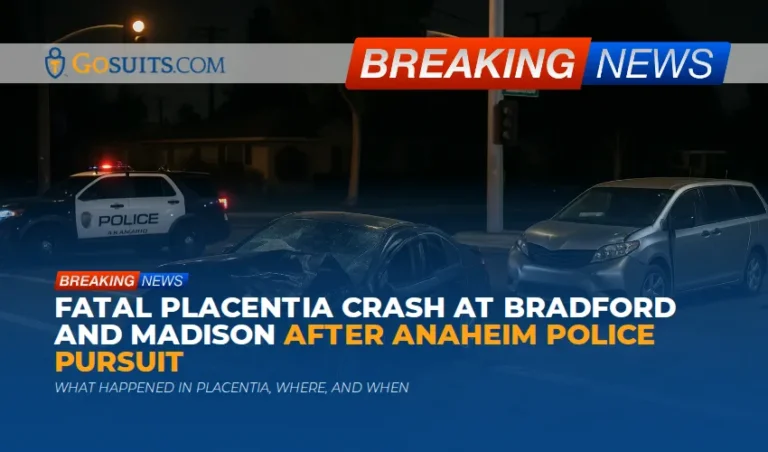
On a Wednesday night in late January, a police pursuit that began in Anaheim crossed into Placentia and ended at the intersection of Bradford Avenue and Madison Avenue. The collision took a neighbor’s life at that corner, not far from the residential streets that connect to Valencia High School and the neighborhood routes heading toward the 57 Freeway. People who live and work around Chapman Avenue and Kraemer Boulevard know how busy those corridors get after dusk, and it was along those familiar roads that a high-speed sequence unfolded.
Residents described hearing sirens and seeing patrol vehicles racing past. Within minutes, the fleeing vehicle collided with others at Bradford and Madison. First responders converged on the scene, and the intersection was closed overnight as investigators documented debris, vehicle positions, and skid patterns. It was an unimaginable loss in the heart of Placentia.
What we know so far, based on official statements
According to law enforcement statements reported to local media, Anaheim officers observed a Jeep Gladiator being driven recklessly near Miraloma Way and Lawrence Avenue around 7:40 p.m. Officers attempted a traffic stop. The driver initially stopped, then accelerated as officers approached, leading to a pursuit heading toward Placentia.
At Bradford and Madison in Placentia, the suspect vehicle traveling westbound on Madison struck a Honda sedan that had entered the intersection, then continued and hit a Dodge minivan traveling eastbound on Madison. The driver of the Honda, a 59-year-old Placentia man, was pronounced deceased at the scene. The minivan’s driver, an 83-year-old Placentia woman, was transported for evaluation with reported minor injuries and pain complaints. Police indicated a 21-year-old Anaheim resident was taken into custody on suspicion of vehicular manslaughter and felony evading causing injury or death. The identity of the deceased will be released by authorities after family notification. At the time of reporting, this appeared to be Orange County’s first pursuit-related traffic fatality in 2026.
This account reflects statements from police officials and bystander observations shared with local news. Details may be updated by agencies as the investigation continues.
Civil liability after a pursuit crash in California
When a fleeing driver causes a crash that injures or kills others, civil liability typically focuses on negligence, causation, and damages. Fleeing at high speed, running red lights, or driving recklessly can be evidence of a breach of the duty to use reasonable care. If that breach is a substantial factor in causing harm, the driver, and potentially the vehicle’s owner in some circumstances, can be held financially responsible under California law.
Vehicle owner liability may arise if the driver had permission to use the vehicle. California law recognizes owner responsibility for certain harms arising from permissive use. The facts in any given case, including title, insurance, and permission, matter greatly. Where a suspect is uninsured or carries insufficient liability limits, a family’s own uninsured or underinsured motorist coverage may become a critical safety net.
In fatal cases, the law provides two separate, related civil pathways: a wrongful death claim for eligible family members and a survival action that belongs to the decedent’s estate. These claims address different categories of losses and follow different rules, described further below. The focus here is on the civil, not criminal, consequences of the crash.
Could a public agency be liable in a police pursuit crash
Families often ask if the police department or city can be held liable after a pursuit crash. California has special statutes that govern these questions. Officers have statutory immunity for certain pursuit driving when acting within the scope of their duty, and agencies can have immunity as well if they adopt and implement a compliant written pursuit policy and provide regular training.
California Vehicle Code sections address pursuit immunity. Section 17004 provides immunity to public employees for civil damages resulting from the operation of an authorized emergency vehicle in the line of duty. Section 17004.7 establishes that a public agency is immune from liability for damages caused by a suspect evading the police if, at the time of the pursuit, the agency had adopted and implemented a written policy on vehicle pursuits that meets specific requirements and provided regular training that covers that policy. Agencies must meet and maintain these standards to invoke this protection under the statute. Families considering questions around public entity responsibility need to be aware of these rules and the short deadlines that apply to any claim against a government entity in California, including the six-month presentment requirement under the Government Claims Act [1] [2] [3].
Whether any public entity has exposure in a specific case will depend on the facts, the agency’s pursuit policy, training records, and the applicability of statutory immunities. Because the Government Claims Act imposes strict timelines and procedural requirements, families often seek guidance early to preserve their rights, even while investigations are ongoing.
First days checklist for families after a fatal crash
In the immediate aftermath, it can feel overwhelming. Yet a few practical steps in the first days can protect both a family’s peace of mind and their ability to find answers later.
- Confirm the case status with the coroner and ask about reports. In Orange County, the Sheriff-Coroner handles death investigations and releases information to next of kin. Families can inquire about the case number, timeline for the autopsy report if one is performed, and the process for requesting copies. Coroner records have specific release rules under California law [4].
- Order certified death certificates. These are often needed for benefits, insurance, and estate matters. Certificates can be obtained through the California Department of Public Health Vital Records or, when available, through county vital records offices. Processing times and identification requirements vary [5].
- Request the police traffic collision report. Placentia Police Department will typically generate a traffic collision report for a fatal crash within their jurisdiction, and Anaheim Police may have associated reports tied to the initial attempted stop and pursuit. While agency-specific procedures vary, the California Public Records Act and departmental policies govern access. For traffic collisions investigated by the California Highway Patrol, requests are made using CHP 190. Families can review CPRA basics and, if applicable, the CHP 190 request process for general guidance [6] [7].
- File the DMV crash report if required. California requires an SR-1 crash report to the DMV within 10 days for any crash involving injury or death, regardless of fault. Insurers sometimes file on behalf of policyholders, but the duty ultimately rests with the involved party or their representative. The DMV SR-1 information page explains the requirement and form access [8].
- Preserve the vehicles and electronic data. Modern vehicles store crash-related data on event data recorders, sometimes called black boxes. This information can clarify speed, throttle, and braking seconds before impact. Securing the vehicles and ensuring no spoliation of evidence can be vital. NHTSA publishes general information about event data recorders and data access considerations [9].
- Identify potential video and witnesses. Note nearby city cameras, business security cameras, and residential doorbell cameras along Madison, Bradford, Chapman, and Kraemer corridors. Preservation requests should be sent quickly because many systems overwrite within days.
- Document the family’s losses. Keep a list of immediate expenses and practical impacts, from funeral planning to time away from work. In fatal cases, this documentation later supports both wrongful death and survival claims, including loss of financial support and household services.
Insurance layers that may apply in a fatal multi-vehicle crash
Multiple insurance sources can come into play after a pursuit-related crash. Understanding the layers helps families avoid missing important avenues of support.
- At-fault driver’s auto liability policy. This is typically the first layer. If the driver was not the owner, the owner’s policy may also respond depending on permission and policy language.
- Uninsured or underinsured motorist coverage. If the at-fault driver lacks insurance or has insufficient limits, UM or UIM coverage on the family’s policy may provide benefits. California policies often include these protections unless waived in writing.
- Medical payments coverage. MedPay can help with certain immediate costs, subject to policy terms.
- Crime victim assistance. In qualifying circumstances, the California Victim Compensation Board may assist with certain expenses, like funeral costs and counseling, separate from a civil claim. Eligibility, time limits, and documentation rules apply [10].
- Restitution in the criminal case. If there is a criminal case, the court can order restitution to victims for certain economic losses. Restitution is separate from, and does not replace, a civil claim.
Navigating these paths involves detailed coordination and careful communication with insurers. Many families choose to have a representative handle claim notifications and evidence submissions so they can focus on grieving and practical matters.
Independent investigations and evidence to secure
A timely, thorough civil investigation complements the work of law enforcement and can reveal additional layers of accountability. In a crash like the one at Madison and Bradford, investigators often look for:
- Skid, yaw, and debris fields. Measurements help reconstruct speed, angles, and impact sequence.
- Signal timing and phasing. Intersection control data can clarify who had the right of way and the duration of red and green phases at the time of impact.
- Event data recorder downloads. EDR data from involved vehicles can corroborate or clarify speed and braking in the seconds before impact.
- Third-party video. Business and residential cameras along the pursuit path, including Chapman and Kraemer, may capture speed and traffic signal compliance.
- Witness canvassing. Locating residents who heard or saw critical moments can add crucial context, especially at night.
Gathering this material quickly is important because physical evidence can be altered by weather and traffic, and digital evidence is often overwritten. Thorough independent work reduces uncertainty and strengthens the factual record for insurance and court proceedings.
Wrongful death and survival claims in California
California recognizes two separate civil claims when someone is killed by the wrongful act of another. The first is a wrongful death claim, brought by eligible heirs, that compensates family for harms they personally suffer, like loss of financial support, services, and companionship. The second is a survival action, brought by the estate, that recovers damages the decedent could have pursued had they lived, such as economic losses and, in some cases, certain non-economic harms for a limited period.
Key timelines and rules include:
- Wrongful death statute of limitations. In most cases, the deadline to file suit is two years from the date of death [11].
- Government entity claims. If any claim is asserted against a public entity, a written government claim must generally be presented within six months of the date of loss before a lawsuit can be filed. The statute then provides further steps and timelines [3].
- Who can sue. Eligibility for wrongful death claimants, and rules for survival actions, are set out by statute [12] [13].
Families often ask what kinds of damages are considered. Economic components may include lost financial support and the value of household services. There can also be a forward-looking component that people sometimes overlook, including the concept of future accumulations that might have passed to heirs. For more background, see lost future inheritance in wrongful death. Non-economic loss for family members, such as loss of companionship and guidance, is also recognized in wrongful death. Punitive damages may be available only through a survival action in limited circumstances, subject to statutory rules.

Pursuit safety, policy, and statewide data
California law requires public agencies to meet specific standards for pursuit policies and training in order to claim statutory immunity. Those standards cover pursuit decision making, risk factors like time of day and traffic density, supervisory control, and termination criteria. Vehicle Code provisions detail what must be included in a compliant policy and the frequency of training that agencies should provide. These requirements aim to reduce risk to bystanders and officers while recognizing the realities of fast-moving events [2].
On the broader safety picture, national crash data sets track fatalities associated with pursuits and fleeing drivers. Analyses from federal transportation safety agencies using FARS data have shown hundreds of deaths annually nationwide in crashes involving a police pursuit or a vehicle fleeing law enforcement. Those reports help contextualize the risk fleeing drivers pose to everyone on the road, including families driving home from work or picking up kids after practice [14] [15]. California’s traffic safety officials also publish annual statewide traffic safety summaries that include fatal crash trends and factors, useful for understanding how risk evolves over time [16].
Local context in Placentia and Anaheim
For neighbors in Placentia, the corner of Bradford and Madison sits in a residential grid where evening traffic can pick up as drivers move between Yorba Linda Boulevard, Chapman Avenue, and the 57 corridor. Placentia-Linda Hospital is just a short drive, and Cal State Fullerton is minutes to the west. Intersections like Chapman and Kraemer can be especially busy during the dinner hour, which is exactly when many families are out running errands.
That local reality is why these tragedies feel so close to home. When a driver flees at 70 miles per hour through red lights, even a careful driver approaching a green can be put in sudden danger. The community’s conversation often turns to prevention, including roadway design and lighting, but the most immediate risk remains the choice of a driver to flee at speed.
How to obtain key records and where to call
Several agencies can provide records that help families understand what happened and manage practical needs:
- Orange County Sheriff-Coroner, Coroner Division. Provides coroner case reports and information to next of kin according to local and state rules. Families can ask about report timelines, toxicology, and release procedures. The Orange County Sheriff’s Office publishes coroner information for the public [4].
- Placentia Police Department Records. The traffic collision report, photographs, and supplemental narratives are typically requested through the department’s records unit. Processing times vary. When in doubt, review California Public Records Act basics to understand eligibility and exemptions [6].
- Anaheim Police Department Records. Because the pursuit began in Anaheim, there may be separate reports or dispatch logs tied to the initial stop attempt and pursuit authorization.
- California Highway Patrol collision reports. If CHP assisted or took over any portion, use the CHP 190 process to request records [7].
- California DMV. Obtain the SR-1 form for crash reporting and check status of any driver-related filings tied to the collision [8].
- California Department of Public Health, Vital Records. Request certified death certificates when they become available, needed for insurance and estate administration [5].
- California Victim Compensation Board. Learn about funeral cost assistance, counseling, and other support programs for eligible victims and families [10].
If an insurance company calls
Insurance adjusters often contact families quickly with questions or requests for recorded statements. It is completely understandable to want to cooperate, but there is also risk. What is said can be used to limit or challenge a later claim, even when said in grief. Before contacting the insurer, it is wise to speak with a knowledgeable representative who can explain rights and help plan communications. Many people choose to have someone handle the notifications and statements on their behalf. In situations like these, families often look for car accident lawyers who understand multi-vehicle fatal crashes and the unique evidentiary needs of pursuit cases.
If a recorded statement is requested, consider postponing until you have obtained key documents like the traffic collision report and coroner’s preliminary findings, or until you have consulted with someone who can protect your interests.
What this means for the community
Placentia has always been a tight-knit city, and events like this ripple through schools, churches, and small businesses. Community members often come together to support the immediate family and to check on neighbors who witnessed the crash. The discussion also extends to safe driving reminders, including slowing at evening intersections and scanning for late runners even on a green. Our roads are shared spaces where one person’s decision to flee puts everyone at risk.
Local agencies typically conduct internal reviews after serious incidents and sometimes share non-confidential findings about pursuit policy and training. Residents can follow public meetings and reports to stay informed and participate in a constructive way.
Awareness and next steps
Here is what should be done now and why timing matters:
- Preserve evidence immediately. Vehicles can be moved or totaled quickly by insurers, and digital footage is overwritten in days. Acting now can secure crucial facts that would otherwise be lost forever.
- Calendar statutory deadlines. The two-year wrongful death period and any six-month government claim deadline run from the date of loss. Missing these timeframes can limit options later [3] [11].
- Coordinate benefits and paperwork. Death certificates, DMV filings, employer leave documentation, and funeral planning all have their own timelines. Handling them in parallel avoids delays that compound stress.
- Structure insurance communications. A deliberate plan ensures statements are accurate and supported by documents. This is especially important in multi-vehicle crashes with multiple insurers.
- Plan for long-term financial documentation. Gathering tax returns, pay stubs, and household services details now helps quantify economic loss later. This is especially important for families who may assert claims for lost support or future accumulations. Many in Orange County work variable schedules or multiple jobs, so clean documentation makes a real difference.
For those here in town, neighbors often lean on community institutions for support, from local faith centers near Bradford Avenue to counseling resources accessed through county programs. When it comes to the civil process, some families choose to meet with Placentia car accident lawyers who can map out a plan for documents, deadlines, and evidence preservation before any insurer gets a recorded statement.

Commentary from Gosuits Placentia, California Personal Injury Attorney
Our hearts are with the family and friends of the neighbor lost at Bradford and Madison. The purpose of this article is to share general information and guidance the community often asks about after a tragic crash like this. It is educational in nature.
Based on the facts reported by law enforcement, this collision appears to have been caused by a driver fleeing at high speed who struck an uninvolved Honda, and then a minivan. In civil terms, a fleeing driver who runs lights and drives recklessly commonly faces significant liability for the harm that follows. The details will be clarified by collision reconstruction, intersection signal timing, vehicle data, and witness accounts. If public-entity questions arise, California pursuit-immunity statutes and agency policy compliance will come into focus.
Insurance companies and large corporations understand how to manage risk. In the days after a fatal crash, they sometimes ask grieving families for recorded statements or push early paperwork while emotions are raw. Adjusters are trained communicators, and perfectly human answers can be taken out of context later. That is why it is important to understand rights, the order of operations, and what documents are helpful to have on hand before speaking on the record.
Getting a free consultation can help people understand timelines, evidence preservation, and insurance coordination. It is an opportunity to ask questions, learn about options, and decide what steps to take next without pressure. No one should have to navigate this alone.
References
- California Vehicle Code section 17004 – California Legislative Information
- California Vehicle Code section 17004.7 – California Legislative Information
- Government Code section 911.2, Government Claims Act deadlines – California Legislative Information
- Coroner Division Information – Orange County Sheriff’s Department
- Vital Records, Birth and Death Certificates – California Department of Public Health
- California Public Records Act Overview – Office of the Attorney General
- Collision Records and CHP 190 Request – California Highway Patrol
- SR-1 Report of Traffic Accident Occurring in California – California DMV
- Event Data Recorders 101 – National Highway Traffic Safety Administration
- Victim Compensation Program – California Victim Compensation Board
- Code of Civil Procedure section 335.1, Two-Year Limitation – California Legislative Information
- Code of Civil Procedure section 377.60, Wrongful Death – California Legislative Information
- Code of Civil Procedure section 377.30, Survival Actions – California Legislative Information
- Fatalities in Motor Vehicle Traffic Crashes Involving a Police Pursuit – NHTSA
- FARS Encyclopedia: Police Pursuit Involved Crashes – NHTSA
- Annual Reports and Traffic Safety Data – California Office of Traffic Safety
- California Vehicle Code section 17150, Owner Liability – California Legislative Information