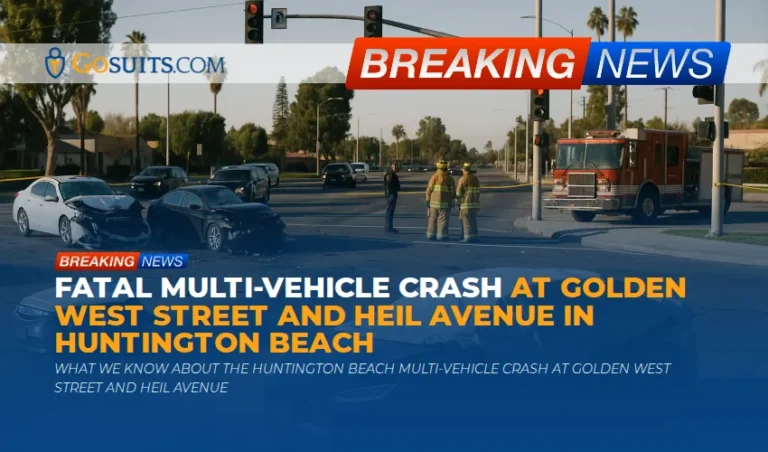
- What we know about the Huntington Beach multi-vehicle crash at Golden West Street and Heil Avenue
- Community context and why this intersection matters
- First steps families and witnesses can take after a serious crash
- How to obtain official records and where to call
- How multi-vehicle collisions are investigated in California
- Understanding potential civil liability in intersection pileups
- Insurance issues in multi-car collisions and how to protect your rights
- Preserving local evidence in Huntington Beach
- Electric vehicle considerations: battery hazards and event data recorders
- Data and trends: intersection safety in California
- Support services and victim resources in Orange County
- Commentary from Gosuits Huntington Beach, California Personal Injury Attorney
- Next steps: Why acting promptly matters
What we know about the Huntington Beach multi-vehicle crash at Golden West Street and Heil Avenue
On Tuesday afternoon, just before 3 p.m., a multi-vehicle crash occurred at the intersection of Golden West Street and Heil Avenue in Huntington Beach. According to the Huntington Beach Fire Department, at least one person lost their life and several others were transported to local hospitals. Aerial footage showed at least four heavily damaged vehicles. Firefighters placed a tarp over an electric vehicle that had flipped upside down. That vehicle appeared to have landed roughly 50 yards from the initial collision point at the intersection. The intersection was closed while officials investigated the scene. Authorities have not yet stated what led up to the crash.
When something like this happens at a busy cross street used daily by families, workers, and students, the shock ripples through the community. Golden West Street is a major north-south corridor through residential neighborhoods and retail plazas, and Heil Avenue connects local blocks where people run errands and head toward nearby parks. A sudden closure here affects many, but the families most affected are those who have lost someone or are facing serious injuries.
Community context and why this intersection matters
Golden West Street and Heil Avenue sit in a dense area that sees steady daytime traffic, including school pick-ups, work commutes, and local service vehicles. Around mid-afternoon in early December, drivers can encounter quickly changing lighting conditions, school traffic patterns, and heavier volumes as people transition from daytime routines to evening plans. In the coastal climate of Huntington Beach, road conditions can also vary with overnight moisture and daytime glare, even when skies are clear. While it is not yet clear what caused this crash, these local realities frame how investigators and safety planners think about intersection risk.
For neighbors in northwest Huntington Beach, an extended closure at this intersection means detours down residential streets and longer drives along nearby arterials. The community impact underscores why clear information, careful investigation, and access to official records are so important for everyone affected.
First steps families and witnesses can take after a serious crash
In the immediate aftermath of a fatal or major-injury collision, small, practical steps can preserve crucial information and support later claims. These steps are general in nature and intended for educational purposes.
- Write down what you know right now. Record the date, time, exact location, weather or lighting conditions, and anything you saw or heard. Even a few details can help later when memories fade.
- Preserve photos and video. Keep any phone photos or videos you took. If you have dashcam footage, save a copy to a separate device or secure folder.
- Identify potential witnesses. If you spoke with bystanders, note their names and contact details. Store this list in more than one place.
- Keep all medical paperwork. Hospital discharge summaries, imaging results, and billing documents form a key part of the record.
- Consider trauma-informed support. After a sudden loss or serious injury, it is common to feel overwhelmed. Taking time to gather support from trusted family, community groups, or professionals can make the process more manageable.
- Before speaking with any insurance company, consider consulting with a seasoned attorney to understand rights and obligations. What is said to insurers can be recorded and used later, which may affect outcomes.
How to obtain official records and where to call
Official records are central to understanding what happened and to navigating insurance and potential civil claims. California law limits who can obtain certain records, but families and injured parties have specific rights. Below are common sources and how to approach them.
Traffic collision report
In California, law enforcement traffic collision reports are confidential and released to parties of interest, such as involved drivers, passengers, vehicle owners, their insurers, and legal representatives, per California Vehicle Code section 20012. You can read the statute here: CVC 20012.
For a crash within city limits, the Huntington Beach Police Department generally handles the investigation and report distribution. Start with the department’s official page to locate contact details for the Records Unit and instructions for requesting a report: Huntington Beach Police Department. Expect to provide the report number if you have it, along with the date, time, and location. There may be a processing time while the report is finalized.

Autopsy report and confirmation of cause of death
In Orange County, death investigations are handled by the Orange County Sheriff-Coroner. Families can request information about the status of an autopsy or coroner’s findings through the Coroner Division. Start here: Orange County Sheriff-Coroner. The coroner can explain what records are available, who qualifies to receive them, and any fees.
Death certificate
Certified death certificates are typically obtained through county or state vital records. For statewide guidance on vital records, including death certificates, see the California Department of Public Health page: CDPH Vital Records. Copies are often needed for estate and insurance matters.
Medical records
Hospitals will release records to the patient or the legal next of kin, consistent with privacy laws. Contact the health information management or medical records department at the treating hospital. Be ready to provide identification and any necessary authorization.
911 audio, radio traffic, and other public records
Audio and certain dispatch records may be available through public records requests, subject to privacy and investigative exemptions. Families or their authorized representatives can submit a public records request to the City of Huntington Beach or the relevant agency. Keep in mind that agencies may withhold or redact portions while an active investigation is underway.
DMV accident reporting requirement
California requires an SR-1 report to the DMV within 10 days when there is injury, death, or property damage over a statutory threshold. See the DMV’s guidance here: DMV accident reporting requirements. This is separate from any police report.
How multi-vehicle collisions are investigated in California
Major-collision investigations are detail oriented. Investigators evaluate the scene for roadway evidence and mechanical and electronic data. While every agency has its protocols, common steps include:
- Scene documentation. Detailed measurements, photographs, location of debris fields, skid or yaw marks, and the rest position of each vehicle. Traffic signal status and signage are also noted.
- Vehicle inspections. Investigators examine damage patterns, airbags, and seat belt systems. For newer vehicles, data can be retrieved from Event Data Recorders when legally authorized.
- Witness statements. Statements from drivers, passengers, and third-party witnesses help piece together timing and vehicle movements.
- Environmental factors. Lighting, sight lines, possible obstructions, construction zones, and temporary traffic controls are assessed.
- Electronic evidence. Intersection cameras, nearby business security systems, and private dashcams are often reviewed when available.
- Collision reconstruction. For severe crashes, specialized units use physics-based methods to determine speeds, angles, and impact sequences.
NHTSA provides public information about Event Data Recorders and their role in crash analysis. For more on EDRs, see NHTSA EDR overview.
Understanding potential civil liability in intersection pileups
While the cause of this Huntington Beach crash is still unknown, intersection collisions often raise recurring civil questions. Multiple drivers may share fault, and responsibility can hinge on right-of-way rules, traffic control devices, and speed.
- Signal compliance. California Vehicle Code section 21453 addresses obedience to red signals. You can review the statute here: CVC 21453.
- Basic speed law and safe speed for conditions. Even at or below the posted limit, drivers must adjust for conditions such as traffic, visibility, and roadway layout, consistent with California’s basic speed principles. NHTSA’s speeding page discusses the risks of excess speed and stopping distances: NHTSA on speeding.
- Following distance and chain reactions. Multi-vehicle crashes can cascade when following distances are too short or braking is delayed. This can lead to multiple claims and cross-claims among drivers and insurers.
- Comparative fault. In California, liability can be apportioned among multiple parties. Each person’s share reflects their contribution to the crash sequence based on evidence.
- Third-party liability. On rare occasions, roadway maintenance, malfunctioning signals, or defective components may be factors. Those questions depend on evidence and are not assumed.
Families navigating liability questions should know that evidence drives outcomes. Early preservation of vehicle data, photos, and witness information can be as important as the official report.
Insurance issues in multi-car collisions and how to protect your rights
Insurance after a multi-vehicle crash gets complicated quickly. There may be several insurers, policy limits, and overlapping medical coverage provisions. A few key considerations:
- Liability coverage. Pays for bodily injury and property damage that an at-fault driver causes, up to policy limits.
- Uninsured and underinsured motorist coverage. Can help when the at-fault driver’s insurance is absent or insufficient.
- Medical payments coverage. Helps pay certain medical expenses regardless of fault, depending on policy terms.
- Multiple claimants. In multi-car events, several people may seek payment from the same policy. When limits are low, funds can be exhausted quickly.
- Recorded statements. Insurers may request recorded statements soon after the crash. Since statements can affect liability and valuation, consider speaking with an attorney first to understand your rights and obligations.
- Total loss and vehicle valuation. For heavily damaged vehicles, valuation disputes are common. Keep service records, aftermarket equipment invoices, and recent comparable listings for reference.
Before starting any claim conversation with an insurance company, it is generally wise to consult with a qualified attorney for a free consultation. Insurers are trained to limit exposure, and early statements can be cited later.
Preserving local evidence in Huntington Beach
Valuable evidence often sits just beyond the crash scene itself. In an urban corridor like Golden West and Heil, relevant materials can include:
- City-operated traffic cameras. Some intersections use cameras for traffic management. Footage is not guaranteed and can be overwritten quickly.
- Nearby business security video. Gas stations, pharmacies, and retail storefronts frequently have exterior cameras that capture lanes of travel. Many systems overwrite within days.
- Residential doorbell cameras. Homes facing the intersection or approach lanes may capture speed, lane use, and signal status at the time vehicles pass.
- Event Data Recorder downloads. With proper legal authority and procedures, EDRs can show speed, brake application, steering inputs, and seat belt status for seconds prior to impact.
- Towing and storage yards. Vehicles may be moved quickly. Promptly identifying where a vehicle is stored can help preserve physical evidence and prevent spoliation.
If you are not sure where to begin, the Huntington Beach Police Department page is the best starting point for confirming report status and, when appropriate, learning where vehicles were towed: Huntington Beach Police Department.
Electric vehicle considerations: battery hazards and event data recorders
The report of an electric vehicle flipping and coming to rest some distance from the initial impact point draws attention to two EV-specific topics.
- High-voltage battery hazards. First responders follow special procedures for EVs due to battery damage risks and delayed thermal events. NHTSA offers consumer safety materials on electric vehicles and crash response considerations here: NHTSA electric vehicles.
- Event Data Recorders in EVs. Many EVs maintain EDRs or similar vehicle logs. NHTSA’s overview of EDRs explains what data may be available and how it assists in reconstruction: NHTSA EDR overview.
Whether a particular EV stores specific data depends on the make and model. Access usually requires proper tools and observance of legal protocols.
Data and trends: intersection safety in California
Safe travel through intersections remains a major concern statewide. Intersection and signalized-junction crashes contribute significantly to serious injuries and fatalities. Federal and state resources offer high-level context that is helpful when communities consider safety investments.
- National perspective. The Federal Highway Administration provides extensive materials on intersection safety strategies aimed at reducing fatal and serious-injury crashes at signalized and stop-controlled intersections. See the FHWA intersection safety resource: FHWA intersection safety.
- California collision data. The California Office of Traffic Safety maintains statewide collision data and research summaries, useful for understanding broader trends that can inform local planning: California OTS collision data.
- Local mapping tools. UC Berkeley SafeTREC’s Transportation Injury Mapping System offers public tools to visualize crash history data by city or corridor for educational and planning purposes: TIMS by UC Berkeley SafeTREC.
Intersection risk is multifactorial. Speed management, protected turn phases, signal timing, visibility, and enforcement practices all play roles. While data can inform improvements, each crash demands specific fact-finding before drawing conclusions about causes.
Support services and victim resources in Orange County
After a sudden loss or major injury, families often need more than technical answers. Support programs can assist with counseling costs, funeral expenses, and victim services.
- California Victim Compensation Board. CalVCB provides financial assistance for eligible victims and families, including funeral and burial costs, mental health counseling, and income loss in certain situations. Learn more here: CalVCB.
- Coroner support and identification process. The Orange County Sheriff-Coroner can guide families through identification procedures, release timelines, and available records: Orange County Sheriff-Coroner.
- State vital records. For death certificates and related documentation needed for estates and benefits, see CDPH Vital Records.
Local hospitals, community centers, and faith-based organizations in Huntington Beach can also provide grief and crisis support. It is very normal to need help with the emotional weight of a sudden tragedy.
Commentary from Gosuits Huntington Beach, California Personal Injury Attorney
We extend our deepest sympathies to everyone affected by the crash at Golden West and Heil. This article is intended for community education and general information. It cannot account for all the facts that investigators will uncover, and it does not substitute for tailored legal guidance.
From a civil-injury perspective, multi-vehicle intersection crashes are among the most complex events our community faces. Questions often center on signal compliance, safe speed for conditions, and the sequence of impacts. When an electric vehicle travels a significant distance from the initial impact and overturns, investigators will look closely at speed, pre-impact braking, the geometry of the collision, and whether secondary impacts contributed. Physical evidence, EDR data when available, and credible witness accounts become the backbone of any civil claim.
Insurance carriers and corporate defendants have structured processes that start within hours. Adjusters may gather statements quickly, frame liability positions early, and sometimes imply that limited policy limits are already spoken for. The lack of early information available to families makes it easy to feel rushed. What people say in that window can shape fault assessments and damages evaluation. Preserving your options means understanding your rights before giving statements, signing medical releases, or agreeing to recorded interviews.
A free consultation can help people understand how reports, medical records, and policy limits interact, what evidence to safeguard, and when to request specific records like EDR data or intersection camera footage. It is a simple step that can prevent unforced errors at the beginning of a long process.
Next steps: Why acting promptly matters
The following practical steps can help anyone affected by a serious intersection crash stay organized, protect evidence, and preserve rights in the days and weeks ahead.
- Document everything immediately. Capture photos of injuries, vehicle damage, and the intersection approaches if it is safe and lawful to do so later. Keep a written timeline of events, symptoms, and contacts with any agency or insurer.
- Request official records as soon as eligible. Track the collision report’s availability with the Huntington Beach Police Department. For fatalities, contact the Orange County Sheriff-Coroner for status and next steps regarding autopsy findings and release. Early requests can reduce delays later.
- Preserve electronic evidence. Save dashcam video, phone photos, and cloud backups. If a vehicle has an Event Data Recorder, ensure the vehicle is preserved in its post-crash state until qualified professionals can evaluate it.
- Coordinate medical care and records. Follow medical recommendations, attend appointments, and retain all bills and clinical notes. These documents are essential for any insurance claim or civil action.
- Avoid recorded statements to insurance without preparation. Since early statements can affect liability and valuation, prioritize speaking with a qualified attorney for a free consultation before giving any recorded statement. This is especially important in multi-party collisions.
- Note deadlines. The DMV SR-1 reporting requirement may apply when there is injury, death, or qualifying property damage. See the DMV requirement here: DMV accident reporting requirements. Insurance policies can also have notification requirements.
- Identify where vehicles are stored. Contact the investigating agency to learn where vehicles were towed. Promptly arrange to preserve the vehicle to prevent loss of data or parts that may be important evidence.
- Look beyond the immediate scene. Ask nearby businesses if their cameras captured the approaches to the intersection. Many systems overwrite within days, which is why time is of the essence.
Where to call for official information
- Huntington Beach Police Department for traffic collision report status, towing information, and general case inquiries: Huntington Beach Police Department.
- Orange County Sheriff-Coroner for autopsy status, decedent identification procedures, and coroner records: Orange County Sheriff-Coroner.
- California Department of Public Health for statewide guidance on death certificates and vital records: CDPH Vital Records.
- California Office of Traffic Safety for data and educational materials on California collision trends: California OTS collision data.
- NHTSA for national safety information, including speeding risks and EDR information: NHTSA on speeding and NHTSA EDR overview.
Acting promptly helps secure records before they are archived or overwritten, ensures medical needs are documented, and preserves your options in a process that often moves faster than families expect. Taking these steps early can reduce stress later, keep timelines on track, and protect the integrity of the information that will matter most.