- What we know about the I-805 Mission Valley motorcycle fatality
- Where and when it happened
- Traffic impacts and morning commute alternatives
- What investigators typically examine after a freeway motorcycle crash
- Why speed and freeway dynamics make motorcycles vulnerable
- Local resources: how to get official records and information
- Legal rights after a fatal or serious motorcycle crash in California
- Insurance considerations and common pitfalls
- Practical next steps for community members
- Why acting promptly matters
- Community safety notes for the I-805 corridor
- Commentary from Gosuits San Diego, California Personal Injury Attorney
- References
What we know about the I-805 Mission Valley motorcycle fatality
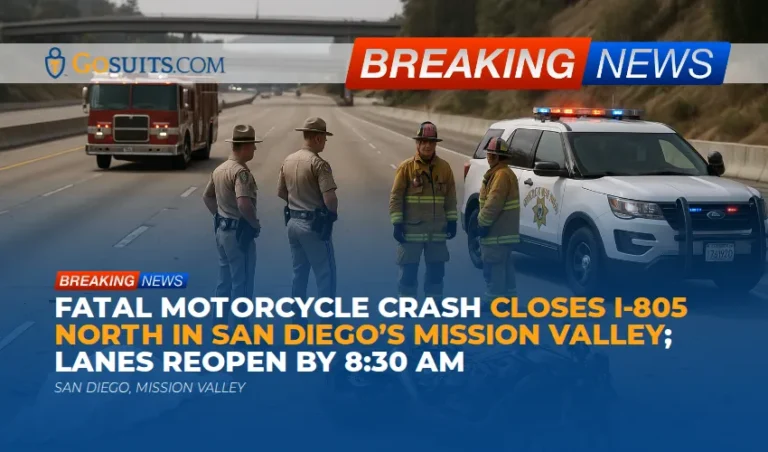
A fatal crash involving a motorcycle and another vehicle led to the full closure of the northbound lanes of Interstate 805 in San Diego early Thursday morning. According to initial information shared by the California Highway Patrol, the collision occurred shortly after 5 a.m. in the Mission Valley corridor, north of Friars Road and south of Murray Ridge Road. The motorcyclist was reportedly traveling at a high rate of speed just before the crash. For several hours, traffic was diverted and a SigAlert was issued while responders worked the scene and investigated. By approximately 8:30 a.m., officials reported all northbound lanes had reopened.
At the time of the update, the exact number of people involved was still unclear. When a crash of this scale happens on the I-805, it commonly affects multiple lanes and often requires specialized response teams for scene mapping and evidence preservation, which is one reason the CHP uses temporary full closures during the early phases of an investigation.
Where and when it happened
The crash took place in the Mission Valley area of San Diego, a highly traveled stretch of freeway framed by neighborhoods like Serra Mesa and Linda Vista, and just a few minutes from major destinations such as Fashion Valley. The reported location places the incident between Friars Road and Murray Ridge Road on the northbound side, a segment of freeway that funnels commuters toward the I-8, SR-163, and the Kearny Mesa employment centers. The initial call to CHP came shortly before 5 a.m., during the early morning build-up when commuter volumes begin to rise.
Local residents know this corridor well. Morning traffic here can tighten quickly even on routine days, and any major incident sends a ripple across the grid, affecting alternate routes like SR-163 through Hillcrest and Balboa Park, or I-15 through City Heights and Kensington.
Traffic impacts and morning commute alternatives
CHP initially diverted traffic to the I-8 and advised drivers to use Interstate 15 or State Route 163. Lanes 4 and 5 reopened roughly an hour after the closure began, with the remaining lanes reopening later as investigators cleared the scene and towing units completed vehicle removal. If you were in the area Thursday morning, you likely saw backups stacking up far south, as far as Division Street, which signals a significant regional impact reaching into Southcrest, Logan Heights, and beyond.
Drivers navigating the I-805 corridor can monitor impacts and closures using Caltrans QuickMap, which provides live incident markers, cameras, and lane closure details for San Diego County and beyond. It is the same platform traffic operations rely on to share real-time freeway status with the public [1].
What investigators typically examine after a freeway motorcycle crash
While each collision scene is unique, investigators commonly focus on several core elements when a motorcycle and another vehicle are involved on a high-speed corridor like the I-805:
- Scene documentation Officers create scale diagrams, measure skid or scuff marks, and photograph debris fields to help reconstruct the sequence of events.
- Vehicle inspections Damage patterns, lighting, and mechanical conditions are examined. On modern cars, electronic data may be preserved if available.
- Speed and sight lines Investigators consider posted speeds, prevailing traffic speed, curves, elevation changes, and visibility.
- Driver behavior and impairment Standardized assessments may be performed where appropriate alongside witness statements and 911 transcripts.
- Environmental factors Lighting conditions, roadway surface, weather, and temporary hazards are noted. If roadway condition is suspected, agencies may preserve additional evidence for later review.
On San Diego freeways, it is common to see multi-agency coordination when a fatality occurs. CHP generally serves as the lead agency on state freeways, while San Diego Fire-Rescue and EMS handle life safety and medical response, and the San Diego County Medical Examiner manages decedent care and post-incident documentation.

Why speed and freeway dynamics make motorcycles vulnerable
Motorcyclists are uniquely exposed to injury risk because they lack the structural protections that enclosed vehicles provide. National data show that motorcyclists face a higher rate of fatality per vehicle miles traveled than occupants of passenger cars. NHTSA’s motorcycle safety resources underscore that even modest increases in speed can significantly raise the risk and severity of injuries for riders [2]. Helmets remain one of the most effective tools for reducing head injury and death; CDC materials consistently highlight helmet effectiveness and the value of comprehensive rider safety practices [3].
In California, lane splitting is permitted under state guidance, and CHP provides safety tips aimed at reducing risk for riders who choose to lane split in congested conditions. CHP encourages riders to consider speed differentials, overall traffic flow, and surrounding driver behavior to make safer decisions while sharing lanes [4]. While the present incident was reported during the early morning commute period and involved high speed, specific decisions or maneuvers leading up to this crash will be assessed by investigators based on the evidence.
Local resources: how to get official records and information
After a serious freeway collision, families and those involved often need documents that only public agencies can provide. Here is how those typically work in San Diego County and across California.
CHP traffic collision report
- Who can get it California Vehicle Code section 20012 limits access to involved parties, their legal representatives, and affiliated insurers. This protects sensitive information while enabling civil claims and insurance reviews [5].
- How to request CHP provides instructions and the CHP 190 request form for collision reports. Requests can be made by mail or in person, and some offices offer online options. You will generally need the date, time, location, and party names if known [6].
- Where to send For an I-805 crash in San Diego, the San Diego Area CHP office typically manages the report. CHP maintains an online directory of area offices to confirm where to submit your request [7].
San Diego County Medical Examiner records
- Autopsy and investigative reports The San Diego County Medical Examiner provides record request options for next of kin, including autopsy reports and related documents, subject to applicable privacy laws. Families can start with the Medical Examiner’s main page and follow the Records and For Families instructions [8].
- Death certificates Certified copies are issued through Vital Records. State-level guidance is available through the California Department of Public Health to help navigate requests and eligibility [9].

Traffic conditions and closure verification
- Live statewide updates Caltrans QuickMap provides official closure details, CHP incidents, and traffic camera feeds so you can verify when lanes reopen or if detours remain in effect [1].
If the crash had occurred on city streets instead
- San Diego Police Department reports SDPD handles most city-street collisions within the City of San Diego. Their Records Division provides instructions for requesting traffic collision reports if the roadway is under city jurisdiction rather than CHP [10].
Legal rights after a fatal or serious motorcycle crash in California
California civil law provides pathways for injured people and families to pursue compensation after a crash caused by negligence. Two commonly discussed civil actions after a roadway fatality are wrongful death and a survival action. Wrongful death focuses on losses suffered by eligible family members, while a survival action addresses certain claims the decedent could have pursued if they had survived. The general statute of limitations for wrongful death in California is two years from the date of death, set out in Code of Civil Procedure section 335.1 [11]. Different deadlines may apply if a public entity is involved.
If a roadway condition, deficient signage, or a design/maintenance issue is suspected, claims against a public entity often require a government claim to be filed within six months under the Government Claims Act before a lawsuit can proceed. The initial claim deadline is set by Government Code section 911.2 [12]. Determining whether a public entity bears any responsibility is highly fact specific and typically requires a prompt technical review.
For a deeper, plain-language overview of how legal counsel supports riders and families in these cases, see The role of a personal injury lawyer in motorcycle accident cases in California. That guide explains typical evidence, timelines, and how counsel addresses insurance and liability disputes.
When people start researching help, many quickly encounter the term motorcycle accident lawyers. That phrase simply describes attorneys who handle motorcycle crash injury and wrongful death claims within the broader field of personal injury law. Whether a case involves a single vehicle, multiple vehicles, or unclear liability, early evidence preservation and careful analysis often shape outcomes later on.
Insurance considerations and common pitfalls
Insurance adjusters often move fast, especially after severe crashes, because early statements can influence later decisions. It is generally wise to consult with a qualified attorney before providing recorded statements to an insurer. What someone says in the first 24 to 72 hours can be used against them later, even if they did not yet have access to the collision report, autopsy findings, or vehicle inspections.
Complex questions can come up immediately: Was the at-fault driver underinsured? Does uninsured motorist coverage apply? Were there multiple policies or potential claims, including employer or commercial coverage for any involved vehicle? In larger losses, coordinating benefits and negotiating medical liens become critical. In and around Mission Valley and Serra Mesa, commuters share lanes with delivery vans, rideshares, and construction traffic, which sometimes complicates the insurance picture.
If you are comparing options or seeking to understand how law firms approach these claims in California, many look for San Diego motorcycle accident lawyers who can step in quickly to preserve evidence and coordinate communications. Skilled counsel can also evaluate whether a time-limited policy-limits demand is appropriate once liability and damages are better understood.
Remember the general rule of thumb shared above: speak with an attorney first before opening or discussing a claim with any insurer. Insurers are within their rights to ask questions, but you are also within your rights to understand the scope of coverage and the implications of your statements.
Practical next steps for community members
In the wake of a serious crash, people often feel unsure what to do first. The actions below are general, not case-specific, and intended to help community members stay organized.
- Preserve evidence early Save photos, dashcam footage, and location data. Keep clothing, helmet, and gear in their post-incident condition if a motorcycle was involved.
- Request official records Note the report number if provided at the scene. Use CHP’s collision report process and the Medical Examiner’s records portal as applicable [6] [8].
- Track treatment and symptoms Maintain a running log of medical visits, pain levels, and work impacts. This helps align medical findings with day-to-day effects.
- Coordinate with employers and schools Obtain documentation of missed work or classes, schedule changes, and any functional limitations.
- Consult an attorney before insurance statements Seek a free consultation with a qualified professional to understand your rights and the best sequence for reporting to insurers. Early statements can carry lasting consequences.
- Identify all possible coverages Look for MedPay, UM/UIM, and any applicable employer policies if a commercial vehicle was involved. Ask about coordination of benefits and lien issues.
- Consider roadway context If you suspect a roadway hazard, photograph it quickly and log weather, lighting, and traffic conditions. Potential public-entity claims require very short deadlines [12].
Why acting promptly matters
Several timelines start immediately after a crash. Acting sooner rather than later helps ensure nothing important slips through the cracks.
- Evidence is perishable Vehicles are repaired or destroyed, dashcam systems overwrite old footage, and roadway conditions change. Timely preservation can make a decisive difference.
- Records take time Collision and autopsy reports are not always available right away. Getting requests in early can shorten the wait once documents are complete [6] [8].
- Deadlines are strict Wrongful death claims have a two-year general limitation period in California, and many public-entity claims require a government claim within six months [11] [12].
- Insurance strategy benefits from planning A coordinated approach to coverage, medical billing, and lien resolution usually yields fewer surprises and clearer next steps.
Community safety notes for the I-805 corridor
The I-805 is one of San Diego’s most heavily used freeways, bridging communities from the South Bay through Mission Valley and up to Sorrento Valley. On-ramps near Friars Road and the interchange merges with SR-163 often create dense clusters of vehicles, especially during the morning push toward Kearny Mesa and the hospitals near Mesa College. When traffic is heavy, small changes in speed can ripple outward and lead to sudden braking and lateral movements by drivers.
Statewide collision ranking and safety resources maintained by the California Office of Traffic Safety show how different roadway types and traffic volumes affect risk profiles across cities and counties. Their annual county and city-level dashboards are useful for seeing broader safety trends that can inform personal driving and riding habits [13]. For riders navigating Mission Valley and the nearby canyon corridors, combining safe speeds, high-visibility gear, and defensive positioning with CHP’s lane-splitting guidance is a practical way to reduce exposure in these busy merging zones [4].
If you are gathering educational material about the legal process after a motorcycle crash in California, you might also appreciate in-depth explainers like The role of a personal injury lawyer in motorcycle accident cases in California, which breaks down evidence, timelines, and common legal questions in plain language.

Commentary from Gosuits San Diego, California Personal Injury Attorney
Our hearts go out to everyone affected by the fatal crash on the northbound I-805 near Mission Valley. Incidents like this are devastating for families and hard on the wider community that drives these roads daily. This summary is offered for general information and education only.
From what has been shared, the collision occurred during the early morning commute on a fast-moving corridor, and speed was reportedly a factor. Motorcycle cases on freeways often turn on split-second dynamics: speed differentials, lane positioning, and driver perception in heavy merge areas. Even when a rider is traveling quickly, investigators still examine whether other drivers maintained safe following distances, signaled lane changes, and kept a proper lookout. Evidence preservation is crucial. Photos, dashcam downloads, scene measurements, and the official collision report help define what really happened.
In the aftermath, insurance companies tend to move quickly. They may request recorded statements, push early settlement discussions, or focus attention on select details in the absence of the full record. Large insurers and corporate risk managers do this every day, and they know how to frame the conversation to their advantage. People dealing with shock and grief often do not realize how their words can be characterized later or how policy provisions like exclusions, offsets, or low limits can affect a claim.
That is why a free consultation matters. It gives space to understand rights, identify all potential coverages, and plan a step-by-step approach before saying anything on the record. It also helps families learn about timelines, including the two-year wrongful death period in most California cases and the much shorter deadlines for any claim that could involve a public entity. With clear information, better choices follow.
References
- Caltrans QuickMap – California Department of Transportation
- Motorcycles – National Highway Traffic Safety Administration
- Motorcycle Safety – Centers for Disease Control and Prevention
- Lane Splitting Safety Tips – California Highway Patrol
- Vehicle Code § 20012 – California Legislative Information
- Collision Reports – California Highway Patrol
- Find a CHP Office – California Highway Patrol
- Medical Examiner – County of San Diego
- Vital Records – California Department of Public Health
- Records Division – San Diego Police Department
- Code of Civil Procedure § 335.1 – California Legislative Information
- Government Code § 911.2 – California Legislative Information
- Collision Rankings and Data – California Office of Traffic Safety