- What we know about the I-10 two-vehicle crash west of Bob Hope Drive
- Local context: rain, standing water, and why this I-10 stretch can be dangerous
- Injuries, loss of life, and immediate aftermath described by officials
- How DUI allegations and reckless driving can shape civil liability
- Could standing water support a dangerous condition claim against a public entity?
- Passenger rights and overlapping insurance paths in a two-car crash
- Where families can call for official records in Riverside County
- Evidence to preserve now to protect civil claims
- Talking to insurance companies after a fatal or serious crash
- Key legal timelines that commonly apply in California
- Safety notes for wet-weather driving on I-10 through the Coachella Valley
- Action steps and why timing matters
- Commentary from Gosuits Cathedral City, California Personal Injury Attorney
- References
What we know about the I-10 two-vehicle crash west of Bob Hope Drive
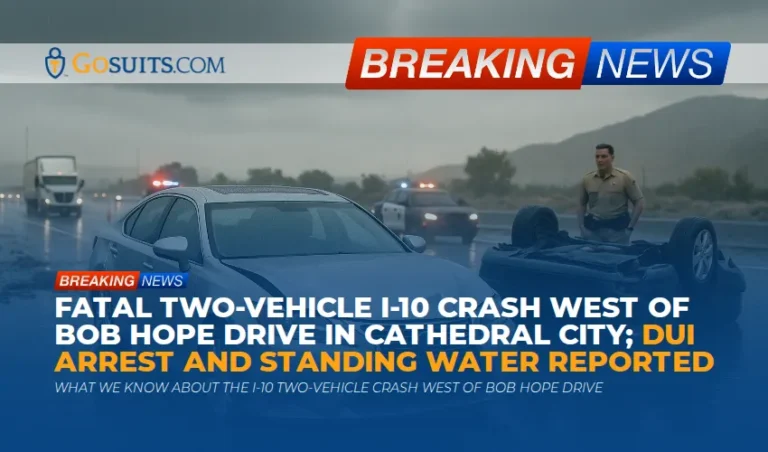
Early Saturday morning just after sunrise, California Highway Patrol responded to a serious two-vehicle crash on eastbound Interstate 10, just west of Bob Hope Drive in Cathedral City. Officials reported a Lexus traveling in the number one lane and a Toyota in the number three lane, both moving eastbound. Witnesses described the Lexus as driving recklessly before veering right into the Toyota. At that location, a standing body of water remained from recent rainfall. The Lexus came to rest upright within the pooled water. The Toyota overturned onto its roof and became submerged.
According to CHP’s summary shared with local media, the Lexus driver self-extricated and was later evaluated at a hospital. Four passengers riding in the Toyota managed to get out. The Toyota’s driver was believed to be underwater when first responders arrived; he was extricated but remained unresponsive at the scene and was taken to Desert Regional Medical Center, where he did not survive. CHP later stated the Lexus driver was arrested on suspicion of DUI following medical evaluation. The Riverside County Coroner has publicly identified the deceased as a 65-year-old man from Bell.
The site is well known to locals. Eastbound I-10 just west of Bob Hope sits near the Rancho Mirage and Cathedral City boundary. When winter rains push across the pass from Whitewater and into the Valley floor, water can collect alongside the eastbound lanes between Date Palm Drive and Ramon Road, and winds often funnel across open desert reaches. Those conditions appear to have been a factor here, as officials confirmed pooled water near where both vehicles left the roadway.
Local context: rain, standing water, and why this I-10 stretch can be dangerous
If you drive I-10 through the Coachella Valley, you know the story. Storm cells can drop fast rain on hard-packed desert soil. Runoff from sloped shoulders and the Whitewater River channel area can sheet across low points and settle in dips beside the eastbound lanes, especially between Bob Hope Drive and the Monterey Avenue interchange. Even hours after a storm, shaded pockets or drainage depressions hold water. Hydroplaning risk goes up dramatically when tires meet a thin film on the pavement, and it only takes a momentary loss of traction to throw a car off line.
Federal safety guidance underscores the risk. NHTSA warns that wet roads reduce traction and visibility, making speed, lane changes, and abrupt steering especially dangerous. Slowing down, avoiding cruise control, and replacing worn tires are consistent wet-weather safety steps recommended by federal safety officials [11].
This stretch of I-10 is also a gateway corridor. Morning traffic heading east from the San Gorgonio Pass mixes with local drivers from Cathedral City, Rancho Mirage, and Palm Desert ramping on and off near Bob Hope and Monterey. Add lingering standing water south of the travel lanes, and a single errant movement can lead to a spin, rollover, or secondary impact into another car that is minding its lane. That appears to mirror what CHP described in this crash sequence.
Injuries, loss of life, and immediate aftermath described by officials
CHP and tow operators reportedly worked to recover both the Lexus and the Toyota from the pooled water. Four Toyota passengers escaped with varying injuries and were hospitalized. The Toyota overturned and was submerged, and its driver could not be resuscitated after extrication. The Lexus driver, after an initial medical evaluation, was taken into custody on suspicion of driving under the influence.
In the days after a deadly collision like this, families are often focused on two urgent tasks: obtaining accurate official documentation and making immediate arrangements. That process can feel overwhelming, particularly when it involves multiple agencies like CHP, the Riverside County Sheriff’s Coroner Bureau, hospitals, and potentially Caltrans if roadway drainage or standing water played a role.
How DUI allegations and reckless driving can shape civil liability
When a driver is arrested on suspicion of DUI after a collision causing injury or death, that criminal process runs on a separate track from any civil claims. For civil injury and wrongful death cases, California law recognizes that violating a safety statute can create a presumption of negligence if certain criteria are met. This concept is often called negligence per se, codified in Evidence Code section 669 [10]. In plain terms, if a driver violates a safety law designed to prevent the kind of harm that occurred, and that violation substantially caused the harm, the law can presume negligence unless there is a legally valid excuse.
Reckless driving behaviors like unsafe lane changes, speeding, or operating a vehicle under the influence can also open the door to claims for punitive damages in some cases. Punitive damages are not about making someone whole, they are about punishing particularly egregious conduct and deterring it. Whether punitive claims are viable depends on a detailed review of the facts and California’s standards, which require more than mere carelessness.
At a practical level, the civil investigation will typically focus on the Lexus driver’s conduct, the condition of the roadway, and any contributing factors such as speed, visibility, prior hazard reports, and mechanical conditions. Statements from independent witnesses, onboard telematics or event data recorders, and post-crash toxicology records can become central pieces of evidence. Federal safety materials confirm that many modern vehicles store crash-related data through an event data recorder, which can be preserved and analyzed by qualified professionals [13].

Could standing water support a dangerous condition claim against a public entity?
Families sometimes ask a difficult but fair question after a crash near pooled water: can a public agency be liable for drainage or roadway design? The answer depends on specific facts. California allows claims against public entities for a dangerous condition of public property under certain conditions. However, these are not ordinary claims, and strict notice rules apply.
Because the incident was on I-10 within Riverside County, Caltrans District 8 is the state agency that maintains this freeway segment. District 8 covers Riverside and San Bernardino Counties and is the point of contact for roadway maintenance, drainage, and capital improvements on state highways in the Coachella Valley [6]. If a family believes a roadway defect, poor drainage, or a recurring pooling hazard contributed to the crash, they can submit a maintenance service request to document the condition and also evaluate whether a Government Claims Act notice is warranted. Caltrans provides a Customer Service Request portal to report roadway issues like standing water, damaged signs, or potholes [7].
For civil claims against a public entity like Caltrans, the California Government Claims Act generally requires a written claim within six months of the incident for claims relating to death or injury. This is a shorter timeline than the typical two-year statute for other defendants, and missing it can jeopardize the claim [8]. Because dangerous-condition claims are complex and very fact-specific, they usually involve early expert review of drainage design, prior incident records, and maintenance logs.
Related reading that may help explain weather and roadway factors: weather related car accidents driver negligence gosuits.
Passenger rights and overlapping insurance paths in a two-car crash
Passengers in the Toyota may have several insurance avenues. First is the liability policy of any at-fault driver. If CHP and forensic evidence show the Lexus driver’s actions substantially caused the crash, claims can be presented to that driver’s insurer. In a two-car crash, it is also standard practice to evaluate the Toyota driver’s policy, not because fault is presumed, but because California allows passengers to claim against any negligent party, and in multi-factor crashes, more than one driver can share fault.
Uninsured or underinsured motorist coverage on a passenger’s own policy, or on the Toyota’s policy if passengers qualify as insureds under that contract, can also come into play if third-party liability limits are not enough. Med-pay benefits can help cover immediate medical expenses without regard to fault, subject to policy terms. The interaction between liability coverage, med-pay, and UM or UIM can be complicated. Coordinating benefits and preventing duplicate payments or offsets is an area where seasoned advocates can add clarity. Many look to car accident lawyers for guidance navigating coverage layers and avoiding mistakes that reduce net recovery.
In Riverside County, overlapping coverage is common because families often carry UM or UIM for precisely these worst-case scenarios. Determining which policy pays first, how to preserve rights against multiple insurers, and how to handle hospital liens requires careful attention to policy language and California insurance rules. Consumer resources from the California Department of Insurance explain core auto claims concepts, which can serve as a helpful starting point before deeper case-specific analysis [14].
Where families can call for official records in Riverside County
CHP traffic collision report
Because the collision occurred on I-10, CHP is the agency of record. Families can request the CHP traffic collision report using the CHP 190 form. The form can be submitted by mail or in person to the appropriate area office. The Indio Area Office is typically responsible for the I-10 corridor through Cathedral City and Rancho Mirage. The CHP 190 form and office information are available from official CHP sources [1] [2]. Reports are released in accordance with California law to authorized parties, which typically include involved persons, their legal representatives, and next-of-kin for a decedent.
Riverside County Sheriff’s Coroner Bureau
Next-of-kin can request information about the autopsy process and, when finalized, may request the coroner’s report through the Riverside County Sheriff’s Office. Timeframes vary based on investigative steps and toxicology testing. The Sheriff’s Office publishes general guidance and contact pathways for the Coroner Bureau on its public site [3].
Medical records
Hospitals maintain their own Health Information Management departments. Families are often asked to complete an authorization and present identification to receive the decedent’s records. Federal privacy rules give individuals and, in certain circumstances, personal representatives a right to access medical records. The U.S. Department of Health and Human Services provides a clear explanation of these access rights and typical steps to request records [5].
Accident reporting to DMV
If a party to the crash is alive and must report to DMV, California requires an SR-1 to be filed within 10 days for any crash with injury, death, or significant property damage. The form can be submitted online or by mail. The DMV outlines who must file and how to do it [4]. In fatal cases, law enforcement reporting and coroner notification proceed in parallel, and families should confirm with counsel whether any DMV steps apply to their situation.
Roadway maintenance or hazard reports
To report a drainage issue, standing water, or other roadway hazard on a state highway, Caltrans provides a customer service portal for maintenance requests. District 8 serves Riverside County and can route reports for review and response. This is not the same as a legal claim, but it can document conditions and trigger a maintenance assessment [6] [7].
Evidence to preserve now to protect civil claims
Crashes that end in the water or overturn a vehicle can strip away important clues. Quick, careful evidence preservation is essential. Consider the following:
- Identify and secure eyewitness information including names, phone numbers, and any dashcam footage they may have saved. People traveling through the Coachella Valley on a Saturday morning often include commuters, service workers, and weekend travelers who may have recorded video without realizing its value.
- Preserve vehicle data. Many vehicles store crash metrics in an event data recorder. Your team can send preservation notices and coordinate lawful access to download crash data before repairs or salvage operations wipe it clean [13].
- Request official records promptly. File CHP 190 for the traffic collision report and diagram, and note any evidence list referenced by the investigating officer [1].
- Document roadway conditions near the eastbound lanes west of Bob Hope Drive. Photos and video of pooled water, drainage inlets, and shoulder conditions can be time-sensitive, since Caltrans crews may pump or dissipate water after a major incident.
- Track medical care and hospital billing. Keep discharge summaries, imaging reports, and itemized invoices. HHS guidance explains your right to request and receive these records [5].
- Note prior hazard history. If neighbors or regular commuters have observed recurrent pooling in that location, their testimony and any prior maintenance requests to Caltrans can be relevant. Submitting a maintenance service request documents the concern for future reference [7].
Talking to insurance companies after a fatal or serious crash
Insurance adjusters typically make contact quickly. Initial calls often sound routine: “we just need your statement” or “can we get your date of birth to set up the claim.” What people say in those first conversations can later be used to limit or deny coverage. That is why many families choose to speak with a qualified attorney first, before talking to any insurance company about causation, fault, or injuries. Even seemingly harmless comments about speed, weather, or seat belt use can be taken out of context.
The Department of Insurance provides consumer-facing explanations of how auto claims work in California. Reviewing those materials can help any caller understand basic terminology, like med-pay, UM or UIM, recorded statements, and policy limits [14]. People who want a local perspective often search for Cathedral City car accident lawyers to learn how coverage layers may apply to a specific crash scenario in Riverside County.
Key legal timelines that commonly apply in California
While every case is unique, several time limits frequently affect serious and fatal crash claims:
- Wrongful death and personal injury claims. In many cases, California law allows two years from the date of injury or death to file a civil lawsuit against private parties, such as another driver. See Code of Civil Procedure section 335.1 [9].
- Government Claims Act notice. If a public entity claim is considered, such as a dangerous condition of public property against Caltrans, the Government Claims Act generally requires a written claim within six months of the incident for injury or death claims. See Government Code section 911.2 [8].
- DMV accident reporting. Parties to a crash must file an SR-1 with DMV within 10 days when injury, death, or certain property damage thresholds apply. The DMV explains who must file and how [4].
- Preservation of vehicle and roadway evidence. There is no statute that automatically saves evidence. Preservation letters should go out rapidly, especially when a vehicle is at risk of being totaled or salvaged. If an insurer moves a vehicle to a storage yard in Indio or Thousand Palms, access can become harder by the day.
Because missing a deadline can cut off claims, it is sensible to confirm applicable timelines early, including any shorter deadlines under an insurance contract that may require prompt notice.
Safety notes for wet-weather driving on I-10 through the Coachella Valley
In this crash, officials described pooled water near where the vehicles came to rest. Wet-weather crashes rise when speed and driver behavior do not match conditions. NHTSA’s rain driving guidance emphasizes practical steps: reduce speed, increase following distance, avoid sudden steering or braking, and never use cruise control on wet pavement [11]. The California Office of Traffic Safety also highlights the ongoing danger of impaired driving in our state, which becomes even more hazardous when visibility and traction are reduced [12].
Around Cathedral City, standing water can appear unexpectedly after a storm, especially alongside the eastbound lanes where shoulders drain poorly near low points. If you commute past Bob Hope Drive toward Monterey Avenue and Cook Street, you have probably seen shallow ponds hugging the right-of-way after a night of rain. When drivers adjust speed and look far ahead for reflections or spray plumes from other cars, they buy themselves a margin of safety. When they do not, a hydroplane or lane departure can unfold in seconds.
Action steps and why timing matters
Serious freeway crashes set in motion a cascade of deadlines, evidence risks, and insurance decisions. The most helpful actions are often time-sensitive. Consider these steps and why they matter:
- Obtain the official CHP collision report quickly. The report anchors key facts, including the diagram, measurements, and contact information for witnesses. If errors are present, documenting corrections early avoids months of confusion later [1] [2].
- Preserve vehicles and download crash data. Tow yards do not hold vehicles indefinitely. Once a car is sold for salvage, event data and physical evidence can be lost. Early preservation letters can secure the car and prevent spoliation [13].
- Centralize medical bills and records. Families often receive hospital, emergency physician, radiology, and ambulance bills separately. Keeping a running log helps prevent missed items, supports insurance submissions, and reduces later disputes about what was treated and when [5].
- Be cautious with recorded statements. Adjusters sometimes request statements within days. Saying too much before all facts are known can narrow or compromise claims. Confirming rights and obligations first helps prevent avoidable missteps [14].
- Calendar legal deadlines. Mark the two-year period under Code of Civil Procedure section 335.1, and any six-month Government Claims Act deadline if a public entity claim is considered [8] [9].
- Report persistent road hazards. If standing water regularly appears at a known location, submitting a Caltrans maintenance request documents the issue and can trigger mitigation steps, potentially improving safety for all drivers on I-10 [7].
Acting on these items early often preserves options, reduces confusion with insurers, and protects the evidentiary foundation of any civil claims tied to the crash.

Commentary from Gosuits Cathedral City, California Personal Injury Attorney
Our hearts go out to everyone involved in this crash and to the family mourning the loss of a loved one. The details released by CHP and the coroner are difficult to read, and the images of a vehicle overturned in water are especially heartbreaking. This commentary is shared for educational purposes and general information, not as a substitute for personalized guidance.
Based on the information publicly reported, several civil liability issues are front and center. First, the allegation that the Lexus was driven recklessly and the subsequent DUI arrest point to a strong focus on driver negligence, potential negligence per se under Evidence Code section 669, and in some circumstances a review of whether punitive exposure could apply given the nature of the conduct. Second, the confirmation of pooled water near the eastbound lanes raises the question of whether a recurring drainage problem contributed to the severity or dynamics of the crash, which is something that may warrant investigation under California’s public-entity liability framework, with the important caveat that strict Government Claims Act timelines apply.
We also see, day in and day out, how insurers and large corporate defendants leverage information gaps. They record statements early, push quick releases, and rely on families not knowing how multiple policies interact. Without context, people can unknowingly give up key rights, accept low valuations, or miss shorter deadlines that only apply to public entities. An early, no-cost consultation gives people a clear picture of their options, how coverage layers work, and what to avoid saying in those first calls. That kind of conversation helps level the playing field before insurers set the narrative.
References
- Traffic Collision Report Request Form (CHP 190) – California Highway Patrol
- Indio Area Office Information – California Highway Patrol
- Riverside County Sheriff’s Office Main Site – Riverside County Sheriff
- Vehicle Accident Reporting Requirements (SR-1) – California DMV
- Your Rights to Access Medical Records – U.S. Department of Health and Human Services
- Caltrans District 8 Overview – California Department of Transportation
- Customer Service Request Portal – California Department of Transportation
- Government Claims Must Be Presented Within Six Months – California Government Code § 911.2
- Two-Year Statute for Injury or Death – California Code of Civil Procedure § 335.1
- Negligence Per Se – California Evidence Code § 669
- Driving in the Rain Safety Guidance – National Highway Traffic Safety Administration
- Impaired Driving Program Overview – California Office of Traffic Safety
- Event Data Recorders: Research and Data – National Highway Traffic Safety Administration
- Automobile Insurance Basics – California Department of Insurance