- What We Know About the Deer Park Crash at Lake Cook Road and Quentin Road
- Why Disabled-Vehicle Situations Are So Dangerous on Suburban Arterials
- Potential Civil Liability Considerations Under Illinois Law
- Steps Families and Injured Passengers Can Take Right Now
- How Investigators Reconstruct Crashes Like This
- Community Context and Practical Safety Guidance for Deer Park Drivers
- Claim Process Overview Without Pitfalls
- Time Windows That Matter in Illinois
- What Others in Lake County Can Do to Help After a Fatal Crash
- Call to Action: Steps That Should Happen Soon
- Commentary from Gosuits Deer Park, Illinois Personal Injury Attorney
- References
What We Know About the Deer Park Crash at Lake Cook Road and Quentin Road
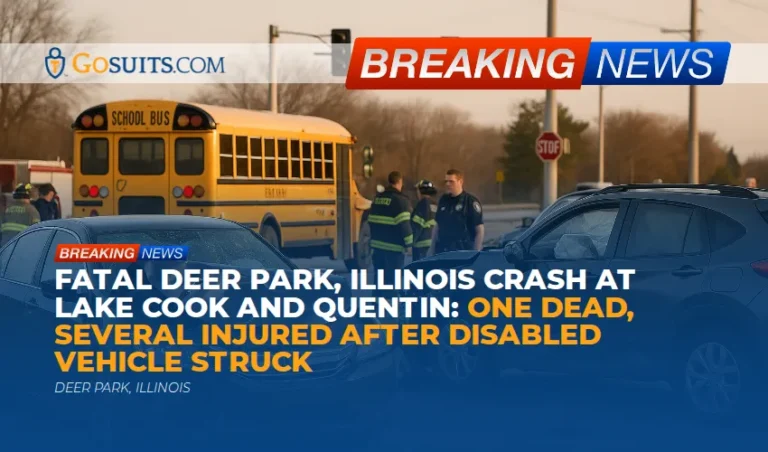
On a Tuesday afternoon around 3:15 p.m., at the intersection of Lake Cook Road and Quentin Road in Deer Park, Illinois, a serious crash led to a tragic loss of life and several injuries. Investigators in Lake County reported that a Honda Accord had broken down, and its driver got out to look under the hood. Another vehicle, a Honda HR-V, then struck the Accord, fatally injuring the man who was beneath it. According to officials, passengers in both vehicles were injured, though they were expected to recover. A school bus was sideswiped in the incident, with only the bus driver inside, who was not hurt.
This junction, which sits along the busy Lake Cook corridor and serves local traffic bound for Deer Park Town Center, nearby neighborhoods, and forest preserves, often carries steady afternoon traffic. That is important context for understanding how quickly risks can escalate when a vehicle becomes disabled in or near a travel lane during the after-school and after-work hours.
Location and time
The collision occurred at Lake Cook Road and Quentin Road in Deer Park, around the 3:15 p.m. hour. Afternoon light, commuting patterns, and typical suburban arterial speeds can combine to make roadside breakdowns particularly hazardous during this part of the day.
Vehicles and parties involved
Two primary vehicles were involved: a Honda Accord that had reportedly broken down, and a Honda HR-V that struck the Accord. A school bus was also grazed. The Accord’s driver, who was outside his vehicle at the time, sustained fatal injuries. Passengers in the Accord and HR-V were injured but expected to be okay based on early information from investigators. The bus driver reported no injuries.
Investigation status
Major crash investigations typically span several weeks and may involve scene measurements, vehicle inspections, event data recorder downloads, and toxicology. In a multi-vehicle crash with a fatality, investigators carefully determine pre-impact vehicle positions, impact dynamics, and driver actions before assigning final contributing factors. Families and injured passengers often find it helpful to know that these steps take time and that additional details can emerge as investigators complete their work.
Why Disabled-Vehicle Situations Are So Dangerous on Suburban Arterials
Most of us have experienced a breakdown at some point. On high speed or high volume suburban arterials, though, a disabled vehicle can quickly create a dangerous situation. Illinois driver guidance underscores the importance of pulling off the roadway when safe, using hazard lights, and staying as far away from moving traffic as possible [1]. Federal roadway safety guidance offers similar advice and emphasizes setting out warning triangles or flares when safe, staying visible, and avoiding standing in travel lanes [2].
Limited reaction time and visibility
Drivers moving through intersections like Lake Cook and Quentin are often managing multiple tasks at once, from watching signals to scanning for cross traffic. A disabled vehicle near or in a lane can leave limited time to react, especially if the disabled vehicle is around a curve, near a crest, or if lighting and weather reduce visibility. National data show pedestrians are especially vulnerable outside vehicles, particularly in low light; situational awareness and visibility become critical when someone must exit a car on the roadside [13].
Best practices when a vehicle breaks down
Illinois and national safety guidance both stress a few core principles to reduce the risk of secondary crashes or pedestrian strikes after a breakdown:
- Get to safety if you can. Pull as far off the road as possible and turn on hazard lights [1] [2].
- Increase visibility. Use flares, cones, or reflective triangles when you can do so safely. Keep the vehicle’s lights on if the battery allows [2].
- Avoid standing in live lanes. If you must exit, do so carefully, ideally from the side away from traffic, and stay behind a barrier if one exists [2].
- Call for assistance. Use a roadside service or non-emergency line. If the vehicle creates an immediate hazard, consider contacting law enforcement to help with traffic control.
Of course, every situation is unique. Not every breakdown allows a driver to safely reach the shoulder. That is why approaching drivers also have an ongoing duty to keep a proper lookout and adjust their speed and lane position when they see a disabled vehicle ahead.
Potential Civil Liability Considerations Under Illinois Law
When a fatal crash happens in Lake County, families naturally want to understand what legal paths may be available. The civil framework below is general and not exhaustive. It is provided for educational purposes only.

Duty of care for approaching drivers
Under Illinois law, all drivers must operate their vehicles with reasonable care. That includes maintaining a proper lookout, controlling speed, and leaving enough room to avoid foreseeable hazards. When a driver approaches a disabled vehicle or people outside a vehicle, that duty of care can require heightened caution. Whether a driver acted reasonably often turns on the specific facts of time, distance, speed, lighting, and visibility documented during the investigation.
Responsibilities of drivers with disabled vehicles and comparative negligence
The Illinois Secretary of State’s Rules of the Road encourages drivers experiencing a breakdown to move the vehicle out of traffic when possible, activate hazard lights, and take steps to be seen and stay safe [1]. If a disabled vehicle cannot be moved or someone must exit the vehicle, the law still looks at the reasonableness of everyone’s actions.
Illinois follows a modified comparative negligence rule. If multiple people share fault, their percentage of fault can reduce their recovery, and a claimant more than 50 percent at fault cannot recover under the comparative fault statute [3]. Applied to disabled-vehicle crashes, the allocation of fault can depend on factors like where the vehicle was stopped, what warnings were present, the behavior of approaching drivers, and roadway conditions.
Wrongful death and survival actions
Illinois recognizes two distinct types of civil actions after a fatal crash:
- Wrongful death. A claim brought for the benefit of the surviving spouse and next of kin to compensate them for losses like loss of society and services. Generally, an action must be filed within two years of death under the Wrongful Death Act, subject to specific statutory exceptions [4].
- Survival action. A claim that preserves the decedent’s own causes of action that accrued before death, such as pain and suffering and medical expenses, under the Survival Act [5].
Each case is fact-specific, and deadlines can vary depending on who is involved and the circumstances.
Insurance coverages that may come into play
Illinois is a fault based auto insurance state that requires drivers to maintain liability insurance [6]. In a multi-vehicle crash with a fatality, several coverages may be relevant:
- Bodily injury liability. Covers injury claims against an at-fault driver, up to policy limits.
- Uninsured or underinsured motorist coverage. May apply for injured occupants or next of kin if an at-fault driver has no insurance or insufficient limits, subject to policy terms.
- Medical payments coverage. Often available regardless of fault to help with immediate medical bills, again subject to policy terms.
Navigating layered coverage and policy language can be complex. Families frequently turn to seasoned car accident lawyers to evaluate how multiple policies interact, identify primary and excess coverage, and protect against quick, inadequate settlements.
Steps Families and Injured Passengers Can Take Right Now
In the hours and days after a serious crash, information can be scattered. Taking measured steps helps protect health and preserve facts that matter later.
Preserve evidence
- Secure the vehicles. Do not authorize repairs or disposal until an independent inspection can occur. Modern vehicles often store pre-crash speed, braking, and seat belt data in an event data recorder. Collecting that information requires the car to be intact.
- Collect scene media. Save any photos or videos you already have. Note the time, exact location, and direction of travel. Nearby homes or businesses along Lake Cook Road and Quentin Road may have exterior cameras that caught the moments before impact.
- Identify witnesses early. Bus drivers, nearby motorists, or shoppers leaving Deer Park Town Center may have seen the breakdown or the collision. Write down names and phone numbers while memories are fresh.
- Keep a health log. For injured passengers, track symptoms, medical visits, and time missed from school or work. Those details can help later, especially if symptoms evolve over days and weeks.
- Speak with an attorney before insurers. Insurance adjusters may ask for recorded statements. What someone says can be used against them later. It is generally wise to consult a lawyer first to understand rights and obligations.
For a practical reference tailored to the region, consider this guide on next steps after a crash in the metro area: What to Do After a Car Accident in Chicago.
Police report: who to contact and what to request
Crash reports in Deer Park are typically maintained by the investigating agency. Because this incident was investigated by Lake County authorities, families can request the traffic crash report and any supplemental narratives from the appropriate records division. Many Illinois law enforcement agencies process record requests under the Illinois Freedom of Information Act, although certain records may be withheld during active investigations [7]. When making a request, have the date, time, location, and known parties ready. Ask specifically for the traffic crash report, any incident reports, and any available diagrams or reconstructions.
Autopsy and coroner documentation
In fatal crashes, the county coroner typically coordinates examination, death certificates, and the release of autopsy reports to next of kin. In Lake County, the Coroner’s Office handles these matters. Families seeking documents should be prepared to provide proof of next-of-kin status and identification, and to follow the office’s procedures for record release [8].
Medical records, billing, and liens
Hospitals and EMS providers will create records and bills for injured passengers. It is important to request copies of medical records and itemized billing. Illinois providers may assert liens against injury recoveries under the Illinois Health Care Services Lien Act, which imposes specific caps and allocation rules among providers [9]. Understanding these liens early helps avoid surprises later in the claim process.
If a public entity might be involved
When a crash involves a public vehicle or occurs in a way that could implicate a local public entity, different deadlines can apply. In Illinois, claims against local public entities and employees generally must be brought within one year, with limited exceptions, under the Local Governmental and Governmental Employees Tort Immunity Act [10]. Even when injuries seem minor, preserving the option to pursue a claim means being mindful of these shorter timeframes.
How Investigators Reconstruct Crashes Like This
Crash reconstruction is a careful process. Investigators typically combine on-scene measurements with vehicle inspections and witness statements to build a timeline.
Measurements and mapping
Investigators record skid marks, final rest positions, debris fields, and vehicle damage profiles. That information feeds into speed and time-distance analyses that help determine whether an approaching driver had enough time and space to avoid a collision, and whether line-of-sight obstructions mattered.
Vehicle inspections and event data
Modern passenger vehicles often store pre-crash data such as speed, brake application, and throttle position for a brief window before impact. Downloading these records from the vehicles involved can corroborate or refine witness recollections and physical evidence. Federal crash data systems are built on standardized investigation methods to improve reliability and consistency in these analyses [11].
Lighting, sightlines, and human factors
Investigators assess sun position, street lighting, weather, and any visual clutter near the intersection. They may also examine driver fatigue, distraction, or impairment. Toxicology results, when applicable, are typically handled through the coroner’s process and released according to county protocol [8].
Community Context and Practical Safety Guidance for Deer Park Drivers
If you live or work in Deer Park, you know that Lake Cook Road is a lifeline connecting neighborhoods, shops, and forest preserves. In the afternoon, traffic builds near Deer Park Town Center, and drivers juggle turns at Quentin Road amid steady cross traffic. On these fast moving corridors, small choices make a big difference.
Practical safety tips grounded in Illinois and national guidance
- At the first sign of trouble, signal and move right. If your car loses power or has a flat, turn on hazard lights and try to coast to the shoulder or a safe parking lot, even if that means crossing a short stretch of grass or curb where legal and safe [1] [2].
- Exit on the non-traffic side. If you must get out, do so on the side away from traffic, and stand behind a guardrail or far from the travel lane [2].
- Set out warning devices. Reflective triangles placed 10 to 100 feet behind the vehicle can boost visibility significantly in the afternoon and twilight hours [2].
- As an approaching driver, slow down and give space. If you see a disabled vehicle ahead, reduce speed and move over when safe, anticipating that someone may be outside the vehicle [1] [2].
These simple steps are not a cure all, but they are proven ways to lower the risk of a secondary crash, especially during busier parts of the day.
Claim Process Overview Without Pitfalls
After a serious crash, insurance carriers move quickly. Understanding the overall sequence helps people make informed choices.
First contacts and recorded statements
Insurers often call within days. Before giving a recorded statement, consider consulting with an attorney. There is no requirement to speak on the record immediately, and statements can be used later to challenge fault or minimize injuries. When questions arise about coverage or fault, many people find it helpful to speak with car accident lawyers who can offer guidance and help manage communications with carriers.
Property damage and total loss issues
If a vehicle is determined to be a total loss, valuation disputes can follow. Keep all repair estimates, tow bills, rental receipts, and photographs. Document personal property damaged inside the vehicle. Ask the insurer to identify the valuation methodology and comparable vehicles used to price the loss.
Medical payments, UM or UIM, and layered coverage
Medical payments coverage may assist with early bills, regardless of fault, up to the coverage limit. If the at fault driver’s liability limits are insufficient, underinsured motorist coverage may be triggered by policy terms. Coverage layering can be complicated when multiple vehicles and policies are involved. Many people in the Chicago area prefer to have car accident lawyers in Deer Park or nearby guide them through this phase to avoid missteps.
Time Windows That Matter in Illinois
Illinois law imposes different time limits depending on the claim and who is involved. Missing a deadline can end a claim before it starts. The points below are general and subject to exceptions.
- Wrongful death. Typically two years from the date of death to file suit, subject to specific statutory exceptions under the Wrongful Death Act [4].
- Survival claims. Governed by the Survival Act and other applicable limitations statutes depending on the underlying cause of action [5].
- Claims against local public entities. Often one year under 745 ILCS 10/8-101, with exceptions [10].
- Property damage. Generally five years for injury to property under 735 ILCS 5/13-205 [12].
Because the specific facts and parties can change these timelines, it is prudent to confirm applicable deadlines as early as possible.

What Others in Lake County Can Do to Help After a Fatal Crash
When a tragedy like this happens, the community often wants to help. Here are constructive ways to support a thorough investigation and the families involved:
- Share footage. If a home or business camera along Lake Cook Road or Quentin Road captured the breakdown or collision, save the footage and provide a copy to investigators.
- Come forward as a witness. Even small details help fill gaps. Contact the investigating agency with the date, time, and what you observed.
- Avoid speculation. Allow investigators to complete their work. Focus on facts and any firsthand information you can share directly with law enforcement.
Call to Action: Steps That Should Happen Soon
- Request official records promptly. Ask the investigating agency for the traffic crash report and available supplements. Early access to the factual narrative can shape next steps and help identify additional evidence sources. If needed, use the Illinois FOIA process to request non exempt records [7].
- Protect the vehicles for inspection. Place written holds with tow yards and insurers so vehicles are not repaired, salvaged, or destroyed before an independent inspection and any event data recorder download.
- Organize medical and expense documentation. Save hospital bills, prescriptions, out of pocket receipts, and proof of lost wages. Early documentation reduces headaches down the road.
- Be cautious with insurance communications. Recorded statements can be used later to limit recovery. Seek a free consultation with a qualified attorney before giving any statement or signing medical authorizations. Understanding rights up front helps avoid missteps.
- Calendar potential time limits. Note the two year wrongful death window and any one year public entity window that could apply. Build in buffers so there is time for investigation and negotiations [4] [10].
Commentary from Gosuits Deer Park, Illinois Personal Injury Attorney
Our hearts go out to everyone affected by this crash at Lake Cook Road and Quentin Road. A man lost his life, and several others were injured. We are truly sorry for the pain and uncertainty that follow. This overview is intended for general information and education about the civil and safety issues that often arise after a serious roadway tragedy.
From a civil injury perspective, disabled vehicle situations on busy suburban arterials are uniquely dangerous. Investigations focus on where the disabled car came to rest, what visibility and warnings existed, and whether approaching drivers had time and distance to react. Those facts inform the duties of care for everyone involved and how fault is ultimately assessed under Illinois comparative negligence rules.
In our experience, insurance companies and large corporations use information gaps to their advantage. Adjusters may request recorded statements before people understand the implications. They may ask for broad medical authorizations, seek quick releases, or focus on incomplete data points to minimize responsibility. Without careful guidance, it is easy to say or sign something that complicates the path forward.
A free consultation helps level the playing field. It provides a safe space to ask questions, understand the insurance coverages likely in play, and plan how to preserve vehicles and records while timelines are still manageable. Whether someone ultimately builds a case or not, getting early clarity often reduces stress and prevents costly mistakes during an already overwhelming time.
References
- Rules of the Road PDF – Illinois Secretary of State
- Roadside Emergencies Guidance – National Highway Traffic Safety Administration
- 735 ILCS 5/2-1116 Comparative Fault – Illinois General Assembly
- 740 ILCS 180/2 Wrongful Death Limitation – Illinois General Assembly
- 755 ILCS 5/27-6 Survival of Actions – Illinois General Assembly
- Mandatory Insurance Overview – Illinois Secretary of State
- Freedom of Information Act in Illinois – Office of the Illinois Attorney General
- Lake County Illinois Government Home, including Coroner and Sheriff – Lake County, Illinois
- Illinois Health Care Services Lien Act 770 ILCS 23 – Illinois General Assembly
- 745 ILCS 10/8-101 Limitation of Actions – Illinois General Assembly
- Crash Investigation Sampling System – National Highway Traffic Safety Administration
- 735 ILCS 5/13-205 Five Year Limitation for Property – Illinois General Assembly
- Transportation Safety Overview – Centers for Disease Control and Prevention
Note on local assistance: Families can obtain police reports and public records from the investigating agency in Lake County, and next of kin can coordinate death certificates and autopsy reports through the Lake County Coroner’s Office. Contact details and procedures are available on the official Lake County, Illinois website [8]. For general questions about requesting public records in Illinois, the Attorney General’s FOIA guidance provides step by step information [7].
Related local legal insight: The Chicago area has unique traffic patterns and claim considerations. Many people start by reviewing reputable how to resources such as What to Do After a Car Accident in Chicago to help organize immediate next steps.