- What we know about the Silver Strand bicycle crash
- Location context: SR-75, Tulagi Road, and the Naval Amphibious Base area
- How crash investigations typically proceed in California
- Key California bicycle and roadway laws that may be relevant
- How to access police reports, autopsy findings, and official records
- Civil wrongful death and injury claims after a bicycle and vehicle collision
- Insurance coverages that may apply in a fatal bicycle crash
- Time-sensitive evidence to preserve after a roadway fatality
- Community safety notes for the Silver Strand corridor
- What families can expect in the next few days
- Why timely action matters after a fatal crash on SR-75
- Commentary from Gosuits Coronado, California Personal Injury Attorney
- References
What we know about the Silver Strand bicycle crash
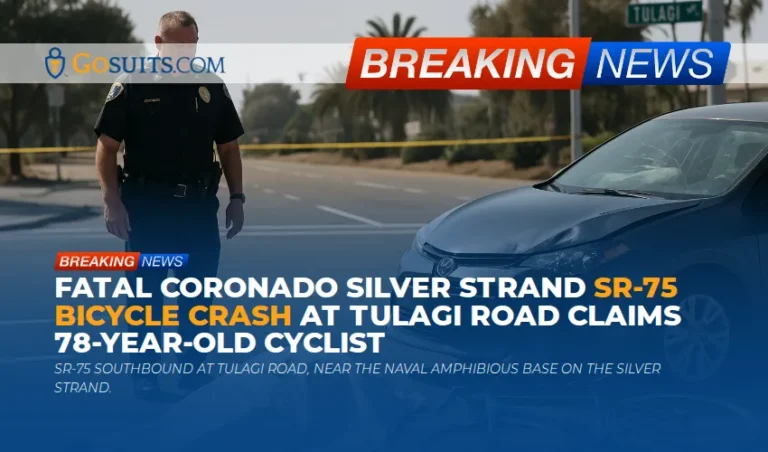
Tuesday afternoon, Coronado police responded to a 911 call reporting a collision involving a bicyclist and a car on the southbound Silver Strand, State Route 75, at the intersection with Tulagi Road near the Naval Amphibious Base. The call came in shortly after 1:30 p.m. Officers and the driver attempted lifesaving measures, but the 78-year-old bicyclist died at the scene, according to Coronado police. Investigators stated they do not believe alcohol or drugs were factors. Southbound traffic on SR-75 was redirected through the island for several hours while officers investigated the scene.
Verified details from initial reports
- Location: SR-75 southbound at Tulagi Road, near the Naval Amphibious Base on the Silver Strand.
- Time: Shortly after 1:30 p.m. on a Tuesday.
- Involved parties: A 78-year-old bicyclist and a motorist.
- Outcome: The bicyclist tragically died at the scene.
- Preliminary note from police: Investigators indicated they did not suspect alcohol or drugs.
- Traffic impact: Southbound SR-75 traffic was rerouted for several hours during scene work.
As more information becomes available from official sources, we will understand additional details such as the point of impact, vehicle direction, signal status, lighting and visibility conditions, and any witness statements. For now, the above points mark the publicly released facts as of this writing.
Location context: SR-75, Tulagi Road, and the Naval Amphibious Base area
Anyone who lives in or regularly visits Coronado knows the Silver Strand section of SR-75 well. The corridor links the City of Coronado and Imperial Beach and offers striking views of the Pacific on one side and the San Diego Bay on the other. Tulagi Road is one of the key access points tied to the Naval Amphibious Base and nearby facilities. Bicyclists in this area may be riding on the roadway, crossing at intersections to access bayside paths, or following the Bayshore Bikeway segments that parallel parts of the corridor.
Midday traffic on SR-75 often includes a mix of base-related traffic, beachgoers, local residents, and commercial vehicles headed between the South Bay and Coronado. Afternoon sun angles, onshore winds, and shifting marine layers can affect how visible people on bikes are to drivers. Those factors can shape an investigation, but they are not themselves indicators of fault. They simply help explain why detailed scene measurements, vehicle inspections, and witness accounts matter so much in reconstructing what happened.
How crash investigations typically proceed in California
In a fatal roadway collision, agencies typically secure the scene, document physical evidence, and conduct witness interviews. Here is what usually happens, step by step, in California bicycle-motor vehicle crashes:
- Scene preservation and mapping: Officers photograph the location, mark tire impressions or skid evidence if any, document roadway markings, signage, signal timing, and collect measurements. Drone photographs or total station mapping may be used.
- Vehicle and bicycle inspections: Investigators examine the car for damage, sensor deploy history, and potential data downloads if available, and they inspect the bicycle for impact points, brake function, and lighting or reflector configuration.
- Witness and driver statements: Statements can help clarify travel paths, signal phases, and speed impressions, though they are weighed against physical evidence.
- Environmental and visibility factors: Sun position, roadside vegetation, roadway curvature, and wind can be documented.
- Records collection: Investigators may request traffic signal timing logs, nearby traffic camera footage if it exists, and emergency communications records.
- Collision report and causation analysis: A formal collision report is prepared and, in fatal cases, may include a reconstruction analysis to assess factors such as right-of-way, safe passing distance, or roadway position of the cyclist. Access to police collision reports is governed by California law and typically limited to involved parties and next-of-kin, with certain exceptions [11].
In some situations, if a nearby federal facility’s cameras may have captured relevant footage, families can explore whether a federal records request is appropriate. Federal agencies process such requests under the Freedom of Information Act and agency-specific regulations [13].
Key California bicycle and roadway laws that may be relevant
California law treats bicyclists as lawful users of the road. While we do not yet know the specific cause of this crash, the following state laws often factor into investigations and civil liability assessments:
- Bicyclists have the same rights and duties as drivers: California Vehicle Code section 21200 confirms that bicyclists generally must follow the rules of the road and are entitled to use public roads [2].
- Position on the roadway: Section 21202 addresses where bicyclists should ride when moving slower than traffic, with important exceptions for avoiding hazards, preparing for a left turn, or when a lane is too narrow for a bike and vehicle to travel side-by-side safely [3].
- Bike lane use: Section 21208 outlines when a bicyclist must use a bicycle lane and when it is lawful to leave it, including for left turns, avoiding debris, or approaching intersections where a right turn is permitted or required [4].
- Three-foot passing law: Section 21760 requires motorists to give at least three feet when passing a bicyclist. If three feet are not feasible, drivers must slow to a reasonable and prudent speed and pass only when it will not endanger the bicyclist [1]. For a practical breakdown of how this works on San Diego roads, see California three foot law cyclists.
- Education and visibility: The California DMV and Office of Traffic Safety provide safety guidance for drivers and cyclists about sharing the road, visibility at intersections, and safe speeds in mixed-traffic environments [6][7].
State and national data consistently show how severe bike-vehicle crashes can be, especially on higher-speed corridors. NHTSA’s most recent annual summary reflects the ongoing toll of bicyclist fatalities nationwide, underscoring how critical driver attention, safe passing, and intersection awareness are for everyone’s safety [5].
How to access police reports, autopsy findings, and official records
After a fatal collision, families often need several types of documents from different public offices. Coronado residents typically work with local authorities and San Diego County departments. Here is a roadmap:
Police collision report
- What it is: The formal crash report prepared by law enforcement, which can include diagrams, statements, and the investigating officer’s findings.
- Who can get it: In California, access is controlled by statute. Generally, involved parties, their legal representatives, and certain insurance representatives may obtain copies. The report is otherwise confidential under state law [11].
- How to request: Contact the responding agency for their specific process. Requests may be made under the California Public Records Act for releasable portions, but collision reports themselves remain governed by confidentiality rules. The California Attorney General provides general CPRA guidance on request submissions and response timelines [10].
Autopsy report and cause of death
- Office to contact: The San Diego County Medical Examiner’s Office handles death investigations and, when performed, autopsy findings. They can advise who may receive reports and what documentation is required. Their website outlines services, case status tools, and how to request records [8].
Death certificates
- Where to obtain: The San Diego County Clerk/Recorder manages certified copies of death certificates for eligible requestors. The County provides instructions for in-person, mail, and other request methods, along with identity and authorization requirements [9].
Traffic signal data, roadway information, and potential camera footage
- Roadway and corridor details: Caltrans manages State Route 75, including the Silver Strand. District 11 provides corridor information and may maintain traffic management resources that can be relevant in some cases [12].
- Camera footage: If any state-maintained traffic cameras exist near the area, retention is often short. Requests generally must be made quickly. While procedures vary, Caltrans’ traffic management resources can be a starting point for determining whether video exists.
- Nearby federal facilities: If a federal agency controls any cameras that might have captured the incident, requests go through the federal FOIA process. FOIA.gov outlines how to submit and track a request [13].
Civil wrongful death and injury claims after a bicycle and vehicle collision
When a loved one is lost in a roadway crash, families may have civil claims under California law. Liability typically turns on whether a driver, or another party, failed to use reasonable care under the circumstances. Investigations consider right-of-way at the intersection, safe passing requirements, visibility, lane positioning, and whether either party was acting lawfully.
Many families choose to consult with car accident lawyers to understand how insurance coverage, fault allocation, and damages might be evaluated. California follows comparative negligence principles, meaning each party’s share of responsibility can factor into any civil recovery. That can make careful evidence review essential.
- Who may bring a claim: California’s wrongful death statutes allow specific heirs to bring a claim for losses such as financial support, companionship, and related harms. A separate “survival” action may address claims the decedent could have pursued had they lived.
- Time limits: In many cases, the statute of limitations for wrongful death in California is two years from the date of death [14]. If a public entity might be implicated, shorter administrative claim deadlines can apply, often six months to present a claim under the Government Claims Act before filing suit [15].
- Possible defendants: The at-fault driver is most common. Depending on facts, potential additional parties could include a vehicle owner under permissive use theories or an employer if the driver was working at the time. If roadway design or signal function is alleged to be a factor, claims procedures and immunities for public entities must be carefully evaluated.
- Damages: Wrongful death damages can include loss of financial support, household services, and the intangible loss of love, companionship, and guidance. A survival action may include certain economic losses. Each case turns on its facts and available proof.
If considering a claim, it is wise to speak with a seasoned attorney before engaging with any insurer. What someone says to an insurance carrier can later be used to limit or dispute a claim. Early counsel can help protect rights and frame communications in a careful, accurate way.
Insurance coverages that may apply in a fatal bicycle crash
Several insurance layers can come into play in a roadway fatality:
- At-fault driver’s liability coverage: This is the primary source when another motorist is legally responsible. Policy limits vary widely.
- Uninsured/underinsured motorist (UM/UIM): If the at-fault driver is uninsured or has insufficient coverage, UM/UIM on the decedent’s own auto policy, or a household member’s policy in some circumstances, may provide benefits. The California Department of Insurance offers consumer guidance on UM/UIM coverages and how they work [16].
- Medical payments coverage: Some auto policies include medical payments coverage, which can help with certain medical or funeral costs regardless of fault, subject to policy terms.
- Employer or commercial policies: If a driver was in the course and scope of work, business or commercial coverage may be implicated.
It is common for carriers to quickly request statements and authorizations. Before giving a recorded statement or signing any medical or claims authorizations, consider consulting counsel to understand the implications. Coronado car accident lawyers familiar with SR-75 collisions can help families navigate multi-policy issues, examine permissive use or employment questions, and evaluate whether any public entity notice requirements apply.
Time-sensitive evidence to preserve after a roadway fatality
Some of the most important evidence in a roadway case can disappear in days or weeks. Acting promptly can make the difference between having a clear factual record and facing gaps later on. Consider the following:
- Vehicle and bicycle preservation: Request that the involved vehicle and bicycle be preserved for inspection. Impact points, lighting, and damage patterns can be crucial.
- Dashcam, helmet cam, or phone video: Identify and download any footage immediately. Ask nearby drivers, rideshare operators, or cyclists whether they captured video.
- Business and traffic cameras: Determine whether any state or private cameras near Tulagi Road may have recorded the incident. Public camera retention can be short, so quick requests are important.
- Witness identification: Record names, phone numbers, and brief notes of what each person saw, including signal phases and vehicle movements.
- Public records requests: Use California Public Records Act guidance to request releasable records from public agencies. Be specific about dates, times, intersections, and the type of records sought [10].
Before speaking to any insurance carrier, it is prudent to consult an attorney. Communications with insurers can be used to challenge liability assessments or to minimize damages later. Many families consult car accident lawyers early to coordinate evidence preservation letters and structured communications.
Community safety notes for the Silver Strand corridor
The Silver Strand is one of the region’s most scenic corridors, and it draws cyclists year-round. Locals know a few conditions that can affect safety here:
- Multiple access points: Intersections and driveways related to the Naval Amphibious Base and nearby facilities bring turning vehicles into the mix.
- Visibility and glare: Midday and afternoon light can create glare for southbound drivers, depending on cloud cover and season.
- Wind and roadway debris: Onshore winds may blow sand or debris, which can push cyclists toward or away from the lane line.
- High variance in travel speeds: Fast-moving traffic mixed with slower bicycle speeds requires attentive driving and strict adherence to the three-foot passing law [1].
For drivers, this corridor is a reminder to check mirrors and blind spots carefully, plan passes only when safe and lawful, and reduce speed as needed when approaching intersections where cyclists may be crossing. For cyclists, lighting, reflective gear, and deliberate lane positioning consistent with California law can improve conspicuity where separation from traffic is limited [6][7].
What families can expect in the next few days
In the immediate aftermath of a fatal collision, several parallel processes often unfold:
- Law enforcement investigation continues: Measurements, interviews, and any reconstruction steps may take days or weeks. Traffic collision reports typically become available after internal review.
- Medical Examiner documentation: The San Diego County Medical Examiner’s Office will manage official cause-of-death records and can advise on timelines for release of findings [8].
- Vital records: The County Clerk/Recorder handles certified death certificates, which families often need for estate, insurance, and other matters [9].
- Insurance notifications: Insurance companies may begin reaching out. Before giving statements, families commonly consult counsel to understand rights and obligations.
Why timely action matters after a fatal crash on SR-75
In the days and weeks after a tragedy, a handful of time-sensitive steps can make the path forward clearer. Here is what to prioritize and why it matters:
- Preserve physical evidence now: Ask that the bicycle and vehicle not be altered until an independent inspection can occur. That preserves impact data that can clarify speed, angle, and point of contact.
- Request official records promptly: Submit requests for the collision report to the investigating agency following their procedures, and begin the process for obtaining the autopsy report and death certificates. This documentation becomes the foundation of any later legal or insurance claim [8][9][11].
- Identify and secure video: Camera footage can be overwritten quickly. Ask nearby businesses and public agencies whether any cameras may have recorded the area around Tulagi Road at the time of the collision.
- Be cautious with insurers: Before contacting any insurance company, consult with an attorney so that statements are accurate and do not inadvertently harm future claims. What is said early can be used against the claim later. Free consultations are commonly available so people can understand their rights before speaking on the record.
- Calendar legal deadlines: Track the standard two-year wrongful death deadline and assess whether any shorter public entity claim deadlines could apply if roadway design or government actors are potentially implicated [14][15].
Acting quickly helps prevent loss of critical information and protects the ability to make informed decisions about next steps.

Commentary from Gosuits Coronado, California Personal Injury Attorney
Our hearts go out to the family, friends, and neighbors grieving this loss along the Silver Strand. This note is meant for general information and community understanding. It is not a substitute for guidance about any particular situation.
Based on the information publicly shared so far, this tragedy occurred at a location where turning movements, visibility, and the interaction between bicycles and vehicles require extra care from everyone. California law recognizes cyclists as rightful users of the road, and the three-foot passing requirement reflects the heightened vulnerability of people on bikes. A careful investigation that documents roadway conditions, video, and impact points will be essential for clarity.
In our experience, insurance companies and corporate interests often move fast after a serious crash. They may seek statements quickly, frame events in ways that reduce their exposure, and request medical and other records that are not necessary at early stages. Without complete information, families can feel pressured to accept a narrative or decisions that do not reflect the full circumstances.
A free consultation serves an important purpose: it helps people understand their rights before speaking with insurers, learn which documents to request, and identify time-sensitive evidence that could make a difference. Early guidance can help ensure that communications are accurate and that critical proof is not lost.
References
- California Vehicle Code § 21760 Three-Foot Passing – California Legislative Information
- California Vehicle Code § 21200 Rights and Duties of Cyclists – California Legislative Information
- California Vehicle Code § 21202 Position on Roadway – California Legislative Information
- California Vehicle Code § 21208 Bicycle Lanes – California Legislative Information
- Traffic Safety Facts: Bicyclists and Other Cyclists – NHTSA
- Sharing the Road: Bicycles – California DMV
- Bicyclist Safety Program – California Office of Traffic Safety
- San Diego County Medical Examiner – County of San Diego
- Vital Records: Birth, Death, and Marriage – County of San Diego
- California Public Records Act Guidance – Office of the Attorney General (CA)
- California Vehicle Code § 20012 Accident Reports Confidentiality – California Legislative Information
- Caltrans District 11 San Diego and Imperial Counties – Caltrans
- Freedom of Information Act Portal – FOIA.gov
- Code of Civil Procedure § 335.1 Two-Year Limitation – California Legislative Information
- Government Code § 911.2 Claims Presentation Deadline – California Legislative Information
- Uninsured and Underinsured Motorist Coverage – California Department of Insurance