- Quick-read highlights
- What we know so far about the Beverly Hills crash
- Location context: Wilshire and Robertson in Beverly Hills
- How fatal-collision investigations work in California
- Key California traffic laws investigators may review
- How to secure official records and information
- Civil law context: wrongful death and survival actions in California
- Insurance considerations after a deadly motorcycle and truck collision
- Preserving evidence from nearby cameras and vehicles
- Community safety reflections for Beverly Hills riders and drivers
- What to do next: practical steps for the first days
- Local resources and agencies in Los Angeles County
- Commentary from Gosuits Beverly Hills, California Personal Injury Attorney
- References
Quick-read highlights
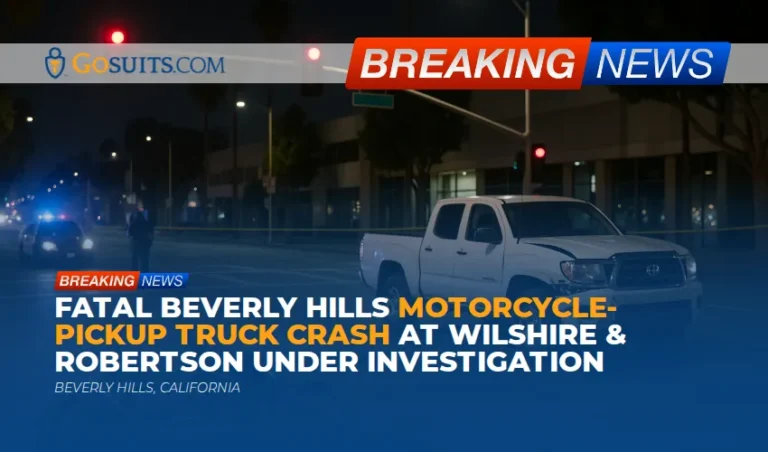
Late Saturday night, a collision between a motorcycle and a pickup truck at Wilshire Boulevard and Robertson Boulevard in Beverly Hills resulted in one fatality, according to Beverly Hills Police Department officers cited by local news. The intersection was sealed for several hours while an investigation began. Details about the cause remain under review.
If you are looking for immediate, practical information, you will find how fatal crash investigations proceed in California, which official records to request, where to reach the Los Angeles County Medical Examiner-Coroner for reports, and what civil legal pathways may exist under California law for surviving family members. Where relevant, we cite only government or academic sources.
What we know so far about the Beverly Hills crash
On a weekend night in Beverly Hills, at around 9:55 p.m., a motorcycle and a pickup truck collided at the intersection of Wilshire Boulevard and Robertson Boulevard. Police confirmed that one person was pronounced dead at the scene. A downed motorcycle and a white pickup were visible a short distance apart, and officers closed the intersection for several hours to preserve evidence and begin the investigation.
It is not yet clear what caused the crash. In situations like this, agencies typically examine right-of-way rules, traffic signal phases, vehicle speeds, potential impairment, and visibility factors. We will update this resource if an agency releases a public report clarifying the cause.
Location context: Wilshire and Robertson in Beverly Hills
Wilshire Boulevard is one of Los Angeles County’s core east-west arteries, connecting Miracle Mile, Beverly Hills, and Westwood. The Wilshire and Robertson intersection sits near the edge of the Beverly Hills business district and the Pico-Robertson neighborhood, an area that stays active with evening dining and weekend foot traffic. The mix of turning vehicles, pedestrians, and riders creates complex sightlines at night, particularly when larger vehicles or parked cars limit a driver’s view of smaller profiles like motorcycles.
Locals know that weekend traffic around Beverly Hills Triangle and along the Wilshire corridor can be brisk, with drivers navigating multiple signalized intersections in quick sequence. Even a momentary misread of a light phase or an improper left turn can have catastrophic consequences for a motorcyclist who has minimal physical protection. Statewide, motorcyclists are overrepresented in serious and fatal injury crashes due to exposure and lower conspicuity. Public safety authorities emphasize scanning and yielding behaviors, especially at intersections where left-turn and crossing conflicts are common [1].
How fatal-collision investigations work in California
When a fatal collision occurs, California law requires that crashes involving injury or death be reported without delay to law enforcement, often via local police or the California Highway Patrol, and that a written report be completed within 24 hours by the investigating officer [2]. At the scene, officers typically:
- Secure and preserve the scene to protect evidence, ensure public safety, and keep a clear perimeter for investigators.
- Document roadway evidence: skid and scuff marks, debris fields, point of impact, final rest positions, and any visible defects in traffic control devices.
- Collect witness statements, check for nearby cameras, and record environmental factors like lighting and weather.
- Evaluate vehicle condition and note whether any data recorders may have captured speed or braking inputs.
- Coordinate with the coroner-medical examiner when there is a fatality to establish identification and cause and manner of death.
In Los Angeles County, the Medical Examiner-Coroner conducts death investigations and can provide copies of available reports upon request after case processing is complete [3]. Parallel to that, investigating agencies compile a traffic collision report that may include a narrative, diagrams, and any preliminary determinations. Some portions can take weeks or longer to finalize, depending on the complexity and whether specialized reconstruction is needed.
Key California traffic laws investigators may review
Investigators typically cross-check facts against specific sections of the California Vehicle Code to assess whether any party failed to follow right-of-way, signal, or safe operation rules:
- Left turns and right-of-way: A driver turning left at an intersection must yield to approaching traffic that is close enough to be a hazard before making the turn [4]. Left-turn conflicts are a frequent scenario in motorcycle crashes because of smaller profiles and closing speeds.
- Red signal compliance: Drivers must stop at a steady circular red signal and remain stopped until permitted by law to proceed [5]. Any question about signal timing or phase would be evaluated alongside physical evidence and witness accounts.
- Reporting requirements and documentation: Officers must prepare written reports for injury or fatal collisions under state law [2], and those reports may later inform insurance evaluations and civil claims.
- Motorcycle operations and safety: California publishes official motorcycle guidance, including skill and awareness topics in the Motorcycle Handbook [6]. California also recognizes lane splitting, with statewide safety guidelines published by the CHP to minimize risk [7]. Whether lane positioning or splitting is relevant will depend on the facts documented by the investigating officers.
None of these laws, on their own, decide fault in a case like this. Instead, they provide the legal framework that helps agencies assemble a full picture of how the collision unfolded, second by second.
How to secure official records and information
In the aftermath of a fatal collision, families often need documents for practical reasons and for understanding what happened. These are the primary records routes in Los Angeles County and California:
- Traffic Collision Report: The investigating agency prepares this report. For many Los Angeles area incidents, that is the local police department that responded on scene. California law also details how collision reports are retained and shared. Records units typically require proof of involvement or a lawful interest to release a copy. The California Highway Patrol maintains a statewide portal and guidance for requesting reports when CHP is the investigating agency [8]. For non-CHP cases, the same general principles apply, though you would request directly from the city police department’s records division.
- Medical Examiner-Coroner reports: In Los Angeles County, the Medical Examiner-Coroner handles death investigations. Families can request autopsy and investigation reports when they are available, following the County’s procedures [3].
- Death certificate: The Los Angeles County Registrar-Recorder/County Clerk issues death certificates. Requests can be made online or by mail once the certificate is filed [9].
- Public records framework: California’s Public Records Act provides a structure for requesting public records from state and local agencies, subject to exemptions that protect certain investigative records and privacy interests [10].
When making any records request, include the date, time, intersection, agency report number if known, and your relationship to the decedent. Be aware that certain investigative materials may be withheld during an active investigation.
Civil law context: wrongful death and survival actions in California
California law provides two distinct civil pathways after a fatal crash. They serve different purposes and are often pursued together.
- Wrongful death: This action belongs to eligible surviving family members specified by statute, such as a spouse, domestic partner, children, or others who were financially dependent. The claim seeks compensation for the losses the survivors suffer due to the death, including loss of financial support and companionship, among other recognized harms under California law [11].
- Survival action: This action belongs to the decedent’s estate and can seek damages the decedent incurred before death, such as medical expenses or certain economic losses. It is governed by a separate California provision [12].
California also has time limits to bring these civil claims. Many wrongful death and personal injury claims must be filed within two years of the date of death or injury, with exceptions in specific circumstances. Anyone considering a claim should be mindful of the statute of limitations provisions [13].
Because the law is precise about who may file and what damages may be sought, families often speak first with seasoned counsel to understand how these legal avenues apply to their specific facts. Skilled motorcycle accident lawyers can help families understand the scope of potential claims and how evidence fits into the civil framework without making any promises about outcome.

Insurance considerations after a deadly motorcycle and truck collision
Collisions involving a pickup truck and a motorcycle frequently involve multiple insurance layers. There may be liability coverage from the truck’s policy, potential underinsured or uninsured motorist coverage on the motorcycle policy, and sometimes medical payments or other first-party benefits. California’s Department of Insurance publishes consumer resources explaining how auto insurance coverage works, the role of adjusters, and the claims process [14].
One key caution is timing. Insurance carriers often seek recorded statements quickly. What someone says to the insurance company can be used against them later. It is common practice to consult an attorney first, before engaging with any insurer. That early guidance helps ensure communications and documentation align with the facts and protect legal rights.
If questions arise about obtaining the official crash report, CHP provides a public process when they are the investigating agency [8]. Otherwise, seek the report from the local police department that handled the scene. In complex cases that involve serious injuries or fatalities, families sometimes also need coroner documentation for claims. The Los Angeles County Medical Examiner-Coroner outlines how and when those materials can be requested [3].
If local counsel is involved, it is typical for them to assemble the paper trail and preserve data early. In a metropolitan corridor like Beverly Hills and adjacent Los Angeles neighborhoods, private and municipal cameras can be invaluable. That is one reason people in greater Los Angeles often look to Beverly Hills motorcycle accident lawyers who are familiar with local traffic agencies and neighborhood camera practices, simply to speed up early evidence preservation without guaranteeing any specific result.
Preserving evidence from nearby cameras and vehicles
At Wilshire and Robertson, there are often multiple potential sources of video, such as traffic signal cameras, nearby business security systems, or dashcams from passing vehicles. In fatal collisions, even a few seconds of footage helps clarify approach speeds, relative positions, and signal phases. California’s public records framework can help access certain public video if it exists and is disclosable, though investigative exemptions may delay release until a case closes [10].
Beyond video, modern pickup trucks may contain electronic data recorders that can capture pre-impact speed and braking inputs. Although motorcycles generally have less event data, some modern bikes and accessories log limited telemetry. Rapid notice to preserve potentially relevant data can make a difference in how much detail is recoverable.
For a simple, practical reminder of the types of materials that matter after a crash in the city, see this internal resource: los angeles motorcycle crash checklist. It walks through the images, notes, and records people often overlook in the first days.
Community safety reflections for Beverly Hills riders and drivers
A tragedy like this weighs on neighbors across Beverly Hills, Beverly Grove, and Pico-Robertson. Many residents have driven Wilshire countless times. Riders know the unique risks of late evening traffic on broad arterials where some drivers accelerate to clear lights. State and county safety programs keep stressing the same fundamentals because they remain effective:
- Look twice at intersections, especially before turning left across oncoming traffic. Smaller profiles can be hard to judge for distance and speed.
- Maintain safe speeds and clear lines of sight. Speed reduces available reaction time for both drivers and riders.
- Increase conspicuity with reflective gear and lighting. Visibility matters most at night and during transitional lighting.
- Follow CHP lane-splitting guidance and ride within personal skill limits if lane splitting is part of your commute [7].
Statewide, public safety agencies continue to publish training and awareness resources for riders and drivers alike [1][6]. In Los Angeles County, the trauma system is robust, with designated centers that handle high-acuity injuries; that system’s rapid response saves lives every day even when outcomes, tragically, cannot be reversed [15].
What to do next: practical steps for the first days
These steps are general, meant to reduce information gaps and protect rights in the early days after a fatal collision. Every situation is different, but time often matters.
- Start a file with dates, times, agency contacts, and any report or incident numbers you receive. Save photos, messages, and notes in one place.
- Request the Traffic Collision Report from the investigating agency as soon as it becomes available. If the California Highway Patrol handled it, use their request process [8]. If it was a city police department, follow that department’s records procedures.
- Contact the Los Angeles County Medical Examiner-Coroner to learn when autopsy or investigation reports might be released and what you will need to request copies [3].
- Order certified death certificates through the Los Angeles County Registrar-Recorder/County Clerk once filed [9].
- Preserve potential video by noting nearby businesses, traffic devices, and any private cameras. Politely request copies where appropriate and send preservation letters promptly.
- Avoid recorded statements to insurance until you have spoken with an attorney. What is said early can affect later evaluations.
- Consult an attorney first before contacting any insurance company. An initial consultation can help clarify who should speak to whom, in what order, and what documentation to gather.
- Consider a notice of claim if any governmental entity may be implicated. Special rules and deadlines apply when a public agency could be involved [16].
Why timing matters now
Video systems overwrite quickly, sometimes in days. Witnesses can be hard to reach later. Vehicle data can be lost once a car is sold or repaired. Taking organized steps in the first week improves the chances of reconstructing what happened accurately. Acting sooner also helps ensure insurance communications are factual and complete, reducing the risk of misunderstandings about fault or coverage.
Local resources and agencies in Los Angeles County
These county and state public agencies commonly play key roles after serious or fatal crashes in and around Beverly Hills:
- Investigating law enforcement: The responding police department generates the Traffic Collision Report. If CHP is the investigating agency, follow the CHP’s formal process to request a copy [8].
- Los Angeles County Medical Examiner-Coroner: Handles death investigations and provides information on requesting reports [3].
- Los Angeles County Registrar-Recorder/County Clerk: Issues death certificates once filed [9].
- California Department of Insurance: Offers consumer-facing information about auto insurance rights and claims [14].
- California Office of Traffic Safety: Publishes statewide traffic safety data and resources that help contextualize local risks [17].

Commentary from Gosuits Beverly Hills, California Personal Injury Attorney
Our hearts are with everyone affected by the deadly crash at Wilshire and Robertson. Losing a life on our roads, especially in a familiar neighborhood like Beverly Hills, is devastating. This write-up is intended for general information and education. It is not a substitute for case-specific guidance.
From a civil-injury perspective, intersections like Wilshire and Robertson present classic risk patterns that investigators see again and again: potential left-turn yield questions, signal timing disputes, and visibility challenges at night. With motorcycles, even a small timing error by another driver can be catastrophic because riders have so little physical protection. When the cause is not yet known, careful preservation of camera footage, on-scene measurements, and any available vehicle data becomes essential.
In our experience, insurance companies and corporate defendants move quickly after a serious crash. Adjusters often call within days seeking recorded statements. They frame questions narrowly, and those early statements can be misinterpreted or taken out of context. Corporations and carriers also control crucial information, from telematics to internal incident notes, and they do not always volunteer it without a formal request. That imbalance of information can make a difficult moment even harder for regular people who do not deal with these systems every day.
That is why a no-cost, initial consultation matters. Speaking with seasoned counsel first helps people understand the process, what to say and not say to insurers, how to request official reports, and which deadlines apply. While no lawyer can guarantee any outcome, a thoughtful early plan often prevents avoidable problems and helps families focus on what matters most.
References
- Motorcycles Safety – National Highway Traffic Safety Administration
- California Vehicle Code 20008 – Duty to Report Accidents – California Legislative Information
- Requesting Copies of Reports – Los Angeles County Medical Examiner-Coroner
- California Vehicle Code 21801 – Left Turns/Right-of-Way – California Legislative Information
- California Vehicle Code 21453 – Red Signal – California Legislative Information
- California Motorcycle Handbook – California DMV
- Lane Splitting Guidelines – California Highway Patrol
- Collision Report Request – California Highway Patrol
- Death Records – Los Angeles County Registrar-Recorder/County Clerk
- Public Records Act Summary – California Department of Justice
- Code of Civil Procedure 377.60 – Wrongful Death – California Legislative Information
- Code of Civil Procedure 377.30 – Survival Actions – California Legislative Information
- Code of Civil Procedure 335.1 – Statute of Limitations for Injury/Wrongful Death – California Legislative Information
- Automobile Insurance Guides – California Department of Insurance
- Trauma System – Los Angeles County Department of Health Services EMS Agency
- Government Code 911.2 – Claims Presentation to Public Entities – California Legislative Information
- Traffic Safety Facts – California Office of Traffic Safety