- What we know about the Cooper Street and Eden Road crash in Arlington
- Timeline and surveillance details reported by investigators
- Status of the investigation
- Community context in South Arlington and nearby corridors
- Safety and legal implications under Texas law
- What families can request and where to call in Tarrant County
- Preserving critical evidence quickly
- Civil liability questions that often arise after high-speed intersection crashes
- Insurance issues families confront after a fatal crash
- If an insurer calls: how to protect the claim
- Support after a sudden loss
- Time-sensitive next steps after a deadly traffic collision
- Commentary from Gosuits Arlington, Texas Personal Injury Attorney
- References
What we know about the Cooper Street and Eden Road crash in Arlington
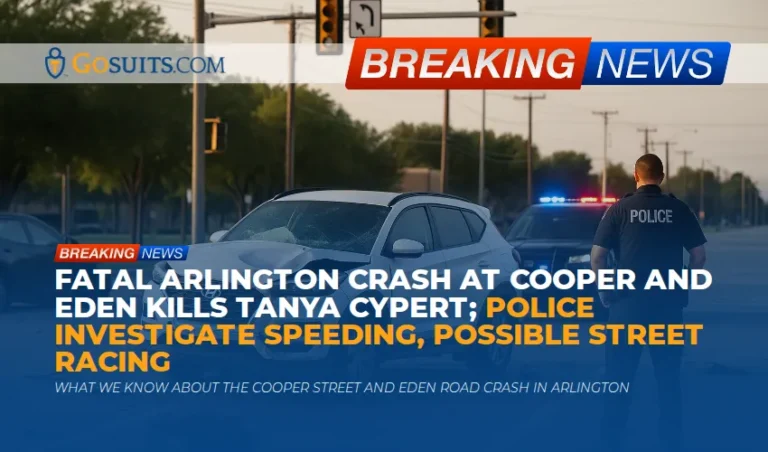
On a Friday afternoon in Arlington, a violent collision at Cooper Street and Eden Road took the life of 43-year-old Tanya Cypert and also killed her French bulldog, according to local reporting. Investigators said speed was a factor, and they are working to determine whether street racing played a role. Surveillance video from a nearby business reportedly captured two black sedans speeding and weaving northbound on Cooper moments before the wreck. One of those vehicles, a 2025 Mercedes sedan driven by an 18-year-old, collided with Cypert’s white Hyundai Tucson as she slowed to turn left onto Eden Road. The impact was so forceful that an engine detached and came to rest in the roadway. The Mercedes driver was hospitalized with broken bones. No arrests have been announced as of this writing, and police are still interviewing witnesses and reviewing video evidence.
Cypert, a South Arlington resident, was less than a mile from home and headed to pick up food before her shift at Great Wolf Lodge in Grapevine. Family members visited the crash site soon after to honor her memory, sharing reflections on her kindness and their desire for justice without revenge. The family also noted that an off-duty Midlothian police officer witnessed the incident and was first to stop and help.
Timeline and surveillance details reported by investigators
While the formal collision reconstruction will take more time, the reported sequence as described publicly so far includes these elements:
- Northbound high speed approach: Two black sedans are seen on surveillance video traveling north on Cooper Street. The second sedan, identified as a 2025 Mercedes, appears to weave between other vehicles.
- Left turn setup on Eden Road: Another camera angle shows Cypert’s white Hyundai Tucson slowing at the intersection, preparing to make a left turn onto Eden Road.
- Near-miss and impact: The first black sedan proceeds through the intersection. Seconds later, the Mercedes enters the intersection and collides with the Tucson. A cloud of smoke follows, and debris scatters, including a dislodged engine.
- Emergency response: Cypert was transported to a hospital where she later died. The 18-year-old Mercedes driver sustained serious injuries and remains hospitalized.
These public details provide only a partial picture. Official crash reconstruction typically examines pre-impact speeds, signal timing, line-of-sight, vehicle dynamics, occupant kinematics, restraint use, roadway design, and whether mechanical issues or other external factors contributed. Findings often depend on downloading event data recorder information when available, collecting third-party video, mapping the scene, and analyzing physical evidence such as yaw marks, crush profiles, and debris fields.
Status of the investigation
Arlington police say the investigation is active, with officers interviewing multiple witnesses and reviewing surveillance video. Investigators have not yet publicly stated whether they believe an illegal speed competition occurred. Even without a racing determination, Texas law prohibits driving at a speed greater than is reasonable and prudent under the circumstances and mandates appropriate control and reduced speed when hazards are present [2]. Racing on a highway is a separate offense under the Texas Transportation Code [1]. Whether any criminal charges may eventually be filed is not known at this time. From a civil perspective, the same evidence set will generally be central to determining fault and responsibility for losses.
Community context in South Arlington and nearby corridors
Cooper Street is a heavily traveled north-south arterial that runs through Arlington and connects neighborhoods, shopping centers, and employment areas as it extends toward Mansfield. The Cooper and Eden Road intersection sits in South Arlington near the Tarrant County line with growing traffic volumes, especially during afternoon and early evening periods. Residents often note that speeds can climb along longer straight stretches, particularly when congestion ebbs. Those familiar with the area know that even a moment of aggressive driving near a left-turn movement can leave very little margin for error.
Local families, commuters, and small businesses rely on this corridor daily. When a tragic crash happens close to home, it ripples through the neighborhood quickly as people recognize the intersection, landmarks, and routines that frame their own days. That proximity makes the loss feel personal to many in Arlington, not only those who knew the victim.

Safety and legal implications under Texas law
Investigations into alleged high speed or potential racing often implicate two Texas Transportation Code provisions:
- Racing on a highway: Texas Transportation Code 545.420 broadly prohibits participating in speed competitions or exhibitions on public roads. It also covers acceleration contests and tests of physical endurance of the operator [1].
- Reasonable and prudent speed: Texas Transportation Code 545.351 requires drivers to operate at a speed that is reasonable and prudent under existing conditions. Drivers must control speed to avoid collisions and must reduce speed when hazards exist, such as intersections or traffic conditions [2].
Why does this matter in a civil claim? In general, proof that a driver violated a safety statute can significantly affect fault determinations in a civil wrongful death or injury case. If investigators confirm excessive speed, weaving through traffic, or an illegal race, those findings can weigh heavily in any civil proceeding evaluating negligence and causation. Nationally, speeding remains a leading factor in deadly wrecks, with NHTSA reporting that speeding killed more than ten thousand people in a single recent year [3].
If a family pursues civil remedies in Texas following a fatal crash, the claim typically proceeds under the state’s wrongful death statute, with the related survival claim addressing harms the decedent suffered before death [8]. The general statute of limitations for wrongful death claims in Texas is two years from the date of death, subject to certain exceptions [9]. Families should consider calendaring important deadlines early and confirming timelines with a trusted attorney, because evidence preservation and statutory timing often drive outcomes.
What families can request and where to call in Tarrant County
Families often need official records for insurance, employer benefits, and probate matters, or simply to understand what happened. In Tarrant County and Texas generally, the following sources can be important:
Police crash report
Texas crash reports are released to qualifying parties under Texas Transportation Code 550.065 [5]. Many local agencies route public purchases through the Texas Department of Transportation’s Crash Records Information System (CRIS), which allows eligible requestors to search and purchase a report online by crash details such as date, location, and involved names [4]. If Arlington Police Department provides report copies directly, their Records Unit can guide requestors on whether to obtain it via the City or through TxDOT.
Medical examiner and autopsy information
In Tarrant County, the Medical Examiner’s Office handles medicolegal death investigations. Families can contact the office regarding autopsy determinations, cause and manner of death, and the process for obtaining reports when available [6]. Toxicology processing and report release timelines can vary based on lab workload and case complexity.
Death certificate
Death certificates in Texas are handled through the Texas Department of State Health Services Vital Statistics. Certified copies can be requested through the state or through the local registrar, depending on residency and eligibility requirements [7]. Insurance and certain employer benefits often require certified copies, so families may wish to order more than one.
Traffic camera or third-party video
Texas crash reports sometimes note the presence of nearby cameras or witnesses. State law governs access to official crash report information [5]. Private businesses along the corridor, such as fuel stations or retail centers, may have surveillance systems with limited retention windows that can overwrite footage in days. Quick outreach is key. If counsel is retained, they often send evidence preservation notices immediately to secure any available videos, point-of-sale timestamps, or delivery vehicle telematics before data cycles erase them.
Preserving critical evidence quickly
Speed-related intersection collisions raise time-sensitive evidence issues. Families and their representatives often consider the following steps to protect a future civil claim:
- Identify and preserve video: Canvass nearby businesses along Cooper Street and Eden Road for camera views of approaches and the intersection. Ask about retention policies to know how long footage will last without a hold request. Note cameras on both sides of the street and at adjacent driveways.
- Secure vehicle inspections: Ensure both vehicles, especially the striking vehicle, are preserved in their post-crash state until independent inspection and downloads are complete. Event data recorders can hold pre-impact speed, throttle, and braking data depending on make and model.
- Document the scene: If safe and allowed, capture photographs of skid marks, yaw marks, debris fields, gouge marks, and any damaged fixtures or signal equipment. Even after cleanup, scrape marks and subtle scarring can persist on pavement for a short time.
- Collect witness information: Early witness outreach helps fix memories while details are fresh. Note vantage points, distances, lighting, and whether the witness saw both vehicles, just one, or only the impact flash.
- Obtain the official report: Purchase the Texas crash report when available through TxDOT CRIS or as directed by the agency [4].
Civil liability questions that often arise after high-speed intersection crashes
Courts and insurers frequently zero in on a few core questions following an alleged high-speed or street racing scenario at an intersection:
- Excessive speed and control: Was the striking driver traveling at a speed that was reasonable and prudent under the conditions, and did they maintain proper control as required by law [2]?
- Illegal competition: Is there credible evidence that two or more vehicles were engaged in a prohibited speed competition under Texas Transportation Code 545.420 [1]?
- Right-of-way and signal status: What did the traffic signals display, and who had the right-of-way at the moment of entry to the intersection?
- Perception-reaction time: At alleged high speeds, even fractions of a second can eliminate any chance to avoid a turning vehicle. Analysts examine approach speeds, sight lines, and conflict points.
- Causation: Did the speed and maneuvering conduct substantially contribute to the collision, injuries, and death?
Answers are built on evidence. Independent reconstruction, event data recorder analysis, and high-quality video can clarify what human memory alone cannot. When a case involves catastrophic harm, families often want a seasoned team to gather, analyze, and present the story of what happened and why under Texas standards.
Insurance issues families confront after a fatal crash
Insurance questions become complex quickly in a deadly crash. Several coverage layers may apply:
- Liability coverage: The at-fault driver’s liability policy is usually the primary target for bodily injury and wrongful death claims. Multiple claimants and severe losses can create policy limits concerns.
- Underinsured motorist coverage: If applicable on the victim’s policy, UM/UIM can help when the at-fault driver’s limits are insufficient. Coordination with liability claims is important to preserve contractual rights.
- Property damage: Total loss valuation disputes often arise, especially when aftermarket work or recent maintenance affected value. Documentation helps.
- Prompt payment rules: Texas Insurance Code Chapter 542 contains timelines for insurers to acknowledge, investigate, and pay certain claims, with potential interest penalties for violations [10]. Families should keep written records of all communications and dates.
It is common for insurers to request recorded statements early. Speaking with an attorney before giving any statement can help protect the claim and avoid inadvertent admissions or misunderstandings that an insurer may later use to limit recovery.
Experienced counsel or qualified car accident lawyers can coordinate parallel claims, monitor policy-limit exposures, and manage communications so families are not burdened during grief.
If an insurer calls: how to protect the claim
After a fatal collision, multiple insurance adjusters may reach out quickly. Here are practical safeguards:
- Speak with counsel first: Conversations with insurance adjusters are recorded or heavily documented. Statements can be used later to challenge liability, causation, or damages. Consulting an attorney first helps ensure rights are protected.
- Limit authorizations: Broad medical or records authorizations can open up private information beyond what is relevant. Narrow scope and timeframes where possible.
- Control the narrative with evidence: Let documented facts lead. As more official information becomes available, counsel can supplement the record rather than speculating early.
Local familiarity matters. Arlington corridors like Cooper Street see varied traffic patterns from morning commute into evening retail and restaurant peaks. Counsel who regularly handle intersection and high-speed crash cases in Tarrant County understand how to frame evidence for the roadway context, lighting, and line-of-sight specific to this area. In serious cases, Arlington car accident lawyers can also issue timely preservation letters to nearby businesses along Cooper and Eden to secure critical video before it is overwritten.
Support after a sudden loss
Grief after a sudden traffic death is disorienting. While neighbors in South Arlington often rally with meals, vigils, and memorials, families may also benefit from structured support. Community-based grief resources, houses of worship, and counseling providers can help loved ones process trauma over time. For many, taking small steps like organizing important paperwork, journaling key dates, and designating a single family point-person for outside communications can reduce stress while honoring a lost loved one’s memory.
For practical help on the administrative side, families in North Texas sometimes use guides that list what to gather in the first weeks. A helpful resource is this Dallas wrongful death paperwork checklist for families that outlines documents and timelines to consider. Even if the loss occurred in Arlington, much of the checklist applies across Tarrant County.
Time-sensitive next steps after a deadly traffic collision
When a traffic death happens close to home, many do not know where to begin. It helps to break tasks into urgent, near-term, and longer-term items:
- Urgent: Secure the Texas crash report when released through TxDOT CRIS or via the agency’s process [4]. Request preservation of nearby business surveillance footage. Coordinate with the Tarrant County Medical Examiner’s Office about report timelines [6]. Begin a simple file for receipts, letters, and claim numbers.
- Near-term: Order certified death certificates through Texas Vital Statistics if eligible [7]. Document immediate out-of-pocket costs and time missed from work by close family who are handling arrangements. If there are vehicle financing or insurance matters, note payment due dates and communicate proactively.
- Longer-term: Calendar the two-year wrongful death limitations period in Texas, subject to any tolling or exceptions [9]. Evaluate insurance layers and potential policy-limits exposure. Consider whether independent reconstruction is warranted based on case severity and available evidence.
Throughout, it is wise to speak with an attorney before contacting any insurance company to understand rights and risks. What is said to an insurer can be used later to minimize recovery, so informed communication is essential.

Commentary from Gosuits Arlington, Texas Personal Injury Attorney
Our hearts go out to the family and friends mourning this loss in South Arlington. This writeup is shared for educational purposes and general information only. Losing a loved one near home on familiar roads like Cooper Street compounds the pain. When speed or potential racing is part of the picture, the devastation is often total in a split second.
From what has been publicly described, investigators appear to be focusing on excessive speed and whether two vehicles were engaged in prohibited competitive driving. In civil cases, that kind of evidence can become central to assigning fault and explaining causation. Independent preservation of video, data, and scene evidence is often the difference between disputed recollections and a clear, fact-based record.
Insurance companies and large corporations know families are overwhelmed after a fatal crash. They move quickly with calls, forms, and requests for broad authorizations. Adjusters may sound sympathetic, yet their job is to evaluate risk and pay as little as possible. Recorded statements taken without guidance can later be parsed to reduce liability or to question the full extent of the harms suffered. Policy limits, underinsured motorist coverage, and coordination between claims can become traps for the unwary.
There is real value in obtaining a free consultation early, before any insurer is contacted. A consultation helps clarify rights, outline immediate steps, and avoid missteps that can weaken a claim. It also allows families to ask hard questions about evidence, timelines, and realistic expectations while they focus on honoring their loved one.
References
- Texas Transportation Code 545.420 Racing on Highway – Texas Legislature Online
- Texas Transportation Code 545.351 Maximum Speed Requirement – Texas Legislature Online
- Speeding – National Highway Traffic Safety Administration
- Texas Crash Report Purchase System (CRIS) – Texas Department of Transportation
- Texas Transportation Code 550.065 Release of Certain Information Relating to Accidents – Texas Legislature Online
- Medical Examiner – Tarrant County, Texas
- Vital Statistics – Texas Department of State Health Services
- Wrongful Death and Survival – Texas Civil Practice and Remedies Code Chapter 71
- Limitations Periods – Texas Civil Practice and Remedies Code Section 16.003
- Prompt Payment of Claims – Texas Insurance Code Chapter 542
- Motor Vehicle Safety – Centers for Disease Control and Prevention
- Texas Motor Vehicle Crash Facts and Summaries – Texas Department of Transportation