- What we know about the 110 Freeway crash near 3rd Street
- Who investigates and what reports exist
- How families can get official documents
- Legal issues that often arise after a Downtown LA freeway rollover and fire
- Rights of the surviving passenger and of the family who lost a loved one
- Insurance coverage snapshot for Los Angeles freeway crashes
- Practical next steps in Downtown LA this week
- Community safety context on the 110 Freeway
- Why Acting Now Matters
- Commentary from Gosuits Los Angeles, California Personal Injury Attorney
- References
What we know about the 110 Freeway crash near 3rd Street
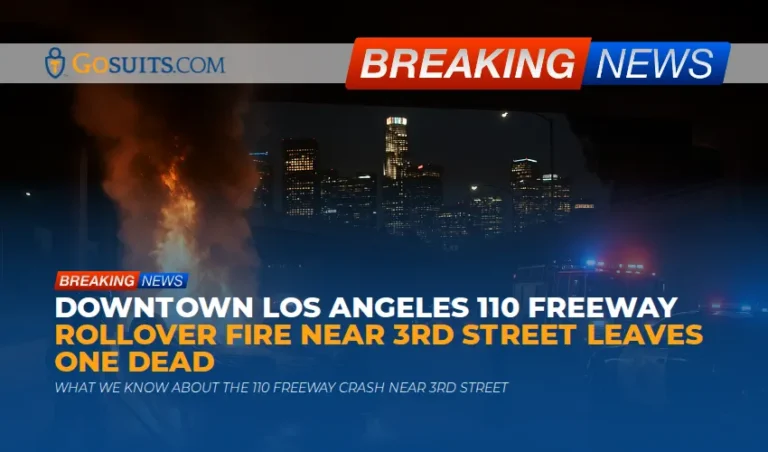
Before sunrise on a quiet Sunday, a violent crash on the northbound 110 Freeway at 3rd Street in Downtown Los Angeles ended in tragedy. According to first responders, the vehicle overturned and burst into flames. Firefighters worked to knock down the blaze while traffic stacked up near the Bunker Hill and Civic Center on- and off-ramps.
Incident timeline and immediate facts
Based on information reported by authorities and local media, the crash was reported around 1:46 a.m. on the Harbor Freeway near the 3rd Street area. One person died at the scene. Another individual was transported to a hospital in critical condition. The California Highway Patrol is managing the collision investigation on the freeway, and officials have not yet released the identity of the person who died, pending next-of-kin notification.
Response and early investigation status
Crashes that involve rollovers and post-impact fires often require extended on-scene work. After firefighters control flames and ensure the area is safe, investigators document the scene, diagram vehicle positions, and look for roadway evidence like skid marks, gouge marks, and debris fields. On the 110 through Downtown, lighting conditions under overpasses and the close spacing of lanes and barriers can affect both crash dynamics and the visibility of pre-impact maneuvers. The cause here remains under investigation, and CHP will produce the official traffic collision report when complete [1].
Who investigates and what reports exist
For freeway incidents within Los Angeles city limits, CHP typically leads the collision investigation, while the Los Angeles Fire Department handles fire suppression and emergency medical response. When a fatality occurs, the Los Angeles County Department of Medical Examiner oversees the decedent’s examination and related records.
CHP traffic collision report
CHP creates the primary collision report for crashes on state freeways like the 110. Families and involved parties can request it from CHP using the agency’s process for traffic collision reports, which requires proof of involvement or interest and payment of a fee [1]. The report usually contains party statements, witness information, roadway conditions, diagrams, and any preliminary fault assessments. Supplementary reports can follow if the investigation continues or if lab results return at a later date.
Medical Examiner records
For the decedent, the LA County Department of Medical Examiner maintains official records. Depending on case status, available documents may include a death certificate, autopsy report, and toxicology report. Some records can take several weeks to finalize if additional testing is needed. The Medical Examiner outlines how authorized requesters may obtain records and what identification is required [2].
Fire and EMS response documentation
LAFD response logs and medical transport records may exist when firefighters and paramedics respond. While the fire department’s website and the City’s public records portal provide request pathways, general access rules fall under the California Public Records Act, which governs how to request non-exempt government records statewide [12].
Hospital records
When someone is transported in critical condition, hospital records are protected by privacy laws. The patient or a lawful representative can request billing and treatment records directly from the hospital’s Health Information Management department. If a family member seeks records on behalf of an incapacitated patient, the hospital typically requires proof of authority, such as a valid healthcare directive or other documentation recognized by the facility.
How families can get official documents
If you are navigating an aftermath like this in Downtown, here is the typical document roadmap and where to start.
- CHP Collision Report
- What it is: The official law enforcement report for crashes on state freeways.
- Who to contact: The CHP office handling Downtown Los Angeles freeway incidents. Use the CHP statewide process to request traffic collision reports and be ready to verify your involvement or lawful interest [1].
- What you will need: Report number if available, date, location, and names of involved parties. A driver’s license or other identification is often required.
- Department of Medical Examiner Records
- What it is: Death certificate, autopsy report, and possibly toxicology for the deceased.
- Who to contact: LA County Department of Medical Examiner, which explains eligibility, fees, and how to submit a request [2].
- Timeframe: Toxicology and certain findings can take weeks or longer, depending on testing backlogs.
- DMV Accident Reporting
- What it is: California’s SR-1 form is required within 10 days if a crash caused injury, death, or property damage of $1000 or more, regardless of fault.
- Where to look: The DMV outlines SR-1 requirements and form submission options [3].
- Fire and EMS Records
- What it is: Fire suppression and paramedic response information, if available for release.
- How it works: Requests to local agencies are governed by the California Public Records Act. Exemptions apply to protected medical information and certain investigative records [12].
- Hospital Medical Records
- What it is: Treatment and billing records for the injured patient.
- How to request: The patient or a legal representative can contact the hospital’s Health Information Management department and follow HIPAA-compliant procedures for release.
Legal issues that often arise after a Downtown LA freeway rollover and fire
When a crash involves a rollover and fire on the Harbor Freeway, several civil liability and insurance questions immediately come into play. Even while officials are still investigating, it helps to understand the typical issues that later appear in claims.
Potential civil liability and contributing factors
- Driver negligence: Speeding, unsafe lane changes, distraction, impairment, or following too closely can all contribute. Nighttime freeway traffic in Downtown often includes abrupt merges near tight ramps and short weaves between the 4th Street and 3rd Street exits.
- Vehicle defects: Tire or component failures can cause loss of control. Post-crash fire severity may also relate to fuel system integrity. Preserving the vehicle is critical for any potential product evaluation.
- Roadway environment: While Caltrans maintains the freeway, claims involving roadway conditions have unique notice and deadline requirements for public entity claims. Evaluation depends on documented hazards, prior complaints, and engineering standards.
Evidence that matters on the Harbor Freeway
- Scene documentation: Photos of debris, fire patterns, lane markings, guardrails, and any fluid trails can help reconstruct events. In Downtown, overhead signage and nearby structures can cast shadows that affect nighttime visibility.
- Witness statements: Independent witnesses who were traveling between the 6th Street Viaduct approach and the 3rd Street exit may have seen last-second maneuvers. Prompt outreach increases the chance of accurate recall.
- Vehicle data: Many modern vehicles store speed, braking, and seatbelt usage in event data recorders. Proper preservation and retrieval can be essential in fatal or catastrophic cases.
- Public records: Requesting CHP reports and any releasable fire response records helps establish a timeline and response details [1][12].
For those trying to understand the freeway-specific issues, this resource can help orient the next steps: car accident i110 injury claims los angeles.
Many people find it helpful to speak with car accident lawyers early. That conversation can clarify what evidence to preserve, which insurance policies might apply, and how to avoid common claim mistakes that can be hard to fix later.
Rights of the surviving passenger and of the family who lost a loved one
California law provides different civil remedies for those injured and the families of those who die in a crash.
Injury claims for the survivor
Injury claims can address medical expenses, lost income, pain and suffering, and other losses when another party’s negligence caused harm. The injured person can pursue a claim against the at-fault driver’s auto liability insurer. If that coverage is insufficient, the injured person’s own underinsured motorist coverage may be available, depending on the policy [7].
Wrongful death and survival actions
When a crash causes a death, certain family members may bring a wrongful death claim under California Code of Civil Procedure section 377.60. A survival action may also be available through the decedent’s estate to recover losses the decedent sustained before death, such as medical expenses and lost earnings, if supported by the evidence [4][6].
These cases have strict time limits. In most negligence actions for injury or wrongful death, California’s statute of limitations is two years from the date of the incident, with exceptions for claims against public entities and other specific circumstances. The primary deadline is codified at section 335.1 [5]. It is crucial to confirm the correct deadline based on the facts of the case and any public entity involvement.
Insurance coverage snapshot for Los Angeles freeway crashes
On freeways through Downtown, multiple layers of coverage may be implicated. Understanding those layers early can protect access to necessary medical care and financial recovery options.
Liability, UM/UIM, and required forms
- At-fault liability coverage: The negligent driver’s liability policy is the first source for bodily injury losses. Determining the policy limits and whether any exclusions apply is key.
- Uninsured and underinsured motorist coverage: If the at-fault driver lacks enough insurance, the injured person’s UM/UIM coverage can step in, subject to the policy’s terms [7].
- MedPay or medical payments coverage: Some auto policies include medical payments benefits that can help with immediate bills, regardless of fault. Terms vary by insurer.
- DMV SR-1 reporting: California requires drivers to submit an SR-1 form to DMV within 10 days for any crash causing injury, death, or significant property damage. This reporting requirement applies regardless of fault and is separate from an insurance claim [3].
Recorded statements and early insurer contact
Insurance adjusters often move quickly to obtain recorded statements. Those statements can be used to limit or deny claims later. It is generally wise to consult an attorney before providing statements to any insurer. A short, no-cost consultation can help you understand rights, obligations, and how to avoid inadvertently harming a valid claim. When people go it alone, adjusters sometimes press for early settlements before injuries are fully understood, or they frame questions in a way that shifts blame.
Conversations with experienced counsel such as Los Angeles car accident lawyers can help level the playing field when dealing with complex coverage questions, contested fault, or serious injuries.
Practical next steps in Downtown LA this week
If a crash like this one affected your household, here are practical steps rooted in the realities of Downtown traffic corridors and how agencies operate.
- Preserve vehicle evidence: If a vehicle is at a tow yard near the Historic Core, Arts District, or south of the 10 interchange, ask in writing that the yard preserve the vehicle intact until your legal team can evaluate it. This is especially important in rollover and fire cases where component failure and crashworthiness may be issues.
- Gather scene media: Save any photos, dashcam files, and smartphone videos. Check with rideshare passengers or nearby drivers who might have captured the blaze or the moments before impact.
- Identify witnesses: At night, traffic thins but there are still late-shift workers and rideshare drivers on the Harbor Freeway. Write down names, contact information, and vehicle descriptions. Even brief observations can help fill gaps in the timeline.
- Request public records: Track your CHP report request and note the report number. Consider public-records requests to agencies for releasable materials, following California’s Public Records Act procedures [12].
- Document medical care: For the injured survivor, keep a running list of providers, dates, referrals, and out-of-pocket expenses. Los Angeles County’s trauma system channels the most serious cases to designated centers with specialized teams and equipment [11].
- Respect privacy and next-of-kin processes: The Medical Examiner follows strict procedures before releasing decedent information and records. Families can begin preparing identity and relationship documents needed for requests [2].
Community safety context on the 110 Freeway
Downtown residents and commuters know the 110 can feel unforgiving, especially late at night near closely spaced exits. Statewide and national data offer context for the risks that can turn a crash into a catastrophic event.
- Speed remains a major factor: Federal safety agencies continue to identify speeding as a leading contributor to traffic deaths nationwide. High speeds reduce reaction time and increase crash forces, elevating the likelihood of severe injury in rollovers and fixed-object impacts [9].
- Vehicle fires add unique hazards: Vehicle fires can trap occupants, complicate rescues, and cause life-threatening smoke inhalation. National fire data underscore the destructive nature of post-crash fires and the critical importance of swift fire response [10].
- Local collision trends: California’s Office of Traffic Safety tracks and ranks collision outcomes by jurisdiction, helping communities understand where and how severe crashes cluster. That data informs enforcement and engineering decisions that can improve safety over time [8].
These realities are not abstract to our neighbors in the Old Bank District, Bunker Hill, or Little Tokyo. The early-morning calm can lull drivers into complacency, and a single abrupt movement in tight Downtown freeway lanes can spiral into something no one can take back.
Why Acting Now Matters
When a serious Downtown freeway crash occurs, the window to protect rights is shorter than most people realize. Here is what should happen next, why it matters, and the benefit of moving promptly.
- Secure official records quickly
- Exact step: Submit the CHP collision report request and track the report number.
- Why now: Reports can take time, and claim decisions may hinge on initial findings. Early requests help avoid delays once treatment bills and funeral costs begin to arrive [1].
- Preserve key evidence
- Exact step: Instruct towing and storage facilities not to alter or dispose of the vehicle until an inspection is arranged.
- Why now: Vehicles can be crushed or parted out quickly. Once gone, critical proof about the rollover, restraint use, and the fire’s origin may be lost forever.
- Document medical care and expenses
- Exact step: Keep organized records of ambulance, ER, inpatient care, follow-ups, and prescriptions.
- Why now: Early records demonstrate medical necessity and tie conditions to the crash, reducing disputes over causation later.
- Avoid recorded statements to insurers until you are informed
- Exact step: If contacted by any insurer, schedule time to understand your rights before giving a recorded statement.
- Why now: Statements given in the first days after a crash can be used to limit or deny claims. Knowing what to expect can prevent preventable harm to a valid claim [7].
- Calendar legal deadlines
- Exact step: Note the general two-year statute for personal injury and wrongful death and shorter timelines for any public-entity claims.
- Why now: Missing a deadline can end a claim regardless of its merit. Early review ensures the correct timetable is followed [5].
Finally, before starting an insurance claim, consider a brief, free consultation with a qualified attorney to understand options and obligations. What is said to an insurance company can be used against a claimant later on, and early advice often prevents costly missteps.
Commentary from Gosuits Los Angeles, California Personal Injury Attorney
Our hearts are with everyone affected by the overnight crash on the Harbor Freeway. We know many Downtown families and commuters travel that corridor daily, and incidents like this are deeply felt across neighborhoods from Bunker Hill to Echo Park. This article is intended for general information and education, and it should not be taken as a statement about fault or outcome.
From our perspective, an overturned vehicle fully engulfed in flames raises immediate concerns about impact forces, pre-impact maneuvers, and post-impact fire dynamics. The location near 3rd Street presents tight weaving sections and short decision distances, especially in low-light hours. Preserving the vehicle and obtaining full investigative materials will be vital to understanding what happened and why.
Insurance carriers, and sometimes large corporations, know the first 72 hours can shape a case. They may ask for broad or rapid recorded statements, suggest fast settlements before injuries are fully evaluated, or point to incomplete facts from a preliminary report. Without guidance, people can unknowingly accept blame or sign forms that limit their rights. Knowing the process, the documents to request, and the deadlines to follow makes a real difference in leveling the playing field.
If a claim is being considered, getting a free consultation early helps clarify coverage, fault, and next steps without pressure. The goal is simple: make informed choices, protect key evidence, and avoid avoidable mistakes while investigations proceed.
References
- How to Obtain a Traffic Collision Report – California Highway Patrol
- Request Records – Los Angeles County Department of Medical Examiner
- Vehicle Accidents and SR-1 Reporting – California DMV
- Code Civ. Proc. § 377.60 – California Legislative Information
- Code Civ. Proc. § 335.1 – California Legislative Information
- Wrongful Death – California Courts Self-Help
- Automobile Insurance and Claims Guide – California Department of Insurance
- Collision Rankings – California Office of Traffic Safety
- Speeding – National Highway Traffic Safety Administration
- Vehicle Fires – U.S. Fire Administration
- Trauma System – Los Angeles County EMS Agency
- California Public Records Act – Office of the Attorney General