- What we know about the downtown Dallas multi car pileup
- Local context and where this occurred
- Witness narration versus official confirmation
- Civil liability issues in a police involved crash
- How to get official records in Dallas County and North Texas
- Insurance in a multi vehicle crash involving a police car
- If you were involved or witnessed it, how to preserve evidence
- Are Dallas drivers among the worst in Texas, and what the data says
- Community safety notes for downtown, Uptown, and the Tollway corridor
- What to do next, time sensitive steps
- Commentary from Gosuits Dallas, Texas Personal Injury Attorney
- References
What we know about the downtown Dallas multi car pileup
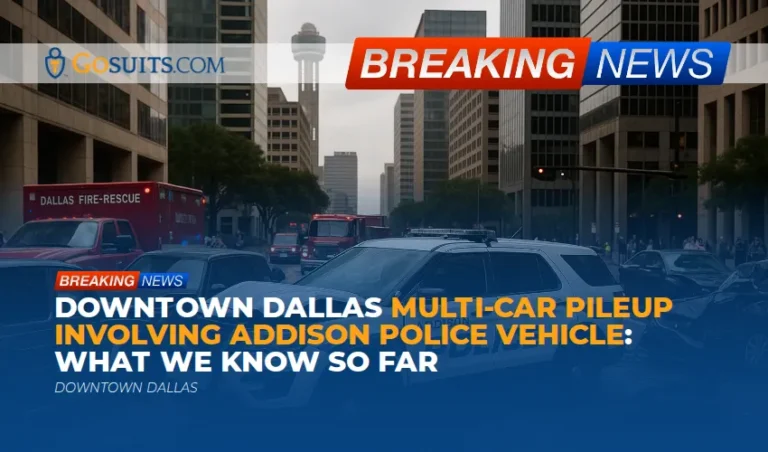
A widely shared bystander video posted from downtown Dallas describes a multi car crash that involved an Addison Police Department vehicle and a Mercedes G Wagon, along with several other cars and responding fire and tow trucks. The narrator says the Addison patrol car collided head on with the G Wagon and that multiple vehicles were struck. Spectators are seen nearby and first responders are on scene. The clip was posted two days before the report time and appears to be filmed near the city core where traffic, construction detours, and weekend activity often mix.
As of now, there is no official public report in the story confirming the exact cause sequence, crash diagrams, or any citations. Patch Texas reportedly reached out to the Addison Police Department and to a family mentioned in the video for comment, and those responses were not available at the time of writing. That is typical in the first 48 to 72 hours after a Dallas car accident of this size, when agencies still gather witness statements, extract event data from vehicles, and review available cameras.
It is encouraging that fire crews and law enforcement were already on scene in the video. In downtown Dallas, Dallas Fire Rescue, the Dallas Police Department, and neighboring jurisdictions such as Addison often coordinate on large incidents when they affect state or regional roadways, cross city boundaries, or require specialized resources.
Local context and where this occurred
The clip was posted from downtown Dallas, and the description mentions Addison Police involvement and a luxury SUV. Downtown corridors can be complicated by lane closures, major venues, and tight timing between lights. Just a few blocks can shift you from the AT&T Discovery District to Klyde Warren Park and the Woodall Rodgers connector, where traffic layers can be unforgiving at rush hour or during events. North of there, the Dallas North Tollway and the Belt Line Road corridor in Addison funnel business and nightlife traffic back toward Victory Park and the Arts District.
Why does this matter to an investigation? In the urban core, there are more potential camera sources than on a suburban arterial. Private parking structures near Elm and Main, hotel forecourts by the convention center axis, DART platforms, and TxDOT traffic management cameras on feeders can all help reconstruct a chain reaction crash. Even when traffic cameras are not retained for long or are not recorded for public archive, nearby businesses frequently keep short loops of security footage that can help clarify speed and lane position in the moments before impact.
Witness narration versus official confirmation
The viral video provides a colorful and immediate description, but an official crash report is the cornerstone for insurance coverage and any civil claim. Under Texas law, investigating officers prepare a CR 3 crash report, and release of that report is governed by statute [2]. The report usually includes a diagram, harmful event sequence, contributing factors the officer observed, listed witnesses, and details about road conditions.
It is important to treat early social media claims as preliminary. Eyewitnesses can be mistaken about angles, speeds, or which vehicle crossed where. Officers also evaluate whether an authorized emergency vehicle was operating with lights and siren and whether the driver exercised due regard for the safety of all persons, which Texas law requires even when certain traffic rules are waived during an emergency response [3]. Until an agency releases a crash report or a news release, everyone is working with incomplete information.

Civil liability issues in a police involved crash
When a police vehicle is involved, the legal framework is more complex than a typical fender bender on McKinney Avenue. Claims against a governmental unit in Texas are generally handled under the Texas Tort Claims Act, found in Chapter 101 of the Civil Practice and Remedies Code [4]. Several points matter right away.
- Authorized emergency vehicles still owe a duty of care. Texas Transportation Code Chapter 546 allows emergency vehicles certain privileges while responding to calls. Those privileges are not absolute. Drivers must operate with due regard for the safety of others, and the statute does not protect them from consequences of reckless disregard [3].
- Short notice deadlines can apply. The Tort Claims Act includes a notice requirement that can be as short as six months from the date of the incident, and some cities set earlier notice deadlines by local rule. The general statute is in Section 101.101 [5]. Missing notice windows can jeopardize a claim.
- Damages caps can limit recovery. The Act includes liability caps for governmental units. That can affect how insurance coverage stacks and how claims are pursued.
- Emergency response status matters. Whether the patrol car was actively responding, using lights and siren, or engaged in routine movement can influence liability analysis under Chapter 546 and the Tort Claims Act framework.
From a practical perspective, chain reaction crashes in tight downtown lanes often involve multiple at fault findings, which is why a careful look at each point of impact, witness vantage points, and any onboard or fixed cameras is essential.
How to get official records in Dallas County and North Texas
If you were in the crash or have a legitimate interest under Texas Transportation Code Section 550.065, you can purchase the official CR 3 crash report through the statewide TxDOT Crash Records Information System portal [1] [2]. You can also request the report directly from the investigating agency’s Records Unit, which for a downtown incident will typically be the Dallas Police Department. When a patrol car from another city is involved, you may need to check with that agency’s records department as well.
- Police crash report. Use the TxDOT CRIS portal to search and purchase the CR 3, or contact the Dallas Police Department Records Unit if DPD investigated. If Addison PD conducted the investigation, contact Addison PD Records. Be prepared with the date, approximate time, location, and the names of involved drivers if known. Statutory release rules apply [2].
- Body worn camera or dash camera video. Requests for police video are governed by the Texas Public Information Act and specific provisions in the Texas Occupations Code for body camera footage. Some videos may be exempt or require redaction. See the Attorney General’s overview of the Public Information Act [6] and Occupations Code provisions at Chapter 1701 [12].
- Dallas Fire Rescue incident notes. EMS patient care reports are protected health information. However, incident run sheets may be available to involved persons or their authorized representatives through a records request under the Public Information Act [6].
- Autopsy and medical examiner records, if any fatality occurred. Dallas County autopsy authority is governed by Texas Code of Criminal Procedure Chapter 49 [7]. Next of kin can contact the county medical examiner for status. No public reports suggest any fatalities in this event, but the process is included for completeness.
Tip for timing. Agencies often take several days to finalize the CR 3 report. If a serious injury is involved, diagrams and supplements may take longer. It helps to mark your calendar and follow up rather than assuming the report will auto populate in the state system.
Insurance in a multi vehicle crash involving a police car
Insurance analysis gets layered when a governmental unit is involved in a multi car pileup. You may see three distinct buckets of coverage in play.
- Governmental unit risk pool or insurer. Claims for bodily injury or property damage caused by a governmental employee acting within the scope of employment are processed under the Tort Claims Act rules and any municipal insurer or risk pool. Caps and notice rules apply [4] [5].
- Private auto liability for other civilian drivers. Other motorists in the chain may carry Texas minimums or higher limits. Fault can be shared, so adjusters will apportion based on the evidence.
- Your own first party coverages. Collision, medical payments, and UM or UIM can bridge gaps while liability is sorted. Texas regulators provide consumer guidance on auto coverages and claims [13].
Order of payment and subrogation rights are often misunderstood in chain reaction crashes. For a deeper dive on priority and overlap, see Which Insurance Pays First After a Multi Car Crash.
Before speaking to any insurer, it is wise to consult with seasoned car accident lawyers about how recorded statements and early medical authorizations can affect your claim. Insurance carriers are trained to ask questions in a way that narrows liability and damages. Even an innocent phrase like “I am okay” may be used later to downplay injuries.

If you were involved or witnessed it, how to preserve evidence
Downtown Dallas has a mix of municipal cameras, DART platforms, private garage decks, hotel porte cochères, and storefront CCTV. That is an opportunity, but only if you move quickly. Many businesses overwrite video within 7 to 14 days.
- Secure your own photos and video. Immediately download anything you or companions recorded. Back it up to a second location. Capture the date and time.
- Write down what you saw. Memory fades. Note where you were standing, which direction vehicles were facing, the color of light cycles if you noticed them, weather, and any horn or siren you heard.
- Identify cameras and businesses on the block. List the nearest hotel, parking garage, retail storefront, and any transit stops. A preservation letter from auto accident attorneys can be sent quickly to request that video be saved.
- Check for vehicle data. Many modern vehicles store limited speed and brake data. Your own car’s event data recorder and infotainment unit may contain helpful clues, and qualified vendors can extract it after a preservation plan is in place.
- Do not give a recorded statement before legal counsel. What you say to an adverse insurer can be used to reduce or deny your claim later. Consult first with car crash injury lawyers who handle North Texas roadway cases.
Are Dallas drivers among the worst in Texas, and what the data says
Social media often ranks cities by “worst drivers,” but those lists usually rely on proprietary scoring. To ground the discussion, it helps to look at public safety sources.
- Speeding is a leading factor statewide. NHTSA continues to report that speeding is a major contributor to serious and fatal crashes nationwide, including urban cores like Dallas where short blocks and aggressive merges increase conflict points [8] [9].
- Texas has focused on reducing serious crashes. TxDOT’s End The Streak TX campaign highlights that Texas has endured many years without a deathless day on the road, and it urges practical steps like slowing down and maintaining space, which are especially relevant near downtown work zones and tight corridors [10].
- Work zones and lane shifts elevate risk. Even when no crews are present, lane closures and detours can raise the risk of sideswipes and chain reactions. FHWA reports special hazards in work zones that match what drivers see near U S 75 and Woodall Rodgers connectors when lanes narrow or shift unexpectedly [11].
Anyone who drives the Dallas North Tollway into the urban core on a rainy evening knows the feeling. The road shines, braking distances shrink, and one abrupt stop can stack cars quickly. That does not mean Dallas drivers are uniquely reckless. It does mean the environment demands patience and a clear head at the wheel.
Community safety notes for downtown, Uptown, and the Tollway corridor
Near the American Airlines Center and Victory Park, events can release hundreds of cars and rideshares into surface streets at once. Uptown patio blocks on McKinney and State Thomas add pedestrian flows and frequent curb movements. The Klyde Warren Park cap also compresses space as drivers weave between the park, the Arts District, and the Perot Museum.
What helps right now. Slow down as you approach the downtown core from I 35E, I 345, or the Tollway. Leave a cushion in front, especially when following a larger SUV that can block your view of brake lights ahead. Signal early when leaving the Dallas North Tollway onto Wycliff or Harry Hines. If sirens are approaching, do not guess at where they are. Put on your signal and move to the right only when it is safe and predictable for those behind you. Emergency drivers are trained to anticipate, but they need room.
Finally, consider routing. Many locals already use side streets like Cedar Springs or Maple to ease downtown entries, but construction schedules change. A quick glance at the City’s traffic updates or a mapping app that shows lane closures can save a headache.
What to do next, time sensitive steps
There are a few critical actions that should be taken as soon as possible after a pileup like this. The benefit is clarity and preserved rights. The urgency is because evidence disappears, deadlines run, and insurers move fast.
- Get medical evaluation early. Even if you feel okay, delayed pain from soft tissue or concussion is common. Early care documents the link between the crash and symptoms.
- Preserve video and witness contacts within days. Downtown businesses often overwrite recordings in a week or less. Ask politely for the manager’s name and confirm retention periods so a formal preservation letter can be sent in time.
- Request the crash report as soon as it is available. Monitor TxDOT CRIS for the CR 3 posting and note the investigating agency listed [1].
- Consult an attorney before opening an insurance claim. Initial statements to an adverse insurer can limit later recovery if key facts are stated imprecisely. A brief consultation helps frame communications and protects your rights.
- Calendar Tort Claims Act notice. If a governmental vehicle is involved, put a reminder for the notice deadline that may be as short as six months under state law, and verify whether a local rule shortens that window [5].
- Do not post about injuries or fault on social media. Insurance adjusters and defense teams routinely review public posts. Keep details offline.
Why act now. Physical evidence fades, and insurance carriers set early reserves based on first impressions. Those impressions are shaped by the crash report, early photos, and your initial statements. Acting promptly helps ensure that the documentation reflects what truly happened rather than a rushed assumption.

Commentary from Gosuits Dallas, Texas Personal Injury Attorney
We are very relieved that this downtown pileup did not immediately report fatalities. Collisions in dense Dallas blocks can turn tragic in seconds. If you or someone you love was involved, please know that this overview is for general information and community awareness. It is not a substitute for advice tailored to your situation.
Based on what is publicly described, there are real questions about how the crash sequence began and whether an emergency vehicle was responding at the time. Texas law recognizes the vital role of first responders and also requires due regard for everyone on the road. Sorting that out takes methodical work with reports, camera footage, and independent witness accounts.
In the immediate aftermath, insurers and risk pools often contact people quickly and ask for recorded statements. Corporations and carriers are sophisticated. They understand how to frame questions to minimize responsibility and reduce what they pay. Many people do not realize that a casual apology or a guess about speed can be used against them months later. That is why it is prudent to speak with a knowledgeable advocate before giving any statement or signing medical authorizations.
A free consultation can be a pressure release valve. It gives you space to understand your rights, your deadlines, and the likely order of insurance coverage without committing to anything or risking a misstep that cannot be undone. Whether the path forward involves your own UM or UIM, a claim against another driver, or a Tort Claims Act notice to a governmental unit, early guidance can help protect both your health and your claim.
References
- TxDOT Crash Records Information System CRIS Purchase Portal – Texas Department of Transportation
- Texas Transportation Code Chapter 550, including Section 550.065 on Crash Report Release – Texas Statutes
- Texas Transportation Code Chapter 546 Operation of Authorized Emergency Vehicles – Texas Statutes
- Texas Civil Practice and Remedies Code Chapter 101 Texas Tort Claims Act – Texas Statutes
- Texas Civil Practice and Remedies Code Section 101.101 Notice Requirement – Texas Statutes
- Overview of the Texas Public Information Act – Office of the Attorney General of Texas
- Texas Code of Criminal Procedure Chapter 49 Inquests and Autopsies – Texas Statutes
- Speeding and Aggressive Driving Risk Factors – National Highway Traffic Safety Administration
- Traffic Safety Facts and Crash Data Portal – National Highway Traffic Safety Administration
- End The Streak TX Safety Campaign – Texas Department of Transportation
- Work Zone Safety and Mobility – Federal Highway Administration
- Texas Occupations Code Chapter 1701 Law Enforcement Officers including Body Worn Camera Provisions – Texas Statutes
- Consumer Bill of Rights for Personal Auto Insurance – Texas Department of Insurance