- What we know about the I-35 18-wheeler crash in Denton
- Why lost cargo on an 18-wheeler is so dangerous
- Federal and Texas rules on cargo securement
- Immediate steps after a serious truck crash in Denton
- Getting official records and where to call locally
- Understanding potential liability in a load-loss crash
- Evidence that matters in a Denton truck case
- Insurance issues after a Denton 18-wheeler collision
- Roadway context: I-35 through Denton
- How to track road closures and detours after a major crash
- How to request public records and protect rights in Texas
- Commentary from Gosuits Denton, Texas Personal Injury Attorney
- Action steps to consider now
What we know about the I-35 18-wheeler crash in Denton
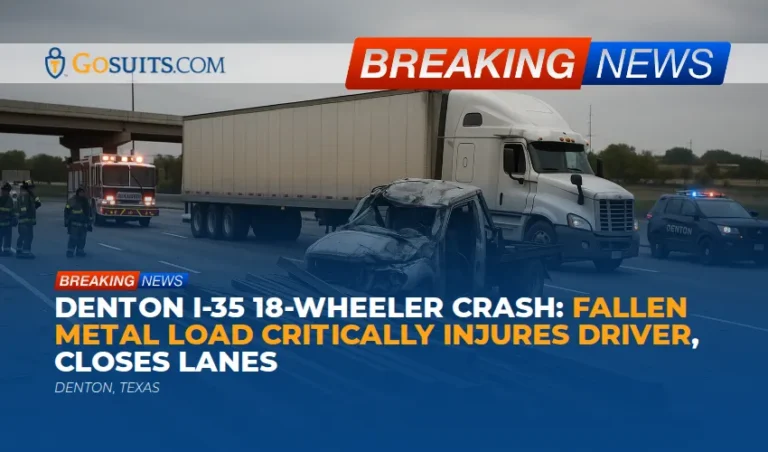
Early Thursday evening in Denton, a crash involving two 18-wheelers on southbound Interstate 35 near West Oak Street left one driver in critical condition. According to preliminary information shared by a Denton police spokesperson, one tractor-trailer lost its load of metal. That falling cargo struck a second 18-wheeler and trapped its driver inside the cab. Denton firefighters arrived quickly, performed an extrication, and transported the injured driver to a local hospital. Southbound mainlanes reopened by around 7:30 p.m., but the service road south of U.S. Highway 380 was expected to remain closed for several hours as crews worked the scene and cleared the debris.
If you were stuck in traffic around the University Drive and West Oak Street areas, you likely noticed the ripple effect on nearby connectors, including the approaches to the Square and the segments leading toward Loop 288. Evening crashes at 6:45 p.m. often collide with the end-of-day commute and with freight traffic pushing through the corridor, which can complicate both public safety response and detour routes.
Details will continue to develop as investigators review vehicle damage, cargo securement, and any available video. For now, the central fact pattern is straightforward: cargo shifted or fell from one tractor-trailer, and the resulting impact critically injured another driver who needed to be cut free.
Why lost cargo on an 18-wheeler is so dangerous
Loose or shifting cargo turns a heavy truck into a moving hazard not only for the driver hauling that load, but for everyone around them. When a bundle of metal or industrial materials breaks free, it can drop directly onto the roadway or onto nearby vehicles at highway speed. The forces involved are enormous. Even a modest-sized steel component can carry enough momentum to crush structures, rupture windshields, and pin occupants under twisted frames.
Beyond the initial strike, debris can trigger multi-vehicle collisions as motorists swerve to avoid hazards. Secondary crashes often happen in the confusion that follows. That’s one reason first responders in Denton move quickly to shut down lanes, slow traffic on the service road, and hold space for fire crews to work. The faster a dangerous scene is secured, the lower the risk of a chain-reaction crash.
Cargo drops are preventable when the load is properly planned, balanced, and secured. The federal cargo securement rules set minimum standards for tie-downs, blocking, bracing, and periodic inspections. If any link in that chain of responsibility breaks down, the consequences can be life-altering.
Federal and Texas rules on cargo securement
Core federal requirements
The Federal Motor Carrier Safety Regulations require carriers and drivers to ensure loads are secured to prevent shifting or falling during normal driving maneuvers. The rules cover securement systems, working load limits, and commodity-specific methods for items like metal coils and heavy machinery. Key subparts include 49 CFR 393.100 through 393.136, which explain how cargo must be immobilized, how tie-downs should be used, and how inspections are to be performed during a trip.
Drivers are required to inspect cargo securement at the start of a trip, again within the first 50 miles, and periodically thereafter, adjusting as needed to maintain compliance. These are practical, on-the-ground checks that can catch a problem before it becomes a road emergency.
Texas legal framework
Texas law also addresses debris and unsafe loading, including preventing material from escaping a vehicle and causing harm on the highway. The state’s crash report release rules are contained in Texas Transportation Code § 550.065 (helpful for accessing the official record after a collision), while the obligation to keep loads from causing hazards on the road is addressed elsewhere in Transportation Code provisions dealing with transport of materials. While the state framework is broad, for interstate carriers in Texas the operative day-to-day securement standards are the federal rules cited above.

Immediate steps after a serious truck crash in Denton
There’s nothing abstract about a crash like this. It’s loud, disorienting, and frightening. Once the immediate emergency has been addressed and it’s safe to do so, concrete steps can make a difference in health outcomes and in preserving facts that matter later.
- Get thorough medical evaluation. Critical injuries require immediate hospital care, but even seemingly minor symptoms can evolve. Follow-up imaging and specialist assessments can catch internal trauma or spinal injuries that aren’t obvious in the first hours.
- Preserve photos and video. If safe at the scene, capture the cargo debris pattern, skid marks, lane closures, and vehicle positions. Afterward, save dashcam footage and any smartphone photos with timestamps. These details can help reconstruct how a load fell and what struck the second truck.
- Identify witnesses. Get names and contact information for drivers who saw the load fall or the moment of impact. Independent accounts can corroborate securement failures.
- Avoid recorded statements to insurers. Before speaking with any insurance representative for the trucking company or shipper, talk with a lawyer. What’s said in a recorded call can be used later in ways that aren’t obvious in the moment.
- Note road conditions. Weather, lighting, ongoing construction, and traffic density near West Oak Street and the US 380 corridor may be relevant. Write down what you observed while it’s fresh.
- Document expenses. Keep all bills, receipts, and mileage logs for medical visits, temporary transportation, and vehicle towing or storage.
Getting official records and where to call locally
After a major truck collision, several official records can help families and injured motorists understand what happened and what comes next. Here’s how to approach them and why they matter.
Police crash report
In Texas, certified crash reports are maintained by the Texas Department of Transportation. The state outlines eligibility and the process for obtaining crash reports under Transportation Code § 550.065. TxDOT provides information and access to crash reports through its official channels on txdot.gov. When requesting, have the date, location (southbound I-35 near West Oak Street in Denton), and involved vehicles ready. If a case number was given at the scene, include it.
Incident logs and 911 audio
Texas public records are governed by the Public Information Act. Requests for incident logs, CAD entries, and certain communications can be made under Texas Government Code Chapter 552. The Texas Attorney General’s open government page explains how agencies process requests and what may be withheld for safety or privacy. See the AG’s guidance at the Open Government section of texasattorneygeneral.gov.
EMS and fire run reports
Emergency medical services and fire response documentation can include times of arrival, extrication details, and care provided. Portions of these records may be available via a public information request under Chapter 552, with health privacy redactions as required.
Hospital records
Patients have a right to access their medical records. The U.S. Department of Health and Human Services provides a plain-language overview of this right under HIPAA. See the access right overview at hhs.gov. Ask the hospital’s Health Information Management department for the process, and request imaging, operative reports, and discharge summaries.

Autopsy and medical examiner records, if a death occurs
If an injury later becomes fatal, autopsy and death investigation records are handled by the county medical examiner or, in some counties, a Justice of the Peace. Texas law governing inquests and autopsies appears in Texas Code of Criminal Procedure Chapter 49. Families can request guidance on how to obtain those records from the appropriate county office. Timing and availability can depend on the status of any ongoing investigations.
Understanding potential liability in a load-loss crash
From a civil-injury perspective, a load falling from a tractor-trailer raises urgent questions about who had control and who had duties to prevent it. Liability may involve multiple parties, and every case is specific to its facts. In general, consider the following roles.
- Driver. Operators must inspect and re-check securement at the start of the trip, within the first 50 miles, and as necessary. A failure to identify a shifting load can be a factor.
- Motor carrier. The trucking company is responsible for training, policies, and supervision. It’s also accountable for maintaining the vehicle and ensuring securement equipment meets standards.
- Shipper or loader. When a shipper or third-party loader controls how a commodity is stacked, blocked, or braced, their methods and instructions can be central. Industry often uses bills of lading and load plans that show who handled what.
- Equipment providers. Faulty straps, chains, winches, or anchor points can fail under load. If equipment failed unexpectedly, product condition and maintenance records matter.
Texas applies well-established negligence principles. The practical path is evidence-driven: who had the last clear chance to catch a securement problem, what inspections were done, and whether the methods used matched what the federal rules require.
Evidence that matters in a Denton truck case
Evidence disappears quickly. Some items are overwritten in days, others in months. Preservation letters sent early can help ensure critical material is not lost.
- Electronic logging device data and hours-of-service records. These may show driver fatigue and inspection windows. Under 49 CFR 395.8, carriers must retain records of duty status and supporting documents for six months. That window can close fast.
- Pre-trip and en route inspection records. Checklists and DVIRs can document that securement was inspected or that defects were reported.
- Cargo securement details. Photographs of the load, the tie-downs used, working load limits, and the number and placement of chains or straps can be matched against the federal securement rules.
- Bills of lading and load diagrams. These can show who loaded the cargo, the weight distribution, and any special instructions.
- Truck and trailer maintenance files. Carriers must keep maintenance records while a vehicle is in service and for a period after it leaves the fleet. See 49 CFR 396.3.
- Event data recorders and dashcams. ECM and camera footage can capture speed, braking, and the moment the load fell. Some dashcam systems overwrite on short loops.
- Weigh station and scale tickets. Weight distribution and axle loads can corroborate how cargo was positioned.
Insurance issues after a Denton 18-wheeler collision
Truck crashes involve multiple layers of insurance. There’s usually a motor carrier liability policy, sometimes excess coverage, plus potential cargo and shipper policies depending on contracts. Federal rules require minimum public liability coverage for interstate motor carriers transporting non-hazardous property, currently listed in 49 CFR 387.9.
Early contact from insurers often comes with requests for recorded statements and medical authorizations. It’s common for adjusters to sound helpful while seeking statements that limit or shift responsibility. Before any recorded call or signed authorization, it’s wise to talk with a lawyer. What’s said can be used later, and medical releases can allow broad access that goes beyond the crash-related care.
If a claim is eventually made, it’s important to understand how comparative fault works, what policies may apply, and how to avoid pitfalls like quick, insufficient settlement offers before injuries are fully understood and documented.
Roadway context: I-35 through Denton
Interstate 35 through Denton is a lifeline for the region, carrying a heavy mix of local commuters, university traffic, and long-haul trucks. The corridor near West Oak Street and south of U.S. 380 sees frequent merges as drivers enter and exit for downtown, the Square, and neighborhoods around UNT. Evening travel near 6:45 p.m. can be especially dense, leaving little margin when debris appears suddenly in a lane. That density is why troopers and city officers move quickly to pace traffic and why Denton fire units often stage a buffer with apparatus for scene safety.
Local drivers know the rhythm of this stretch: when a crash forces mainlane closures, service roads and cross-streets can back up toward University Drive and along feeders that loop toward Loop 288. Planning detours with reliable maps and official road condition tools can reduce the stress of getting home after an incident like this.
How to track road closures and detours after a major crash
For state-maintained highways, TxDOT provides official road condition information. The agency’s traveler information is accessible from txdot.gov road conditions, which posts closures, construction, and incident updates. Checking the state’s page can be more reliable than crowdsourced reports during an active emergency response, because lane statuses can change as responders adjust their traffic control plans.
How to request public records and protect rights in Texas
Public records can clarify the timeline and decisions made at a crash scene. Here’s a straightforward approach grounded in Texas law.
- Identify the agency and records. For a crash inside the City of Denton, you may need records from the city’s police and fire departments, and from TxDOT for the certified crash report.
- Cite the Texas Public Information Act. When writing a request, note that you’re requesting records under Texas Government Code Chapter 552.
- Be specific. Include date, time, and location, and request the call-for-service log, CAD notes, any photos or video, and EMS run sheets if available. Agencies will review for exemptions but specificity helps.
- Track deadlines. Agencies have timelines to acknowledge and respond. The Texas Attorney General’s Open Government section explains the process and timelines at texasattorneygeneral.gov.
- Request the certified crash report via TxDOT. Eligibility and process are governed by Transportation Code § 550.065.
If injuries evolve or additional parties are identified, further records like carrier safety policies, driver qualification files, and maintenance logs can be requested from private entities through formal discovery if a claim proceeds.
Commentary from Gosuits Denton, Texas Personal Injury Attorney
Our first thoughts are with the driver who was extricated and taken to the hospital, and with the crews who worked quickly to secure a very dangerous scene. What follows is for education and general information. Every situation turns on its specific facts.
When cargo falls from a tractor-trailer and crushes another vehicle, it’s a red flag that securement may not have matched what the federal rules require. The facts reported so far point to a load of metal that came off one truck and struck another, trapping the second driver. In our experience with highway incidents on I-35, careful early work to document securement, the number and type of tie-downs, and inspection intervals can make all the difference in understanding accountability.
Insurance carriers and corporations typically move fast after a serious crash. They may deploy investigators within hours and reach out for recorded statements or broad medical authorizations. That speed can catch people at a vulnerable moment. It’s common to see statements framed in ways that minimize responsibility for load securement or shift focus away from the party who controlled the cargo.
That’s why a free consultation with a seasoned lawyer can be important before talking to insurers. It’s a chance to understand how federal securement rules, Texas evidence rules, and insurance policies fit together, and to learn about preserving critical records like electronic logs and maintenance files that can be lost if not requested promptly.

Action steps to consider now
- Prioritize comprehensive medical care. Seek prompt evaluation and follow-up. Traumatic injuries can evolve, and early documentation protects both health and the factual record.
- Preserve evidence and request key records. Save photos, video, dashcam files, tow invoices, and personal notes. Consider written requests for public records under Texas Government Code Chapter 552, and obtain the certified crash report through TxDOT consistent with Transportation Code § 550.065.
- Consult an attorney before contacting insurance. Speak with a lawyer first, including before any recorded statement to a trucking company insurer. What’s said to an adjuster can be used later, sometimes out of context.
- Act within critical time windows. Certain trucking records are retained for limited periods. For example, carriers must keep driver records of duty status and supporting documents for six months under 49 CFR 395.8. Vehicle maintenance records are retained while in service and for a period after under 49 CFR 396.3. Requests made sooner can help preserve what matters.
- Mind the statute of limitations. Texas sets most personal injury claims on a two-year filing timeline. See Texas Civil Practice and Remedies Code § 16.003. Delays can limit options and make evidence harder to find.
- Keep a recovery journal and cost log. Track symptoms, medical visits, out-of-pocket costs, and missed work. Detailed, contemporaneous notes often carry weight later.
- Limit social media. Posts can be misinterpreted and are often requested by insurers. It’s prudent to avoid discussing the crash or your health online.
Why acting now matters
Highway debris gets cleared, skid marks fade, and electronics overwrite themselves. Meanwhile, the other side may already be assembling its narrative. Swift, steady steps can protect access to the full picture, helping ensure decisions are based on what actually happened on southbound I-35 near West Oak Street, not on partial information.
Where official information lives
- Crash reports and closures: TxDOT maintains crash records and publishes road condition information at txdot.gov.
- Public records process: The Texas Attorney General’s Open Government resources explain how to request records under the Public Information Act at texasattorneygeneral.gov.
- Medical records rights: HHS outlines access rights for patients at hhs.gov.
- Truck safety rules: Federal cargo securement, hours-of-service, insurance, and maintenance record rules are available on ecfr.gov at the links above.