- Dallas North Tollway wrong-way crash near Royal Lane: what authorities have confirmed
- Timeline and precise location
- Vehicles and people involved
- Investigation status and what it means
- Why wrong-way crashes happen on limited-access roads
- Medical care in Dallas after serious highway crashes
- Where to request official records in Texas
- Civil liability issues in a head-on wrong-way crash
- Dealing with insurance companies after a severe crash
- Community safety notes for Dallas North Tollway drivers
- Next steps to consider and why timing matters
- Commentary from Gosuits Dallas, Texas Personal Injury Attorney
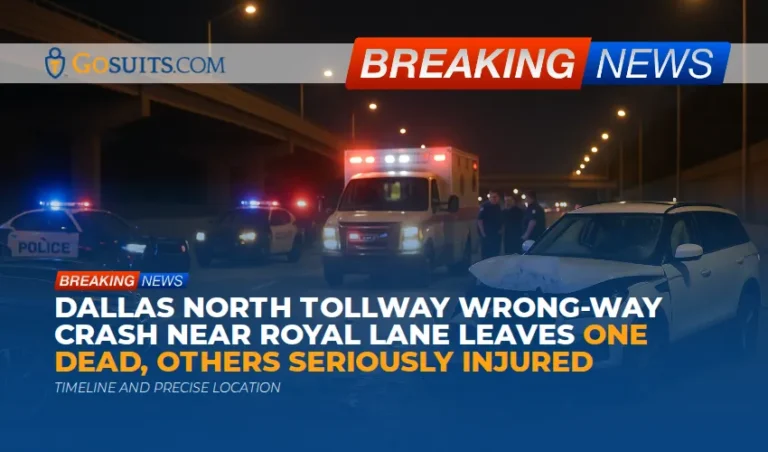
Dallas North Tollway wrong-way crash near Royal Lane: what authorities have confirmed
Early Monday morning, a deadly wrong-way collision shut down part of the Dallas North Tollway in the Royal Lane area. Texas Department of Public Safety troopers responded at approximately 2:10 a.m. to the southbound lanes near Royal Lane. According to preliminary information, a Hyundai Tucson was traveling northbound in the southbound lanes when it struck a Land Rover Velar head-on. The driver and passengers in the Land Rover were taken to nearby hospitals with serious injuries. The wrong-way driver was transported to a hospital and later pronounced deceased. Identities have not been released as the investigation continues.
If you drive the DNT regularly, you know this stretch near Royal Lane sits between Northaven and the exits that serve Preston Hollow and the Galleria area. In the early morning hours, lighting, lower traffic volumes, and complex interchanges can combine to make wrong-way entries more likely than during the day. Even so, investigators will review all factors carefully before releasing a final report.
Timeline and precise location
Authorities received the call just after 2 a.m. and responded to the southbound lanes of the Dallas North Tollway near Royal Lane. That corridor funnels traffic toward downtown, with entrances and exits serving Royal Lane, Forest Lane, and nearby neighborhoods. The crash location suggests a wrong-way entry occurred somewhere upstream of Royal Lane’s southbound side.
Vehicles and people involved
Two vehicles were involved: a Hyundai Tucson and a Land Rover Velar. The Land Rover’s occupants sustained serious injuries and were hospitalized. The Hyundai driver was also transported but was pronounced deceased at the hospital. Names and ages have not yet been released.
Investigation status and what it means
DPS indicated the investigation is ongoing. In a case like this, investigators typically examine:
- Crash scene evidence: final rest positions, skid or yaw marks, debris fields, and roadway geometry.
- Vehicle data: onboard event data recorders when available, airbag control module data, and damage patterns.
- Environmental factors: lighting conditions, signage visibility, and roadway maintenance.
- Human factors: potential impairment, fatigue, distraction, and driver decision-making.
Findings from these areas inform a formal crash report. In Texas, official crash reports can later be requested by eligible parties through the state’s records system [1], and the release of certain details is governed by state law [2].
Why wrong-way crashes happen on limited-access roads
Wrong-way collisions on divided highways are relatively rare compared to other types of crashes, but when they occur, they are disproportionately severe because of the closing speeds and head-on impact dynamics. Federal safety research has long noted the elevated risk profile of wrong-way incidents and has outlined countermeasures such as enhanced signage, wrong-way detection systems, and ramp design improvements to prevent them [3].
On the Dallas North Tollway, managed by a regional toll authority, typical mitigation strategies include clear ramp markings and signs, prominent “Do Not Enter” and “Wrong Way” postings, and in some corridors, technological detection paired with alerts to law enforcement. Investigators will look closely at whether a ramp was misused and what factors preceded the wrong-way entry.

Common contributing factors identified in research
- Nighttime conditions: Most wrong-way crashes occur at night, when visibility is reduced and fatigue is more common [3].
- Driver confusion at interchanges: Complex or unfamiliar ramp layouts can lead to wrong-way entries, particularly for out-of-area drivers.
- Impairment or fatigue: Safety studies associate elevated wrong-way risk with driver impairment and drowsiness [3].
- Signage and roadway elements: Investigations assess whether signs were present, visible, and compliant with standards.
It is too soon to draw conclusions about this crash. DPS will ultimately determine the sequence of events.
Medical care in Dallas after serious highway crashes
In Dallas, severe trauma patients are often routed to designated trauma facilities. Parkland Memorial Hospital is recognized as a Level I trauma center for adults, meaning it offers the highest level of trauma care around the clock. The Texas Department of State Health Services maintains the official listing of designated trauma facilities statewide [4]. Depending on the nature of injuries, patients in the Royal Lane corridor may also be transported to other Dallas hospitals capable of handling complex trauma.
When a fatality occurs, the county medical examiner typically takes jurisdiction to determine the cause and manner of death in accordance with Texas law [5]. Autopsy and investigative records are generally maintained by the medical examiner’s office and are subject to the Texas Public Information Act, which controls what can be released and when [6].
Where to request official records in Texas
Gathering documents early helps families and injured passengers understand what happened and plan next steps. Here are the most relevant record sources for a Dallas tollway crash:
Texas crash report (CR-3)
Eligible requestors can purchase the official Texas crash report through the state’s online system. The portal permits searches by involved party name, crash ID, or crash date and location. Fees apply, and you will typically receive a certified copy appropriate for insurance and legal use [1]. The availability and release of certain information in crash reports is governed by statute [2].
Medical examiner and autopsy materials
Autopsy reports, toxicology, and related files are kept by the county medical examiner where the death investigation occurs. Under the Texas Code of Criminal Procedure, inquest and autopsy procedures are detailed for counties that operate medical examiner systems [5]. Public access to these records is subject to the Texas Public Information Act, with certain confidential items withheld or redacted. If you are next of kin, you may have enhanced access to particular records depending on the circumstances and exemptions that apply [6].
911 audio, dispatch logs, and traffic camera footage
Emergency communications and dispatch logs can sometimes be requested under the Texas Public Information Act. Release rules vary depending on whether the records would interfere with an active investigation or contain protected information. Agencies must follow specific timelines and exemption processes when responding to requests [6]. Traffic cameras on tollways may be owned by a toll authority; availability and retention vary and may be impacted by investigative holds. Even when video exists, agencies can withhold certain footage while a crash remains under investigation.

Hospital records
Patients have a right under federal law to access their medical records and discharge summaries. HIPAA rules outline the process and timelines for requesting medical records from a provider or hospital, including permitted fees and formats [7]. For minors or incapacitated adults, authorized representatives can generally make requests on the patient’s behalf consistent with federal and Texas law.
Vehicle data and forensic downloads
Many modern vehicles store event data recorder information governed by federal regulation. Extracting this data often requires specialized tools and cooperation from the vehicle owner and insurer. The federal EDR regulation outlines standardized data elements and access considerations [8]. Preservation letters are sometimes used to ensure vehicles are not destroyed before key evidence can be documented.
If a family needs a practical roadmap for organizing death-related documents in Dallas, this resource may help: Dallas wrongful death checklist families.
Civil liability issues in a head-on wrong-way crash
From a personal injury perspective, head-on wrong-way crashes raise several recurring questions. Although each case turns on its facts, here are common civil issues attorneys evaluate when they review a record like this.
Fault analysis and duty of care
- Wrong-way operation: Driving against traffic on a controlled-access highway is typically powerful evidence of negligence. Investigators still examine whether roadway conditions, signage, or third-party actions contributed to the entry error.
- Comparative responsibility: Texas follows proportionate responsibility principles in civil cases. Even where wrong-way driving is clear, parties and insurers may dispute percentages of fault depending on additional facts that emerge during the investigation.
- Third-party factors: If evidence indicates an equipment failure, contractor signage issue, or a hazard beyond the drivers’ control, lawyers consider whether additional parties share civil responsibility. Those inquiries rely heavily on expert review and official records.
Insurance coverage layers that may apply
- Liability coverage of the at-fault driver: Texas law requires minimum liability limits of 30,000 per injured person, 60,000 per crash for bodily injury, and 25,000 for property damage [9]. Serious injuries often exceed minimum limits.
- Uninsured/underinsured motorist coverage: UM/UIM may address shortfalls when an at-fault driver’s policy is insufficient. Policies vary; claimants review policy language carefully before giving any recorded statements or signing releases.
- PIP or MedPay: Texas policies include an offer of Personal Injury Protection unless properly rejected in writing. PIP can pay certain medical and related costs regardless of fault, subject to policy terms [10].
- Stacking multiple policies: In some households, multiple UM/UIM policies or resident relative policies may be implicated. Claims handling gets complex; documentation and timing matter.
Wrongful death and survival claims in Texas
When a crash leads to a fatality, two categories of civil claims are typically considered under Texas law:
- Wrongful death claim: Certain family members may bring claims for their own losses arising from a loved one’s death, including mental anguish and loss of companionship, subject to statutory provisions [11].
- Survival claim: The decedent’s estate may pursue claims the decedent could have brought had they survived, such as conscious pain and suffering prior to death [11].
Texas also sets deadlines for bringing these civil actions, and those statutes of limitations can be short. For many personal injury and wrongful death claims, the general two-year limitations period applies, measured from the date of the crash, though exceptions exist [12].
Dealing with insurance companies after a severe crash
Insurers often reach out quickly after a high-severity crash, sometimes within a day or two. What people say in those early conversations can shape the entire claim. Before speaking to any insurance adjuster or providing a recorded statement, it is wise to consult with an attorney to understand rights and potential pitfalls. If a claim will be made, that strategy is best set with counsel first.
Conversations with car accident lawyers can help clarify coverage, identify every potentially liable policy, and plan a documented recovery path without jeopardizing your position. Remember that insurers evaluate claims based on the evidence they receive and the statements on record. Once given, recorded statements are hard to unwind.
In serious Dallas highway collisions, many turn to Dallas car accident lawyers for early guidance on preserving vehicles, obtaining CR-3 reports, and coordinating with medical providers. Early, careful coordination can make later stages smoother, especially where multiple injured passengers and a fatality are involved.
Community safety notes for Dallas North Tollway drivers
Those who commute the Dallas North Tollway between Royal Lane and the I-635 interchange know how quickly traffic speeds can rise in the overnight hours. Safety planners encourage a few habits that, while basic, are especially important at night:
- Scan far ahead: On long, straight segments, look beyond immediate taillights for unexpected hazards. Sudden clusters of brake lights at 2 a.m. can signal trouble ahead.
- Use lane discipline: Keep right except when passing, and avoid lingering in the far-left lane during low-visibility periods.
- Report wrong-way sightings immediately: If you safely observe a vehicle traveling the wrong direction, call 911 as soon as possible. Accurate location details matter on corridors with closely spaced exits.
- Avoid distractions: Even brief glances away from the road reduce reaction time when a hazard presents directly ahead.
State and federal safety materials emphasize that strong signage, detection technology, and well-designed ramps can reduce wrong-way entry risks on divided highways [3]. While infrastructure matters, attentive driving and rapid reporting also make a difference.

Next steps to consider and why timing matters
In the aftermath of a severe head-on collision, time matters for medical care, documentation, and legal rights. Here is a practical, action-focused checklist for the days and weeks ahead. This is general information only.
- Document a clear timeline: Create a dated log of events from the moment you learned of the crash. Include hospital names, treating providers, and any case numbers provided by DPS or first responders.
- Preserve evidence immediately: Ask that vehicles be preserved and not destroyed until photographs, inspections, and any event data recorder downloads can occur. Preservation letters are commonly used for this purpose.
- Request key records in sequence: Order the Texas CR-3 crash report when it becomes available [1]. If a fatality is involved, begin the process of requesting autopsy materials consistent with Texas law [5] and the Public Information Act [6].
- Coordinate medical records: Secure discharge summaries and imaging reports from hospitals and clinics under HIPAA rights [7]. Track out-of-pocket costs and mileage to appointments.
- Consult counsel before insurer contact: Before notifying any insurer or giving a recorded statement, schedule a consultation with a qualified attorney. Statements given early can be used later to narrow or dispute claims.
- Track deadlines now: Mark potential civil deadlines on a calendar, including the general two-year civil limitations period in Texas for many personal injury and wrongful death claims [12]. Some deadlines can be shorter if a government entity is involved.
- Limit public posting: Avoid social media posts about the crash or injuries; insurers often review public content for inconsistencies.
Acting promptly tends to preserve options. Records retention policies for 911 audio, dash and body-worn camera video, and roadway footage can be short. Early requests under the Texas Public Information Act can help secure time-sensitive materials [6].
Commentary from Gosuits Dallas, Texas Personal Injury Attorney
Our hearts are with everyone affected by this wrong-way collision on the Dallas North Tollway. Crashes on this corridor hit close to home for so many North Dallas families who rely on the DNT to get to work, school, or medical appointments. This commentary is offered for educational purposes and general information.
Based on the information released so far, investigators are looking at a classic head-on wrong-way scenario in the southbound lanes near Royal Lane. In civil cases, driving the wrong way on a controlled-access highway is usually compelling evidence of negligence. Even so, we wait for DPS to complete its work, which may include vehicle data, autopsy findings, and a detailed crash reconstruction. Those details matter for a complete picture and for any civil claims by injured passengers.
In our experience, insurance carriers often move quickly in severe crashes to shape the record. Adjusters may seek recorded statements before people fully understand their rights or the long-term medical outlook. Corporations and insurers work from day one to reduce exposure by limiting who is considered at fault, narrowing medical causation, and pushing for quick, low-information resolutions. When evidence like vehicle EDR data or possible roadway video might exist, delays or informal communication can risk spoliation or missed preservation opportunities.
That is why a free consultation can be so important early on. A consultation can help families and injured passengers understand potential coverage layers, the sequence for ordering official records, and strategies to avoid unforced errors with insurers. It also helps set expectations for timelines, including coordination with the medical examiner and the state’s crash records systems. No one should have to navigate this process alone, particularly after a traumatic event on a major Dallas roadway.
References
- Purchase Crash Reports – Texas Department of Transportation (CRIS)
- Texas Transportation Code § 550.065 – Release of Certain Information Relating to Accidents – Texas Statutes
- Wrong-Way Driving Countermeasures – Federal Highway Administration
- Trauma Facility Designation – Texas Department of State Health Services
- Code of Criminal Procedure Chapter 49 – Inquests Upon Dead Bodies – Texas Statutes
- What to Expect When Requesting Public Information – Office of the Texas Attorney General
- Your Rights Under HIPAA: Right of Access – U.S. Department of Health and Human Services
- 49 CFR Part 563 – Event Data Recorders – Electronic Code of Federal Regulations
- Texas Transportation Code § 601.072 – Minimum Amounts of Motor Vehicle Liability Insurance – Texas Statutes
- Texas Insurance Code § 1952.151 – Personal Injury Protection Coverage Required to Be Offered – Texas Statutes
- Texas Civil Practice and Remedies Code Chapter 71 – Wrongful Death; Survival; Liability
- Texas Civil Practice and Remedies Code § 16.003 – Two-Year Limitations Period