- What happened on the Dallas North Tollway near Royal Lane
- Where and when the crash occurred, and local context residents recognize
- Who was involved and the immediate response captured on video
- How to get official records and evidence in Dallas County and statewide
- Texas civil claims after a wrong-way crash
- Insurance issues and common pitfalls after a Dallas car accident
- Practical first steps in the first 7, 30, and 90 days
- Why wrong-way crashes are so deadly, and what agencies recommend
- Local support and practical resources around North Dallas
- Community reflections from Royal Lane to LBJ Freeway
- Commentary from Gosuits Dallas, Texas Personal Injury Attorney
- Why acting now matters
What happened on the Dallas North Tollway near Royal Lane
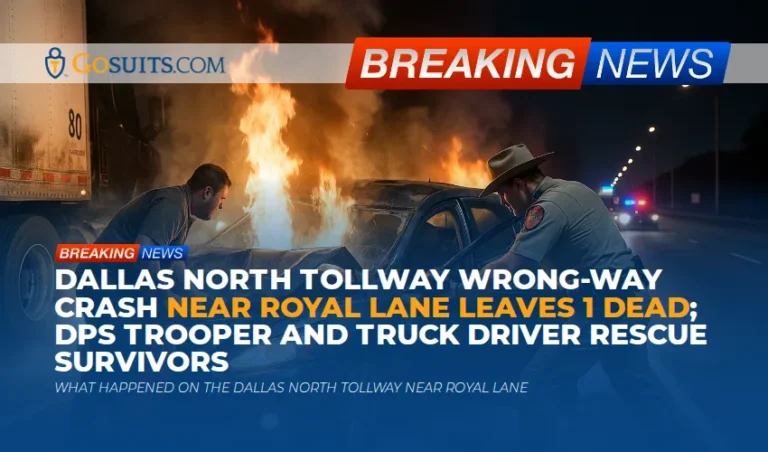
In the early morning hours of May 12, on the Dallas North Tollway near Royal Lane, a wrong-way driver traveling north in the southbound lanes sideswiped an 18-wheeler and then struck a Nissan Altima head-on. The violent impact left five women trapped in the Altima as fire and smoke spread. A Texas Department of Public Safety corporal and the 18-wheeler driver rushed to the wreckage, pulled survivors from the sedan, and used several fire extinguishers to hold back the flames until firefighters arrived. One passenger died at the scene. Authorities have said the wrong-way driver survived and faces multiple felony charges.
Dash camera and body camera footage shows the trooper and the truck driver working together under extreme conditions to rescue people who were injured and unable to move. Their actions, and the immediate response by first responders, prevented additional loss of life.
Where and when the crash occurred, and local context residents recognize
This Dallas North Tollway wrong-way crash happened near Royal Lane, a corridor that many North Dallas drivers know well. Royal Lane sits between key landmarks like Preston Hollow to the west and the Dallas Galleria corridor near LBJ Freeway to the north. Regular commuters use the stretch between Northwest Highway and I-635 daily, especially during predawn hours when overnight shifts end and early flights beckon at Love Field. The tollway carries a steady mix of passenger vehicles and commercial trucks, so any head-on collision there can escalate rapidly.
Timing matters in these incidents. Early morning driving often coincides with fatigue and reduced visibility. On tollways, speed differentials and limited turnaround options can make a wrong-way event particularly dangerous. When flames were seen on the vehicles at this scene, responders knew they had minutes, not hours, to act.
Who was involved and the immediate response captured on video
Authorities reported that an 18-wheeler was sideswiped before the Nissan Altima sustained a head-on impact from the wrong-way driver. Five women inside the Altima were trapped by the collision forces. A Texas DPS corporal arrived quickly, followed by another trooper. The truck driver involved, who had stopped to help, joined the effort. They unbuckled seat belts, extricated passengers, and evacuated the injured as flames crept up the hoods of both vehicles. According to statements, multiple fire extinguishers were used to keep the blaze down until Dallas-area firefighters got water on the fire.
Despite the heroic response, one passenger died at the scene. The wrong-way driver was hospitalized. Authorities have stated that multiple felony charges are being pursued against that driver. The trooper and the good Samaritan truck driver were later recognized for their lifesaving actions.
How to get official records and evidence in Dallas County and statewide
Crash report
In Texas, official crash reports prepared by investigating officers are typically filed using the Texas Peace Officer’s Crash Report, form CR-3. Most crash reports can be purchased through the Texas Department of Transportation’s Crash Records Information System. Families and injured passengers can order a copy online through TxDOT. See: TxDOT CRIS crash report portal.
What to have ready: the date of crash, the location, the names of drivers or involved parties if known, and the investigating agency. If you are unsure which agency took the report, the location on the Dallas North Tollway suggests involvement by a Texas DPS trooper and possibly tollway police services. TxDOT’s system can still locate the CR-3 if it has been processed.
Medical examiner and autopsy records
For fatal crashes in Dallas County, postmortem examinations are handled by the county medical examiner’s office. Immediate next of kin can typically request autopsy reports, case numbers, and related records once the report is finalized. Although each county has its own process, requests are generally made in writing and may require identification and proof of kinship. If you do not know the case number, provide the decedent’s name, date of death, and location of death.
If you are unsure where to start, ask the funeral home to help coordinate record requests or call the county medical examiner during business hours to learn the specific steps and fees. Autopsy reports can take weeks to finalize depending on toxicology testing timelines.

Body camera, dash camera, and 911 audio
Texas agencies process requests for body camera footage, dash cam video, and 911 recordings under the Texas Public Information Act, subject to specific exceptions and timelines. Agencies often have online portals for public information requests. For statewide law enforcement records such as DPS video or reports, review the DPS open records guidance and submit a written request with as many specifics as possible. See: Texas DPS open records and general request guidance from the Attorney General: Texas Public Information Act request guide.
Tips when requesting video or audio:
- Be specific on time and place. Include date, approximate time, roadway, near Royal Lane, direction of travel, and the Dallas North Tollway southbound lanes if known.
- Identify responding agencies. If you know DPS troopers responded, note that. If you believe local fire or EMS responded, include that.
- Expect redactions. Texas law allows redaction of certain sensitive material. Fatality scenes often involve privacy protections.
- Preservation letters. Consider having an attorney send a preservation notice to relevant agencies and entities to ensure video is not overwritten by routine retention policies.
EMS and fire reports
Ambulance run sheets and fire incident reports can provide crucial timelines and injury details. In Dallas, prehospital care is commonly provided by Dallas Fire-Rescue within city limits, though jurisdiction on tollways can involve multiple agencies. These records may also be requested through open records processes. Ask for the incident number and include location details like Dallas North Tollway near Royal Lane.
Commercial vehicle evidence
When an 18-wheeler is involved, additional evidence may exist, including electronic control module data, dash camera footage, driver logs, and bill of lading documents. Accessing those materials typically requires legal process or cooperation from the trucking company. An attorney can issue preservation letters quickly, then pursue formal discovery if a civil claim is filed.
Texas civil claims after a wrong-way crash
Wrong-way driving on a divided highway usually points to strong liability against the wrong-way motorist, but each case requires a careful review of evidence. In a crash like this Dallas North Tollway collision, multiple civil claims can arise.
Wrongful death claims
When a loved one dies because of another person’s wrongful act or negligence, certain family members may bring a wrongful death claim in Texas. Eligible family members include the surviving spouse, children, and parents. The Texas Wrongful Death Act is found in the Civil Practice and Remedies Code. See: Texas Civil Practice and Remedies Code Chapter 71.
Survival claims
A survival claim is brought by the decedent’s estate to recover damages the person would have been entitled to had they lived, such as medical expenses and conscious pain and suffering. Survival actions proceed under the Civil Practice and Remedies Code as well. See: Texas CPRC 71.021.
Claims by injured passengers
Passengers injured in a Dallas car accident may have claims against the at-fault wrong-way driver. Where multiple vehicles are involved, a careful investigation examines whether any other party contributed to the crash, such as improper roadway signage, disabled warning systems, or a third vehicle. On tollways, there can be unique roadway features and detection systems to review.
Statute of limitations
Texas has time limits for filing civil cases. Generally, a two year limitations period applies to personal injury and wrongful death claims, measured from the date of injury or death. There are exceptions that can shorten or, in some circumstances, extend deadlines. See: Texas CPRC 16.003. Acting promptly helps protect rights, especially when crucial video or vehicle data may be overwritten.
Potential alcohol service issues
In some wrong-way events, intoxication is a factor. If a commercial alcohol provider served a person who was obviously intoxicated and that person then caused a crash, a separate claim may exist under Texas law against the provider. This depends entirely on evidence and strict legal standards. See: Texas Alcoholic Beverage Code Section 2.02.
Insurance issues and common pitfalls after a Dallas car accident
Insurance can be complicated after a multi vehicle crash on a high speed corridor like the Dallas North Tollway. Claims may involve the wrong-way driver’s liability policy, uninsured or underinsured motorist coverage on the injured person’s policy, personal injury protection or medical payments coverage, and, in rare cases, third party entities.
- Liability coverage. Texas drivers must carry minimum liability insurance, but catastrophic crashes often exceed those limits. When limits are low, underinsured motorist coverage on the victim’s policy may come into play.
- Uninsured and underinsured motorist coverage. UM and UIM protect you when the at-fault driver has no insurance or insufficient limits. Policies have strict notice requirements.
- PIP and MedPay. Personal injury protection and medical payments coverage can help with medical bills regardless of fault, subject to policy terms and limits.
- Commercial carriers. If a commercial vehicle is involved, its insurer will likely deploy adjusters quickly. Their goal is to limit exposure.
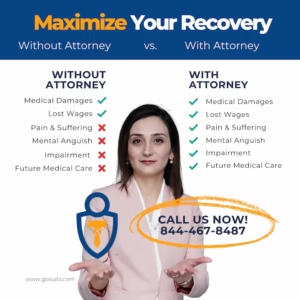
What you say to any insurance company can be used to minimize or deny your claim later. It is wise to contact an attorney first, before giving recorded statements or signing medical authorizations. A free consultation helps you understand your rights and your options without commitment.
Practical first steps in the first 7, 30, and 90 days
First 7 days
- Medical care first. Prioritize emergency care and follow up visits. Keep every discharge paper, imaging report, and prescription receipt.
- Preserve evidence. Save photos, clothing, vehicle contents, and any fragments or devices from the crash. Store them in a safe, dry place.
- Identify witnesses. Write down names, phone numbers, and any details you remember. If a good Samaritan helped, try to note their name or employer if known.
- Send preservation notices. Ask an attorney to send letters to preserve dash cam video, tollway cameras, patrol body cam footage, 911 audio, and commercial vehicle data.
- Get the CR-3 crash report. Order the report from TxDOT when available: TxDOT CRIS. If it is not ready yet, set a weekly reminder to check.
First 30 days
- Document injuries and limitations. Keep a journal of pain levels, mobility limits, and missed work. Photographs of visible injuries should include dates.
- Vehicle and property damage. Obtain repair estimates or total loss valuations. Save towing and storage receipts.
- Funeral and estate tasks. In a wrongful death, gather funeral bills, obituary costs, and estate paperwork. Request death certificates as needed.
- Avoid quick settlements. Do not accept early offers before the medical picture is clear. Early settlements can permanently close claims for less than full losses.
- Consult an attorney before speaking with insurers. Recorded statements can be used against you. Speak with counsel first to understand what must be provided and how.
First 90 days
- Specialists and second opinions. Complex injuries evolve. Follow referrals to specialists to document the full extent of harm.
- Assess UM or UIM coverage. If the wrong-way driver’s insurance is inadequate, explore underinsured motorist claims on your policy.
- Coordinate benefits. Track health insurance subrogation rights, short term disability claims, and any leave benefits.
- Plan for long-term needs. Consider therapy, vocational impacts, and future medical care when discussing case valuation.
Why wrong-way crashes are so deadly, and what agencies recommend
Head-on collisions are among the most lethal crashes on high speed divided highways. National transportation investigators have documented that wrong-way crashes frequently involve impaired driving and occur during nighttime hours, compounding risk with speed, limited visibility, and delayed recognition by oncoming drivers. The National Transportation Safety Board has highlighted the strong relationship between wrong-way events and high blood alcohol concentrations and has urged a mix of enforcement, education, and engineering countermeasures. See NTSB materials: NTSB press summary on wrong-way collisions.
On the engineering side, federal highway safety officials promote tools like lower mounted wrong-way signage, reflective delineators, wrong-way detection systems with alerts, and ramp design improvements. These are designed to catch a wrong-way entry early and warn both the driver and traffic management centers. See Federal Highway Administration guidance: FHWA wrong-way driving countermeasures.
In Texas, divided highways and toll roads are widely used, and agencies have deployed a combination of signage upgrades and targeted detection in higher risk zones. Although the Dallas North Tollway is a limited access facility, wrong-way entries can still occur at ramps or turnarounds. Video and rapid response from patrol units are crucial in the first minutes of an incident, especially when fire is present.
Local support and practical resources around North Dallas
When a Dallas truck accident or Dallas car accident causes severe injury or a wrongful death, families often need help from multiple institutions at once. Here is a practical roadmap tailored to this corridor of North Dallas.
- Hospitals and trauma care. Many serious crash victims in central and north Dallas receive care at major trauma centers in the county hospital system or nearby private hospitals. Keep every discharge instruction, billing statement, and itemized ledger for later insurance coordination.
- Funeral homes. Funeral directors can help request death certificates and may coordinate with the medical examiner for release of remains and certificates required for insurance benefits.
- Employers and schools. Request documentation of time missed from work or class, job duty modifications, and any short term disability paperwork.
- Law enforcement and tollway authorities. The investigating Texas DPS trooper number, incident number, and any tollway patrol reference will streamline records requests. Ask for the report number before leaving the scene, if possible, or call the non emergency line later with the date, time, and Royal Lane reference.
- Counseling and grief support. After a sudden loss, grief can be overwhelming. Dallas area counseling resources include nonprofit and faith based programs. If you need immediate support, talk with your primary care provider for a referral or seek local crisis lines.
If you are trying to track who to call first, start with the crash report and the medical examiner. The crash report anchors timelines and parties. The medical examiner’s report confirms cause of death and can be required by insurers. For video and 911 audio, follow Texas Public Information Act processes using the links above to request records from DPS and other agencies.
Community reflections from Royal Lane to LBJ Freeway
Anyone who drives the Dallas North Tollway regularly can picture the stretch near Royal Lane. The sun rises behind the skyline to the south, and heavy traffic blends with merging drivers from mid cities and northern suburbs. Overnight, the tone shifts to quieter lanes and long haul trucks finishing nocturnal routes. A wrong-way driver in that setting places everyone at risk within seconds.
The heroism shown by the Texas DPS corporal and the 18-wheeler driver resonates because North Texas values neighbors helping neighbors. Those few minutes, spent dragging injured passengers out and fighting back flames with handheld extinguishers, remind us how fragile and precious life is on our roadways. We honor the person who was lost and those still healing.
Commentary from Gosuits Dallas, Texas Personal Injury Attorney
First and foremost, our hearts are with the family who lost a loved one and with the survivors who endured a terrifying wrong-way crash near Royal Lane. The details described here are provided for general information and education, not as a substitute for specific legal guidance about any case.
From a civil injury perspective, a wrong-way head-on collision on a divided tollway often indicates clear fault with the wrong-way driver. That said, real cases turn on evidence. We look closely at the crash reconstruction, body cam and dash cam video, 911 timelines, vehicle event data recorders, and any available roadway or tollway camera footage. We also review whether impairment, fatigue, or a medical event played a role and whether additional parties contributed through negligent maintenance or other acts.
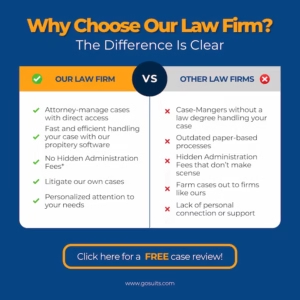
Insurance carriers and large corporations have playbooks designed to minimize payouts. Adjusters can appear helpful, but they collect statements that may later be used to reduce or deny claims. Quick settlement offers before the full medical picture is known are common in serious Dallas car accident cases. The paperwork may include broad medical releases, allowing insurers to comb through unrelated history to question causation. Before talking to any insurer or signing anything, it is prudent to have a free consultation with a skilled attorney who can explain rights and obligations in plain language.
A free consultation creates a space to understand coverage layers, deadlines, and the evidence needed to support a claim. It also helps prevent preventable missteps, like missing a limitations period or failing to preserve critical video from a patrol unit or tollway system.
Why acting now matters
Here is what should be done, and why timing matters.
- Secure the crash report. Ordering the CR-3 crash report from TxDOT is the foundation for insurance claims and estate paperwork. The sooner it is obtained, the sooner you can confirm parties, insurers, and next steps. If the report is not yet available, calendar weekly checks through the TxDOT CRIS portal.
- Preserve video and data. Patrol body cam, dash cam, 911 audio, tollway cameras, and commercial vehicle data can be overwritten under routine schedules. Sending a preservation request now increases the chance this evidence survives. Delays of even a few weeks can mean permanent loss.
- Document injuries and losses. Medical records, photos, wage loss documentation, and funeral invoices are critical. Creating an organized file early prevents gaps later and strengthens any claim evaluation.
- Consult an attorney before speaking with insurers. Early calls from adjusters often happen within days. Statements can be recorded and used later. A consultation before speaking to insurers helps clarify what must be disclosed and how to avoid misstatements.
- Track deadlines under Texas law. Many claims are subject to a two year statute of limitations, with some shorter notice requirements depending on the parties involved. Missing a deadline can end a claim regardless of merit. Acting now preserves options while the facts are still fresh. See: CPRC 16.003.
Taking these steps promptly helps protect rights, maintains crucial evidence, and positions any future claim on the strongest possible footing while memories and records are still accessible.
References and resources
- TxDOT Crash Records Information System
- Texas DPS open records
- Texas Public Information Act guidance from the Attorney General
- Texas Civil Practice and Remedies Code Chapter 71
- Texas CPRC 16.003
- Texas Alcoholic Beverage Code 2.02
- FHWA wrong-way driving countermeasures
- NTSB wrong-way driving press summary