- What We Know About the I-20 Shoulder Crash Near Spur 408 and Mountain Creek Parkway
- Roadside Assistance Work Is High Risk in Dallas County: Laws That Should Protect Workers
- Civil Liability After a Fatal Shoulder Collision: How a Wrongful Death Case Is Evaluated in Texas
- Key Records Families May Need and Where to Request Them in Dallas County
- Insurance Issues That Arise After Fatal Highway Collisions
- Practical Next Steps the Community Can Take Now
- Local Context: I-20 Corridor Safety Considerations Near Mountain Creek
- How a Seasoned Dallas Personal Injury Law Firm Analyzes Similar Cases
- Click to Action: Why Timely Action Matters Now
- Commentary from Gosuits Dallas, Texas Personal Injury Attorney
- References
What We Know About the I-20 Shoulder Crash Near Spur 408 and Mountain Creek Parkway
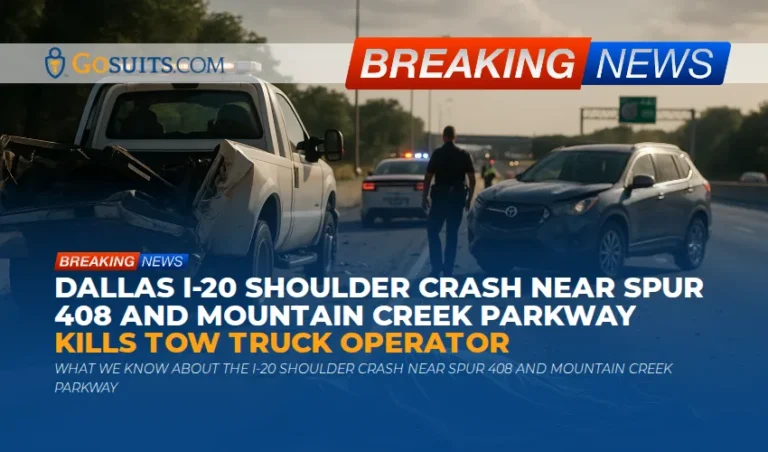
On a weekday afternoon along the westbound lanes of Interstate 20 near Spur 408 and Mountain Creek Parkway, a 67-year-old tow truck driver was assisting a motorist with a flat tire when tragedy struck. According to information shared by authorities, a silver SUV left its lane, swerved fully onto the shoulder, and hit both the tow truck and the operator. First responders arrived around 3:43 p.m., finding the tow operator unconscious with severe head injuries. He was transported to Methodist Central Hospital in critical condition and later died.
Deputies from the Dallas County Sheriff’s Office noted a report from a witness at a nearby gas station who saw the collision unfold. Investigators identified the driver as Selvin Omar Amador Morazan. He reportedly told deputies he briefly looked down after receiving a call from his wife and realized only upon looking back up that he had struck something. The affidavit indicates deputies observed red, glossy eyes and noticed a strong odor of alcohol from the back of the squad car; the driver reportedly admitted to having a single 12-ounce Michelada earlier that day. Authorities also noted he was en route to a shift at a Chicken Express in Grand Prairie. The Sheriff’s Office reported no prior DWI arrests for the driver.
For neighbors who drive this stretch regularly, the pinpointed location matters. The I-20 shoulder near Mountain Creek Parkway sits close to the Mountain Creek Lake corridor, where lane changes and high speed can converge with heavy afternoon traffic returning toward Duncanville, Grand Prairie, and Southwest Center Mall. It is a space where roadside assistance crews are especially vulnerable, even when fully on the shoulder.
Timeline and location details that matter in civil cases
In civil wrongful death and injury cases, details like time of day, lighting, weather, traffic density near Spur 408, and line-of-sight around any curves or ramps can become central. The time stamp around mid afternoon, visibility conditions, and the shoulder positioning described by the assisting motorist who was being helped all become part of the liability analysis. The affidavit language noting the truck was fully on the shoulder is also significant, because Texas’s Move Over or Slow Down law protects roadside workers and requires drivers to take specific safety actions when passing them [1].
Initial observations from deputies and witnesses
As described in the affidavit, the eyewitness account and deputies’ first observations will likely be supplemented later by crash reconstruction data, body camera footage when available, and measurements such as skid or yaw marks. Statements about distraction and potential impairment are noteworthy and often prompt parallel evidence collection like blood alcohol testing, phone records, and electronic data recorder pulls. Texas law defines intoxication in several ways, and the Penal Code includes intoxication manslaughter as a felony offense when a death results from intoxication while operating a motor vehicle [4]. While the criminal process will take its own path, those facts also inform the civil liability analysis.
Roadside Assistance Work Is High Risk in Dallas County: Laws That Should Protect Workers
Anyone who has changed a tire on I-20 knows how fast traffic moves and how narrow the margin is between safety and danger on the shoulder. For tow operators and roadside service professionals, the risk is constant and well documented in national and state safety data. Two legal frameworks are often front and center after crashes like this: Texas’s Move Over or Slow Down law and Texas’s restrictions on device use while driving.
Texas Move Over or Slow Down law applies to tow trucks
Texas Transportation Code section 545.157 requires drivers approaching certain stationary vehicles displaying authorized visual signals to either move over to a non-adjacent lane or slow down to a specific safe speed. Tow trucks with flashing amber lights are included. If a lane change is unsafe, the driver must reduce speed to at least 20 miles per hour below the posted limit, and to 5 mph when the posted limit is 25 mph or lower [1]. This law exists to protect people working on the shoulder. Evidence that a driver did not take these measures can be powerful in a civil negligence case.
Distracted driving and phone use
Texas law prohibits reading, writing, or sending electronic messages while driving and restricts handheld device use in specific situations. Even when a driver claims to have taken a quick glance at a phone or to have answered a call briefly, that momentary distraction can have catastrophic consequences at highway speeds [5]. NHTSA reports thousands of fatalities each year nationally related to distracted driving, underscoring the risk that even seconds of inattention pose to roadside workers and stranded motorists [2].

Impaired driving remains a leading factor in fatal crashes
NHTSA’s national data tracks alcohol-impaired driving deaths annually in the tens of thousands. Impairment can reduce reaction time, narrow the field of vision, and increase lane deviation risk, all of which heighten the chance of a shoulder intrusion that endangers roadside workers [3]. Whether and to what extent impairment is proven in any single case is a matter of evidence and testing. In civil court, a violation that causes harm can help establish negligence.
Civil Liability After a Fatal Shoulder Collision: How a Wrongful Death Case Is Evaluated in Texas
Texas law allows certain family members to bring a wrongful death action when a death is caused by a person’s wrongful act, neglect, carelessness, unskillfulness, or default. The estate may also pursue a survival action for damages the decedent could have claimed had they lived. Both are governed by Chapter 71 of the Texas Civil Practice and Remedies Code [8]. The facts emerging from the I-20 shoulder crash, as described by authorities, raise several civil-law questions.
How attorneys analyze duty, breach, causation, and damages
In a roadway shoulder crash, the injured party’s legal team typically evaluates:
- Duty: Every motorist owes a duty to operate with reasonable care and to follow safety statutes, including the Move Over or Slow Down rule when passing roadside workers [1].
- Breach: Evidence that a vehicle drifted onto the shoulder, failed to move over, or failed to slow sufficiently can indicate breach. Impairment or distracted driving, if supported by credible evidence, can reinforce that showing [2] [3] [5].
- Causation: The crash reconstruction links the breach to the fatal injuries. Skid marks, point of impact, vehicle damage profile, and wound mechanics help establish this.
- Damages: In wrongful death, damages may include loss of companionship and support for statutory beneficiaries; in a survival action, damages can include conscious pain and mental anguish and medical expenses incurred before death [8].
Who might be civilly responsible in a case like this
Without speculating about final outcomes in the I-20 crash, cases of this type commonly consider:
- The driver and vehicle owner: The at-fault driver’s legal responsibility is primary. If the vehicle was owned by someone else, the owner’s liability may depend on factors like permission and negligent entrustment.
- Third parties tied to alcohol service: In some cases, claims may explore whether a licensed provider served a patron who was obviously intoxicated and that service was a proximate cause of the crash. This is a highly fact-specific inquiry under Texas’s Dram Shop law and does not apply in every case [12].
- Employers: If the at-fault driver was acting in the course and scope of employment, vicarious liability and commercial coverage may be in play. The driver here reportedly said he was on his way to work, which is typically not in the course and scope, but each fact pattern is evaluated on its own.
Texas comparative fault and why it matters
Texas follows proportionate responsibility. A claimant barred from recovery if over 50 percent responsible is a critical rule in many collision cases. For a tow operator who was reportedly fully on the shoulder, the comparative fault evaluation would focus heavily on the encroaching vehicle’s actions and whether statutory protections for roadside workers were violated [1].
Key Records Families May Need and Where to Request Them in Dallas County
In the first weeks after a highway fatality, families often need to gather foundational documents to understand what happened and to protect their rights. Here are the records typically requested in Dallas County shoulder-collision cases on I-20 near Mountain Creek and Spur 408.
Official Texas crash report
Texas crash reports are maintained through the Texas Department of Transportation’s Crash Records Information System. Under Transportation Code 550.065, certain people and entities have access to the CR-3 report, including drivers, authorized representatives, and others with a proper interest [9]. These reports can be purchased through TxDOT’s online system [7]. The narrative, diagram, and contributing factor boxes can be pivotal in civil evaluations.

Autopsy and medical examiner information
In Dallas County, the medical examiner conducts death investigations where required by law. Texas law governing inquests and autopsies is found in the Code of Criminal Procedure, Chapter 49 [10]. While specific local procedures vary, next of kin can typically request certain autopsy records consistent with state law and any privacy exemptions. When questions arise about what is releasable, the Texas Public Information Act and Attorney General guidance provide the framework for access and exceptions [11].
911 calls, radio traffic, CAD logs, and body-worn camera
Emergency communications and body-worn camera footage may exist from the initial 3:43 p.m. response. These records are often subject to release rules that balance transparency with investigative needs. Families or their authorized representatives can use Texas’s open records process to request available items, with the understanding that some materials may be temporarily withheld if there is an active criminal investigation [11].
Vehicle black box data and private video
Modern vehicles often contain electronic control modules that log pre-impact speed, throttle, braking, and seatbelt status. In a shoulder-impact scenario, that data can corroborate whether a lane departure occurred and at what speeds. Nearby businesses such as gas stations by Mountain Creek Parkway may also have exterior camera footage. Preservation letters are time sensitive because many systems overwrite within days or weeks.
For a concise, Dallas-focused paperwork roadmap families can lean on while gathering records, this resource may help: Dallas wrongful death checklist for families.
Insurance Issues That Arise After Fatal Highway Collisions
Serious shoulder collisions tend to trigger multiple layers of insurance. Understanding how these interact is critical to avoid mistakes that can reduce available recovery. Before anyone engages an insurer to give a recorded statement or accepts a preliminary offer, it is prudent to consult with a qualified attorney in your area. What a person says to an insurance adjuster can be used against them later.
At-fault liability, UM/UIM, and PIP
- Liability coverage: The at-fault driver’s bodily injury liability policy is the first target of a civil claim. Policy limits vary.
- Uninsured and underinsured motorist coverage: If liability limits are insufficient, the decedent’s or the assisting motorist’s own UM/UIM coverage may apply, depending on policy terms and insured status at the time of the crash.
- Personal Injury Protection or MedPay: These first-party coverages can help with immediate medical expenses incurred before death, depending on policy elections.
When dealing with insurers, many families choose to work with car accident lawyers to coordinate claims, identify coverage gaps, and navigate subrogation issues without missing deadlines. Offering statements before understanding coverage and fault implications can complicate the claim process.
Employer coverage and benefits for a tow operator
Whether the tow operator was employed or contracted affects benefits and claims. Texas does not require private employers to carry workers’ compensation. When an employer is a subscriber, workers’ compensation benefits may be available; when a non-subscriber, different legal avenues may open, including negligence claims against the employer in certain circumstances. This is a nuanced area governed by the Texas Department of Insurance, Division of Workers’ Compensation [12].
Practical Next Steps the Community Can Take Now
In the Mountain Creek community and across Dallas County, many neighbors stop to help a stranded driver. If someone you know was involved in a similar incident, these steps can preserve important rights and evidence while the criminal process unfolds separately.
Within the first 7 days
- Preserve evidence immediately: Secure photographs of the scene, damage, and any tire marks on the shoulder or fog line. Ask nearby businesses near Spur 408 for exterior camera retention policies and request they save video.
- Request the crash report as soon as it is available: TxDOT’s online portal will host the official CR-3 when it is released [7] [9].
- Keep all medical and funeral documentation: These records support survival and wrongful death damages under Texas law [8].
- Avoid statements to insurers until counsel is consulted: Adjusters often call within days. Consider speaking with a qualified attorney first, because recorded statements can be used later to dispute liability.
Within the first 30 days
- Submit preservation requests: Ask the at-fault driver’s insurer and vehicle owner to preserve the vehicle and onboard data. Seek 911 audio, CAD logs, and any available body-worn camera through the Texas Public Information Act process [11].
- Document the family’s losses: Texas wrongful death law recognizes loss of companionship and support; begin journaling family impacts and gathering proof of the decedent’s household contributions [8].
- Review all applicable insurance policies: Identify liability, UM/UIM, and any life or accidental death benefits. Clarify deadlines and notice requirements.
Local Context: I-20 Corridor Safety Considerations Near Mountain Creek
Residents around Dallas Baptist University, Mountain Creek Lake, and the neighborhoods along Clark Road know the I-20 shoulder can feel unforgiving. Speed limits are high, traffic is dense during the afternoon, and entrance ramps around Spur 408 and Mountain Creek Parkway can funnel vehicles into short decision windows. At these speeds, a brief glance down at a phone or delay in moving over around a tow truck with flashing amber lights can produce a catastrophic outcome. Statewide data emphasizes how often Texans are hurt when drivers do not slow or shift lanes near roadside workers [6]. For local drivers, it is a reminder to scan the shoulder ahead, anticipate flashing amber lights, and start changing lanes early when you see a tow operator working.
How a Seasoned Dallas Personal Injury Law Firm Analyzes Similar Cases
When a case involves a fatal strike on the shoulder with a tow operator fully on the shoulder line, the analysis often begins with statutory duties. A review looks closely at whether the Move Over or Slow Down requirements were met, whether distraction or impairment was present, and what the vehicle’s pre-impact path shows on the roadway. In Dallas County, reconstruction may incorporate traffic camera data, on-ramp merge dynamics near Spur 408, and slope or curvature that could affect a driver’s line of travel. Families in North Texas frequently turn to Dallas car accident lawyers for help coordinating evidence preservation across agencies and insurers while they focus on immediate personal matters.
In addition to the core negligence questions, the inquiry often explores additional insurance layers or third-party responsibility. If there were indications of alcohol service, counsel may evaluate the Texas Dram Shop framework without assuming it applies in any given case [12]. If the tow operator was on duty, the status of the employer as a workers’ compensation subscriber or non-subscriber can change the mix of claims and available benefits. It is common for car accident lawyers to recommend that families avoid recorded insurer interviews until they understand the implications and potential coverage interplay.

Click to Action: Why Timely Action Matters Now
What should be done next? Begin a focused documentation and preservation plan. That typically means securing the official crash report when available, sending preservation notices for vehicle data and nearby video, and requesting public safety records that shed light on the traffic stop and emergency response timeline. It can also mean compiling family-impact documentation for a potential wrongful death claim under Texas law.
Why act promptly? Key records can be overwritten or lost quickly. Business surveillance near ramps such as Mountain Creek Parkway often retains only a short lookback window. Vehicle event data can be altered if a car is moved or repaired. Under Texas statutes, certain claims carry deadlines, and early steps can simplify insurance coordination and help prevent coverage disputes later [8] [9].
What outcome can timely steps support? Acting now helps preserve objective evidence that clarifies lane position, speed, and driver behavior in the moments before impact. It positions a family or claim representative to navigate communications with multiple insurers effectively and reduces the risk that avoidable gaps in proof will undermine a legitimate claim. Educating oneself about rights before speaking with adjusters can prevent inadvertent statements that complicate the process.
Commentary from Gosuits Dallas, Texas Personal Injury Attorney
First and foremost, our hearts go out to the tow operator’s loved ones and to the motorist he was helping. Serving a stranded driver on the shoulder of I-20 is a selfless act that keeps our neighbors safe. This article is meant for general information and community education.
From a civil-law perspective, a scenario where a vehicle swerves onto the shoulder and strikes a roadside worker invites close scrutiny of two issues: compliance with Texas’s Move Over or Slow Down requirements and any impairment or distraction that may have contributed. Reports that the tow truck was fully on the shoulder and that the driver looked down just before impact raise serious safety concerns that are sadly familiar on our high-speed corridors.
It is also important to understand how insurance companies and large corporate entities can use information asymmetry to their advantage. Adjusters sometimes contact families very quickly, seeking recorded statements or proposing early resolutions before the full scope of harms and legal rights are clear. They may rely on partial records or provisional police notations and press for admissions that later limit recovery. Corporations and insurers know this is a difficult time and may move fast while crucial evidence like roadside video or vehicle data remains uncollected.
This is why obtaining a free consultation matters. A conversation with a skilled North Texas injury firm can help a family understand which records to request, what to avoid saying to insurers, and how to preserve the data that tells the true story of what happened on the shoulder of I-20. It does not commit anyone to a path, but it levels the playing field at a moment when choices have long-term consequences.
References
- Texas Transportation Code 545.157 Move Over or Slow Down – Texas Legislature Online
- Distracted Driving – National Highway Traffic Safety Administration
- Alcohol-Impaired Driving – National Highway Traffic Safety Administration
- Texas Penal Code 49.08 Intoxication Manslaughter – Texas Legislature Online
- Texas Transportation Code 545.4251 Use of Portable Wireless Communication Device – Texas Legislature Online
- Move Over or Slow Down Campaign and Work Zone Safety – Texas Department of Transportation
- Crash Reports and Records – Texas Department of Transportation
- Texas Civil Practice and Remedies Code Chapter 71 Wrongful Death and Survival – Texas Legislature Online
- Texas Transportation Code 550.065 Release of Accident Reports – Texas Legislature Online
- Texas Code of Criminal Procedure Chapter 49 Inquests Upon Dead Bodies – Texas Legislature Online
- Texas Public Information Act – Office of the Attorney General of Texas
- Workers’ Compensation for Employers and Non-subscribers – Texas Department of Insurance, Division of Workers’ Compensation
- Emergency Responders and Roadside Safety – Occupational Safety and Health Administration