- What we know right now in North Texas
- Cold fronts, wet roads, and injury risks around Dallas–Fort Worth
- Slips, trips, and falls in stores and parking lots
- Major developments and construction safety across Dallas and nearby suburbs
- Work zone traffic crashes and how liability may be evaluated
- Where to get police reports, autopsy information, and official records
- Legal rights after an injury in Texas: timelines and public-entity notice rules
- Insurance considerations and common pitfalls
- How to preserve evidence after a serious injury
- Who can be held responsible in these scenarios
- Official sources and weather/road safety data
- Commentary from Gosuits Dallas, Texas Personal Injury Attorney
- Why acting promptly matters
What we know right now in North Texas
Local headlines in Dallas–Fort Worth are centered on three very different developments: a state-level legal dispute over a proposed “Epic City” development, a returning cold front with rain potential, and the long-anticipated approval for a new H‑E‑B location in the Dallas city limits. While none of these are injury events by themselves, they touch real, everyday safety concerns for people navigating our roads, sidewalks, and stores this week.
Across central Dallas and its surrounding communities like Oak Cliff, Lake Highlands, Far North Dallas, and East Dallas—plus neighboring cities along US‑75, I‑35E, I‑30, the Dallas North Tollway, and LBJ Freeway—cold rain and wind can quickly turn routine errands into riskier trips. Shoppers heading to existing grocers in places like Frisco, Plano, or Lakewood are likely to see crowded parking lots, slick walkways, and more delivery truck activity in advance of weekend crowds. And on the development front, when large projects are being planned or built, work zones, lane shifts, truck traffic, and sidewalk closures can increase the chance of crashes or falls if not well managed.
If you live near Klyde Warren Park, Deep Ellum, Bishop Arts, or Preston Hollow, you’ve probably felt the quick swings in North Texas weather. Those swings carry legal implications after an injury, particularly around what property owners, contractors, and public agencies are required to do to reduce foreseeable hazards. This article explains those issues in plain language and points to official places to obtain reports and records that can help families piece together what happened after a serious incident.
Cold fronts, wet roads, and injury risks around Dallas–Fort Worth
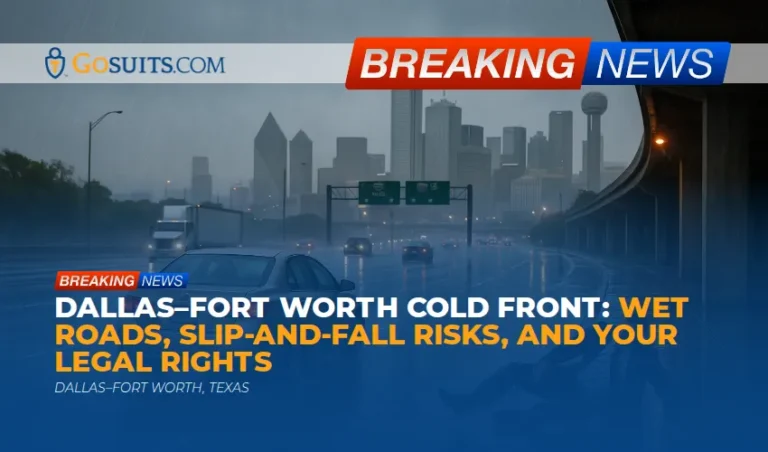
Cold fronts in North Texas rarely arrive quietly. We often see fast temperature drops, gusty winds, and bands of drizzle or steady rain. On I‑635 near the High Five, on Woodall Rodgers, or on Central Expressway, a little rain can mix with oil residue, creating slick pavement. On surface streets near schools or shopping centers, braking distances lengthen and visibility drops just as foot traffic rises.
National analyses show that a significant share of crashes each year are weather-related, particularly during precipitation and on wet pavement. The Federal Highway Administration notes that wet pavement and rainfall are leading contributors to weather-related crashes, injuries, and fatalities across the nation. Localized hazards in Dallas—puddling in low spots, poor drainage where construction narrows lanes, and limited lighting under overpasses—can compound the risk.
In practical terms, that can mean:
- Longer stopping distances on I‑30 near downtown, the Canyon on I‑35E, and along the S‑curves by Fair Park.
- Reduced lane traction on elevated ramps like the High Five and the Mixmaster interchanges.
- Visibility issues near Love Field and along Lemmon Avenue as rain and spray obscure brake lights.
- Pedestrian slip risks at light-rail stations and crosswalks around West End and Mockingbird Station.
North Texans rely on official forecasts from the National Weather Service’s Fort Worth office for storm timing, temperature drops, and roadway advisories. Before heading out, especially at night, checking current forecasts and radar can inform safer choices about routes and timing.
Official resource: National Weather Service Fort Worth.
Slips, trips, and falls in stores and parking lots
When a new grocery location is approved or an existing store sees heavy traffic, the duty of the business to maintain reasonably safe premises becomes central. On rainy days in Dallas neighborhoods like Lakewood, Vickery Meadow, or Oak Cliff, the entry mats, vestibule tiles, and curb ramps can become slick. Parking lots fill quickly, and traffic patterns can change with temporary cones or re-striping.
In Texas, a business that invites the public in typically owes a duty to exercise reasonable care to protect invitees from known or reasonably knowable hazards. While every case turns on its facts, common questions after an injury in a store or parking lot include:
- Did the owner or manager know, or should they have known, about the hazard? For example, recurring water accumulation at the entrance or a leaking refrigeration unit near produce.
- Were reasonable steps taken to reduce or warn about the risk? This might include absorbent mats, non-skid surfaces, frequent inspection logs, visible signage, and staff assigned to spot hazards during storms.
- Was lighting adequate in the lot, on stairs, and at curb ramps, especially at dusk or in heavy rain?
- Were cart corrals, speed bumps, and pedestrian paths clearly marked to separate walkers from vehicle flow near the storefront?
Falls can cause serious harm, particularly for older adults and those with prior injuries. National public health guidance underscores the severity of fall-related injuries in general, which can include fractures, serious head injuries, and long-term mobility impacts.
Official resource: CDC: Falls – Home and Recreational Safety.

Major developments and construction safety across Dallas and nearby suburbs
Large-scale developments in North Texas—from Uptown towers to suburban mixed-use campuses—are often built over many months, sometimes years. During these periods, conditions can change daily: new fencing lines, sidewalk closures, uneven temporary surfaces, and deliveries by large trucks backing across public rights-of-way near pedestrian routes. In high-activity corridors like the Design District or the Medical District, these interactions can be complex.
Key safety practices that are commonly expected in active construction areas include:
- Clear pedestrian detours with stable walking surfaces and curb ramps compliant with accessibility standards.
- Visible barricades and tape that remain intact during wind and rain events.
- Lighting adequate for early morning and evening hours when crews start before dawn or wrap up after sunset.
- Traffic control plans for lane closures and flagging when trucks enter and exit job sites onto roads like Harry Hines Boulevard, Greenville Avenue, or Mockingbird Lane.
For workers, the Occupational Safety and Health Administration provides national standards for construction safety. While OSHA standards apply primarily to workplace safety, patterns of jobsite control and hazard mitigation can also shape how risk spills over into public areas when a site borders sidewalks, bus stops, or bike lanes.
Official resource: OSHA: Construction.
Work zone traffic crashes and how liability may be evaluated
When public streets are affected by construction—whether city-led, TxDOT-managed, or utility work—drivers pass through temporary configurations that can be confusing, especially at night or in wet conditions. Missing cones, misaligned arrow boards, abrupt lane drops, or poorly placed steel plates can all contribute to crashes on roads like I‑35E through the Dallas Horseshoe, US‑75 through North Dallas, or SH‑183 toward Irving.
Injury cases in work zones often turn on the details:
- Was the layout consistent with an approved traffic control plan? Documentation matters, including daily logs and certified plans.
- Were signs and devices compliant with standards and maintained as conditions changed?
- Did weather require additional precautions? For instance, covering or removing conflicting signs during off-hours, or adding advance warning during rain and low visibility.
TxDOT emphasizes work zone safety statewide, urging drivers to slow down and be alert, and reminding contractors about proper traffic control practices. That messaging reflects a broader duty to minimize foreseeable risks in changing roadway environments.
Official resource: TxDOT: Work Zone Safety.
Where to get police reports, autopsy information, and official records
After a serious injury or fatal crash in Dallas, official records help families and representatives understand what happened. Here are public sources and what they typically provide:
Police crash reports and crash data in Texas
Crash reports for incidents investigated by law enforcement in Texas are maintained at the state level. In many cases, these are requested through the Texas Department of Public Safety’s Crash Records section. These reports include the basic facts of the crash, involved vehicles, weather and roadway conditions as recorded by the officer, and preliminary contributing factors.
- Texas DPS Crash Records: request and information page at dps.texas.gov/section/crash-records.
Some crashes in city limits may also generate supplemental documents through municipal police records divisions. Public access is governed by the Texas Public Information Act. Even when certain details are redacted by law, individuals can request the portions that are public.
- Public Information Act overview: Texas Attorney General: What information is public.

Autopsy and inquest information in Texas
In Texas, the process for investigating certain deaths is governed by state law. Depending on the county, cases may be handled by a medical examiner’s office or by a justice of the peace through an inquest. Families can generally request information about the existence of an autopsy and, in many cases, obtain reports subject to statutory exceptions and timelines.
- Texas Code of Criminal Procedure, Inquests: statutes.capitol.texas.gov/Docs/CR/htm/CR.49.htm.
Certified death certificates are obtained through the Texas Department of State Health Services. These documents can be essential for estate matters, insurance claims, and benefits.
- Texas death records (state vital statistics): dshs.texas.gov/vital-statistics/death-records.
Legal rights after an injury in Texas: timelines and public-entity notice rules
Texas law sets deadlines for filing civil injury claims, and shorter deadlines can apply when a governmental unit is involved. Missing a deadline can close the door on a claim, even when the harm is severe.
- General civil limitations period: Many personal injury claims in Texas have a two-year statute of limitations measured from the date of the incident. There are exceptions and special rules, but two years is the common benchmark.
- Claims against governmental units: The Texas Tort Claims Act requires timely notice to the governmental unit when an injury arises from conditions or operations covered under the Act. State law sets a default notice deadline of six months, and some local charters shorten that time. The safest practice is to treat these as urgent matters.
Official statute: Texas Civil Practice and Remedies Code Chapter 101 (Texas Tort Claims Act).
Texas law also addresses specific roadway duties. For example, the Move Over/Slow Down requirement for passing certain stopped vehicles on the roadside aims to reduce collisions with emergency and service personnel. While not directly about civil claims, transportation statutes can be part of the factual analysis after a crash.
Official statute: Transportation Code §545.157.
Insurance considerations and common pitfalls
Insurance coverage after an injury can involve multiple layers. In a rainy-day crash on I‑35E, policies might include the at‑fault driver’s liability coverage, your own uninsured/underinsured motorist policy, and personal injury protection if you carry it. In a slip-and-fall at a grocery store, commercial general liability and potentially excess coverage could be involved. With construction-related injuries, policy questions can expand further to contractors, subcontractors, and project owners.
Common pitfalls include:
- Recorded statements too soon: What’s said to an insurer can be used later to dispute fault or minimize injuries. It’s generally wise to speak with an attorney first to understand rights and obligations.
- Incomplete medical documentation: Gaps in care or missing follow-ups can be cited as reasons to undervalue claims.
- Overlooking additional coverage: Umbrella policies, permissive-use coverage, or contractor endorsements can change the available limits.
In Texas, statements to insurance companies are taken seriously, and early negotiation can shape how a case unfolds. Understanding policy language and the evidence necessary to substantiate a claim can help avoid costly mistakes.
How to preserve evidence after a serious injury
Evidence can fade fast—sometimes literally in the rain. Quick steps make a difference:
- Photograph the scene from multiple angles, capturing lighting, wet surfaces, traffic control devices, and any warning signs present or absent.
- Secure names and contacts for witnesses who saw the fall, the lane shift, or the near-miss just before the crash.
- Document conditions over time, especially with weather: initial puddling, increasing rain, changes in signage or cones, and the timing of clean-up.
- Preserve footwear and clothing from a fall event to prevent spoliation arguments about traction and condition.
- Request surveillance footage promptly; many systems overwrite within days.
- Seek medical evaluation quickly; contemporaneous records help link injuries to the event.
If a public entity may be involved—such as a city-managed street, a county facility, or a state highway—note the claim notice requirements described above. Those timelines can be much shorter than the general statute of limitations, and formal notice often must include specific information and be sent to the correct official address.
Who can be held responsible in these scenarios
Responsibility depends on the facts, but typical categories include:
- Private property owners and managers for hazards inside stores, on sidewalks they control, and in lots they maintain.
- Contractors and subcontractors for creating or failing to mitigate jobsite and public-interface hazards.
- Third-party vendors like cleaning crews, snow/ice treatment companies in rare winter events, or traffic control subcontractors.
- Drivers and their employers in delivery or commercial vehicle crashes related to construction or retail operations.
- Governmental units in specific, statutorily allowed situations, such as certain premises defects or vehicle operation claims under the Texas Tort Claims Act.
Determining which parties bear legal responsibility often requires gathering contracts, maintenance logs, incident reports, and insurance disclosures—especially when large developments or multi-tenant retail centers are involved.
Official sources and weather/road safety data
When conditions shift in Dallas and across North Texas, reliable public data and guidance can help frame both safety decisions and the post-incident fact-finding process:
- National Weather Service Fort Worth: weather.gov/fwd for local forecasts and advisories.
- FHWA Weather-Related Crash Statistics: ops.fhwa.dot.gov/weather/q1_roadimpact.htm for national context on wet-weather crashes.
- TxDOT Work Zone Safety: txdot.gov/safety/share-the-road/work-zone.html.
- Texas DPS Crash Records: dps.texas.gov/section/crash-records for crash reports.
- Texas Tort Claims Act: statutes.capitol.texas.gov/Docs/CP/htm/CP.101.htm.
- Texas Transportation Code §545.157 (Move Over/Slow Down): statutes.capitol.texas.gov/Docs/TN/htm/TN.545.htm#545.157.
- Texas Public Information Act overview: texasattorneygeneral.gov/open-government/members-public/what-information-public.
- Texas inquest statute (autopsies/inquests): statutes.capitol.texas.gov/Docs/CR/htm/CR.49.htm.
- Texas DSHS death records: dshs.texas.gov/vital-statistics/death-records.
- NHTSA winter driving guidance: nhtsa.gov/winter-driving-safety.
- CDC fall injury guidance: cdc.gov/homeandrecreationalsafety/falls/index.html.

Commentary from Gosuits Dallas, Texas Personal Injury Attorney
Our thoughts are with everyone navigating the coming cold front and the bustle of Dallas shopping areas this week. This article is for educational purposes and general information. It isn’t a substitute for legal guidance on any particular situation.
From a civil injury standpoint, weather and development stories like these are reminders. Rain doesn’t cancel the duty to act reasonably. Property owners still need to inspect and address hazards that are predictable in wet conditions. Contractors still need to maintain safe work zones as conditions change. And drivers still need to slow down and leave room, especially around crowded retail corridors and lane closures near big projects.
Insurance companies and large corporations understand how these cases are built. They move quickly to secure their own evidence, shape the narrative, and sometimes collect statements that minimize responsibility. Without a clear understanding of rights and the standards that apply in Texas, injured people can feel pressured into early decisions that don’t reflect the full picture.
A no-cost consultation can help clarify responsibilities, identify the right parties, and outline time-sensitive steps like preserving footage and meeting notice requirements when public entities are involved. Even a short conversation can keep someone from saying something to an insurer that’s later used to undermine a valid claim.
Why acting promptly matters
Here’s what should be done after a weather-related crash, a fall in a store or parking lot, or an injury connected to a construction area:
- Document conditions immediately with photos, video, and witness contacts. Weather changes quickly in North Texas, and work zones can look different by morning.
- Request official records early including police crash reports and, where applicable, incident reports. Public records requests take time.
- Preserve surveillance footage by sending written preservation requests to businesses or contractors that may have cameras. Many systems auto-delete within days.
- Seek a medical evaluation to create a clear link between the event and injuries, especially with head, neck, and back symptoms that can worsen over days.
- Review insurance coverage carefully before giving any recorded statement. What’s said can be used later.
- Calendar legal deadlines, including shorter notice requirements for governmental entities under the Texas Tort Claims Act. The default six-month notice window and potential shorter local deadlines make early action critical.
The benefit of acting now is preserving the strongest evidence during a window when conditions still reflect what happened. It also protects access to claims that have strict timelines—particularly those involving public property or vehicles—and gives space to plan medical care without pressure to accept quick, incomplete resolutions.