- What we know so far
- Location context on the Far South Side
- Official sources and where families can get records
- Why rollover crashes are so dangerous
- Civil liability overview in Illinois
- Insurance and claims considerations
- Immediate practical steps for those affected
- Traffic impacts and detours near 111th and 115th
- Data snapshot on severe crashes in Illinois
- Why timely action matters after a serious crash
- Commentary from Gosuits Chicago, Illinois Personal Injury Attorney
- References and resources
What we know so far
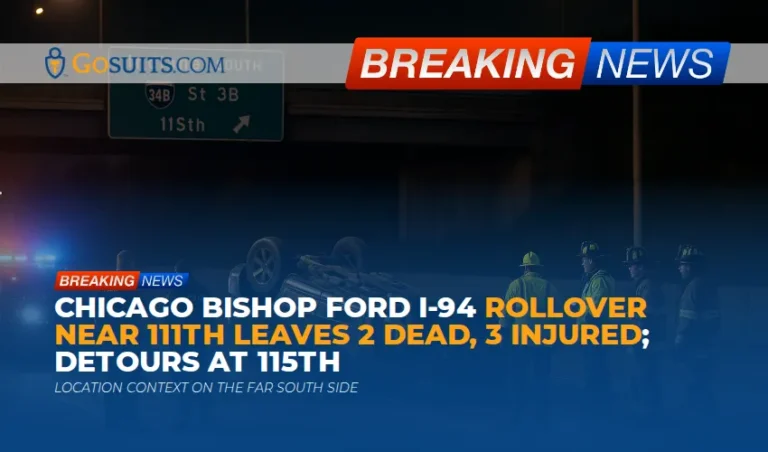
Early Thursday morning, a vehicle rolled over on the inbound Bishop Ford Expressway on Chicago’s Far South Side. The incident occurred around 1:15 a.m. near 111th Street, according to Illinois State Police. Two occupants were pronounced dead at the scene, and three others were taken to area hospitals with injuries. All northbound lanes remained shut down after the crash, with traffic diverted at 115th Street while state police managed the scene and conducted the preliminary investigation. Further official details were not immediately available.
When a crash like this closes a major interstate before dawn, it affects more than a single block or neighborhood. The Bishop Ford carries overnight freight, early-morning commuters, and essential workers who rely on that route to reach the Dan Ryan. Closures near 111th ripple through Roseland, Pullman, West Pullman, and Riverdale, especially when detours push drivers onto local surface streets.
Location context on the Far South Side
The Bishop Ford Expressway, part of I-94, runs through the Far South Side and connects communities from the Calumet area toward the Dan Ryan. The vicinity of 111th Street places the crash near the Pullman and Roseland communities. For many residents, the nearest on-and-off ramps in this stretch can be spaced farther apart than on neighborhood arterials, so when traffic is diverted at 115th Street, congestion often builds quickly on Michigan Avenue, Halsted Street, and Cottage Grove Avenue. Morning delays can extend up toward 103rd and 95th, particularly as inbound drivers merge toward the Red Line 95th/Dan Ryan Transit Center.
Locals know the Bishop Ford can be unforgiving in the early hours. Lighting changes, fast-moving traffic, and occasional debris or disabled vehicles can create sudden hazards. Add to that the mix of commercial trucks, personal vehicles, and overnight construction zones that pop up between 111th and the I-57 split, and you have conditions where a single loss of control can lead to a rollover with devastating consequences.
Official sources and where families can get records
Families and loved ones often need to gather official records soon after a fatal crash. Those documents can answer urgent questions and are also necessary for insurance claims and any civil case that may follow. Here are the primary local and state sources to know:
Illinois State Police crash reports
Illinois State Police typically handle investigations on Illinois interstates, including the Bishop Ford. Families can seek the official crash report, supplemental narratives, and, when available, photographs. The Illinois State Police maintain public records processes for crash report access and related documentation. Start by consulting the Illinois State Police crash report and records information, which outlines how and when reports can be requested [1].
Cook County Medical Examiner for autopsy and cause-of-death records
In Cook County, autopsies and postmortem examinations are handled by the Cook County Medical Examiner. Next of kin can request autopsy reports, toxicology, and related records through the Medical Examiner’s office. Their official pages explain eligibility, processing times, and fees for certified copies [2].
Death certificates through the Cook County Clerk
Certified death certificates for a decedent are issued by the Cook County Clerk’s Office. These records are commonly required by life insurers and for estate matters. The Clerk provides instructions on eligibility, identification requirements, and how to order online, by mail, or in person [3].
Road closure and detour updates
For ongoing updates after major incidents, the Illinois Department of Transportation posts road and travel information including closures, detours, and construction advisories. The IDOT travel information hub is the reliable starting point when checking highway status on I-94 and adjacent interstates [4].
City of Chicago emergency updates
The City of Chicago’s Office of Emergency Management and Communications provides public safety updates, including roadway incidents that can spill onto local streets during interstate closures. During extended diversions at 115th Street, OEMC alerts can help the public navigate safely around the area [5].

Why rollover crashes are so dangerous
Rollover crashes, even at urban interstate speeds, pose unique, severe risks. Vehicles can flip when they trip against a barrier or curb, overcorrect after a drift, or lose stability during abrupt maneuvers. The result is often roof intrusion, multiple impact points, and a higher chance of ejection if occupants are unrestrained.
National highway safety agencies note that rollovers are relatively rare compared with other crash types, but they account for a disproportionate share of serious injuries and deaths. Ejection risk, head and neck trauma, and crushing injuries all rise when a vehicle overturns. The National Highway Traffic Safety Administration provides public safety guidance on rollover dynamics and occupant protection, emphasizing how seat belt use dramatically reduces the risk of ejection and fatal injury [6].
Investigators look at several factors in rollovers, including pre-impact speed estimates, steering input, road design, barrier condition, tire failure, and potential influence of substances or fatigue. Event data recorders, when available, can preserve seconds of data on speed, braking, and steering that help reconstruct what happened. In Chicago’s Far South Side corridors, long curves, entrance ramp merges, and occasional construction staging can also influence a loss of control. Objectively documenting these conditions is essential for a fair evaluation.
Civil liability overview in Illinois
From a civil perspective, liability in a single-vehicle rollover is not always straightforward. Potential fault questions include the conduct of the driver, the condition of the roadway, the presence and design of guardrails or barriers, and whether any third party contributed to a sudden emergency, such as debris from a poorly secured load. Illinois applies comparative fault principles, which can affect recovery depending on how fault is apportioned among the parties involved.
When a crash results in loss of life, the Illinois Wrongful Death Act allows the decedent’s personal representative to bring a claim for the benefit of eligible survivors. This statute addresses recoverable damages for the surviving family in a civil case. The current law and its framework are published by the Illinois General Assembly [6] [7]. Related claims may also be brought under the Illinois Survival Act, which focuses on damages for the decedent’s injuries measured from the event until death [8]. How these claims interact depends on the facts, including timing, medical evidence, and the parties potentially at fault.
In serious cases, it is not unusual for families to consult with Chicago car accident lawyers to understand these overlapping legal pathways, evidence requirements, and the sequence of filings. Conversations like these help families evaluate whether roadway conditions, vehicle defects, or other factors could have played a role, alongside driver-related issues. No two rollovers are the same, and a careful, fact-based review is key.
Insurance and claims considerations
Insurance issues become complex after a fatal interstate crash. Multiple policies can be in play, including the vehicle’s liability coverage, possible umbrella coverage, underinsured or uninsured motorist coverage for injured passengers, and health insurance liens. If there is any suspicion of a phantom vehicle or a non-contact trigger, uninsured motorist coverage can be critical. Statements to insurers should be approached with care, since offhand comments can be taken out of context and used to dispute liability or damages later.
Before calling any insurance company, it is wise to speak with seasoned car accident lawyers for a free consultation about rights, coverage interactions, and risks. Anything said to an insurance adjuster can be recorded and may be used to minimize or deny a claim later on. A prompt legal review can help preserve critical evidence, from vehicle black box data to 911 audio and traffic camera footage, and ensure communications to insurers are accurate and protective of the family’s interests.
Immediate practical steps for those affected
When communities on the Far South Side wake up to news of a deadly crash near 111th Street, families and friends want to help but often do not know where to start. The following steps can guide those seeking information or preparing necessary paperwork:
- Confirm location and agency: If the crash occurred on the Bishop Ford Expressway, Illinois State Police typically handle the investigation. Note the date and approximate time, location near 111th Street, and the inbound direction for reference when requesting records [1].
- Request official crash documentation: The ISP crash report and any supplemental materials form the foundation for insurance claims and later civil filings. Follow the Illinois State Police guidance for obtaining crash records, and save copies of any correspondence [1].
- Obtain medical examiner records: Next of kin can obtain autopsy reports, cause-of-death records, and, when complete, toxicology from the Cook County Medical Examiner. Review eligibility and fees before submitting a request [2].
- Order certified death certificates: Life insurance claims and estate matters require certified death certificates from the Cook County Clerk. Review identification and ordering methods ahead of time [3].
- Track closure and detour information: IDOT posts travel and roadway updates for I-94. If family members need to visit the area for vehicle retrieval or personal effects, check official updates before heading out [4].
- Document what you know: Write down the timeline of calls or notifications received, any hospital names shared by responders, and the case or incident number if one was provided at the scene or by police dispatch.
- Preserve digital evidence: Save texts, dashcam clips, and photos related to the crash or its aftermath. Ask nearby friends or businesses along 111th and 115th if exterior cameras captured traffic around the time of the rollover. Municipal cameras and 911 audio may be subject to retention schedules, so time is of the essence.
- Get oriented to next steps: For a plain-language walkthrough on organizing immediate tasks after a serious wreck, see our internal guide, what to do after a car accident in chicago.
Traffic impacts and detours near 111th and 115th
With all inbound lanes shut down and diversions at 115th Street, drivers often spill onto South Michigan Avenue, South Halsted Street, and other neighborhood corridors. That can create stop-and-go pockets around Roseland and Pullman during the early commute. IDOT’s roadway information hub is the official resource for when lanes reopen or if temporary restrictions remain in place for scene reconstruction work [4]. The City of Chicago OEMC can also issue alerts when a highway closure affects city streets and transit hubs, particularly around the 95th/Dan Ryan transit center [5].
If you must pass through the area on a weekday morning, plan for extra time, watch for pedestrians near bus stops, and anticipate driver frustration as traffic re-enters the expressway. Construction staging or cleanup along the shoulder can briefly narrow lanes even after travel resumes, so stay alert for cones, flashing arrows, and courtesy patrol vehicles.
Data snapshot on severe crashes in Illinois
While single-vehicle rollovers are not the most common crash type, their outcomes are often tragic. Public safety data show how serious the consequences can be statewide:
- Rollover severity: National data indicate that rollovers account for a smaller share of total crashes but a higher share of fatalities, due in part to ejection risk and roof intrusion. NHTSA’s public resources emphasize seat belt use and vehicle stability as key protective factors [6].
- Statewide fatality tracking: The Fatality Analysis Reporting System (FARS) is a national census of fatal motor vehicle crashes. It offers state-level trend insights and can help contextualize severe incidents on Illinois interstates like I-94 [9].
- Illinois crash facts: IDOT publishes Illinois crash facts and statistics, including annual summaries on roadway fatalities, injury counts, and contributing factors. These statewide figures help communities understand the scale and patterns of serious crashes each year [10].
- Trauma system readiness: The Illinois Department of Public Health maintains a directory of designated trauma centers across the state, including Level I centers that receive the most severe cases. Facilities on the South Side and nearby suburbs play a crucial role in treating high-acuity injuries from interstate crashes [11].
Behind each data point is a family, a neighborhood, and a community team of responders. The numbers are only meaningful if they help drive safer design, better enforcement, and quicker access to care.
Why timely action matters after a serious crash
Here is what should happen next and why it matters:
- Secure official records promptly: Crash reports, autopsy files, and death certificates form the backbone of any insurance claim or civil filing. Requests take time to process, and delays can slow everything from funeral arrangements to benefits claims. Filing early preserves your place in line with each agency [1] [2] [3].
- Protect evidence while it exists: Vehicle data, roadway debris, 911 audio, and nearby surveillance footage can be overwritten or discarded. Early action increases the chances of capturing information that might explain how a rollover occurred and whether other factors played a role.
- Understand legal timelines: Illinois law sets time limits for bringing civil claims, including wrongful death and survival actions. Learning about these windows early can help avoid last-minute filings and the risk of missing a deadline. The Illinois statutes are publicly available for review through the legislature’s website [7] [8].
- Avoid claim missteps: Insurer questionnaires and recorded statements can lock in incomplete details that later get used against a claim. A short legal consult before contacting carriers can help prevent unforced errors and clarify which coverages may apply.
- Plan for long-term needs: In cases with serious injuries, families should anticipate future medical care, therapy, and wage loss issues. Getting oriented early helps capture documentation that supports those needs and prevents gaps in the record.
When in doubt, slow down, note what you need, and choose the next concrete step. Support is available across agencies and community institutions, and many processes are explained on public websites for a reason, to help people navigate hard moments with clarity.

Commentary from Gosuits Chicago, Illinois Personal Injury Attorney
Our hearts are with everyone affected by the rollover near 111th Street. Two lives lost is a profound tragedy for the Far South Side, and we offer sincere condolences to the families and friends who are grieving. Please know this article is intended for educational purposes and general information. It is not a substitute for personalized guidance on any specific case.
From a civil-law perspective, a single-vehicle rollover does not automatically answer the liability question. Investigations should examine roadway conditions, barrier performance, potential debris or non-contact triggers, vehicle systems, and the full timeline leading up to the overturn. Preserving vehicle data and identifying third-party footage can be especially important on expressways like the Bishop Ford. If a non-obvious factor contributed, families deserve a fair chance to discover it.
Insurance carriers and large institutions often move quickly to shape the narrative. They may request recorded statements early, press for medical authorizations broader than necessary, or narrow the scope of applicable coverage. These tactics leverage unfamiliar rules and timelines. That is why it is so important to speak with a skilled advocate before giving statements or signing releases. A brief, no-cost consultation helps people understand their rights, the order of operations, and the risks that come with going it alone. Even simple choices can have lasting consequences in a fatal crash case, including how and when to pursue claims under the Illinois Wrongful Death Act and the Survival Act [7] [8].
One final note. Community members often step up with tips and evidence. If you witnessed the crash or captured video around 1:15 a.m. near 111th or the 115th Street diversion, know that your information can matter in ways you might not expect. Responsible sharing through the proper channels helps ensure the record is complete and that families have the answers they seek.
References and resources
- Illinois State Police, Crash Reports and Records Access
- Cook County Medical Examiner, Records and Services
- Cook County Clerk, Death Certificates
- Illinois Department of Transportation, Roadway Information
- City of Chicago, Office of Emergency Management and Communications
- National Highway Traffic Safety Administration, Rollover Safety
- Illinois Wrongful Death Act, 740 ILCS 180
- Illinois Survival Act, 755 ILCS 5/27-6
- NHTSA, Fatality Analysis Reporting System
- IDOT, Illinois Crash Facts and Statistics
- Illinois Department of Public Health, Trauma Centers