- What we know about the I-10 crash near Bob Hope Drive
- Local scene context in Cathedral City and the I-10 corridor
- Weather and roadway factors: standing water and early-morning risk
- Official investigations and records to request
- California civil law context after a fatal highway collision
- Practical steps for affected families and witnesses
- Safety considerations for Coachella Valley drivers
- What happens next in the investigation
- Why acting quickly matters
- References
- Commentary from Gosuits Cathedral City, California Personal Injury Attorney
What we know about the I-10 crash near Bob Hope Drive
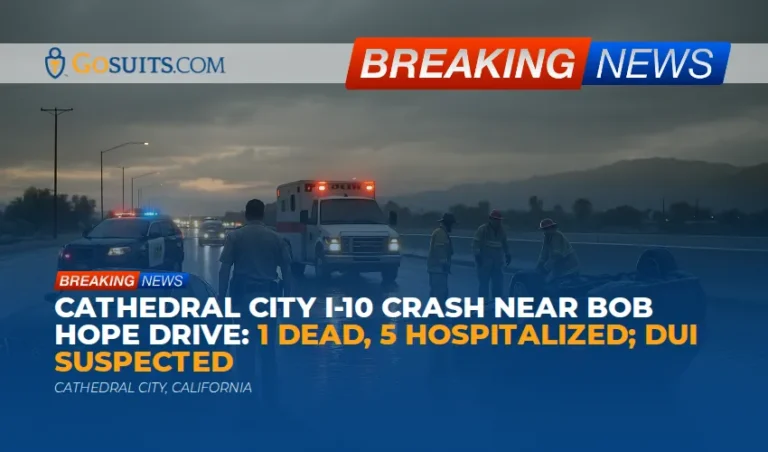
One person died and five others were hospitalized after a two-vehicle crash on eastbound Interstate 10, just west of Bob Hope Drive, in the Cathedral City area on the morning of February 21, 2026, at about 6:37 a.m. According to statements attributed to the California Highway Patrol in local reporting, an eastbound Lexus in the number one lane was described as driving recklessly. A Toyota with five occupants was traveling in the number three lane. The Lexus allegedly veered to the right and struck the Toyota. At this stretch of freeway, officials noted a standing body of water south of the eastbound lanes from previous rainfall. After impact, the Lexus came to rest on its wheels in that water, while the Toyota overturned onto its roof and became submerged.
The Lexus driver reportedly self-extricated. Four of the Toyota’s passengers escaped the vehicle, but the Toyota driver was believed to have remained underwater. First responders extricated the Toyota’s driver, who was unresponsive at the scene and transported to Desert Regional Medical Center, where the driver later died. The Lexus driver was transported for evaluation and, according to CHP statements in news reports, was later arrested on suspicion of DUI. Tow trucks arrived to remove both vehicles from the water.
Investigators will typically document the scene, interview witnesses, evaluate roadway conditions, collect vehicle data, and, when DUI is suspected, pursue toxicology testing. In a complex scene involving submersion, collision reconstruction can include careful mapping of vehicle paths, waterline evidence, and post-crash rest positions, all of which can become important later for insurance evaluations and any civil claims.
Local scene context in Cathedral City and the I-10 corridor
This crash occurred along a heavily traveled stretch of I-10 between Cathedral City and Rancho Mirage, near the Bob Hope Drive interchange. Morning commuters heading toward Palm Desert, Indian Wells, and Indio know this corridor well, especially the low-lying areas where brief desert storms can leave pooled water near the shoulder. The proximity to Bob Hope Drive means traffic can feel compressed as drivers transition between longer-haul freeway speeds and the more local ramps in and out of Rancho Mirage and Cathedral City. In the cooler winter months, drivers also contend with sun glare cresting over the San Jacinto Mountains around sunrise, which can mask standing water or debris until the last second.
Desert Regional Medical Center in Palm Springs is the major receiving hospital for high-acuity trauma in the central Coachella Valley, so it is common for serious I-10 crashes in Cathedral City, Rancho Mirage, and Palm Springs to be routed there when time and transport criteria are met.
Weather and roadway factors: standing water and early-morning risk
Officials noted standing water near the crash scene. Even after rain ends, pooled water beside or partly within freeway lanes can create hazards for vehicles involved in a collision and for those attempting to avoid a crash. Hydroplaning risk increases with speed and tire wear, and submersion risks rise if a vehicle departs the roadway into a low-lying basin or drainage channel. California’s basic speed law requires drivers to adjust speed for current conditions such as wet pavement, reduced visibility, and traffic, not just the posted limit [2].
Desert storm cells can dump intense rainfall over short periods, creating localized flooding and ponding on shoulders or medians. National guidance consistently urges drivers never to attempt to drive into floodwater and to be prepared for rapidly changing conditions. While this crash is still under investigation, general flood-safety messaging underscores how quickly a vehicle can be compromised when water is present [4]. Caltrans also warns that wet-weather driving demands greater following distance, lower speeds, and caution near standing water to reduce loss of control [5].
Official investigations and records to request
California Highway Patrol collision report
Families commonly start by obtaining the official CHP collision report. For I-10 incidents in the Coachella Valley, the local CHP office that covers this corridor typically processes the report. The request is made using the CHP 190 form and can be submitted in person or by mail to the appropriate office. The report number, date, time, and location help the office locate the file. Eligibility to receive the report is limited to involved parties, their representatives, and certain other authorized requesters [1]. If you are unsure which CHP office is handling the case, CHP’s office locator can point you to the right area office for questions [13].

Coroner’s and autopsy records
In Riverside County, the Sheriff’s Coroner handles death investigations. Next of kin can typically request information about the status of the investigation, identification procedures, and how to pursue autopsy findings and a cause-of-death report. Timelines depend on toxicology and workload. While there is no state-run .gov page specifically hosting Riverside County coroner records, families can call the Riverside County Sheriff Coroner division for case status and guidance on next steps and required documentation. A certified death certificate is usually obtained through the California Department of Public Health’s Vital Records unit or the County Recorder’s Office [12].
Medical records
For those transported to Desert Regional Medical Center or other facilities, authorized requesters can obtain hospital records for treatment, diagnosis, and discharge summaries. Federal privacy rules give patients and personal representatives the right to access medical records, subject to certain limitations. The U.S. Department of Health and Human Services outlines how to make a compliant request under HIPAA and what to do if you encounter delays or denials [14].
Public records requests
In some cases, additional incident-related materials may exist, such as dispatch logs or certain audio recordings. California’s Public Records Act can allow access to specific government records, with exceptions for active investigations and privacy. The California Department of Justice provides a general overview of how public records requests work in the state. This can help set expectations around what may be available and when [9].
California civil law context after a fatal highway collision
When a fatal collision is tied to suspected impaired driving or unsafe maneuvers, several layers of civil law may come into play. Below are general concepts families often encounter in California. This is educational information, not case-specific guidance.
Wrongful death vs. survival claims
California law allows certain family members to bring a wrongful death claim. The statute describes who may sue and the types of losses that may be considered [6]. A separate but related “survival” action may allow the decedent’s estate to recover damages the person could have sought if they had survived for the short time period between injury and death. Families often explore both avenues with counsel to understand which claims may apply in their situation.
Deadlines to file
California’s general statute of limitations for wrongful death and personal injury is two years, measured from the date of death or injury. There are exceptions, and some claims have shorter deadlines, especially if a public entity might be involved. Missing a deadline can bar a claim [7].
DUI, negligence, and comparative fault
Evidence of driving under the influence can factor into negligence analysis. California’s Vehicle Code prohibits driving under the influence of alcohol or drugs, and investigators often pursue toxicology in serious crashes [8]. National safety authorities reinforce the well-documented link between impaired driving and elevated crash risk [3]. California also applies comparative fault, which means a finder of fact can assign shared responsibility among drivers based on the evidence. Even if one driver bears most of the fault, partial fault can sometimes be assigned to others depending on the circumstances. The California Courts’ Self-Help Center provides a general overview of personal injury claims and how fault can affect outcomes [9].
Insurance layers that may be relevant
Multiple insurance layers can apply in a two-vehicle crash: the at-fault driver’s liability coverage, underinsured motorist and uninsured motorist coverage on the victim’s policy, and optional medical payments coverage. California’s Department of Insurance offers consumer education on how these coverages typically function and what information policyholders may request from their insurers [10]. Families sometimes ask what is the average insurance payout for car accident deaths in california. The reality is that outcomes vary widely based on liability facts, available coverage limits, and documented losses.
If roadway conditions could be an issue
Most freeway crashes do not involve government liability. However, in limited situations, California law allows claims for a dangerous condition of public property. These claims require proof of an actual dangerous condition, that the condition was a substantial factor in causing the harm, and that the public entity either created the condition or had notice and a reasonable time to fix it. Strict, early claim deadlines apply for any government-related claim [11]. Because officials reported standing water in this incident’s vicinity, investigators will naturally consider whether that water played any role in the sequence of events or only affected vehicle rest positions after the initial impact. That is a fact-intensive inquiry that unfolds through official reports and expert analysis.
Practical steps for affected families and witnesses
In the immediate aftermath, the top priorities are health, preserving evidence, and avoiding unforced errors with insurance communications. Here are grounded, practical steps community members in Cathedral City and the broader Coachella Valley can take.
- Prioritize medical follow-up. Even passengers who self-extricated might have hidden injuries. Prompt evaluation creates a medical record that can be important later. Keep all discharge papers and imaging reports organized.
- Request the CHP collision report. Use the CHP 190 process and provide the date, time, location near Bob Hope Drive, and vehicle details. Confirm the local CHP office handling the report and ask about processing timelines [1][13].
- Coordinate with the Sheriff Coroner. Next of kin can inquire about identification, cause-of-death determination, and how to receive copies when available. Expect that toxicology may add time to the final report.
- Obtain certified death certificates. For benefits, insurance, and other administrative needs, secure certified copies through California’s Vital Records processes [12].
- Preserve evidence now. Save phone photos, dashcam footage, clothing worn during the crash, towing receipts, and witness contact information. If you were a witness who pulled over safely, consider writing down a contemporaneous account while memories are fresh.
- Be careful with insurance calls. Insurance adjusters often seek recorded statements quickly. Consider consulting an attorney first because what you say can be used to limit or dispute claims later.
- Document the impact on daily life. Maintain a journal of pain, range-of-motion limitations, sleep issues, and how the collision affects work and family responsibilities. Keep receipts for out-of-pocket costs like medications, rides, and childcare.
- Designate a point person. In a large family, choose one person to coordinate document requests, track deadlines, and centralize communications with agencies and insurers to avoid crossed signals.
Safety considerations for Coachella Valley drivers
Drivers in the Cathedral City and Rancho Mirage area know how quickly conditions can turn on I-10. A few local reminders can reduce risk:
- Watch for pooled water near ramps and medians. After desert showers, shallow basins near interchanges like Bob Hope Drive can hold water that surprises drivers at freeway speeds. Caltrans urges slower speeds, gentle steering inputs, and longer following distances in wet weather [5].
- Manage sun glare at daybreak. Around sunrise, glare off the San Jacinto range can reduce contrast and hide hazards. Use sun visors, clean windshields, and build in extra space to react.
- Never enter floodwater. Even a few inches can move a vehicle off course. National Weather Service guidance is simple: Turn Around, Don’t Drown [4].
- Reaffirm the basic speed law. The safe speed is the one that fits current conditions, not only the number on the sign. Wet pavement, limited visibility, and traffic density are cues to slow down [2].
- Plan for high winds. The I-10 corridor near Whitewater can create strong crosswinds that magnify risk during lane changes and around high-profile vehicles. Leave extra room and reduce speed.
What happens next in the investigation
Investigations of serious freeway collisions unfold over weeks. CHP compiles the primary collision report with contributing factors, driver statements, physical evidence, and diagrams. If DUI is suspected, toxicology and additional testing may be routed through the coroner and crime labs. Families can ask the handling CHP office for estimated timelines. Once the report is released, it often includes contact information for involved insurers, witnesses, and tow operators.
From a civil perspective, attorneys commonly move to preserve evidence early. That may include sending letters to secure event data recorder (EDR) downloads from both vehicles, requesting any available traffic camera or Caltrans maintenance logs, and obtaining emergency response timelines. Because one vehicle reportedly overturned and became submerged, preservation of seat belt condition, window integrity, and door latch function can be important, along with post-incident photographs capturing waterlines and mud marks that indicate how long the vehicle was in water and at what depth.
When reconstructed carefully, these details help clarify what happened, in what order, and how injuries were sustained. That, in turn, informs insurance coverage evaluations and, if pursued, civil claims.
Why acting quickly matters
Several important clocks start running immediately after a collision like this. Evidence degrades. Witnesses forget details. Short government claim deadlines can apply in certain scenarios, and insurance policies impose prompt-notice duties.
- Preserve the story. The best time to capture accurate accounts is within days of the event. Memories fade fast, especially in a chaotic freeway scene with multiple responders.
- Secure physical evidence. Vehicles are often moved quickly from tow yards. If inspection is necessary, delay risks key components being altered, discarded, or exposed to the elements.
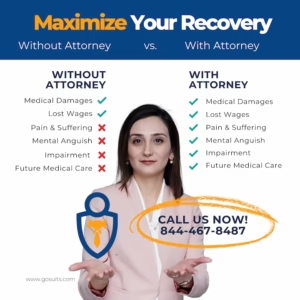
- Protect your rights with insurers. Insurance companies record statements and may request medical authorizations that are broader than necessary. Consider speaking with a qualified attorney before giving any statement or signing releases. Early guidance can help you avoid pitfalls, and most firms offer a free consultation to educate people about their options.
- Meet legal deadlines. Missing a statute of limitations or an early government claim deadline can end a case before it starts. Early assessment helps identify which timelines apply.

References
- Collision Reports – California Highway Patrol
- California Driver Handbook: Special Driving Conditions – California DMV
- Drunk Driving – National Highway Traffic Safety Administration
- Flood Safety: Turn Around, Don’t Drown – National Weather Service
- Winter Driving Tips – Caltrans
- Code of Civil Procedure section 377.60 – California Legislative Information
- Code of Civil Procedure section 335.1 – California Legislative Information
- Vehicle Code section 23152 – California Legislative Information
- Personal Injury Overview – California Courts Self-Help
- Automobile Insurance – California Department of Insurance
- Government Code section 835 – California Legislative Information
- Vital Records – California Department of Public Health
- Find An Office – California Highway Patrol
- Your Rights Under HIPAA to Access Your Health Information – HHS.gov
Commentary from Gosuits Cathedral City, California Personal Injury Attorney
Our hearts go out to everyone affected by this tragic crash near Bob Hope Drive. Lives were changed in minutes. Families and neighbors across Cathedral City and the Coachella Valley feel these losses deeply. This article is intended for general information and education, to help our community understand what typically happens after a serious freeway collision and where important records can be found.
Based on the initial details reported by authorities, investigators are examining two major factors: alleged reckless driving with a possible DUI component and the presence of standing water near the crash site. When a vehicle overturns and ends up partially submerged, the urgency of rescue, seat belt use, window access, and vehicle integrity all matter. Collision analysis in a case like this looks closely at pre-impact driving behavior, point of impact, vehicle trajectories, and whether environmental hazards contributed to the severity of the outcome.
Insurance companies often move quickly to secure statements and define the narrative in ways that minimize their financial exposure. Corporations and insurers know how complex these cases are. They may push for broad medical authorizations, encourage early recorded statements, or suggest that preexisting conditions explain current symptoms. Many people do not realize they can and should pause to understand their rights before speaking on the record. Early guidance levels the playing field, helps preserve crucial evidence, and makes sure the paperwork tells the full story of what happened and how it affected a family.
A free consultation with a seasoned injury attorney can make a practical difference. It helps people understand timelines, what documents to request, how to avoid common missteps with insurers, and what coverage layers might apply. No one should have to navigate this alone, especially when grief, hospitalization, and logistics collide all at once.