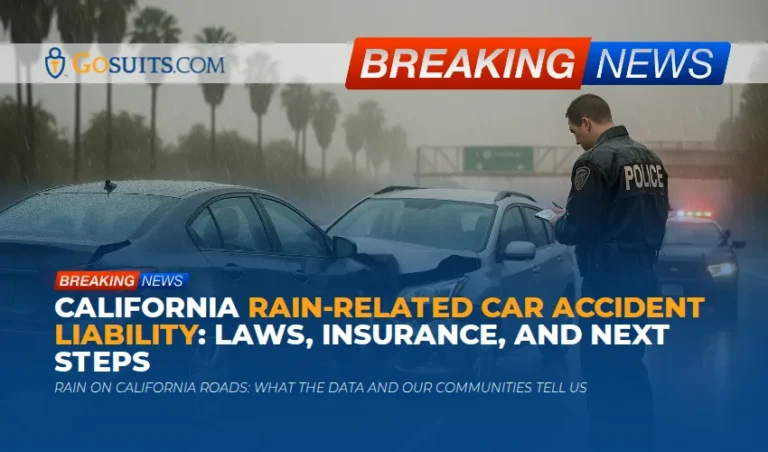
- Rain on California roads: what the data and our communities tell us
- California rules that apply in the rain
- Who can be liable after a rain-related crash
- How fault is investigated and proven on wet roads
- Insurance coverage and claims after a rain-related crash
- Common rain scenarios and how liability may shift
- What to gather at the scene in rainy conditions
- Where to get police reports, autopsy reports, and official records in California
- Practical safety steps during our rainy months
- Why acting promptly matters
- Commentary from Gosuits California Personal Injury Attorney
Rain on California roads: what the data and our communities tell us
From first-of-the-season showers in Los Angeles to steady winter systems over the Bay Area and Sierra foothills, California’s weather can flip quickly. When it does, our roads change too. Oil buildup after dry spells, slick painted lines, metal plates, and pooled water near clogged storm drains can make familiar commutes on the 405, 5, or 101 feel very different.
National safety data shows a consistent pattern. The Federal Highway Administration reports that a large share of weather-related crashes happen on wet pavement and during rainfall. On average, weather plays a role in over a million crashes nationwide each year, with wet pavement and active rain being leading contributors [1]. That data lines up with what many Californians see each winter on I-80 in Sacramento, Highway 17 over the Santa Cruz Mountains, and the I-15 corridor through the Inland Empire.
So who is responsible when a rain-slicked roadway and a collision collide? California law does not excuse unsafe driving because it was raining. Instead, drivers are expected to adapt. The sections below explain how liability is typically evaluated and what steps help protect a claim after a stormy-day crash.
California rules that apply in the rain
Basic speed law
California’s basic speed law requires drivers to drive at a speed that is reasonable and prudent for current conditions. That includes weather, visibility, traffic, and the surface of the roadway. Even when the posted limit is 65, a driver can be negligent for going that fast if heavy rain and spray reduce visibility and traction [2].
Following distance
Following too closely is unlawful. In the rain, a safe distance is longer than in dry conditions because stopping distances increase and hydroplaning can occur. California’s Vehicle Code prohibits tailgating, and investigators often look for rear-end impacts that suggest inadequate spacing in wet weather [3].
Headlights and visibility
Drivers must use headlights during darkness and when weather or atmospheric conditions reduce visibility so that persons and vehicles are not clearly discernible. In steady rain or murky midday storms, low-beam headlights help others see you and are often required by law [4]. The DMV handbook also instructs drivers to slow down, increase following distance, and use headlights in rain [5].
Windshield wipers and equipment
California law requires wipers to be maintained in good working order. Streaking, chattering wipers that impair visibility can be a factor in negligence analysis if poor maintenance contributed to an otherwise preventable crash [6].

Putting these rules together
When it rains, investigators and insurers typically ask simple questions. Did the driver slow appropriately under the basic speed law? Did they leave enough space? Were their headlights on when visibility dropped? Were their wipers functioning? Answers grounded in these rules often drive liability decisions.
Who can be liable after a rain-related crash
Liability depends on the facts. Rain is a condition, not a cause. Negligence is the key. Below are common parties whose conduct might be examined.
- Another driver who failed to adjust to conditions. This is the most common. Examples include driving too fast for wet pavement, following too closely, braking late into standing water, or changing lanes abruptly through spray.
- Multiple drivers in chain reactions. In pileups on I-580 or the 91, several drivers may share fault. California applies comparative fault, which means responsibility and damages can be apportioned among several at-fault parties.
- Employers of on-duty drivers. If a delivery van or service truck hydroplanes while the driver is on the job, the employer can be vicariously liable under California law if the driver’s negligence caused the crash.
- Government entities for dangerous conditions of public property. Claims may arise when a roadway has a dangerous condition like defective drainage that creates predictable, hazardous ponding in the travel lane. These claims require proof that the condition was dangerous, the public entity had notice in time to fix it, and that the condition caused the crash. They must also follow strict claim deadlines under the Government Claims Act [7] [8].
- Maintenance or repair businesses. In limited cases, if a repair shop’s negligent work left wipers inoperable or tires dangerously worn and that failure foreseeably contributed to a crash, liability theories can extend beyond the driver. These cases are fact intensive and often require expert evaluation.
No matter the scenario, the legal question typically returns to whether a person or entity failed to use reasonable care under the circumstances and whether that failure caused the injury.
How fault is investigated and proven on wet roads
Real-world evidence matters, especially in weather conditions that change quickly across neighborhoods from Encino to Mission Valley.
- Scene documentation. Photos or videos showing water pooling, active rainfall, headlight use, spray, and the positions of vehicles can be critical. Markings on the pavement, such as long straight skid marks versus no marks at all, may indicate braking or hydroplaning dynamics.
- Electronic data. Many vehicles store speed, braking, and steering inputs in event data recorders. That information can help show whether a driver slowed to a reasonable speed before a loss of control.
- Witnesses. Independent observations often clarify whether headlights were on, how heavy the rain was, and whether a driver was tailgating or weaving.
- Public records and maintenance logs. In potential roadway condition cases, public records about drainage complaints or prior incidents near the same low spot on a state route can be relevant [7].
- Police or CHP collision reports. Officers frequently note the weather, surface conditions, and visibility, and may cite violations like speeding for conditions or following too closely. Reports can be requested from the appropriate agency (more below) [9].
Seasoned car accident lawyers often bring these pieces together to build a clear picture of what went wrong and why. If you want a deeper dive into how driver conduct is assessed when weather is a factor, see our guide on Weather related car accidents driver negligence.
Insurance coverage and claims after a rain-related crash
California follows a fault-based auto insurance system. The at-fault driver’s liability coverage generally pays for injuries and damage they cause, subject to policy limits. A typical path involves opening a claim with the other driver’s insurer and, if necessary, pursuing underinsured or uninsured motorist coverage on your own policy if the at-fault driver lacks adequate insurance. The Department of Insurance publishes consumer guidance on how auto claims work in our state [10].
Before speaking with any insurance company, it is wise to consult with an attorney about your rights. Statements to an insurance adjuster can be used to limit a claim later, even when made in good faith. California also requires motorists to submit a DMV SR-1 accident report within 10 days for crashes involving injury, death, or property damage over a statutory threshold, regardless of fault [11]. Failing to file can affect driving privileges.
Many people find that California car accident lawyers can explain the interplay between liability coverage, med-pay, and UM or UIM benefits, and can help organize proof of damages like medical bills, time missed from work, and vehicle repair estimates in a way insurers will recognize [10].
Key claim considerations in rainy-day crashes
- Proof of negligence despite weather. Insurers sometimes say the rain caused it. California law expects drivers to adjust to conditions. Evidence that a motorist did not slow, did not use headlights, or followed too closely can rebut weather-only arguments [2] [3] [4] [5].
- Recorded statements. Consider getting legal advice before giving one. Small phrasing choices can be misinterpreted as admissions.
- Medical documentation. Seek timely care and follow your provider’s recommendations. Gaps in treatment are often used by insurers to question causation.
- Vehicle inspection. Preserve damaged tires, wiper components, and the vehicle’s onboard data. They may be relevant to how the crash unfolded.
Common rain scenarios and how liability may shift
Hydroplaning and loss of control
Hydroplaning happens when a film of water lifts the tire off the pavement, reducing traction to near zero. If a driver was going too fast for the depth of water and tire condition, liability can still rest with that driver under the basic speed law [2] [5]. If a known drainage defect creates a deep, hidden pool in the middle of a travel lane and the public entity had notice and time to fix it, a dangerous-condition claim may be explored under Government Code section 835 [7].

Rear-end crashes in freeway spray
Heavy spray on the 110 or 880 can make brake lights harder to see. Drivers must increase following distance accordingly. A rear-end impact often suggests the trailing driver did not leave enough room given wet-road stopping distances, though comparative fault can apply if the lead driver braked abruptly without reason [3] [5].
Chain reactions and multi-vehicle pileups
These collisions can involve numerous vehicles and insurers. Fault may be apportioned among several drivers who each failed in different ways to adjust to the weather. Documentation of timing and spacing between impacts becomes crucial.
Commercial vehicles and employer liability
Delivery vans on tight schedules and box trucks with worn tires pose serious risks on wet grades, like the Grapevine on I-5. If a commercial driver fails to slow for conditions or leaves inadequate following distance, both driver and employer can be on the hook. Company maintenance practices and route policies may come into play during discovery.
Rideshare trips in the rain
Liability still follows negligence principles. Insurance layers can change depending on whether the app was on, the driver was waiting for a ride, en route to a pickup, or transporting a passenger. The same weather rules apply, and investigators still assess speed, spacing, and visibility [10].
What to gather at the scene in rainy conditions
Wet weather can wash away useful clues fast. If it can be done safely, collecting the following can preserve vital context.
- Photos and video. Capture roadway puddles, spray conditions, active rainfall, traffic control devices, headlight use, skid marks, and vehicle resting positions. Include close-ups and wide shots that show lanes and landmarks, whether that is a Caltrans mile marker or a neighborhood sign in Orange County.
- Witness contacts. Get names, phone numbers, and short notes on what they saw, including weather details and whether headlights were on.
- Vehicle condition. Photograph tire tread, wiper blades, and any warning lights on the dash after the crash.
- Official report details. Note the agency and the report number if provided at the scene. In many urban areas, the local police department takes reports. On highways, the California Highway Patrol typically responds.
- Your observations. Jot down what the rain felt like at the time, whether you were using defrosters or wipers at full speed, and how the other driver was behaving before impact.
When it comes time to piece the story together, clear contemporaneous notes and images carry significant weight.
Where to get police reports, autopsy reports, and official records in California
Police or CHP collision reports
Identify which agency handled the incident. For freeway and state route crashes, that is often the California Highway Patrol. For city streets, it is usually the municipal police department or county sheriff. CHP explains how to obtain a collision report, typically using the CHP 190 form and submitting it to the office that holds the report [9]. City police departments have their own request portals and may offer in-person, mail, or online options. Have the date, location, and report number ready, plus your role in the collision. Fees and processing times vary.
DMV accident reporting and records
For collisions with injury, death, or qualifying property damage, California requires the SR-1 report to the DMV within 10 days. You can submit by mail or online. This is separate from any police or CHP report and is required even if someone else was at fault [11].
Autopsy reports and the county medical examiner-coroner
In fatal crashes, the county medical examiner-coroner will usually conduct the examination and maintain the autopsy file. Requests for autopsy reports and death certificates are handled by the county where the death occurred. For example, in Los Angeles County, requests go through the Department of Medical Examiner. Similar processes exist in Orange, San Diego, and other counties, with eligibility, fees, and timelines that depend on local rules [12].
Roadway and maintenance records
If the crash may involve a roadway hazard, some records may be available through the California Public Records Act. Caltrans winter driving resources also provide statewide guidance on storm preparation and road conditions, which can give context to what agencies expect of drivers in poor weather [13].
Practical safety steps during our rainy months
Every community in California has its trouble spots when the skies open. The fast lanes near the 405 and 10 interchange, low dips on Highway 1 south of Pacifica, or the right lanes along the 91 that collect water near on-ramps. A few preventive steps go a long way.
- Slow down and smooth out inputs. Gentle throttle, early braking, and soft steering keep traction:
- Leave extra space before merging or passing.
- Avoid cruise control in heavy rain or standing water.
- Use lights to be seen. Turn on low beams anytime rain or spray reduces visibility, even during daylight [4] [5].
- Defog early. Keep windows clear to expand sightlines before they blur.
- Check tires and wipers. Replace worn blades and monitor tire condition ahead of winter. The DMV handbook stresses longer stopping distances and the need for extra caution in the rain [5].
- Plan for weather. In strong systems, allow more time or delay travel if possible. Caltrans provides statewide winter driving tips and real-time updates that can influence safer route choices [13].
These steps not only reduce risk but also align with the duty to drive reasonably for conditions that California law requires.

Why acting promptly matters
There are a few concrete steps that make a meaningful difference after a rain-related crash.
- Secure time-sensitive evidence. Camera footage from nearby businesses, dashcams, or transit agencies is often overwritten within days. Request preservation right away.
- Get legal guidance before insurer calls. Understanding rights and obligations before giving a recorded statement helps prevent avoidable missteps that can limit a claim later on.
- Meet written deadlines. The DMV SR-1 is due in 10 days for qualifying crashes. Government claim notices can be due in as little as six months if a public entity is involved [8] [11].
- Document medical care. Prompt evaluation connects injuries to the crash and guides treatment. Delays can complicate both health and claim documentation.
These actions can preserve options while the weather report and memory of the scene are still fresh.
Commentary from Gosuits California Personal Injury Attorney
To everyone affected by rain-related collisions across our state, our thoughts are with you. This article is shared for educational purposes and general information. Rain changes the road, but it does not erase responsibility. California law expects drivers to slow down, make themselves visible, and leave space. When someone ignores those basics, even a quick shower can turn into a life-altering crash.
In our view, the key question is whether a driver adjusted to the conditions. The basic speed law, headlight and wiper rules, and safe following distance give clear guideposts. Investigations that capture the weather, the roadway, and driver behavior in the moments before impact tend to produce fairer outcomes.
Insurance carriers and large corporations know most people do not live in the claims world every day. They may push quick statements, suggest the rain alone caused the crash, or point to small treatment gaps to devalue a claim. Understanding your rights early can prevent those tactics from gaining traction.
A free consultation can be important because it helps clarify options, deadlines, and next steps without pressure. It is a chance to understand how evidence is preserved, how coverage applies, and how to avoid common pitfalls in a process that many find confusing and stressful, especially in the wake of an unexpected storm.
References
- How Do Weather Events Impact Roads – U.S. Federal Highway Administration
- California Vehicle Code 22350 Basic Speed Law – California Legislative Information
- California Vehicle Code 21703 Following Too Closely – California Legislative Information
- California Vehicle Code 24400 Headlamps – California Legislative Information
- California Driver Handbook: Special Driving Situations (Rain, Fog, and More) – California DMV
- California Vehicle Code 26707 Windshield Wipers – California Legislative Information
- California Government Code 835 Dangerous Condition of Public Property – California Legislative Information
- California Government Code 911.2 Presentation of Claims; Six-Month Deadline – California Legislative Information
- How to Obtain a Collision Report – California Highway Patrol
- Auto Insurance 101 Consumer Guide – California Department of Insurance
- Accident Reporting SR-1 Requirements – California DMV
- Requesting Reports – Los Angeles County Department of Medical Examiner
- Winter Driving Tips – California Department of Transportation