- What we know about the Cabazon head-on collision on Seminole Drive
- Local roadway context near Morongo and why nights in the Pass can be risky
- Why head-on crashes are so destructive and how speed factors in
- Evidence and records families may need
- Legal considerations after a Riverside County head-on collision
- Insurance questions and early steps to protect your rights
- Why acting promptly matters in Riverside County claims
- References and resources
- Commentary from Gosuits Cabazon, California Personal Injury Attorney
What we know about the Cabazon head-on collision on Seminole Drive
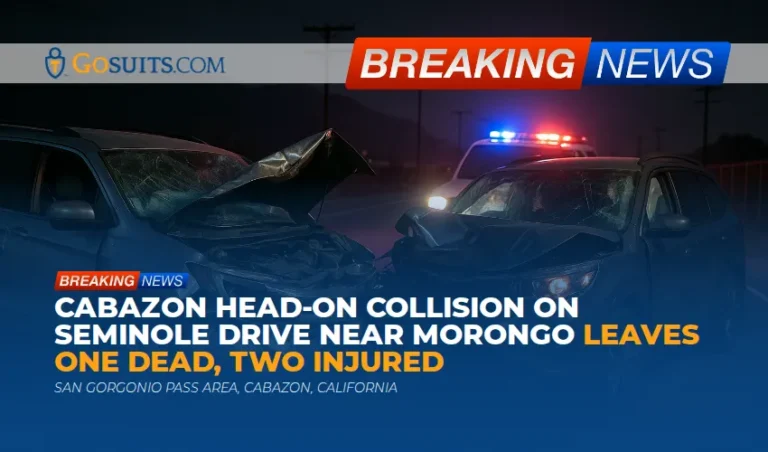
California Highway Patrol reported a deadly high-speed head-on crash in Cabazon just after 9:30 p.m. on Sunday near Seminole Drive and Morongo Trail. According to CHP, a 2020 Honda Pilot traveling about 60 to 70 miles per hour attempted to pass a 2026 BMW 550E on Seminole. The Honda lost control, struck the raised concrete island that separates eastbound and westbound lanes, vaulted into the eastbound lane, continued at a high rate of speed, and collided head-on with a 2023 Kia Telluride. The Honda was then pushed south and impacted a chain link fence.
The Honda’s driver, a 46-year-old Banning resident, was pronounced dead at the scene. CHP said the BMW driver was uninjured although debris struck their vehicle. The Kia’s driver, a 55-year-old Tempe, Arizona resident, sustained moderate injuries, while their passenger, a 53-year-old woman from Fountain Hills, Arizona, suffered major injuries. Both were transported to Desert Regional Medical Center in Palm Springs. Investigators are still working to determine the precise reasons the Honda lost control.
At this time, no additional official causes have been announced. CHP’s investigation typically includes scene measurements, vehicle inspections, witness interviews, and a review of any available camera footage or vehicle data recorders. The collision occurred in an area that sees a mix of local traffic and visitors traveling to Morongo Casino Resort and the Desert Hills Premium Outlets, often at night and on weekends.
Local roadway context near Morongo and why nights in the Pass can be risky
Cabazon sits in the San Gorgonio Pass, a corridor known for high winds, fast-moving traffic off Interstate 10, and changing lighting conditions after dark. Seminole Drive runs roughly parallel to the I-10 frontage in spots, and drivers leaving the freeway can carry highway speeds onto local roads if they do not slow promptly. The presence of a raised concrete island along stretches of Seminole is meant to control left turns and separate traffic direction, but any loss of control at speed can still place a vehicle into oncoming lanes. The area near Morongo Trail draws steady evening activity from casino patrons and outlet shoppers, with traffic patterns that change quickly around closing times and shift changes.
If you live in Banning, Beaumont, or Cabazon, you know how quickly winds can whip through the Pass, particularly in the evenings. While there is no indication wind played a role here, those conditions are a reminder of how fast a roadway can become unforgiving when speeds are high and maneuvers are abrupt. At night, depth perception diminishes and headlights can complicate judgments about distance during passing.
Why head-on crashes are so destructive and how speed factors in
Head-on collisions are among the most severe roadway events because the closing speeds add together. A vehicle that jumps a median or crosses a centerline into an opposing lane at 60 mph can create a catastrophic energy transfer when the other vehicle is moving too. National safety agencies emphasize two core truths: speeding raises the likelihood of losing control and increases the severity of injuries when a crash occurs. The National Highway Traffic Safety Administration notes that speeding is a persistent factor in roadway fatalities nationwide and significantly heightens crash energy and injury risk [2].
Physical separation between travel directions helps, but it is not foolproof. The Federal Highway Administration’s safety research highlights that raised medians and similar treatments reduce certain severe crash types by physically limiting conflict points and errant crossings, though they cannot eliminate risk when a driver is already out of control [4]. California’s traffic safety leaders also continue to track speeding and nighttime risk as key concerns statewide [5].
While CHP is still investigating, the sequence described here is a classic example of how a split-second decision to pass, combined with speed and roadway geometry, can lead to a head-on impact. In the San Gorgonio Pass, where nighttime travel involves long, straight stretches and variable lighting, drivers can misjudge the time and distance needed to pass safely. California’s Basic Speed Law requires drivers to travel at a speed that is reasonable and prudent considering conditions, even if the posted limit is higher [6].
Evidence and records families may need
In a serious Riverside County crash like this, essential records and evidence often come from multiple sources. Gathering them methodically can help injured passengers with their recovery-related paperwork and, where appropriate, help families understand their civil options after a fatality.

CHP traffic collision report: what it contains and how to request it
The California Highway Patrol’s Traffic Collision Report usually includes the officer’s diagram, measurements, statements, preliminary findings, and involved-party and witness information. CHP provides a process for obtaining reports. You can typically request a copy using CHP’s form and instructions, and the local Area office handling Cabazon calls is the San Gorgonio Pass Area. CHP’s statewide guidance on requesting collision reports is published online [1].
Be prepared to provide the date, time, and location, the report number if available, and proof you are an involved party or legal next of kin. Processing can take time, especially in fatality investigations that require supplemental documentation.
Coroner and death records: whom to contact and what to expect
In Riverside County, the Sheriff-Coroner conducts death investigations. Families often seek two things: autopsy findings and certified death certificates. Autopsy reports may not be immediately available while the investigation is open. When released, they can answer questions about cause and manner of death. Death certificates can be requested through the State of California’s vital records system, either from the county or via the California Department of Public Health’s Vital Records office [11].
California law outlines the coroner’s duties and procedures, including investigation and documentation requirements [8]. Some records are subject to timing rules or confidentiality provisions. For certain public records, the California Public Records Act provides a framework for requesting documents, though health and investigatory records may have exemptions or restricted access [14].
Emergency and hospital records
Injured patients and authorized representatives have a right to access their medical records under federal law. The U.S. Department of Health and Human Services explains how the HIPAA Right of Access works, including timelines and permissible fees for copies [12]. Keeping discharge summaries, imaging reports, and all bills from Desert Regional Medical Center and any follow-up providers will be important for insurance coordination.
Vehicle data, scene preservation, and cameras
Many newer vehicles record key crash metrics in an Event Data Recorder, sometimes called a vehicle “black box.” Federal regulations describe the type of crash data that may be captured if a manufacturer includes an EDR, such as speed, throttle, braking, and seat belt usage just before a collision [13]. Preserving vehicles without repairs or salvage, when possible, helps ensure this data is not lost.
Nearby cameras can also matter. Along Seminole Drive, potential sources include traffic-adjacent businesses, resort and outlet properties, and transportation corridors. Camera systems often overwrite data within days. Consider promptly asking nearby property owners to preserve footage. For additional practical tips on approaching this task, see how to deal with insurance companies after an accident and adapt the communication approach to third-party video requests as needed.

Witnesses, photos, and personal notes
Photos of the raised median, tire marks, debris fields, airbag deployment, and final rest positions can help reconstruct what happened. Witness names and phone numbers, even if they gave statements to CHP, should be saved in a personal file. Consider starting a contemporaneous journal of symptoms, appointments, and daily impacts from injuries. California safety officials encourage thorough documentation because it can help both health providers and, if needed later, civil processes [5].
Legal considerations after a Riverside County head-on collision
Every crash has its own facts, and CHP has not released a final determination. That said, certain civil concepts commonly arise in head-on collisions, especially where a passing maneuver and speed are reported. The points below are general information, intended to help community members understand how these events are often analyzed in California.
Potential civil liability issues raised by reported facts
California’s Basic Speed Law requires driving at a speed that is reasonable and prudent for conditions. Even at or below posted limits, a speed can be unlawful if it endangers people or property [6]. Passing decisions also involve judgments about available sight distance, opposing traffic, and lane geometry. When a vehicle loses control, crosses a median or centerline, and collides with oncoming traffic, civil fault analyses look at whether the driver was traveling too fast for the conditions, whether the maneuver was safe, and whether any other contributing factor existed.
California uses a comparative fault framework in civil cases, which means responsibility can be apportioned among multiple parties based on percentages of fault. This approach allows injured people to pursue compensation even if more than one factor contributed, though any recovery can be reduced by their share of fault.
Wrongful death and survival actions in California
After a fatal crash in California, two different civil actions may be available. A wrongful death action belongs to certain family members identified by statute and seeks losses such as financial support the decedent would have provided and the value of household services [7]. A survival action belongs to the decedent’s estate and can address claims the decedent could have brought had they survived, such as medical bills and certain other damages through the time of death [8].
California generally has a two-year statute of limitations for wrongful death and most personal injury actions [9]. There can be shorter deadlines when public entities are involved, and some timelines pause in limited circumstances. These are reasons many families speak with a seasoned attorney early, so all potential timelines are identified.
Insurance layers that may apply
California requires drivers to maintain liability insurance to cover injuries or damages they cause. The state explains proof of financial responsibility and minimum liability requirements for registered vehicles [10]. In many serious crashes, the at-fault driver’s policy may not be sufficient for the losses involved. Uninsured and underinsured motorist coverage from the injured person’s own policy can help fill gaps when the other driver lacks enough insurance. When out-of-state visitors are involved, policies issued in other states often still respond to California crashes, but claim handling details can vary.
In complex multi-vehicle collisions, additional coverage issues can arise, including medical payments coverage, health insurance liens, and subrogation. Navigating these layers often turns on the fine print. This is an area where many people find it helpful to consult with car accident lawyers to understand the insurance landscape and avoid missteps in early communications.
Insurance questions and early steps to protect your rights
In the first days after a serious crash, insurers may reach out quickly. It is common for liability adjusters to ask recorded questions and request medical authorizations. What people say to an insurance company can be used against them later, even from their own insurer in some contexts. Before giving a recorded statement or signing broad releases, it is prudent to speak with an attorney who can advise on scope and timing. For those living or traveling through the Pass, this is particularly important after high-speed head-on collisions where injuries are severe and fault will be closely examined.
California also requires a crash to be reported to the DMV within 10 days if there are injuries, death, or more than a threshold amount in property damage. The state’s SR-1 guidance explains this reporting requirement for involved drivers [3]. Insurers often file on a driver’s behalf, but the duty ultimately rests with the motorist.
When deciding how to move forward, many community members look for local guidance. Cabazon car accident lawyers understand the roadway context around Seminole Drive and the San Gorgonio Pass and can help organize evidence, protect privacy, and coordinate insurance benefits while CHP’s investigation continues.
Why acting promptly matters in Riverside County claims
After a head-on collision, timing affects evidence, benefits, and peace of mind.
- Preserve perishable evidence now. Many camera systems overwrite footage within days. Tire marks fade. Damaged vehicles are towed to yards that begin storage charges and may release to salvage. Quick, polite requests to preserve evidence can make a real difference [13].
- Secure essential records. Request your CHP collision report when eligible [1]. Order hospital records using your HIPAA Right of Access [12]. Obtain certified death certificates through the state’s Vital Records system if a loved one was lost [11].
- Understand deadlines before they pass. Statutes of limitation and notice rules can be strict in California, especially if a public entity may be implicated [9]. Early legal guidance can help chart the right path.
- Avoid pitfalls with insurers. Well-meaning statements or broad medical authorizations can complicate claims. A brief legal consult can help set boundaries for recorded interviews and document sharing [2].
- Prioritize medical continuity. Keep follow-up appointments, track out-of-pocket expenses, and document symptoms daily. Consistent care supports recovery and helps explain treatment decisions if questions arise later [5].
In practical terms, the exact thing to do is create a short, written plan for the first two weeks. List who will photograph the scene and vehicles, who will contact nearby businesses about video, what medical follow-ups are scheduled, and when to check on the CHP report status. The benefit is simple: fewer loose ends, better evidence, and greater clarity about next steps. The urgency is real because video and vehicle data can disappear, and because early statements to insurers are hard to unwind later. Acting promptly helps ensure that when CHP issues findings, you are ready to make informed decisions about insurance, bills, and, if appropriate, civil claims.

References and resources
- How to Obtain a Traffic Collision Report – California Highway Patrol
- Speeding – National Highway Traffic Safety Administration
- Financial Responsibility Requirements – California DMV
- Medians and Pedestrian Refuge Areas – Federal Highway Administration
- Traffic Safety Quick Stats – California Office of Traffic Safety
- Vehicle Code § 22350 Basic Speed Law – California Legislature
- Code of Civil Procedure § 377.60 Wrongful Death – California Legislature
- Code of Civil Procedure § 377.30 Survival Actions – California Legislature
- Code of Civil Procedure § 335.1 Statute of Limitations – California Legislature
- Liability Insurance Requirements – California DMV
- Vital Records: Certified Copies of Birth and Death Records – California Department of Public Health
- Right of Access to Health Information – U.S. Department of Health and Human Services
- 49 CFR Part 563 Event Data Recorders – eCFR
- California Public Records Act – Office of the Attorney General
Commentary from Gosuits Cabazon, California Personal Injury Attorney
Our hearts go out to everyone affected by this crash near Seminole Drive and Morongo Trail. A life lost and serious injuries arriving at Desert Regional on a Sunday night reverberate through families in Cabazon, Banning, Beaumont, and well beyond. This commentary is offered for educational purposes and general information.
From the facts reported so far, investigators are focusing on a high-speed passing attempt, a strike to the raised median, and a resulting head-on impact. On roads flanked by concrete islands and opposing lanes, split-second decisions at night can be unforgiving. In civil terms, fact finders will look at conditions and choices leading to loss of control, including speed and roadway geometry. They will also consider the sequence of impacts and the injuries that followed.
In our experience, insurance companies and large corporate stakeholders often move quickly to shape the narrative. Adjusters may ask for recorded statements, broad medical authorizations, or early settlements before the full picture is clear. The information people provide in those first conversations can be used to dispute fault, minimize injuries, or question the need for certain treatments later on. Corporations and insurers know the system well, and they benefit when individuals do not have complete information.
That is why obtaining a free consultation is so important after a serious head-on crash. A short conversation can help clarify which records to request, how to preserve vehicle and camera data, and how to handle insurance communications without jeopardizing valid claims. It also helps families understand the difference between wrongful death and survival actions, typical timelines, and the need to plan around deadlines and evidence preservation. No one can change what happened on Seminole Drive, but early, informed steps can protect rights and reduce stress in the weeks and months ahead.