- What we know about the motorcycle and pickup collision on FM 1810 in Chico
- Why crashes like this happen on Wise County farm to market roads
- Safety and legal context in Texas
- Potential civil liability questions raised
- How families can obtain official records and documents
- Insurance issues after a fatal motorcycle crash
- Practical next steps and why timing matters
- Community reflections and roadway safety near Chico
- Resources and references
- Commentary from Gosuits Chico, Texas Personal Injury Attorney
What we know about the motorcycle and pickup collision on FM 1810 in Chico
When and where it happened
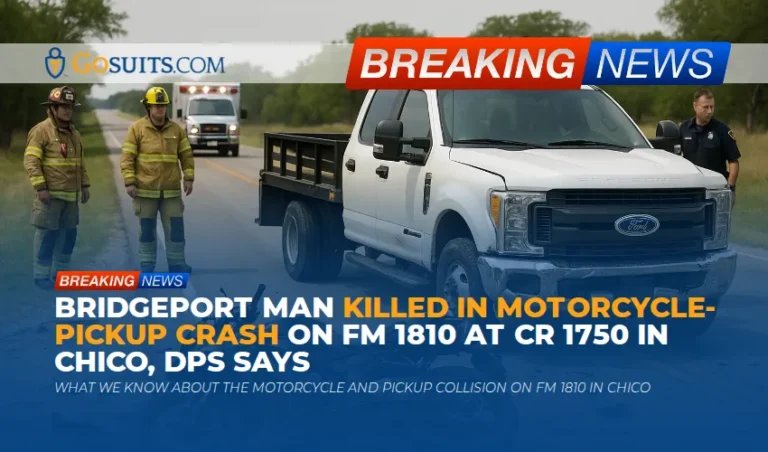
On a late Sunday morning in Chico, just after 11 a.m., a two vehicle crash occurred at Farm Road 1810 and County Road 1750 in Wise County. This rural intersection sits on a stretch of FM 1810 that locals use every day to move between Chico, Bridgeport, and Decatur, including those heading toward US 81 287 or Lake Bridgeport. The collision involved a Ford F 350 towing a trailer and a Honda motorcycle.
Who was involved and immediate response
According to statements relayed by the Texas Department of Public Safety, the motorcyclist, a 53 year old man from Bridgeport, suffered fatal injuries and was pronounced deceased at the scene. The pickup driver was uninjured. Wise County EMS placed an air ambulance on standby, then canceled when it became clear it would not be needed. The response included Chico Volunteer Fire Department units and Wise County EMS Medic 2, Rescue 1, and Squad 1. Scenes like this are sadly familiar along our farm to market roads, where a quiet weekend ride can be interrupted in seconds.
Initial law enforcement statement
DPS’s preliminary information indicates the Ford F 350 was traveling east on FM 1810 and began a left turn onto County Road 1750. The motorcycle had been following and attempted to pass in a marked no passing zone, striking the turning pickup. DPS’s preliminary findings can evolve as investigators review physical evidence, roadway markings, statements, and any available camera or electronic data. Families should understand that a “preliminary” account is not the final word. It is the starting point, and more detail often emerges from the official crash report, scene measurements, and later reconstructions.
Why crashes like this happen on Wise County farm to market roads
Residents in Chico and Bridgeport know that FM 1810 can be unforgiving. It is a rural corridor with changing sightlines, occasional trailers entering and exiting ranch gates, and traffic mixing oilfield pickups, grain haulers, and weekend riders. At CR 1750, drivers turning left must judge oncoming and following traffic carefully, while riders and drivers in the flow often deal with limited passing opportunities and variable speeds. Even a moment’s misread of a turn signal or a hidden no passing stripe as the pavement curves can set up a high risk situation.
Weekend daylight riding brings additional variables. Glare, light patches under tree canopies, and trailing dust from roadside work can all diminish contrast and make a small profile motorcycle less visible than a full size pickup. Intersections on farm to market roads may not have dedicated turn lanes or lighting, and shoulders can be narrow. Those design and environment realities do not excuse unsafe decisions, but they help explain why these crashes happen in our county more than anyone would like.
Safety and legal context in Texas

No passing zones and left turns at county road intersections
Texas law sets clear expectations for both passing and turning. Drivers are restricted from driving left of center in no passing zones and near intersections, and they must pass only when the left side is clearly visible and free of oncoming hazards. See the Texas Transportation Code, including provisions on no passing limitations and left of center restrictions, which are organized within Chapter 545 regarding rules of the road. The full chapter is available through the state’s official site at statutes.capitol.texas.gov.
At the same time, a driver who intends to turn left must ensure the movement can be made safely and must yield to approaching traffic that is so close as to pose a hazard. Signaling is also required continuously during the last 100 feet before the turn. These duties exist even when the other vehicle’s maneuver later proves unlawful. In practice, crash investigators assess line of sight, markings, distance, the status of any turn signal, and whether the left turning driver checked mirrors and rechecked a blind spot or immediate trailing lane before committing to turn.
Intersection visibility and signaling
On roads like FM 1810, drivers towing a trailer need additional distance and time to clear a turn. Lawful signaling and proper lane positioning matter, but so do practical visibility checks. Texas law requires appropriate signaling prior to a lane change or turn. The challenge is that a rider behind a large pickup and trailer can be hidden from mirrors for a heartbeat as both vehicles position for the turn. That is why many safety officials emphasize looking twice and delaying the turn by a second to recheck mirrors and blind spots. It is a small habit that often changes outcomes.
Motorcycle vulnerability and visibility
National highway safety research highlights the heightened risk for motorcyclists in multi vehicle crashes, particularly at intersections and during left turn conflicts. The National Highway Traffic Safety Administration provides guidance and data on common crash patterns and visibility issues for riders, available at nhtsa.gov. Even under perfect compliance with traffic rules, riders are more exposed to severe injury because there is no external protective structure. That is why investigators in fatal motorcycle crashes pay close attention to speed, sight distance, lane position, reflective gear, and roadway markings.
Texas also has helmet and equipment rules for motorcycles, which you can read in Transportation Code Chapter 661 at statutes.capitol.texas.gov. Whether a helmet was worn may be noted in the crash report, but it should never be used to assign moral blame. The key questions for civil liability remain duty, breach, causation, and damages as applied to all parties.
Potential civil liability questions raised
A DPS preliminary account that a rider attempted to pass in a no passing zone while a pickup turned left sets up difficult, fact specific questions. In civil claims, Texas uses a proportionate responsibility system. Multiple parties can share fault, and the percentages matter for any recovery.
Proportionate responsibility in Texas
Texas Civil Practice and Remedies Code Chapter 33 explains proportionate responsibility and the 51 percent bar for recovery. In general terms, a claimant who is more than 50 percent responsible for their own harm may not recover damages, and any award can be reduced by the claimant’s percentage of responsibility. The statute is available at statutes.capitol.texas.gov. In a scenario like this, an insurer might argue the no passing maneuver in a marked zone creates substantial comparative fault. Yet, investigators and courts also consider whether the left turning driver kept a proper lookout, signaled adequately, and turned only when safe. A left turn in front of passing or overtaking traffic can create shared responsibility depending on the evidence.
Wrongful death and survival claims
In fatal crashes, two categories of civil claims may be available under Texas law. Wrongful death claims allow certain family members to recover for their own losses stemming from the death. Survival claims allow the estate to pursue claims the decedent could have brought had they lived. These are created by statute in the Texas Civil Practice and Remedies Code, including Chapter 71 and its related provisions. You can read the statute at statutes.capitol.texas.gov. Time limits generally apply. Texas limitations rules for personal injury and wrongful death are found in Civil Practice and Remedies Code Chapter 16, see statutes.capitol.texas.gov. Families often face practical deadlines earlier than the statute of limitations because evidence is perishable and notice requirements for some entities can be shorter.
Evidence that typically matters
In a passing and left turn crash on a two lane rural road, these evidence sources often prove decisive:
- Pavement markings and signage including location and length of the no passing zone and any turn warning signs.
- Skid, yaw, and gouge marks showing impact point, braking, and pre impact positioning.
- Vehicle damage profiles and trailer tongue impacts, which help determine angles and speed changes.
- ECM data and telematics from newer pickups that may log speed and throttle position near impact.
- Headlight filaments that can sometimes indicate whether a lamp was on at impact.
- Witness statements about signals, speed, and whether the pickup paused or executed a continuous turn.
- EMS and 911 records that time stamp events and sometimes capture real time observations.
Collecting this information quickly helps ensure accuracy. Families rarely have the bandwidth to do this alone in the first days, which is why a seasoned team and independent reconstruction can be important in contested liability situations.

How families can obtain official records and documents
Texas Peace Officer’s Crash Report
In Texas, the official crash report, often called the CR 3, is obtained through the Texas Department of Transportation’s Crash Records Information System. Reports can be searched and purchased online through TxDOT at cris.dot.state.tx.us. This report will include the investigating officer’s narrative, diagram, listed contributing factors, and any citations noted, along with identifiers for involved vehicles and drivers.
EMS and fire department run reports
Wise County EMS and the Chico Volunteer Fire Department generate incident and patient care records. Access is governed by privacy laws and the Texas Public Information Act. The Attorney General’s Office maintains an overview of public information rights and procedures at texasattorneygeneral.gov. Requestors typically provide the date, time, location, and name of the individual to allow the agency to locate the correct records. Some medical information may be redacted under health privacy rules.
Autopsy, inquest, and death certificate
In many rural Texas counties, a Justice of the Peace conducts the inquest and determines whether to order an autopsy. Where a county medical examiner district is used, that office handles examinations and releases. Because arrangements differ by county, the most direct approach is to contact the appropriate Wise County inquest authority noted in the crash report. Death certificates are maintained by Texas Department of State Health Services Vital Statistics, with ordering information at dshs.texas.gov. Autopsy and inquest records are generally held by the county authority that ordered the exam, subject to disclosure rules and any required redactions.
911 audio, dash cameras, and body worn cameras
911 call audio and certain law enforcement recordings can be requested under the Texas Public Information Act. Some recordings may be exempt or partially redacted. The request should identify the date, general time frame, location, and agency. If the scene involved state troopers, relevant video would typically be held by DPS, while dispatch audio might be with the county’s communications center. The Attorney General’s overview at texasattorneygeneral.gov explains timelines and exceptions.
Roadway maintenance or design records
If questions arise about visibility, striping, or signage on FM 1810 near CR 1750, the Texas Department of Transportation Fort Worth District is the public custodian for state road maintenance in Wise County. TxDOT’s site provides district contact information and general safety program information at txdot.gov. Requests can seek plans, striping logs, and work orders for the segment. These records can help confirm the precise location and length of a no passing zone and whether any recent changes occurred.
Insurance issues after a fatal motorcycle crash
Types of coverage that may apply
Several insurance layers may be in play in a crash like this:
- Liability coverage on the turning vehicle for bodily injury and wrongful death damages, if the driver is found legally responsible.
- Uninsured or underinsured motorist coverage on the motorcycle’s policy, which can apply in some shared fault or low limit scenarios.
- Personal Injury Protection or MedPay on the motorcycle policy, depending on elections, which may help with certain expenses regardless of fault.
- Trailer and commercial policies if the pickup and trailer were used for business, which can add complexity and potential coverage.
- Accidental death benefits under life or accidental death and dismemberment policies, which are contract based and separate from fault questions.
Dealing with adjusters and recorded statements
Insurance adjusters often move quickly after a fatal crash and may request interviews or recorded statements. It is important not to provide recorded statements or broad authorizations before understanding rights and the potential consequences. Statements can be used later to shape a liability narrative under Texas’s proportionate responsibility rules. It is prudent to consult with a qualified attorney first, then decide how and when any communication with an insurer should occur. If a claim must be set up to preserve benefits, counsel can often handle the initial notice and ensure the information provided is accurate and appropriately limited.
Practical next steps and why timing matters
Here are concrete actions that should be taken promptly when a serious or fatal crash occurs, along with why they matter:
- Secure the official crash report through TxDOT’s CRIS portal. The report number or the date, time, and location can be used to locate it. This anchors facts such as roadway markings, stated contributing factors, and agency contacts for follow up.
- Preserve vehicles and electronic data by ensuring the motorcycle and pickup are not altered or destroyed before inspection. Preservation letters can be sent to storage yards and insurers to maintain ECM and telematics data that can resolve speed, braking, and signal use questions.
- Document the scene and markings as soon as possible while temporary paint and debris fields are still visible. On rural segments, rain or routine maintenance can erase useful clues within days.
- Request EMS, fire, and 911 records to capture timelines and on scene observations. These time stamped records help align witness accounts and vehicle movements.
- Collect witness information and verify phone numbers. Rural scenes often draw help from passing drivers who may not wait for law enforcement to arrive. Their accounts can be critical, especially in passing versus turning disputes.
- Avoid early recorded statements to insurers until legal counsel is consulted. Early statements can be incomplete or misinterpreted and may affect fault allocation later.
- Review relevant Texas statutes on turns, passing, signaling, and comparative responsibility to understand how facts may be analyzed. The state statutes are publicly available and provide helpful context.
- Consider grief and mental health resources through local providers, faith communities, or county resources. Practical steps are important, but emotional support is equally critical in the first weeks after a loss.
Why act now? Physical evidence disappears, memories fade, and electronic data can be overwritten or lost when vehicles are repaired or salvaged. Some insurance policies have short internal deadlines for notice, and public records requests are smoother when made while case numbers and personnel are still fresh.

Community reflections and roadway safety near Chico
Chico residents often share the road with friends and neighbors, whether heading to ballfields near the schools, running errands in Decatur, or meeting family at Lake Bridgeport. FM 1810 is a familiar ribbon of pavement connecting many parts of our lives. This crash at CR 1750 is a reminder of how easily routines intersect with tragedy.
There are practical, community level steps that can reduce risk on our rural roads:
- Give extra space behind trailers and turning pickups and assume a left turn may begin sooner than expected. Trailers change the driver’s timing and clearance requirements.
- Treat every intersection like a hidden hazard even if there is no stop sign or signal. County road traffic, farm equipment, or a vehicle preparing to turn can appear with little warning.
- For riders, avoid passing anywhere the pavement or signage limits visibility, and wait for long, clear sight lines. A few seconds of patience can eliminate a high risk closing angle at a left turn.
- For drivers, signal early and recheck mirrors and blind spots immediately before turning. When in doubt, wait a heartbeat and look again.
Local knowledge matters. Those who drive FM 1810 daily know where the pavement dips, where the sun hits hard late morning, and where county roads open onto the highway unexpectedly. Sharing that knowledge with new drivers and riders in our families can make a quiet, practical difference.
Resources and references
- Texas Transportation Code Chapter 545, Rules of the Road
- Texas Transportation Code Chapter 661, Protective Headgear for Motorcycle Operators and Passengers
- Texas Civil Practice and Remedies Code Chapter 33, Proportionate Responsibility
- Texas Civil Practice and Remedies Code Chapter 71, Wrongful Death and Survival
- Texas Civil Practice and Remedies Code Chapter 16, Limitations, including section 16.003
- TxDOT Crash Records Information System, purchase an official crash report
- Texas DSHS Vital Statistics, Death Records
- Texas Attorney General, Public Information Act overview
- NHTSA, Motorcycle Safety resources and data
- Texas Department of Transportation, Fort Worth District information and roadway safety programs
Commentary from Gosuits Chico, Texas Personal Injury Attorney
Our hearts are with the family, friends, and neighbors affected by this loss in the Chico and Bridgeport communities. Articles like this are shared for educational purposes and general information. They are not a substitute for personalized guidance that accounts for every fact and document in the case.
Based on the preliminary account, investigators believe a left turn onto CR 1750 coincided with a passing attempt in a marked no passing zone. That pattern presents tough questions about timing, visibility, signaling, and lookout. In many left turn versus passing collisions, a fuller picture comes from the crash report, measurements of the no passing zone, an inspection of the pickup and trailer’s signal systems, and a close analysis of witness statements. Shared fault can arise even when one maneuver was unlawful, because Texas law also requires that left turns be made only when safe and that signals be used properly.
Insurance carriers and large corporate policyholders often move quickly to lock down a fault narrative, sometimes before all evidence is gathered. Adjusters may ask for recorded statements, broad medical authorizations, or quick consent to vehicle disposal. Those steps can take advantage of people’s lack of familiarity with the process and can unintentionally compromise the ability to establish what really happened under Texas’s proportionate responsibility framework. It is sensible to have an attorney act as a buffer, request preservation of vehicles and data, and control the flow of information so that the evidence, not assumptions, drives the outcome.
There is real value in a free consultation early on. It allows a family to understand which records to order, how fault may be allocated under Chapters 33 and 545 of Texas law, and how insurance coverages might apply. It also helps ensure that vehicles, ECM data, and roadway evidence are preserved before they are altered or lost. Even when the path forward is uncertain, that initial conversation can provide clarity on immediate priorities and deadlines, and it can reduce the stress of navigating a complex system while grieving.