- The Blythe three-vehicle crash: what we know
- Why multi-vehicle intersection crashes are so dangerous
- How fault is investigated in three-car collisions
- Immediate next steps for those involved
- How to request official records and updates
- Medical transport and trauma care in the Palo Verde Valley
- Insurance after a three-vehicle crash: whose policy applies
- Potential civil liability themes in intersection collisions
- Key California timelines and deadlines
- Local context: Blythe roads, traffic patterns, and seasonal conditions
- How families can track credible updates without rumors
- Action steps to protect your rights now
- Commentary from Gosuits Blythe, California Personal Injury Attorney
- References
The Blythe three-vehicle crash: what we know
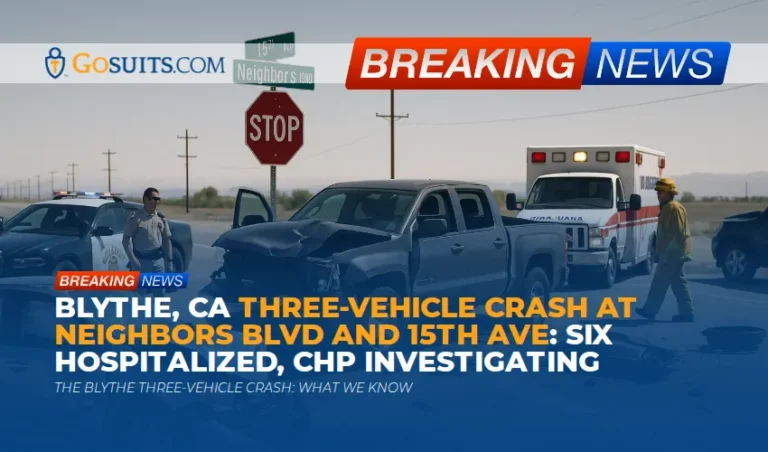
Six people were hospitalized after a three-vehicle collision late Sunday morning in Blythe. According to information released publicly, the crash happened around 11:30 a.m. near the intersection of Neighbors Boulevard and 15th Avenue. Riverside County Fire Department responders reported one individual required extrication from a vehicle. Two people sustained serious injuries and were airlifted to a hospital. Four others had minor to moderate injuries and were taken by ground ambulance. A seventh person was evaluated by paramedics and declined further care. The California Highway Patrol assumed the investigation at the scene.
Neighbors Boulevard and 15th Avenue sit in Blythe’s Palo Verde Valley, just north of I-10 and not far from agricultural fields that see regular truck and farm equipment traffic. At that time of day, local residents are often out for errands or church, and through-traffic on Neighbors can move quickly between neighborhoods. Details about the precise sequence of events, vehicle movements, and contributing factors have not yet been released. CHP will typically collect and review physical evidence, statements, and any available video before releasing a formal collision report.
Why multi-vehicle intersection crashes are so dangerous
Crashes that involve three or more vehicles at or near intersections can produce complex dynamics and severe injuries. Secondary impacts, chain reactions, and side impacts increase the risk of trauma to occupants, even at moderate speeds. National research has long recognized intersections as high-conflict zones where crossing, turning, and merging paths overlap. When drivers misjudge a right-of-way, fail to yield, or are distracted, the risk of a T-bone or angular crash rises significantly, and such impacts are associated with higher rates of serious injury compared with rear-end collisions [7].
Protective measures like proper seat belt use reduce the risk of fatal and severe injury for front and rear occupants in these crash types. While specific occupant restraint use has not been released in this Blythe incident, national data underscores that restraints and correct child seat use remain among the most effective injury mitigations in multi-vehicle collisions [7].
How fault is investigated in three-car collisions
For a collision like the one reported at Neighbors Boulevard and 15th Avenue, investigators generally work through a methodical process:
- Scene documentation: Officers record vehicle resting positions, skid or yaw marks, fluid trails, and debris fields. They may diagram the intersection and measure distances to reconstruct pre-impact paths.
- Vehicle inspections: Crush patterns, airbag deployments, and damage profiles help indicate speed and angle of impact.
- Witness statements: Independent witnesses can clarify signal phases, stop sign compliance, or abrupt maneuvers.
- Onboard and external data: Some vehicles store event data. Investigators may also seek camera footage from nearby businesses or traffic systems.
- Injury profiles: Patterns of injury can correlate with impact direction and severity, though medical findings are primarily for patient care.
In California, responsibility for damages can be shared under the doctrine of comparative fault. That means multiple drivers may each bear a percentage of responsibility, and compensation can reflect those allocations [3]. Ultimately, the official CHP traffic collision report becomes a key record that insurers and attorneys review closely during the claims process [1].
Immediate next steps for those involved
In the hours and days after a multi-vehicle collision, it can feel overwhelming. A steady, stepwise approach can protect health and preserve important information.
- Seek thorough medical evaluation: Even if injuries seem minor, get checked. Some conditions, including concussions and internal injuries, can be delayed in presentation.
- Preserve documentation: Save discharge instructions, imaging records, medication lists, and receipts. Keep a simple daily log of pain and limitations. Photos of vehicles, road markings, and visible injuries are helpful if you have them.
- Be cautious with insurance communications: Before giving a recorded statement to any insurance carrier, consider speaking with an attorney first. Early statements can be used later to limit or dispute claims.
- Note all involved parties: Record plate numbers, insurer names, and policy numbers if available. In three-vehicle incidents, multiple coverages may apply and can interact in surprising ways.
- Track work and activity impacts: Missed shifts, reduced duties, and lost opportunities are part of many claims. Keep supervisor notes and pay stubs reflecting changes.
For those exploring their options or looking for clarity on next steps, talking with seasoned, local counsel can help identify which coverages may be available, how to prioritize medical billing issues, and what to expect from the CHP reporting timeline. In many situations, Blythe car accident lawyers can also help shield claimants from aggressive insurer tactics while evidence is gathered and medical care progresses.

How to request official records and updates
CHP traffic collision report
Because the California Highway Patrol is handling this investigation, requests for the official collision report are routed to CHP using Form CHP 190. The form outlines who may obtain a report, acceptable proof of identity, and submission options. Reports are not immediately available; they are typically released after review and approval by the investigating area office. The state provides instructions for requesting CHP reports [1].
DMV accident reporting requirement
Separately from the law enforcement report, California requires drivers to file a DMV SR-1 report within 10 days if the crash involved injury, death, or property damage exceeding $1,000. This filing requirement applies even if law enforcement took a report, and failure to file can lead to license-related consequences. The DMV provides the SR-1 form and submission guidance online [2].
Fire and EMS information
Riverside County Fire Department, which responded to the scene, may generate incident documentation. Patient medical records are protected by privacy laws, but incident summaries or non-medical records may be obtainable via a public records request. California’s Public Records Act outlines public access to information held by state and local agencies [10].
Medical records
Hospitals and air ambulance providers keep detailed treatment records. Patients can request copies directly from the treating facility’s Health Information Management department. If a patient was transported by helicopter, that provider will have a separate billing record and care summary for the transport. Retain these records in a single folder for ease of reference during the claims process.

Coroner records
There have been no reports of fatalities in this collision. However, when a traffic incident does involve a death in Riverside County, next of kin typically coordinate with the Riverside County Sheriff Coroner for status updates, identification processes, and autopsy reports. Families usually must provide proof of relationship to obtain records. Timelines can vary based on investigative needs.
Medical transport and trauma care in the Palo Verde Valley
Two patients in this incident were transported by helicopter, indicating that EMS crews suspected a higher level of trauma care might be needed. In California, prehospital teams use triage criteria to identify patients who may benefit from advanced trauma center resources. The state’s trauma system guidance and regional protocols help ensure the most seriously injured are routed to appropriate facilities as quickly as possible [6].
Helicopter transports from the Blythe area are not uncommon when higher-level trauma services are needed quickly and ground transport times are long. Crews coordinate destination decisions based on injury patterns, vital signs, distance to designated trauma centers, and air availability. Families should be aware that medevac providers and receiving hospitals generate separate records and bills, so it is important to keep both together when organizing paperwork for insurance or potential claims.
Insurance after a three-vehicle crash: whose policy applies
Three-vehicle collisions often raise complicated insurance questions. Depending on the facts, multiple policies can come into play, including liability coverage for one or more drivers, medical payments coverage, underinsured motorist coverage, and sometimes commercial or employer policies if a vehicle was being used for work.
- Liability coverage: Pays for injuries and damage others suffer due to the at-fault driver. When more than one driver shares fault, insurers may apportion responsibility and negotiate based on available evidence [3].
- Medical payments (MedPay): Optional coverage that may help with immediate medical expenses regardless of fault, depending on the policy.
- Uninsured/underinsured motorist (UM/UIM): May apply when the responsible party lacks sufficient coverage.
- Multiple claimants: In multi-vehicle events with several injured claimants, per-accident liability limits can be reached quickly. That is why early evidence preservation and clear documentation of injuries matter.
One practical question comes up frequently in these scenarios: in what order do insurers pay, and which coverage is considered primary? This often depends on policy language, fault determinations, and whether any vehicle was used for business at the time. For a deeper dive into priority of payments in multi-car claims, see Which insurance pays first after a multi car crash.
It is common for insurance adjusters to ask for recorded statements early. Before speaking with any insurer, consider consulting with car accident lawyers to understand how those statements can affect claim valuation and how to coordinate benefits across multiple policies.
Potential civil liability themes in intersection collisions
Without speculating about this specific incident, several recurring civil liability issues often arise in intersection crashes like the one reported at Neighbors Boulevard and 15th Avenue:
- Right-of-way and yielding: California’s driver handbook and Vehicle Code outline right-of-way rules at controlled and uncontrolled intersections, including stop signs and traffic signals [9].
- Signal compliance: Entering an intersection against a red signal or failing to stop fully at a stop sign can form the basis of negligence when supported by evidence [9].
- Speed and safe following distance: Even a lawful speed can be unsafe under the conditions if visibility or traffic patterns require more care.
- Distraction and inattention: Distraction can contribute to delayed reaction times and missed signals.
- Comparative fault allocations: More than one driver can share responsibility. California allows fault to be apportioned among multiple parties, which can affect recovery amounts [3].
- Public entity considerations: If a traffic control device malfunctioned or roadway maintenance was implicated, separate procedures can apply for potential claims against public entities, and those procedures have short deadlines [5].
Key California timelines and deadlines
Deadlines can arrive quickly after a serious collision. Missing one can waive important rights.
- DMV SR-1 report: Due within 10 days if there is injury, death, or qualifying property damage, even when police respond [2].
- Personal injury statute of limitations: Generally two years from the date of injury to file a civil action in California [4].
- Claims involving public entities: A government claim is commonly due within six months of the incident before a lawsuit can be filed, if a public entity may bear responsibility in some way [5].
Given these timeframes, it is wise to start gathering records early. Even if an individual is still in active medical treatment, initial steps like requesting the CHP report and organizing medical bills and records can proceed in parallel.
Local context: Blythe roads, traffic patterns, and seasonal conditions
Neighbors Boulevard serves residents moving between neighborhoods, schools, and local businesses, with agricultural and service vehicles in the mix. On many weekends, Blythe also sees drivers traveling to and from I-10, with visitors stopping for fuel or food downtown. Midday sun in the Palo Verde Valley can be intense, and at certain times of year, glare at intersections can be a concern. When winds pick up across the flat valley floor, dust can also reduce visibility. None of these factors determine fault by themselves, but they do influence safe speeds, following distance, and reaction time.
Community members know that intersections near fields or along routes frequented by large pickups and equipment can change quickly from quiet to busy. As CHP completes its investigation, the official report will help clarify whether any of these contextual elements had a role and how the vehicles interacted before impact.
How families can track credible updates without rumors
Accurate information takes time. While social media can spread details quickly, it often lacks verification. These steps help families and neighbors stay grounded:
- Rely on official releases: Check for updates from CHP area offices and county agencies. The formal CHP report, once available, is the most complete single document on crash findings [1].
- Use the Public Records Act thoughtfully: California’s Public Records Act provides a framework to request non-exempt government records, which can include certain incident logs or non-medical summaries [10].
- Keep medical privacy in mind: Hospitals and EMS providers protect patient information by law. Families can coordinate directly with treating facilities for their loved one’s records.
- Document your own timeline: Maintain a personal record of care, transport, and communications. This helps align your information with official documentation when it arrives.
Action steps to protect your rights now
This section is designed to explain why prompt, informed action matters and what can be done, without urging any particular person or family to take specific steps.
- Request the CHP collision report: Begin the process using the state’s instructions. Reports can take time to finalize, so starting early helps align medical and insurance documentation when it arrives [1].
- File the DMV SR-1 if required: California requires this report within 10 days after a crash with injury, death, or qualifying property damage. Timely filing helps avoid licensing complications [2].
- Organize medical and billing records: Keep one folder for ER notes, imaging, prescriptions, therapy referrals, and invoices. Clear records make it easier to show what care was required and when.
- Avoid early recorded statements: Statements can be used later to dispute claims or minimize injuries. Speaking with an attorney before engaging insurers helps people understand their rights and risks.
- Calendar legal deadlines: Note the two-year injury statute and the six-month government claim deadline if a public agency could be implicated in any way [4] [5].
- Preserve evidence: Save dashcam files, keep damaged parts, and list nearby cameras that may have captured the collision. Evidence gets lost quickly at busy intersections.
Acting now can reduce the chance of missed deadlines, lost evidence, and insurance confusion. It also supports better continuity of care by keeping treatment records and bills in order.

Commentary from Gosuits Blythe, California Personal Injury Attorney
Our hearts are with everyone affected by the three-vehicle crash at Neighbors Boulevard and 15th Avenue. Serious injuries and air transports are frightening for families and friends who are simply trying to piece together what happened. This commentary is meant for general information and education.
From a civil injury perspective, intersection collisions involving three vehicles almost always trigger complex questions about right-of-way, timing, and vehicle movements. CHP’s thorough documentation and the final collision report are central to understanding how and why the impacts occurred. In our experience, careful review of impact points, road marks, and any camera footage can be decisive in clarifying fault allocations under California’s comparative fault system.
Insurance carriers often move fast in these situations. Adjusters may ask for recorded statements early, and multi-claimant events can strain liability limits. Large carriers and corporate risk managers understand how to shape the narrative before all facts are in, sometimes steering injured people into quick statements that later limit their options. That is one reason why early, knowledgeable guidance matters. It can prevent common pitfalls such as inadvertent admissions, incomplete injury documentation, or missed coverage opportunities.
Finally, for anyone facing medical transports, multiple providers, and fast-changing health needs, a no-cost consultation can be an important first step. It provides space to ask questions, understand timelines, and plan next steps without committing to a course of action. Whether the next move involves requesting the CHP report, coordinating insurance benefits, or mapping out a long-term recovery plan, having a clear picture of rights and responsibilities can make a difficult process more manageable.
References
- How to Obtain a Traffic Collision Report CHP 190 – California Highway Patrol
- SR-1 Report of Traffic Accident Occurring in California – California DMV
- Judicial Council of California Civil Jury Instructions Overview including Comparative Fault – California Courts
- Code of Civil Procedure 335.1 Two-Year Limitation for Injury or Death – California Legislature
- Government Code 911.2 Presentation of Claims to Public Entities – California Legislature
- Trauma System Program Overview – California Emergency Medical Services Authority
- Crash Factors in Intersection-Related Crashes: An On-Scene Perspective – NHTSA
- Traffic Signs and Signals – California Driver Handbook – California DMV
- Right-of-Way Rules – California Driver Handbook – California DMV
- California Public Records Act General Information – California Attorney General