- Multi-car crash in Blythe: what we know
- Where and when it happened
- Emergency response and patient transport
- How CHP investigates intersection crashes
- Immediate steps and rights after a serious crash
- How to get official records and reports
- Medical follow-up after air and ground transport
- Insurance and liability in a three-car California crash
- Preserving evidence from an intersection collision
- Local context in Blythe and Riverside County roads
- Next steps and why timely action matters
- Commentary from Gosuits Blythe, California Personal Injury Attorney
- References
Multi-car crash in Blythe: what we know
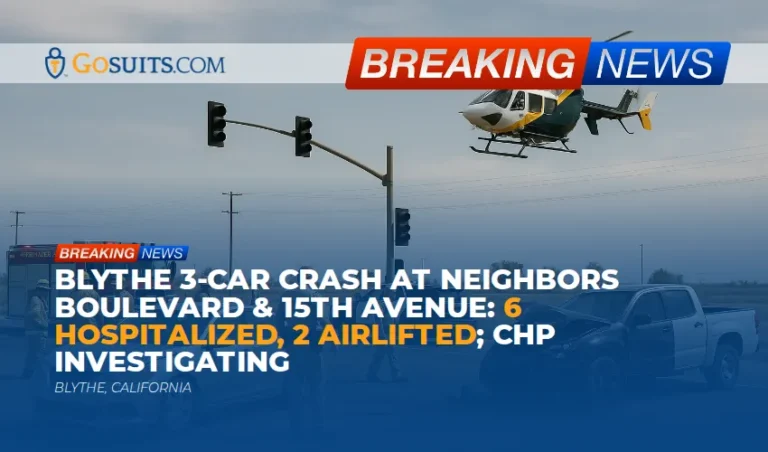
Late Sunday morning, a three-car collision at a Blythe intersection left six people hospitalized and one additional person evaluated at the scene. Riverside County firefighters reported that the crash involved seven total patients, one of whom had to be extricated from a vehicle. Two people with serious injuries were flown by medical helicopter, while four with minor to moderate injuries went by ground ambulance. One person declined further care after paramedics evaluated them. California Highway Patrol officers were notified and assumed the investigation into how the crash occurred. As of the initial reports, no arrests were announced.
When a crash like this shakes a tight-knit community such as Blythe, people naturally want clarity and support. Residents know the crossing of Neighbors Boulevard and 15th Avenue well, whether heading to Palo Verde College, crossing town toward Hobsonway and I-10, or taking Neighbors Boulevard south toward the river and agricultural fields. In the aftermath, it helps to understand what happens next with the investigation, what injured people and their families can do right away, and how insurance typically works after a multi-vehicle collision in California.
Where and when it happened
According to Riverside County fire officials, the collision happened around 11:30 a.m. at the intersection of Neighbors Boulevard and 15th Avenue in Blythe. That crossing sits in a mix of residential streets and local corridors that connect to key community spots along Neighbors Boulevard. Late morning traffic often includes local families, workers, and weekend travelers moving through the area to reach I-10 or the riverfront. While the precise cause remains under investigation by CHP, intersection crashes are a well-recognized safety concern statewide and nationally, with federal transportation agencies publishing ongoing guidance to reduce these incidents [1] [2].
Emergency response and patient transport
Firefighters reported a complicated scene, including one person requiring extrication. That typically triggers additional rescue resources, as well as coordination with air medical teams if injuries appear severe. California’s trauma system prioritizes getting seriously injured patients to the right level of care as quickly as possible. Helicopter transport can significantly reduce transport time when the nearest trauma center is far from a rural community or when roadway congestion would delay ground ambulances [5].
Here, two patients were flown for advanced care, and four others were transported by ground. That combination is common when responders triage multiple patients at a single scene, matching injury severity with transport mode and destination.
How CHP investigates intersection crashes
CHP took the lead on the investigation, which is standard when a crash occurs on a state route or when local agencies request CHP’s assistance. Investigators typically document vehicle resting positions, roadway evidence like skid or yaw marks, debris fields, airbag deployment, and any visible vehicle damage patterns. They also gather driver, passenger, and witness statements; review available traffic signal timing and phasing data; and look for video from dash cameras, nearby businesses, or public surveillance systems. Collision reports aim to record facts and contributing factors such as right-of-way rules, speed, line of sight, and any potential violations related to the intersection [4].
For multi-vehicle crashes, fault can be shared among more than one driver under California’s comparative fault system. Investigators’ findings often inform insurers’ liability decisions, but insurance carriers sometimes disagree. That is one reason why preserving your own evidence and getting independent evaluation can be so important.
Immediate steps and rights after a serious crash
If you or a loved one were involved or impacted, the first days matter. Medical stability comes first, followed by a few key protections that can preserve health, finances, and legal options. Consider the following:
- Get a full medical assessment even if you feel “okay.” Adrenaline can mask symptoms. Ask for follow-up imaging or specialist referrals if pain, headaches, dizziness, or numbness develop or worsen within 24 to 72 hours.
- Document everything including photos of vehicles, the intersection from multiple angles, debris, glass, tire marks, and traffic signal heads. Keep discharge papers, imaging reports, and all bills.
- Save potential video evidence by preserving dash-cam footage and noting nearby businesses or homes with cameras that may capture approach paths or signal phases.
- Avoid detailed statements to insurance right away. In complex three-car collisions, offhand comments can be misunderstood and used to minimize injury claims later. Speak with a qualified attorney first to understand your rights.
- Note missed work and out-of-pocket costs from day one. Keep receipts, mileage to appointments, pharmacy costs, and caregiving or childcare expenses tied to the crash.
When considering legal support, many people search for car accident lawyers to help organize evidence, handle communications, and protect against common insurance pitfalls. The goal is to let injured people focus on healing while claims are properly documented and deadlines are met.
How to get official records and reports
Official documents help establish what happened and how claims should be evaluated. These records are routine to request, though each agency follows its own process. Here are the most relevant sources for an incident like this:
CHP traffic collision report
When CHP leads the investigation, the primary traffic collision report and any additional narratives, diagrams, or supplemental pages are maintained by CHP. Families and involved parties can request a copy after it is approved and released. You can locate the correct area office and inquire about obtaining the report and the CHP 190 request form through CHP’s official site [4]. Have the report number, date, time, and location ready if possible.
DMV accident reporting requirement
Separately from the police report, California requires drivers to submit an SR-1 form to the DMV within 10 days if anyone was injured or if property damage appears to exceed a threshold set by state regulations. This is not a fault admission; it is a statutory reporting requirement. The DMV provides the SR-1 form and instructions online [3].
Medical and EMS records
Ambulance and air medical providers maintain their own run sheets and care records. Hospitals maintain emergency department records, imaging studies, and discharge summaries. Each provider has a standard medical records request process. Patients can request copies for personal use and to support injury claims. California’s trauma system standards guide triage and transport decisions that may appear in those records [5].
Coroner information
In this incident, no fatalities were reported at the time of the initial updates. In cases where a death does occur, the Riverside County Sheriff Coroner’s Office would handle examinations and release reports to next of kin upon completion. Families typically need a case number and proof of relationship to request records.
911 audio and traffic signal data
Depending on agency policies and retention schedules, it may be possible to request 911 call audio or Computer Aided Dispatch logs, as well as traffic signal timing and event logs from the jurisdiction responsible for the intersection. Access and timelines vary. A timely, well-scoped request can be important because some electronic data is overwritten on short cycles.
Medical follow-up after air and ground transport
Two patients were airlifted, which is consistent with trauma triage practices when significant injuries are suspected or when rapid transport to a higher level of care is needed. California’s trauma care framework emphasizes getting severe cases to designated trauma centers, where specialists and resources are available around the clock [5].
Even for those transported by ground with “minor to moderate” injuries, it is common for additional symptoms to surface later. Soft-tissue injuries, concussions, and internal injuries can evolve over days. Follow your discharge instructions, return for care if symptoms worsen, and keep a daily journal of pain, limitations, and sleep disruptions. That record helps your medical team and serves as contemporaneous documentation for any future claim reviews.
Insurance and liability in a three-car California crash
Three-car collisions involve multiple insurance layers and sometimes overlapping fault. California uses a comparative fault system, which means liability can be shared among drivers based on their percentage of responsibility. Adjusters will examine the police report, photos, statements, and any video to allocate fault and decide who pays for what. The process can be confusing and slow, especially when insurers disagree on signal phases or right-of-way at an intersection. A clear documentation strategy and careful communications are essential.
For a practical walkthrough of how coverage can stack in these scenarios, see our in-depth guide, which insurance pays first after a multi car crash. It explains primary liability coverage, medical payments coverage, and how underinsured motorist claims may come into play when multiple parties are involved.
Before contacting any insurer for a recorded statement, it is wise to consult a qualified attorney. What someone says early on can be taken out of context and used to question injuries or fault later. Many people in Riverside County look for Blythe car accident lawyers after complex intersection crashes because coordination across multiple carriers can be time consuming, and deadlines for medical documentation or claims can sneak up.
Key concepts to keep in mind include:
- Property damage vs. injury claims: These are related but separate. Do not sign a property damage release that also waives injury claims.
- Medical payments coverage: Sometimes available under your own auto policy to help with early medical bills regardless of fault.
- Underinsured motorist coverage: Can help when at-fault drivers lack enough coverage to pay for all injuries in a multi-vehicle incident.
- Hospital and insurer liens: Health insurers or hospitals may assert reimbursement rights from eventual settlements. Understanding these early can prevent surprise bills.
If you decide to seek legal help, many people start by consulting car accident lawyers to review coverage maps, coordinate statements, and protect against low or premature settlement offers.
Preserving evidence from an intersection collision
Intersection cases turn on details. The sooner you capture and protect those details, the better your ability to show what really happened. Here is a focused list:
- Photographs and video: Get wide shots showing lane lines, signal heads, crosswalks, stop bars, and approach angles. Capture vehicle damage close-ups and the interior areas where airbags deployed.
- Traffic signal data: In some jurisdictions, controllers log events like phase calls and preemptions. Ask how long logs are retained and whether maintenance records exist for the intersection.
- Dash-cam and nearby camera footage: Obtain the file before it overwrites. Approach nearby businesses respectfully about retaining copies while you request them.
- Vehicle data: Certain vehicles store crash data that can be downloaded and interpreted. Talk with counsel about sending preservation letters to storage yards and insurers to avoid spoliation.
- Witness list: Names, contact information, and brief notes about what each person saw. Memory fades quickly, so early outreach is crucial.
Federal safety agencies underscore that intersection crashes remain a major source of severe injuries nationwide, and targeted countermeasures like signal timing improvements, protected turn phases, and sightline management can reduce risks [1] [2]. While agencies work on systemic fixes, thorough evidence collection helps individuals reach fair outcomes in the current system.
Local context in Blythe and Riverside County roads
Blythe sits along the Colorado River at the Arizona line, with I-10 bringing a steady flow of travelers and commercial traffic. Neighbors Boulevard functions as a key north-south route through town and connects residents to schools, parks, and services. Seasonal patterns matter here. Winter visitors increase traffic volume, and late morning weekend hours bring a mix of locals and out-of-town drivers navigating unfamiliar streets. Agricultural cycles in the Palo Verde Valley can add slow-moving equipment and trucks at certain times of the year. None of that explains this particular crash, but it does reflect the day-to-day conditions residents know well.
Community members often tell us their biggest concerns include speeding through intersections, red-light running, and limited sightlines near certain corners. Regional and national data affirm that intersection conflicts are a persistent source of risk. That is why many families who travel Neighbors Boulevard want prompt updates on investigations and visible safety steps if any issues with signage, signals, or visibility are identified [2] [8].
Next steps and why timely action matters
There is a lot to do after a serious collision, and it is easy to feel overwhelmed. Acting in a timely and organized way makes a real difference.
- Secure the official collision report: The report anchors insurance decision making. Without it, adjusters often stall or rely on incomplete information [4].
- Comply with DMV reporting: California requires the SR-1 if anyone was hurt or property damage exceeds the statutory minimum. Missing this deadline can complicate things later [3].
- Get all your medical records: Ambulance, air transport, emergency department, imaging, and follow-ups. Consistency between documented symptoms and later claims is important.
- Preserve time-sensitive evidence: Traffic video and some signal logs are overwritten quickly. Early requests can be the difference between having proof or not.
- Understand key deadlines: California’s general statute of limitations for personal injury is two years from the date of injury, with shorter timelines if a public entity may be involved. Do not let time run short while treatment continues [7].
- Choose the right communication strategy: In multi-car collisions, statements given out of sequence can be used against you. Speak with counsel first, then decide what to provide to which insurer and when.
What should people actually do?
- Request the CHP report once it is available and verify all information is accurate.
- Organize a single claim file with medical bills, proof of missed work, photos, and notes.
- Schedule follow-up medical visits and keep a daily pain and activity log.
- Consult an attorney before calling insurers to plan how to handle recorded statements and documentation.
Why act now? Because evidence disappears, memories fade, and administrative deadlines keep moving regardless of your recovery timeline. Coordinating these steps early supports better clarity and can reduce the chance of claim delays.
Commentary from Gosuits Blythe, California Personal Injury Attorney
First, our hearts are with everyone hurt in this collision and with their families. Reading that one person had to be extricated and two were airlifted is alarming for any community, especially in a place as close-knit as Blythe. Everything here is offered for general information, not as a directive about anyone’s specific situation.
From our perspective, a three-car intersection crash raises classic questions about right-of-way, signal timing, and driver attention. Investigators will piece together vehicle paths and what each person could see as they approached. Because comparative fault can apply, it is common for insurers to dispute percentages of responsibility. That makes early evidence preservation and careful documentation essential.
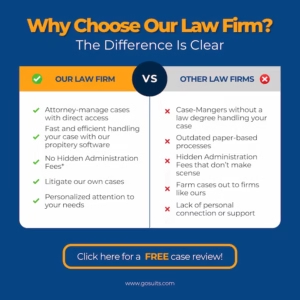
In our experience, large insurance companies and corporate defendants often bank on the complexity of these cases. They may ask for quick recorded statements, push for broad medical authorizations, or make early offers that do not reflect the true scope of injuries or long-term needs. When people have not navigated a claim before, it is easy to say something that later gets spun against them or to accept a resolution before all injuries are fully understood.
A free consultation can be an important first step for anyone sorting through transport bills, missed work, and multiple claims. It helps people understand timelines, how to coordinate with medical providers, and the best way to communicate with insurers so nothing important is lost or misinterpreted.
References
- Intersection Safety – NHTSA
- Intersection Safety – Federal Highway Administration
- SR-1 Report of Traffic Accident Occurring in California – California DMV
- Find an Office – California Highway Patrol
- Trauma System and Trauma Centers – California EMS Authority
- NHTSA Crash Stats and Data Tools – NHTSA
- California Code of Civil Procedure 335.1 – Statute of Limitations
- Media and Research – California Office of Traffic Safety