- What happened at Green Hill Drive and Pinto Place
- Where and when the crash occurred, and who responded
- Early remarks from officials and why they matter
- Cyclist and transit driver duties under California law
- Possible civil liability in a bus and bicycle fatality
- Evidence that can clarify what happened
- How to get key public records in Los Angeles County
- Deadlines that can affect a civil claim in California
- Insurance and public entity issues in transit crashes
- Santa Clarita Valley context and safety considerations
- Practical steps for neighbors and witnesses
- Calm, informed actions families can take this week
- Call-to-Action: Timely steps that protect legal options
- Commentary from Gosuits Castaic, California Personal Injury Attorney
- References
What happened at Green Hill Drive and Pinto Place
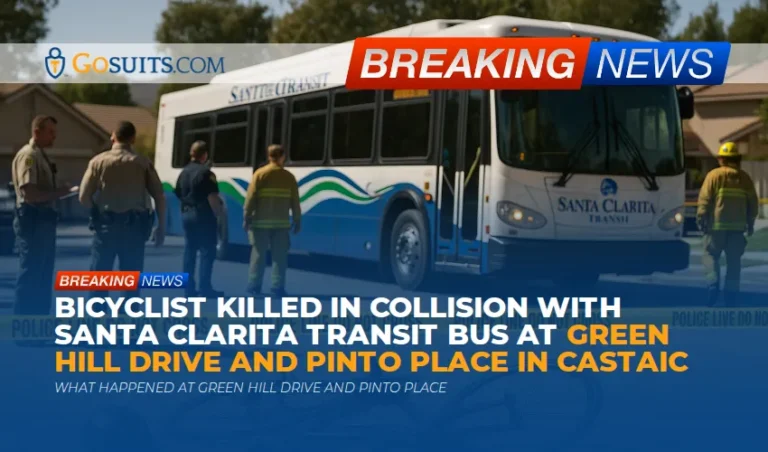
Early Wednesday morning, March 11, 2026, a bicyclist was killed following a collision with a City of Santa Clarita Transit bus at the intersection of Green Hill Drive and Pinto Place in Castaic. According to the California Highway Patrol Newhall Area Office, a 57-year-old man on a bicycle was pronounced deceased at the scene by Los Angeles County Fire Department personnel. CHP noted in preliminary remarks that the bicyclist may have drifted into the bus’s lane. A single passenger riding the bus reportedly left before officers arrived, while the bus driver remained and cooperated with investigators.
This intersection sits in a residential pocket north of the I-5 corridor where morning traffic includes commuters, school drop-offs, and service vehicles. Neighbors often walk dogs and cyclists use the rolling streets that connect to Castaic’s hills. Crashes in these quiet interior streets are rare, so the community’s shock is understandable.
Where and when the crash occurred, and who responded
Time of call: approximately 7:34 a.m. Location: Green Hill Drive at Pinto Place, Castaic, Los Angeles County. Responding agencies included the CHP Newhall Area Office, the Los Angeles County Fire Department, and the Los Angeles County Medical Examiner. CHP officers secured the scene to document physical evidence and roadway conditions, while Fire Department personnel confirmed there were no transports. The Medical Examiner’s Office took jurisdiction of the deceased and has not yet released the individual’s identity pending notification of next of kin.
In the Santa Clarita Valley, the CHP Newhall Area typically investigates fatal traffic incidents outside incorporated city police jurisdictions, especially where state routes and county roads intersect. The City of Santa Clarita Transit operates fixed-route buses that run through neighborhoods and major corridors like The Old Road, Valencia Boulevard, and McBean Parkway, connecting residents to work hubs and medical facilities.
Early remarks from officials and why they matter
CHP’s early comment that the bicyclist may have drifted into the bus’s lane is preliminary. It provides context but does not determine civil fault. Civil findings consider a broader set of facts: vehicle speeds, sightlines, braking and steering inputs, compliance with right-of-way rules, roadway design, conspicuity of the cyclist, and the professional obligations of a transit operator. Official reconstruction can take weeks or months as agencies review scene diagrams, onboard video, and witness accounts. Families should know that early statements are just one piece of the puzzle and can change as more evidence is analyzed.
Cyclist and transit driver duties under California law
California law recognizes a bicycle rider’s right to use most roadways and subjects cyclists to the same rules of the road as drivers, with some bicycle-specific provisions. Vehicle Code section 21200 states that bicyclists generally have the same rights and duties as the driver of any other vehicle on the roadway [1]. California’s Three Feet for Safety Act, Vehicle Code section 21760, requires drivers passing a bicyclist to give at least three feet of clearance, or to slow to a safe speed if three feet is not possible when passing [2]. Professional drivers, including bus operators, are expected to follow these and all other traffic safety statutes at all times.
At the same time, bicyclists must ride as close as practicable to the right-hand curb or edge when slower than traffic, except in specific situations such as preparing for a left turn, avoiding hazards, or when a lane is too narrow for a bicycle and a vehicle to travel safely side by side. Everyone on the road shares responsibilities that are assessed in light of real-world conditions, like a narrow lane, parked vehicles, or a blind curve common on some Santa Clarita Valley residential streets.

Possible civil liability in a bus and bicycle fatality
When a crash involves a public transit bus and a bicyclist, several parties may be implicated in a civil investigation, depending on the facts:
- Transit operator and employer: The operator’s conduct, training, and compliance with safety policies are routinely examined. If negligent operation contributed to the collision, the public entity employer could face liability under respondeat superior.
- Public entity maintenance and fleet safety: Brakes, steering, lighting, mirrors, tire condition, and camera systems are relevant. Maintenance records can indicate whether the vehicle was safe to operate.
- Roadway design or signage: If an intersection’s sightlines, signage, or pavement markings are alleged to be dangerous, potential roadway design issues may be explored.
- Comparative fault: California applies comparative negligence in civil cases. The fact finder may consider the actions of all involved to apportion responsibility consistent with the evidence.
Because a death occurred, families often look for information about wrongful death claims. In general, California allows certain heirs to seek civil remedies for a death caused by wrongful act or neglect. Legal strategy depends on the evidence, the involvement of a public entity, and strict time limits that apply to claims against government agencies.
In conversations about legal representation, some families look for fatal accident lawyers who understand both traffic and public-entity claim procedures. Experienced counsel can coordinate with investigators, protect evidence, and help families understand the path ahead without making promises about outcomes.
Evidence that can clarify what happened
Traffic fatalities involving transit vehicles often generate multiple layers of evidence. Prompt preservation requests are important because some data can be overwritten within days or weeks.
- Onboard bus video: Modern city buses frequently carry outward- and inward-facing cameras. These can show lane positions, distance, horn use, and driver reactions. Families or their representatives can send a written preservation notice to the transit agency to prevent routine deletion.
- Vehicle data and telematics: Some buses store speed, brake application, turn signals, and throttle position. Telematics can corroborate timeline and driver inputs.
- Third-party video: Doorbell cameras and security cameras on nearby homes in Castaic neighborhoods often capture street activity. A timely canvass can secure valuable footage before it auto-deletes.
- Scene evidence: Tire marks, debris fields, gouge marks, scuff marks from a bicycle pedal, and final rest positions help reconstruct the collision. Photos with scale markers are ideal.
- 911 audio and CAD logs: Dispatch times and caller observations can support a timeline.
- Medical Examiner documentation: Cause and manner of death, along with injury patterns, may inform direction of impact and mechanism of injury when cross-referenced with scene data.
One practical guide families often find useful is the Los Angeles Wrongful Death Paperwork Checklist for Families, which outlines documents that commonly matter in the first weeks.
How to get key public records in Los Angeles County
Several agencies maintain records that can help answer what happened. Each has its own process and timing.
CHP Traffic Collision Report
The investigating agency’s collision report is foundational. The CHP explains how traffic collision reports are requested, including eligibility and time frames, on its public portal [3]. Families can typically request reports as next of kin. You may need the date, location, and party names if known. When a public entity’s bus is involved, request any supplemental diagrams or reconstruction attachments as they become available.
Los Angeles County Medical Examiner-Coroner
Next-of-kin can request decedent records, including cause of death and examination reports, from the Los Angeles County Department of Medical Examiner. The department provides record request instructions and helps families understand timelines and any fees [4]. Identification and notification must be completed before a name is released publicly.
Los Angeles County Fire Department incident records
Fire incident reports and, where available, prehospital care records can be requested from the Los Angeles County Fire Department. The department explains how to request incident documentation on its website [5]. These records can confirm dispatch, arrival times, and field observations.
City and transit records
Since a City of Santa Clarita Transit bus was reportedly involved, families may seek public records related to the vehicle, driver training, maintenance logs, and route details. California’s Public Records Act provides a framework to request agency records. The California Attorney General offers a summary of the Public Records Act that explains rights of access and basic procedures for making a request [6]. Requests for transit video should be made as soon as possible to help ensure data is preserved.
Deadlines that can affect a civil claim in California
Time limits are critical, especially when a public entity may be involved.
- Government claim deadline: For claims against a public entity in California, a written claim generally must be presented no later than six months after the date of the incident for personal injury or wrongful death. This requirement appears in Government Code section 911.2 [7].
- Deadline to file suit after claim rejection: If a claim is rejected, there are short windows to file a lawsuit. Government Code section 945.6 sets those time periods, commonly six months from the date of rejection notice for claims subject to the Act [8].
- General wrongful death statute of limitations: Outside of public entity claims, the general California deadline for wrongful death is typically two years from the date of death, under Code of Civil Procedure section 335.1 [9].
These are general summaries of statutes. Because deadlines are unforgiving, many families consult an attorney promptly to calculate the correct timeline for their specific situation. Statements made to an insurer or public agency can be used later, so getting guidance before contacting any insurance carrier can help avoid missteps.
Insurance and public entity issues in transit crashes
Transit systems are public entities. Some are self-insured, some participate in risk pools, and some carry excess coverage. Claims typically begin with a statutory government claim, not a standard liability adjuster call. That process differs from a typical private auto claim and often has stricter formatting and content requirements. It can also trigger an internal investigation spanning operator interviews, camera downloads, and fleet safety audits.
If multiple vehicles or road users are involved, insurers may dispute fault allocation. Evidence from bus video and telematics can reduce disputes. It is not uncommon for insurance teams to contact family members early. Before speaking with any insurer, consider consulting with counsel. Early recorded statements can shape the narrative and may be cited back in later proceedings.
Families in Los Angeles County sometimes search for Castaic fatal accident lawyers with experience handling public-entity transit collisions and wrongful death procedures. Seasoned legal teams can help coordinate preservation letters, interface with agencies, and monitor release of official findings while keeping families updated.
Santa Clarita Valley context and safety considerations
The Santa Clarita Valley includes a mix of high-speed arterials and quiet residential loops. Morning hours around 7:30 a.m. can be busy, with sun angles that change visibility, school traffic, and service vehicles circulating through neighborhoods like Castaic, Saugus, and Valencia. Even without bike lanes, cyclists have the legal right to use most roadways, and operators of large vehicles must exercise due care around vulnerable road users.
On a broader level, bicyclist safety remains a concern statewide and nationally. NHTSA’s bicyclist safety resources track national trends and provide prevention insights [10]. The California Office of Traffic Safety highlights statewide traffic safety priorities, including biking safety, and publishes county-level research tools used by agencies to focus interventions [11]. Locally, that can translate to engineering adjustments, targeted enforcement, and community education for both drivers and cyclists.
Practical steps for neighbors and witnesses
In a close-knit area like Castaic, neighbors often want to help. If you saw anything or have relevant video, your information may be important to investigators and the family.
- Share video promptly: Save any doorbell or security footage from Green Hill Drive, Pinto Place, or adjacent streets. Back it up and note the exact time and camera location.
- Write down what you saw: Note positions, directions of travel, signals, and sounds like a horn or braking.
- Contact investigators: Reach out to the CHP Newhall Area Office with your footage and a short description of what you observed. Preserve the original file until an investigator confirms receipt.
- Avoid speculation online: Public posts can spread incorrect information and complicate investigations. Share information directly with investigators.
Calm, informed actions families can take this week
In the immediate aftermath of a fatal crash, things move fast. Steady, methodical steps help preserve options while allowing space to grieve.
- Designate a point person: Choose a family member to handle communication with agencies. This keeps information organized and reduces repeated, painful conversations.
- Request official records: Start the process for the CHP traffic collision report [3] and Medical Examiner records [4]. Ask for updates if supplemental reports will be added later.
- Preserve personal items and the bicycle: Do not repair or dispose of the bicycle, helmet, lights, or clothing. Store everything safely since these items may be inspected later.
- Send preservation letters: Consider sending written notices to the transit agency and city to preserve relevant bus video, telematics, operator logs, and maintenance records. California’s Public Records Act framework can also be used to request non-exempt records [6].
- Hold off on insurer statements: Before speaking with any insurance company, consult with an attorney. What is said in an early call can be used against the claim later.
For a broader sense of the documents and practical steps that often matter in the weeks after a loss, many families review organized guides like the one linked above to keep tasks manageable and time-sensitive.
Call-to-Action: Timely steps that protect legal options
What should be done right now? Three time-sensitive actions often make the difference between clarity and unanswered questions.
- Protect critical video evidence: Onboard bus video and neighborhood camera clips can auto-delete quickly. Sending immediate written preservation requests to the transit agency and canvassing nearby homes for footage can secure visual proof that may otherwise vanish.
- Start the official records process: Request the CHP collision report and Medical Examiner records early. These documents often take time to finalize and release, and having a request in the queue helps prevent delays when decisions must be made.
- Understand public-entity timelines: California law requires a written claim against a public entity to be filed within a short deadline in wrongful death matters [7]. Knowing the correct timeline now prevents last-minute scrambling later.
Why act now? Early steps preserve evidence and options. They also create a single, reliable record of what agencies and witnesses reported at the time, instead of relying on fading memories. When to act? Within days, not weeks, for video and witness outreach. Within weeks for initial records requests. And well before the six-month government-claim deadline if a public entity is implicated.

Commentary from Gosuits Castaic, California Personal Injury Attorney
Our hearts go out to everyone affected by this tragedy near Green Hill Drive and Pinto Place. A fatal crash in a quiet Castaic neighborhood shakes the entire Santa Clarita Valley community. This commentary is meant to provide general information and education, not to replace guidance tailored to any one family’s situation.
From what is publicly known, this was a collision between a City of Santa Clarita Transit bus and a bicyclist during the morning commute. Preliminary remarks can be helpful for context, but real answers typically come from careful analysis of bus video, scene measurements, and witness statements. In transit-involved fatalities, getting that evidence preserved is step one.
Insurance companies and public entities often move quickly to shape the narrative. They may ask families to give recorded statements before all facts are known. They may reference policy language or procedures that sound conclusive when they are not. Without someone experienced in civil claims and government liability on your side, it is easy to miss short deadlines or accept incomplete information about what happened.
That is why a free consultation matters. Talking with a seasoned attorney early helps families understand the process, avoid pitfalls, and request the right evidence at the right time. It does not obligate anyone to move forward, but it can level the playing field while agencies complete their official work and while critical timelines run in the background.
References
- California Vehicle Code 21200: Operation of Bicycles – California Legislative Information
- California Vehicle Code 21760: Three Feet for Safety Act – California Legislative Information
- Traffic Collision Reports – California Highway Patrol
- Request Records – Los Angeles County Department of Medical Examiner
- Incident Reports – Los Angeles County Fire Department
- Summary of the California Public Records Act – California Attorney General
- Government Code 911.2: Time for Presentation of Claims – California Legislative Information
- Government Code 945.6: Time to File Suit After Rejection – California Legislative Information
- Code of Civil Procedure 335.1: Statute of Limitations for Personal Injury and Wrongful Death – California Legislative Information
- Bicyclist Safety – National Highway Traffic Safety Administration
- Office of Traffic Safety: OTS and Traffic Safety – California OTS