- What we know about the Castaic bicyclist and bus collision
- Where and when it happened in Castaic
- What officials have said so far
- Shared road duties in California and why these crashes happen
- Rights of families after a fatal roadway crash in California
- If a public transit bus is involved: special notice deadlines and hurdles
- Evidence to preserve right away
- Where to obtain key records and who to contact
- Insurance and transit-company claim issues to anticipate
- Local context in Santa Clarita Valley and roadway safety
- Why taking action matters now
- Commentary from Gosuits Castaic, California Personal Injury Attorney
- References
What we know about the Castaic bicyclist and bus collision
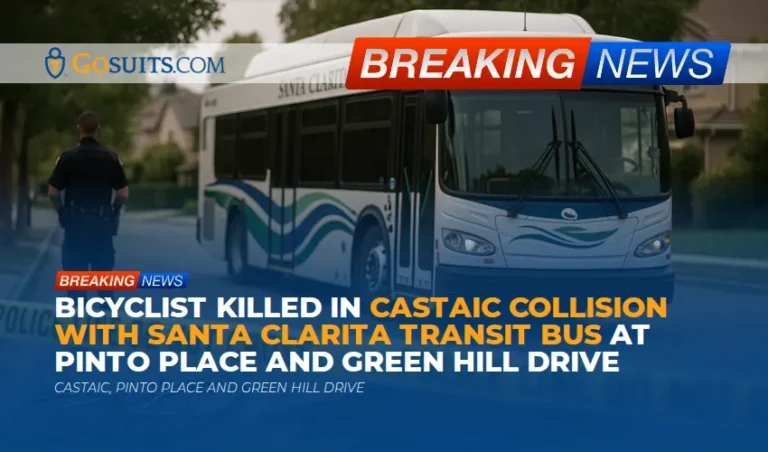
On the morning of March 11, 2026, a fatal collision occurred at the intersection of Pinto Place and Green Hill Drive in Castaic. According to reporting attributed to the California Highway Patrol Newhall Area Office, the initial emergency call came in at approximately 7:34 a.m. describing a collision involving a pedestrian and a school bus. Subsequent clarification from officials indicated the crash involved a bicyclist and a Santa Clarita Transit bus, not a school bus. Los Angeles County Fire Department personnel pronounced the bicyclist deceased at the scene.
Los Angeles County Department of Medical Examiner representatives publicly identified the decedent as a 67-year-old Castaic resident, and their personnel responded to the scene for the investigation and recovery. The bus driver reportedly remained at the location to speak with investigators. A single passenger was said to have been on the transit bus at the time; officials noted that person had left prior to CHP’s arrival. No further details regarding that passenger were available at the time of publication.
Early commentary from CHP suggested the bicyclist may have drifted into the bus’s lane. That observation remains part of a broader investigation. In collisions like this, agency statements are preliminary and typically updated as scene measurements, witness interviews, and any available camera footage are reviewed.
Where and when it happened in Castaic
The crash occurred at Pinto Place and Green Hill Drive, a residential area east of the I-5 corridor in the Castaic community of the Santa Clarita Valley. Morning traffic around 7:30 a.m. can include commuters heading toward the 5 Freeway, local families navigating school-hour drop-offs, and neighborhood drivers cutting through side streets. Visibility, sun angle, and driveway activity can all change rapidly around this time, which is why investigators will typically document lighting and roadway conditions in detail as part of the official report.
Residents in Castaic know the nearby landmarks well, from Castaic Lake and the recreation area to Hasley Canyon and the Valencia commerce corridors. Transit buses serving Santa Clarita often circulate through residential and connector routes in the morning, which can place large vehicles and vulnerable road users like bicyclists and pedestrians in close proximity on relatively narrow streets.
What officials have said so far
Based on statements reported from the CHP Newhall Area Office, the sequence of events is still being pieced together. Key points shared publicly include:
- Time and initial call: Approximately 7:34 a.m., originally reported as a pedestrian and school bus collision.
- Vehicle involved: A Santa Clarita Transit bus, not a school bus.
- On-scene status: Los Angeles County Fire declared the bicyclist deceased at the scene.
- Parties: The bus driver remained on scene and cooperated; one onboard passenger reportedly left before CHP’s arrival.
- Preliminary note: Officials indicated the bicyclist may have moved into the bus’s lane, but formal fault determinations generally require a complete investigation.
Readers should understand that early statements are not final conclusions. CHP collision reports are compiled over days or weeks and incorporate diagrams, measurements, witness statements, and sometimes toxicology results from the Medical Examiner’s office when relevant. Families and community members will often need the final CHP report to understand official findings. Guidance on obtaining that report appears below.
Shared road duties in California and why these crashes happen
California law recognizes that bicyclists are lawful road users, typically required to follow the same rules as motorists while benefiting from additional protections that account for their vulnerability. For example, California’s three-foot passing law requires drivers overtaking a person on a bicycle to leave at least three feet of clearance when passing. If conditions do not allow three feet, drivers must slow to a safe speed and only pass when doing so would not endanger the bicyclist [4].
Transit buses and commercial vehicles present unique visibility challenges due to large turning radii, higher ride height, and blind spots along the right side where cyclists often ride. At low speeds on residential streets, small lateral movements by either a cyclist or a bus can quickly erase safe clearance if operators are not anticipating each other’s position. Collision contributing factors that investigators commonly consider include:
- Lane positioning and clearance: Whether a passing or overtaking maneuver maintained adequate space.
- Speed and stopping distance: Even at modest speeds, a heavy bus requires additional distance to react and stop.
- Line of sight: Parked cars, trees, or curves can obscure a cyclist until the last moment.
- Sun glare and lighting: Morning glare can reduce contrast and impair recognition of a cyclist’s outline.
- Roadway design: Lack of dedicated bike facilities, narrow lanes, or pinch points increase conflict risk.
Bicyclist fatalities are a persistent safety concern statewide. National data compiled by federal transportation agencies confirm that people outside vehicles face higher injury severity in crashes. NHTSA’s analyses and safety advisories reinforce the importance of predictable lane behavior, adequate passing distance, and heightened vigilance from drivers around vulnerable road users [5]. California’s Office of Traffic Safety similarly tracks trends and supports local safety programs to reduce these collisions [6].
For a plain-language walkthrough of California’s three-foot law and how it applies in real-world riding, see what california’s three foot law really means for cyclists.

Rights of families after a fatal roadway crash in California
When a crash results in loss of life, surviving family members may have civil remedies through a wrongful death claim and, in some cases, a related survival action. These claims can address a range of legally recognized harms, including funeral expenses, loss of financial support, loss of household services, and the loss of companionship. The framework for who may bring such claims and what damages are permitted is set by California statutes and case law. While every case is fact-specific, families often need to quickly gather records and preserve evidence to understand what happened and who may be responsible.
Families frequently reach out to seasoned and skilled counsel for help navigating complex questions like public entity liability, commercial insurance layers, and evidence preservation. It is common for people to search for wrongful death lawyers when a government-operated transit vehicle or large commercial vehicle is involved.
Before making any insurance statements, families are typically advised to consult an attorney. What is shared with an insurance adjuster, even in an initial condolence call, can later be used to narrow or dispute claims. Many firms, including wrongful death lawyers, offer free initial consultations to help explain rights and timelines in plain terms.
If a public transit bus is involved: special notice deadlines and hurdles
When a City or other public agency operates the bus involved in a collision, California’s Government Claims Act imposes additional pre-lawsuit requirements. In most personal injury or wrongful death matters against a public entity, a written claim must be presented within six months of the date of the incident. Failure to timely present a proper claim can bar subsequent court action unless a statutory exception applies [3].
Because transit systems often involve multiple entities and contractors, identifying the correct public entity and any private operators or maintenance contractors can take investigation. There may be different insurance policies at play, including self-insured retention by the public entity, third-party administrators, and excess carriers. In short, timelines move faster and documentation standards are strict when a public entity is a potential defendant. Missing a Government Claims Act deadline can close the door on otherwise viable claims.
Given those constraints, many families look for local support right away. In the Santa Clarita Valley, proximity to the CHP Newhall Area Office and the Los Angeles County Department of Medical Examiner can help expedite records requests. When government agencies are involved, wrongful death lawyers in Castaic can also prepare and serve preservation letters to ensure critical evidence like onboard video, telematics, and driver logs are not overwritten.
Evidence to preserve right away
In collisions involving a bus and a bicyclist, early evidence often makes the difference in understanding what took place. Consider the following categories:
- Scene documentation: Photos or video showing vehicle resting positions, skid or scuff marks, gouges, debris fields, and lighting conditions. Even on neighborhood streets like Green Hill Drive, small details such as tire transfer marks or pedal strikes on a curb can matter.
- Vehicle and bicycle condition: Images of damage to the bus’s right side, mirrors, and front fascia, as well as the bicycle’s frame, wheels, and handlebar orientation.
- Onboard data and video: Many transit buses carry forward-facing and right-side cameras, and sometimes inward-facing driver cams. These systems can loop and overwrite quickly if not preserved. Prompt legal preservation requests are critical.
- Third-party video: Residential doorbell cameras and HOA-managed cameras are increasingly common on residential streets in Castaic. Nearby homeowners may have brief clips that fill important gaps before and after impact.
- Witness accounts: Identifying the bus passenger and any neighbors who saw or heard the collision helps corroborate timing, speed, and lane position.
- Official records: The CHP collision report, supplemental diagrams, and the Medical Examiner’s findings provide the spine of a fact record in a fatal crash.
If a claim is contemplated, it is prudent to speak with an attorney before providing statements to any insurance representative. Statements given to a transit agency’s third-party administrator or insurer can be cited later to narrow liability theories or dispute causation.
Where to obtain key records and who to contact
Families and representatives commonly need the following records. Each agency has its own process and eligibility rules for release.
CHP collision report
For this collision, the California Highway Patrol Newhall Area Office is the likely reporting agency. CHP collision reports can be requested by involved parties or their representatives. The request process is outlined by CHP, including required forms and identification of the reporting office [1]. If you do not have a report number, the date, location, and involved party names typically help the office locate the file.
Los Angeles County Department of Medical Examiner
The Medical Examiner provides cause and manner of death determinations and maintains related records. Next of kin can request decedent information, including autopsy reports when available, via the Department’s records request procedures. Guidance for ordering records and general contact information is published by the Los Angeles County Department of Medical Examiner [2].
Transit agency evidence
When a public transit bus is involved, requests for onboard video and data must be directed correctly and made promptly. Public entities often require a formal preservation request and, for copies, a subpoena or written authorization from legal counsel. California’s Government Claims Act governs pre-litigation procedures and timelines for public entities [3].
Traffic and roadway information
Depending on the investigation, additional materials may include traffic engineering layouts, sign inventories, or street design documents maintained by the City or County. Some materials can be requested through public records processes. Not every record is public, particularly those tied to security footage or law enforcement investigative files, but roadway design records may be available upon request to the relevant agency.
Insurance and transit-company claim issues to anticipate
Crashes involving a city-operated or contracted transit bus introduce layers of insurance and procedural rules. A transit operator may be self-insured to a certain threshold, then covered by excess insurance above that layer. Commercial carriers and third-party administrators handle claims on strict timelines and with trained adjusters who focus on limiting exposure. Those adjusters will seek early statements and may ask narrow, leading questions. That is why many families prefer to consult counsel before speaking with any insurer or administrator.
Claims may hinge on specific operational questions, such as whether the driver attempted a pass, whether the bus encroached on a bike’s operating space while overtaking, or whether the cyclist’s path required merging to avoid a hazard. When liability is disputed, technical reconstruction using scene geometry, vehicle dynamics, and sometimes video frame analysis can be decisive.
In fatal crash contexts, it is natural for people to look for wrongful death lawyers who understand how public-entity claim procedures, insurance layers, and technical reconstruction intersect. Even a brief conversation can help families avoid pitfalls like missing the six-month Government Claims Act presentation deadline or inadvertently providing statements that insurers might later construe against them.
Local context in Santa Clarita Valley and roadway safety
In neighborhoods like the one around Pinto Place and Green Hill Drive, the mix of residential driveways, morning sun, and neighborhood bus traffic can compress reaction time. Residents often report that school-hour traffic peaks amplify near misses between large vehicles and cyclists or pedestrians cutting across streets on their way to parks, trailheads, or bus stops.
Local institutions like Henry Mayo Newhall Hospital in Valencia serve much of the valley’s serious injury care needs, which underscores how quickly a quiet morning can turn. Community groups in the Santa Clarita Valley have pushed for better signage and traffic calming on popular cut-through routes over the years. Even where there is not a dedicated bike lane, California law still requires motorists to provide three feet of space when passing a bicycle and to slow to a safe speed if three feet is not possible [4].
Transit operators are trained to anticipate vulnerable road users. Federal transit safety materials emphasize hazard recognition, safe overtaking, and blind-spot management for large vehicles in mixed traffic. The Federal Transit Administration maintains best-practice safety resources for agencies nationwide [7].
Why taking action matters now
Start with preservation. The most urgent step in the days after a serious crash is preserving evidence. Onboard transit video and bus telematics are frequently overwritten within days or weeks if there is no formal hold. Doorbell camera footage on nearby homes also recycles quickly. Acting now can keep those materials available for review.
Get the official record and keep your own. Request the CHP collision report and any supplemental diagrams once available. Maintain a simple timeline of events, including calls received from insurers or administrators. Keep copies of any correspondence and note dates of contact.
Avoid recorded statements until you are informed. Insurance and claims representatives may call early. Recorded statements can be used later to limit recovery or shift blame. Consulting an attorney before any recorded statement helps ensure your rights and timelines are clear.
Calendar statutory deadlines. If a public entity may be involved, calendar the six-month Government Claims Act presentation window from the collision date. Do not assume the deadline will be extended.
Clarify benefits and losses. Document funeral and burial expenses, household services formerly provided by the decedent, and any immediate financial impacts. Even basic records like receipts and a list of tasks the decedent performed around the home can assist later assessments.
Taking these steps preserves options. They help ensure that, when investigators complete their work and records become available, the information needed to make informed decisions is still within reach.

Commentary from Gosuits Castaic, California Personal Injury Attorney
Our hearts go out to the family, friends, and neighbors mourning this loss in Castaic. The information here is for general education and community awareness. It is not a substitute for case-specific guidance.
From what has been reported, this tragedy unfolded on a quiet neighborhood street at a time of day when traffic and visibility can change minute to minute. In cases involving a transit bus and a bicyclist, small misjudgments in lane positioning or passing distance can have irreversible consequences. A thorough fact review usually requires onboard video, precise scene measurements, and the final CHP report to fairly evaluate how and why contact occurred.
In our experience, insurance companies and corporate administrators move quickly to shape the narrative. They may request recorded statements, ask highly specific questions without full context, or imply conclusions from incomplete facts. Families who are grieving should not have to spar with that process. Early, informed guidance helps level the field, especially when a public entity’s strict six-month claim presentation rule applies.
When someone is navigating the aftermath of a fatal crash, a free consultation can clarify the path forward, including how to preserve evidence, protect timelines, and avoid unintentionally limiting claims by speaking too soon with an insurer. Conversations like these help people understand their options before they make decisions that could affect them later.
References
- How to Obtain a Public Record/Accident Report – California Highway Patrol
- Records Requests – Los Angeles County Department of Medical Examiner
- California Government Code Section 911.2 – California Legislative Information
- Sharing the Road: Bicyclists – California DMV
- Bicyclist Safety – National Highway Traffic Safety Administration
- Bicyclist Safety – California Office of Traffic Safety
- Office of Transit Safety and Oversight – Federal Transit Administration